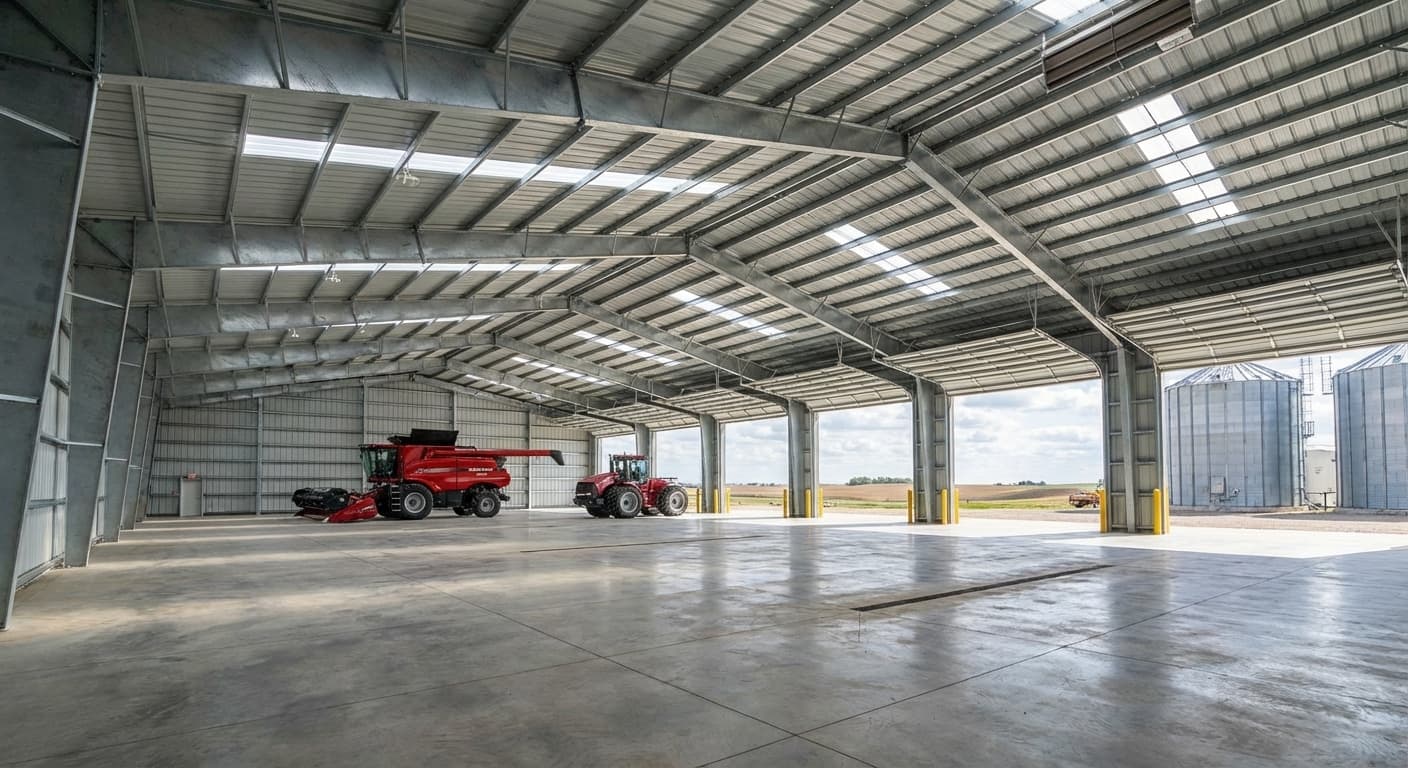

When 60-foot buildings cramp your operation, clear-span steel structures unlock up to 300 feet of column-free space, letting combines move in straight lines and letting you reconfigure the same building from harvest sorting to cattle shelter without ever moving a post. The article walks you through the engineering realities–why single-slope rigid frames deliver the best value between 60-120 feet, how deeper trusses trade vertical clearance for load capacity, and why professional engineering becomes mandatory once you cross the 60-foot "long-span" threshold–while showing how Grade-55 I-beams, galvanized coatings, and fire-proof steel slash lifetime maintenance to about 1 % of initial cost annually versus 2-4 % for wood or concrete. You'll learn to lock in volatile steel pricing early, exploit parallel scheduling (permits, fabrication, site prep) to cut total build time to 6-16 weeks, and insist on stamped drawings keyed to your exact postal code so wind, snow, sprinkler, and equipment loads are calculated together, not guessed. By using a single-source partner who controls design, fabrication, and erection, you eliminate finger-pointing, ensure anchor bolts align with arriving trusses, and catch drainage, soil, access, and utility issues before steel is cut–turning a risky large-span project into a low-maintenance, insurance-friendly, 20-30 % appreciating asset that pays for itself in energy savings and avoided repairs while your operation keeps growing inside walls that never box you in.
Why Choose a Clear-Span Steel Structure
Clear-span steel buildings eliminate interior columns, letting your equipment move in straight lines and adapting to seasonal storage needs without structural constraints.
Eliminating Interior Columns for Unobstructed Workflow
You know those interior columns in traditional barns? They're costing you time and money every day. Your combines have to navigate around them. Your storage layout is locked in place. And when you upgrade to bigger equipment, you're stuck with a building that doesn't fit.
Clear-span steel buildings eliminate every interior column. The engineered framing routes all roof load to the exterior walls, giving you a completely open floor. [1] Now your equipment moves in straight lines–no more three-point turns around posts, no more dings on that new sprayer. [2]
That open space adapts to your needs: sort harvest in October, shelter cattle in January, store implements in March–all in the same building without moving a single column. [1] With steel spanning 100+ feet without support, your building finally matches your equipment instead of limiting it. [3] Our
Structural Strength and Span Capabilities
When your operation outgrows 60-foot buildings, you need steel that can keep up. Clear-span steel structures reach up to 300 feet without a single interior column–though the sweet spot for cost efficiency sits between 40 and 100 feet wide. [4]
Past that 60-foot mark, your framing choice drives your budget. Single-slope rigid frames deliver the best value for 60-to-120-foot spans with 10-to-24-foot eave heights, using less steel than other systems. [4] Need even wider? Truss systems distribute weight through triangular frameworks that can span 300 feet while handling whatever Mother Nature throws at them. [5]
Here's what matters for your bottom line: wider spans mean deeper beams, which can eat into clearance height near the walls. That's why we engineer the right depth-to-span ratio for your specific use–ensuring your tallest equipment still fits comfortably. [4] Grade 55 steel I-beams transfer loads straight down to the foundation, scaling to virtually any size you need. [5]
Every building comes with stamped engineered drawings proving it meets your local codes. Wind loads up to 185 mph? Snow loads up to 100 pounds per square foot? Your structure is engineered specifically for your site's weather patterns. [5]
Maintenance-Free Durability for Farm Operations
You've got enough on your plate without babysitting your buildings. Steel eliminates the maintenance headaches that eat into your time and budget. No rot. No warping. No termites. No mold. Just a building that stands there and does its job. [6]
Every steel component arrives with galvanized coatings and rust-resistant finishes already applied. That means no repainting schedules, no chemical treatments, no weekend projects patching wood rot. The building handles rain, snow, and humidity on its own. [7]
Fire resistance matters when you're storing fuel, hay, and expensive equipment under one roof. Steel doesn't burn–period. That's fewer sleepless nights and often lower insurance premiums. [8]
Bottom line: you'll spend more time using your building and less time fixing it. Maybe an occasional wash-down, but that's it. Steel works for you because it takes work off your list. [6]
Design Strategies for Spans Beyond 60 ft
Beyond 60 feet, your truss profile choice directly determines interior clearance, so rigid frames and arch buildings give you the column-free space to maximize every square foot.
Selecting Appropriate Truss Systems and Depth Ratios
Once you cross 60 feet, building codes classify your structure as "long span"–which means you need professional engineering for the truss design and bracing. [9] This isn't just red tape. Beyond 60 feet, your choice of truss profile directly affects how much vertical clearance you get inside. You've got three main options: parallel chord trusses for flat roofs (the budget-friendly choice), scissor trusses when you want a vaulted interior without deep trusses eating up headroom, and tapered trusses that build roof drainage right into their shape–no extra framing needed. [9]
Here's what matters for your operation: deeper trusses handle loads better but steal vertical space. That's the trade-off. [10] When your tallest equipment needs every inch of clearance, you'll work with ratios between 10 and 25–the sweet spot depends on your specific loads. For a 100-foot building, expect primary trusses every 20 to 25 feet with secondary framing between them. [10]
Past 70 feet, installation changes too. Crews assemble trusses on the ground with sheathing already attached, then crane them up as complete units. Some manufacturers actually require this method–it's safer and faster than piece-by-piece assembly at height. [9]
Integrating Rigid Frames and Arched Solutions
You've got two proven ways to get column-free space beyond 60 feet: rigid frames and arch buildings. The choice comes down to how you'll use every square foot.
Rigid frames work like traditional buildings with a twist–tapered I-beams that get deeper where they meet the columns, pushing all the weight to your exterior walls. [11] You get straight walls and a flat ceiling, which means you can use every inch. Stack storage to the walls. Run your electrical and HVAC wherever you need it. Add any exterior finish you want. Your
Ensuring Code Compliance and Wind/Snow Loads
Building codes aren't uniform–what passes inspection in one county can fail twenty miles away. National codes like IBC and ASCE 7 set the floor, but local building departments add their own requirements based on weather patterns and past storms. That's why we pull load requirements using your exact postal code before cutting any steel. Generic regional specs lead to permit rejections and expensive fixes. [13]
Your engineer doesn't just check wind loads or snow loads–they calculate what happens when both hit at once. Add in your sprinkler system (3-4 PSF), any suspended ceilings (4 PSF), and the building's own weight, and you see why this gets complex fast. [13] Snow loads tell the story best: under 10 PSF in the Gulf states, but over 70 PSF in northern Minnesota. Cold-climate operations often need 60+ PSF ratings to handle wet snow, drifting, and those nasty rain-on-snow events. [13] [14]
Roof pitch matters too. You need at least 1:12 slope for snow to shed, but 2:12 or 3:12 works better in heavy snow country. Build it into your design from day one–retrofitting pitch gets expensive. [15]
Here's the bottom line: certified buildings come with stamped engineering drawings that prove code compliance for your exact location. Non-certified buildings might work where permits aren't required, but the moment an inspector asks for load calculations, you're stuck. The cost difference between certified and non-certified vanishes the first time you need to add reinforcement to meet code–and that retrofit always costs more than doing it right initially. [13] [14]
Budgeting and ROI for Large-Span Buildings
Lock in steel prices early with escalation clauses and single-source suppliers to protect your large-span building budget against market swings.
Accurate Cost Estimation and Price-Lock Options
Steel prices move fast–sometimes brutally fast. Between late 2020 and the end of 2021, structural steel prices jumped 91%, catching plenty of agricultural projects mid-stride. [16] Projects stalled. Budgets broke. Scopes shrank. That volatility? Still here. Pre-engineered building kits averaging $17-$20 per square foot can swing 10-20% on market conditions alone–before your soil type or local labor even enters the picture. [16]
For large-span structures where you're buying serious steel volume, even a small per-square-foot shift hits hard. On an 80×200-foot building, labor alone runs $6-$10 per square foot–that's $96,000-$160,000 before you've bought a single beam. [16] Here's what works: get detailed quotes from multiple suppliers that break out steel, fabrication, delivery, and labor separately. Know exactly where your exposure sits. Build in a real contingency–5-10% isn't padding, it's protection against steel price swings and surprise site conditions. [16]
Your best defense against mid-project sticker shock? Lock in prices early with escalation clauses that adjust for material changes. [17] When you work with a single-source provider who controls the entire supply chain, you eliminate the markup layers that compound price volatility. That's how you keep a large-span agricultural project on budget when the market's doing its worst.
Long-Term Savings from Low Maintenance and Energy Efficiency
Here's where steel pulls ahead–not in year one, but in years two through twenty. Your maintenance on a 10,000-square-foot steel building runs about 1% of initial cost annually. That's $1,500-$2,500 per year for occasional cleaning and inspection. [18] No rot to repair. No pests to poison. No paint to refresh.
Compare that to wood or concrete buildings eating 2-4% annually–$7,000-$20,000 on the same footprint. [18] And that's before surprises hit. Termite infestation? Add $30,000. Over 20 years, you're looking at $320,000 to $750,000 more in maintenance costs alone. [18] The "cheaper" initial price tag becomes expensive fast.
Energy costs tell the same story. Insulated metal panels create a continuous thermal barrier that cuts energy bills 10-20% annually–saving $2,000-$5,000 per year in agricultural operations. [18] Wood and concrete can't match that performance. Too many seams, too much thermal bridging. Their best case saves half what steel delivers. [18]
Then there's insurance. Steel doesn't burn. Pests don't eat it. Your premiums reflect that. [19] And when it's time to sell? Steel buildings appreciate 20-30% over 20 years beyond base property value–because the next owner knows they can expand, reconfigure, or repurpose without starting over. [18] That's ROI that compounds.
Financing and Warranty Benefits with National Steel Buildings
You don't need the full cost upfront–smart operators rarely pay that way. Traditional bank loans work well for established businesses, offering competitive rates over extended terms. SBA-backed construction loans open doors with government support and flexible structures. Lease-to-own programs get you operating immediately while spreading costs over time. [20]
Agricultural operations have specialized options too. Some lenders structure financing around harvest cycles and production goals rather than standard commercial metrics. [21] Down payments typically run 10-30%, depending on your credit profile and chosen program. Need to move fast? Alternative lenders can approve in days instead of weeks–though speed costs more in interest. [20]
The warranty matters as much as the financing. When manufacturers back their
Executing the Build with a Single-Source Partner
One team managing design through final assembly ensures your components arrive perfectly coordinated, eliminating costly field modifications and delays.
Coordinated Design, Fabrication, and Erection Services
You've seen it happen–three different vendors pointing fingers while your project sits idle. When design, fabrication, and erection come from separate sources, simple mismatches turn into expensive delays. Drawings don't match what arrives on site. Anchor bolts land in the wrong spots. Your crews burn billable hours fixing problems that shouldn't exist.
A single-source approach eliminates those headaches. One team handles everything from initial drawings through final bolt-up, so every piece arrives ready to fit. [24] Your assembly drawings match what the fabricator built because the same engineers created both. Your anchor bolt patterns align perfectly because one system generated all the specs. [24] No on-site cutting, no field modifications, no surprises–just components that go together as designed. [3]
For spans beyond 60 feet, this coordination becomes critical. One misaligned connection point or wrong-sized member doesn't just cost you a day–it can cascade into a full week while you wait for corrections. That's why
Clear Communication Milestones and Timeline Management
Your steel building timeline breaks into four phases, and smart scheduling saves you weeks. [25] Here's what to expect: design and permits take 1-3 weeks, fabrication runs 3-6 weeks based on your span complexity, and erection adds 1-3 weeks. Total time: 6 to 16 weeks from concept to completion. [26]
The real time savings come from running phases in parallel, not sequence. Submit permits while engineers finalize drawings. Start site prep–clearing, grading, pouring footings–while your steel gets fabricated. [26] That way your foundation is cured and ready the moment trucks arrive. For spans over 60 feet, this parallel approach prevents cascade delays. One late foundation or misplaced anchor bolt pattern doesn't just cost a day–it ripples into a week of idle crews and equipment rental. [27]
Your single point of contact keeps all these moving parts synchronized. Weekly check-ins track permits, fabrication progress, and site readiness. Shared delivery schedules mean your concrete crew knows exactly when to finish. Built-in weather buffers protect against the unpredictable. [25] [26] When everyone works from the same timeline, you get a building that goes up on schedule–not a series of delays blamed on the other guy.
Problem-Solving Support During Site Preparation and Installation
Find site problems during assessment, not installation–that's the difference between a quick fix and an expensive delay. Your thorough site evaluation needs to catch four critical factors before steel gets cut.
First, drainage patterns. Water pooling at your building perimeter will undermine the foundation over time. Many jurisdictions also require specific runoff management in your grading plan before they'll issue permits. [28]
Second, soil composition. Dense soil supports more load with less prep work. Soft or uneven ground needs compaction or engineered fill before your slab or pier system will perform to spec. Catching this early means budgeting for it, not scrambling to cover unexpected costs. [28]
Third, site access. Your delivery trucks need a clear path with overhead clearance mapped out. You'll need a designated staging area sized for your components. Without it, you'll watch erection crews stand idle while materials get shuffled around. [28]
Fourth, utilities. Know where every line runs before you break ground. One severed cable or cracked pipe stops everything.
When one partner handles design through erection, these site factors get built into your plans from day one. [29] Foundation specs match actual soil conditions. Access routes accommodate your specific delivery requirements. Drainage works with local codes, not against them. You get a foundation that's ready when steel arrives–not a crew waiting while concrete cures a second time because something got missed.
- Clear-span steel removes all interior columns up to 300 ft, letting equipment move in straight lines.
- Beyond 60 ft, single-slope rigid frames give the lowest cost for 60-120 ft widths.
- Certified engineering with local snow/wind loads is mandatory for spans over 60 ft.
- Steel maintenance runs 1% of build cost yearly vs 2-4% for wood/concrete, saving $320-750k over 20 yrs.
- Lock steel prices early with escalation clauses to dodge 10-20% mid-project surges.
- Use one source for design, fab, erection to cut weeks and eliminate on-site rework.
- Parallel scheduling–permits, site prep, fabrication–shrinks total build time to 6-16 weeks.
- https://ecosteel.com/ecosteelprefab/clear-span-buildings-operational-efficiency/
- https://www.jysteelstructure.com/blog/spacious-interiors-of-agricultural-steel-buildings-easy-machinery-movement
- https://renegadesteelbuildings.com/why-steel-is-the-best-material-for-your-agricultural-building/
- https://www.buildingsguide.com/build/clear-span-buildings/?srsltid=AfmBOootm3won9n7-U9n_xdECXETQZVtkBF8x30q7jdRezyywCQgNbZf
- https://www.clearspan.com/news/guide-to-metal-frame-buildings-steel-frame-structure/
- https://www.universalsteel.com/why-agricultural-steel-frame-buildings-are-the-best-choice-for-modern-farms/
- https://mbmisteelbuildings.com/blog/advantages-agricultural-steel-buildings/
- https://nocobuildings.com/blog/the-benefits-of-steel-farm-buildings-over-traditional-materials
- https://www.structuremag.org/article/long-span-open-web-trusses/
- https://www.newsteelconstruction.com/wp/steel-construction-with-trusses/
- https://armstrongsteel.com/blog/proceed-caution-buy-quonset-hut-rigid-frame-building
- https://www.buildingsguide.com/build/clear-span-buildings/?srsltid=AfmBOorpxxVFkuBF44Hf4vc7kX4ZQw2xmbfQuiPRzP4zCsoZufJJPhLx
- https://norsteelbuildings.com/us/building-codes-permits-us/steel-building-codes-loads/
- https://www.aametalbuildings.com/blog/snow-load-wind-speed-requirements-for-metal-buildings-with-codes-pricing-impact?srsltid=AfmBOooHeOshWRuc_rgxcAYMO6bSgHMBceQJSkf7OxYOTWIaUOvndfGo
- https://mbmisteelbuildings.com/blog/cold-weather-steel-building-design/
- https://www.steelcobuildings.com/metal-building-cost-a-comprehensive-guide-to-budgeting-and-planning/
- https://metalprobuildings.com/building-steels-cost-guide-average-prices-cost-per-square-foot/
- https://www.summitsteelbuildings.com/20-year-cost-comparison
- https://www.drpoulinconstruction.net/how-metal-buildings-deliver-long-term-roi-for-growing-businesses/
- https://www.nationwidesteelstructures.com/post/commercial-metal-building-financing-options
- https://www.worldwidesteelbuildings.com/about/financing-options/
- https://www.hfsfinancial.net/home-improvement-loans/metal-buildings-loans/
- https://www.rhinobldg.com/blog/agricultural-building-trends-part-2
- https://armstrongsteel.com/blog/the-future-of-farming-steel-buildings-and-modern-agriculture
- https://www.wasatchsteel.com/steel-building-construction-timeline-factors/
- https://metalprobuildings.com/pre-engineered-steel-building-timeline/
- https://www.eaglecarports.com/blog/how-long-does-metal-building-installation-take
- https://www.fortifybuildingsolutions.com/resources/blog/how-to-prepare-a-metal-building-site/
- https://www.verdibuilds.com/divisions/varco-pruden-industrial-building-systems-and-pre-engineered-metal-building-systems/