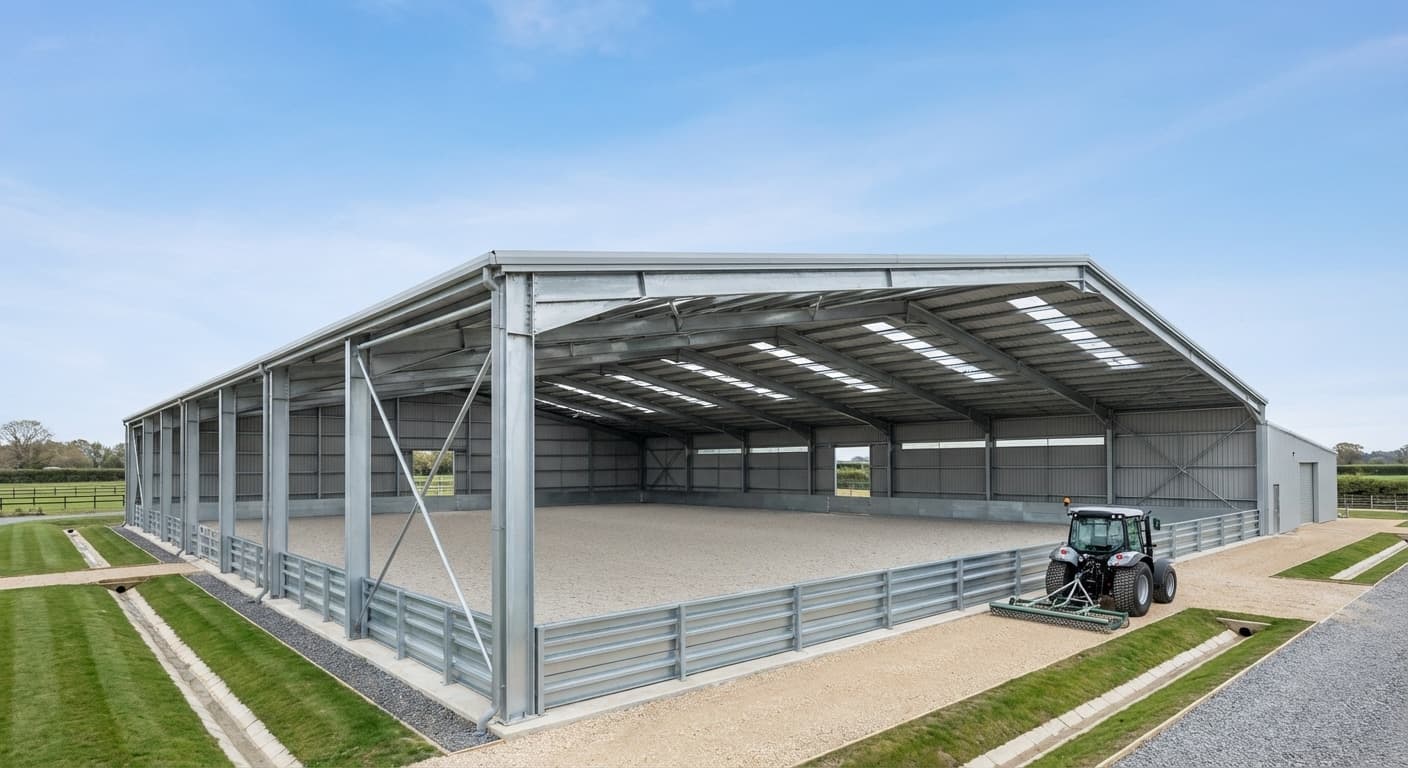

Prefabricated steel riding arenas reward owners with decades of near-zero structural upkeep, but only if you treat the building and footing as one interdependent system: keep the galvanized or powder-coated frames pristine through twice-yearly roof-to-foundation inspections that tighten fasteners, clear drainage, wash off chemicals, and touch-up scratches the same day, while protecting your investment's 25- to 50-year warranty with meticulous logs that turn surprise repairs into planned upgrades; inside, preserve horse safety and arena longevity by crowning the base 1-2 % for runoff, grooming the surface daily to 3-inch moisture with varying drag patterns, deep-conditioning high-traffic zones weekly, and flipping the entire footing each spring to catch drainage or sand-grade issues before they freeze into winter ruts; the article shows exactly how to schedule these tasks around seasonal loads–spring moisture management, summer heat reflection, fall debris removal, and snow-load monitoring–so the modular steel frame can expand effortlessly for stalls or tack rooms while the non-combustible, rot-proof structure continues to shrug off impacts, hose-downs, and extreme weather without ever needing paint, stain, or pesticide.
Understanding Your Prefabricated Steel Riding Arena Kit
Your prefabricated steel arena requires no painting, staining, or pest treatment while expanding modularly as your operation grows.
Key components and their functions
Your prefabricated steel riding arena works as a complete system–every component engineered to deliver years of low-maintenance performance. The clear-span steel framing gives you maximum usable space without interior columns getting in the way [3]. Pre-manufactured off-site, these frames go up fast while meeting every local code for snow, wind, and seismic loads [3].Your foundation does the heavy lifting you never see.
Start with compacted native soil, add 4-6 inches of crushed rock for drainage and stability, then layer in geotextile fabric to block weeds and keep materials where they belong [1]. Edge boards around the perimeter lock everything in place–no shifting, no settling, just consistent footing year after year [1].Your exterior gets customized to match your needs–wall panels, roofing, skylights, and ventilation all designed to keep horses and riders comfortable [3]. Forget the endless maintenance of wood structures.
These metal surfaces clean up with soap and water, period [2]. Need more space down the road? The modular design expands when you're ready–add stalls, tack rooms, or wash bays without starting over [2].
Design features that enhance durability
Every design choice in your steel arena pays you back in durability and flexibility. The corrosion-resistant steel shrugs off daily hosing, cleaning chemicals, and impacts from equipment without breaking down [4]. Expansion stays simple–when you need more space, the modular frames adapt to your growth [4].
You'll never paint, stain, or treat for pests–steel doesn't rot, warp, or feed termites [3]. The non-combustible material gives you built-in fire protection, while the ductile design bends instead of breaking during extreme weather [3]. Keep things comfortable with reflective exterior coatings that cut heat absorption, plus ventilation options that maintain ideal temperatures year-round [4].
Your
Quick-reference maintenance tips for prefabricated steel riding arena kits
Smart maintenance starts with understanding what your arena needs. Daily tasks keep you riding safely–level the surface, fill divots, maintain moisture for dust control [5].
Weekly deep conditioning tackles high-traffic zones before they become problems [6]. Your annual "flipping" refreshes the entire surface while giving you a chance to check the steel structure's foundation [6].
As covered in our seasonal care strategies, each season brings specific maintenance priorities that protect your investment. The right equipment and schedule mean safer rides, happier horses, and an arena that performs year after year [7].
Developing a Proactive Inspection and Maintenance Plan
Catch roof damage, rust, and drainage problems during spring and fall inspections to prevent costly repairs and protect your building's foundation.
Comprehensive exterior and roof inspections
Your building inspection starts at the top. Check your roof twice a year–it takes 30 minutes and saves thousands in repairs. Look for loose fasteners, bent panels, and spots where water pools. Standing water causes rust, period [10]. Clear those gutters and downspouts. Blocked drainage backs water into your building [10]. Walk the exterior panels. Spot dents, scratches, or gaps in sealants? Fix them now before moisture gets in [10].Rust spreads fast.
Check every beam, joint, and fastener–small patches today become big problems tomorrow [10]. Find rust? Clean it, treat it, recoat it. Same day [10]. While you're up there, test those fasteners. Temperature swings and daily use loosen connections. Tight bolts keep your arena standing strong [10].Schedule inspections every spring and fall. Spring checks winter damage. Fall preps for the harsh months ahead [9].
Annual pressure washing? Worth every penny–stops corrosion and keeps your building looking professional [8]. Document everything. Date, issue, fix, cost. This log protects your warranty and spots patterns before they cost you money [9]. Smart owners track problems. Smarter ones prevent them.
Foundation, anchorage, drainage, and structural checks
Your foundation holds everything up–inspect it quarterly. Look for concrete cracks, shifting grade beams, and soil washing away from pads [11]. Those anchor bolts connecting steel to concrete? They loosen. Check them all.
Vibration, weather, and daily use work against you [12]. Bad drainage kills buildings faster than anything else. Water pooling at your base undermines foundations, rusts panels, and shifts slabs [12]. After rain, check corners and downspout areas [11]. Your downspouts need to reach 5-10 feet out.
Ground must slope away at 5% minimum [12]. See rust at panel bases? You've got drainage problems [12]. Our
Creating and using a maintenance log and schedule
A good maintenance log turns emergency repairs into planned upgrades. Track every inspection, repair, and modification. Date it. Detail it. Cost it out [9]. This paper trail saves you on insurance claims, keeps warranties valid, and spots problems while they're still cheap to fix [12]. Build your schedule around the seasons. Major inspections in spring and fall [9].
Monthly: check fasteners and clear drainage. Weekly: maintain your arena surface (detailed in "Understanding Your Prefabricated Steel Riding Arena Kit" above). Go digital–automated reminders beat sticky notes. Photo documentation proves conditions. Cloud storage protects your records [9]. Log the weather with each task. Temperature swings, rain patterns, heavy use days–they all affect your maintenance timing [12]. Keep your contractor list handy.
Part suppliers. Arena specialists. When problems hit, you call, not search [12]. This system adds years to your arena. Data beats guesswork. Prevention beats repair bills.
Seasonal Care Strategies for Year‑Round Performance
Weekly moisture checks with a simple soil-moisture meter keep your arena dust-free and stable while preventing the seasonal drainage problems that turn into costly repairs.
Spring: moisture management and surface preparation
You'll find spring moisture management straightforward when you follow a proven routine. Start by "flipping" your arena surface after winter–scraping down to the base level remixes footing components and shows you exactly what repairs you need before peak season [13]. This annual overhaul saves money by identifying sand quality issues early.
Your moisture monitoring schedule depends on weather patterns. Check levels weekly during stable conditions, daily when windy or warm days accelerate drying [14]. Keep moisture consistent to a 3-inch depth–a simple soil-moisture meter from any garden store gives you precise readings [15]. This investment pays off through reduced dust, better footing stability, and fewer injuries [14].
Change your dragging pattern daily to avoid compaction, particularly along rails where most riding happens (detailed in our maintenance planning section) [13]. Set tines to active positions–3 to 4 inches deep–to break up winter-hardened spots [13]. For sand-based surfaces, check particle graduation regularly. Winter disrupts the balance between large and small particles that creates optimal footing [13].
Fix drainage problems immediately. Spring's variable precipitation turns minor issues into major expenses when some areas stay wet while others dry too quickly [15]. Your steel building's gutters and downspouts play a critical role here–keep them clear and functioning.
Summer: UV protection, ventilation, and heat mitigation
Your steel arena handles summer heat efficiently with simple adjustments.
Focus on your roof first–that's where most heat enters.
Reflective coatings or light-colored
Fall & Winter: debris removal, snow load, and cold‑weather safeguards
Your fall prep determines winter success. Clear gutters and roof valleys of all debris before the first freeze–blocked drainage leads to moisture accumulation and potential corrosion [18]. This simple task prevents expensive spring repairs.
Steel structures handle snow loads exceptionally well, but don't let accumulation exceed design limits [19]. Monitor buildup after each storm, especially where:
- Roof angles meet walls
- Drifting typically occurs
- Uneven distribution creates stress points [19]
Temperature management prevents costly condensation damage. Insulation packages pay for themselves by controlling moisture when interior and exterior temperatures differ dramatically [20]. Without proper condensation control, you risk corrosion on metal components and unhealthy conditions for horses and riders [20].
Prepare your riding surface before the ground freezes. Fix drainage issues now–frozen ruts and uneven footing create serious safety hazards all winter [18]. During cold months, balance ventilation needs carefully. You need enough airflow to prevent moisture buildup from horse respiration, but not so much that you lose all heat [20].
Your steel arena delivers excellent winter performance with minimal effort. These proactive steps keep both structure and occupants comfortable through the coldest months while protecting your investment [18].
Preserving Steel Integrity and Arena Surface Quality
Proper drainage and protective coatings work together to prevent 80% of arena problems and extend your steel structure's lifespan for decades.
Corrosion prevention and protective coating application
Your steel arena faces moisture, chemicals, and weather every day. Here's how to keep it protected for decades.
Start with the right coating. Galvanized steel gives you a zinc barrier that keeps working even after surface scratches [21]. For visible components, powder coating delivers chip-resistant protection in your choice of colors [21]. High-humidity areas need epoxy coatings that stand up to horse sweat and cleaning solutions [21]. Components in direct sun benefit from polyurethane coatings that flex with temperature changes [21].
Prep work makes the difference. Clean off all dirt, oil, and rust before applying any coating–this ensures it sticks and protects properly [23]. Your location matters too. Coastal areas and high-humidity regions need stronger protection like epoxy primers with cathodic systems [22].
Watch for early warning signs:
- Color changes or rust stains
- Bubbling or peeling paint
- Rough surface texture
Catch rust early. Clean the spot, apply rust converter, then recoat immediately to stop spread [23]. Don't forget joints and fasteners–use penetrating coatings that squeeze into tight spaces and block moisture [22].
Your
Arena footing maintenance and drainage optimization
Your arena surface and drainage work together–when one fails, both suffer. About 80% of arena problems trace back to poor drainage [1].
As covered in our maintenance tips section, you need daily dragging with varying patterns and proper moisture control to 3 inches deep [15]. Weekly deep conditioning tackles high-traffic areas that compact and block water flow [15].
Beyond daily care, focus on these drainage essentials:
- Crown your arena center 1-2% toward edges for water runoff [1]
- Keep downspout discharge areas clear with 5% slope away from buildings [24]
- Check fence lines where footing builds up and blocks surface flow [24]
- Clear gutters and downspouts before they back up [24]
Remember the seasonal drainage work discussed earlier–spring "flipping" after winter compaction and pre-winter prep to prevent frozen ruts. Good drainage protects both your riding surface and your steel structure's foundation.
Leveraging warranties, professional support, and future upgrades
Your prefabricated steel arena comes with warranties spanning 25 to 50 years–real protection for your investment [25][19]. Keep all maintenance records to preserve warranty coverage. Note that structural components and hardware often carry different warranty terms.
Work with manufacturers who support you from first call through final assembly [19]. They know exactly how your arena handles weather extremes and meets local codes [19]. This expertise beats general contractors who might not understand steel building specifics.
Plan for growth from day one. Steel arenas expand easily–you can add sections for stalls, wash racks, or storage without starting over [25]. Tell your manufacturer about future plans during initial design so your foundation and connections accommodate expansion [26].
Ready for upgrades? Add these without major structural work:
- Better ventilation systems
- Insulation packages
- Enhanced drainage
- Skylights and windows
Keep all technical documentation handy. Future contractors need these specs to add features correctly [25]. Your investment grows with your operation–that's the beauty of modular steel construction.
- Inspect roof, panels, and fasteners twice yearly to stop rust before it spreads.
- Log every repair with date, cost, and weather to protect warranty and spot trends.
- Keep gutters clear and extend downspouts 5-10 ft to prevent foundation water damage.
- Maintain 3-inch moisture depth and daily drag pattern to stabilize footing and cut dust.
- Flip and remix arena surface each spring to reveal hidden drainage or sand issues early.
- https://www.performancefooting.com/blog/horse-arena-construction-guide/
- https://rapidsetbuildings.com/maintenance-of-metal-horse-stables-is-simple-and-efficient/
- https://smartbuildsystems.com/6-benefits-of-an-all-metal-riding-arena/
- https://atlanticsteelstructures.com/steel-buildings/prefabricated-steel-riding-arenas/
- https://trutexfooting.com/maintenance-guide
- https://premierequestrian.com/maintenance-101/
- https://www.oreateai.com/blog/essential-equipment-for-horse-arena-maintenance-keeping-your-space-safe-and-inviting/2b6d16ce26a63a3a2c498aa7d1a71c9d
- https://www.mscsteel.com/blog/maintenance-tips-for-your-steel-building-with-checklist.html
- https://premierbuildings.com/seasonal-maintenance-guide-for-metal-buildings/
- https://sevenpeakssteel.com/checklist-for-steel-building-maintenance/
- https://coastalsteelstructures.com/14-pro-tips-for-planning-a-steel-indoor-riding-arena/
- https://seufertconstruction.com/company/blog/metal-building-maintenance-checklist
- https://www.performancefooting.com/blog/fundamentals-of-horse-arena-maintenance/
- https://lucasmetalworks.com/2022/06/arena-surface-care-and-maintenance-the-basics/
- https://extension.psu.edu/riding-arena-footing-material-selection-and-management/
- https://extension.psu.edu/horse-stable-ventilation/
- https://equinefacilitydesign.com/equine-care/tips-to-keep-your-stable-and-horses-cool.htm
- https://www.arcosteel.com/the-benefits-of-a-covered-metal-horse-riding-arena/
- https://www.worldwidesteelbuildings.com/steel-buildings/horse-arenas/
- https://coastalsteelstructures.com/why-you-should-spend-more-time-thinking-about-steel-riding-arena/
- https://www.nvcengineering.com/post/best-protective-coatings-for-steel-ultimate-guide-to-prevent-corrosion-and-wear
- https://peb.steelprogroup.com/steel-structure/maintenance/anti-corrosion/
- https://www.worldwidesteelbuildings.com/blog/how-to-prevent-rust-on-metal-buildings/
- https://www.eastwest-construction.com/blog/drainage-is-key-to-good-horse-arena-footing
- https://www.peaksteelbuildings.com/steel-buildings/equestrian-arenas/
- https://coastalsteelstructures.com/planning-on-purchasing-a-riding-arena-read-here-before-you-do/