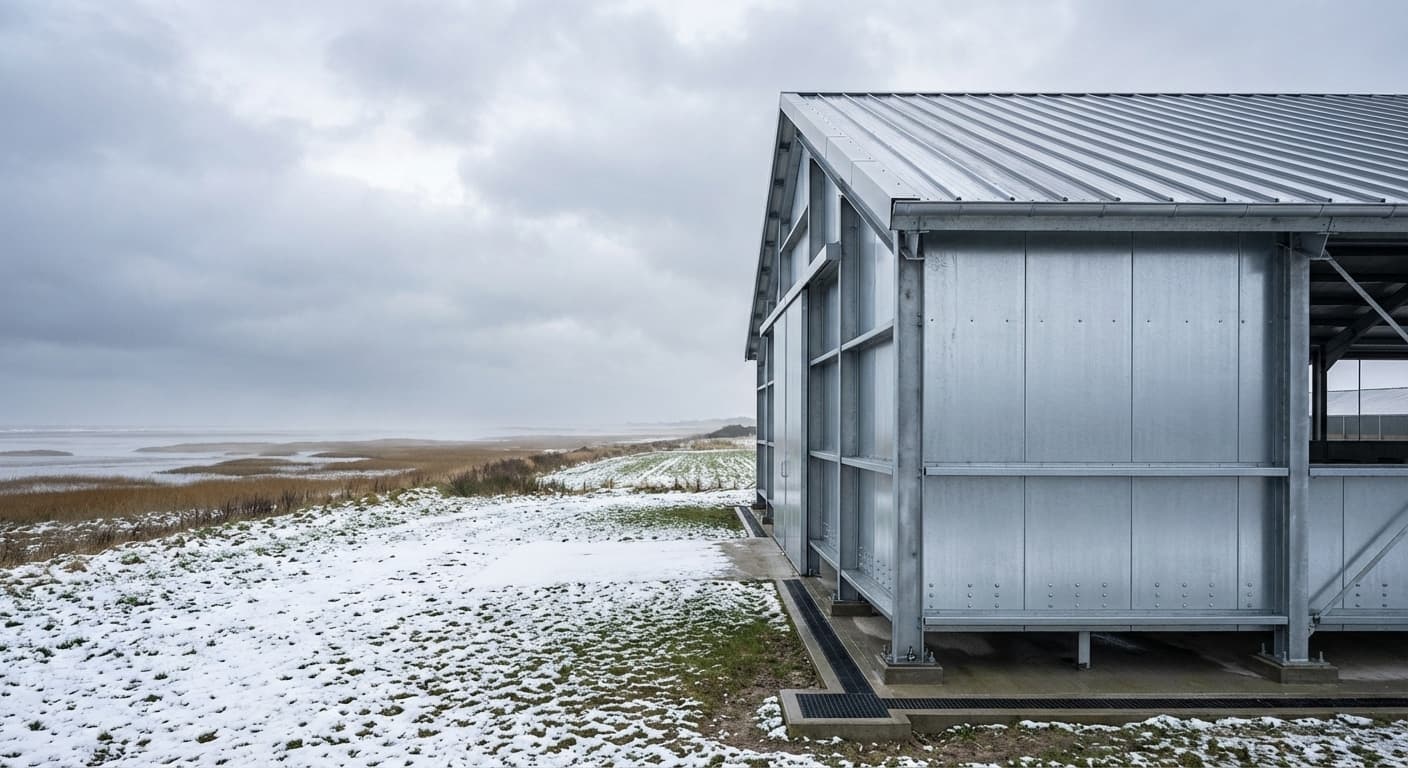

Coastal salt and heavy snow aren't just nuisances–they're barn killers–so this article equips owners with a battle plan that starts with choosing G185-galvanized or Galvalume steel, continuous rigid insulation, and a 6:12 roof pitch to stop 10-times-faster corrosion within a mile of shore and shed wet snow loads that can top 60 psf. Readers learn how to read real-world rust patterns, interpret ISO C5 corrosion ratings, and integrate ridge ventilation, vapor barriers, and site-specific drainage so condensation and drifting snow can't undermine coatings or overload frames. It walks through design details–clear-span framing, wind-aligned ridgelines, ASCE 7-16 load combos–that keep connections safe when uplift and drift hit simultaneously, then lays out a twice-yearly inspection and gentle-wash regimen that replaces zinc-rated fasteners before hidden rust triggers sudden failure. By linking material science, local building codes, and proactive maintenance schedules, the piece shows farmers how to turn a standard metal shell into a 50-year, single-source investment that shrugs off salty humidity, blizzard loads, and the coordination gaps that plague multi-contractor builds.
Assessing Environmental Challenges for Metal Agricultural Barn Durability
Salt corrosion accelerates 10 times faster within 80 feet of the coast, concentrating most severely 12 feet up your barn walls where structural fasteners are most vulnerable.
Understanding Coastal Humidity Impacts
Understanding coastal humidity impacts
Here's what coastal air does to your metal barn: salt rides in on the wind, sticks to metal surfaces, and starts eating through protective coatings faster than you'd expect. Research shows corrosion happens 10 times faster just 80 feet from shore compared to 800 feet inland — and that damage reaches up to 10 miles from the coast. [1]
The worst spot? About 12 feet up your barn walls. That's where salt concentration peaks, right where your structural connectors and fasteners live. [1] You might think covered areas stay safer, but they actually corrode faster. Why? Rain can't wash the salt away from those protected spots under overhangs and in storage bays. [1]
Every hour your barn stays damp, corrosion accelerates. High humidity keeps surfaces wet longer through daily temperature swings, giving rust more time to work. [2] That's why coastal barns need different specs than inland buildings — standard protection won't cut it when salt and moisture team up against your investment.
Evaluating Heavy Snow Load Requirements
Evaluating heavy snow load requirements
Your barn's snow load requirement depends on your zip code — and the numbers vary widely. Maine's coast demands 60+ PSF capacity. Minnesota agricultural areas need 50+ PSF. Colorado mountain regions require 40+ PSF minimums. [3] A barn built for one region won't pass code in another. At National Steel Buildings, we know every local requirement before we start your design.
The math behind snow weight is simple but sobering: six inches of wet snow weighs the same as one inch of standing water across your entire roof — about 5 pounds per square foot. [4] That's thousands of pounds pressing down on your structure.
Building codes (ASCE 7-16) factor in more than just snowfall amounts. They account for:
- Wind creating uneven drifts
- Rain soaking into snow before it freezes
- Snow sliding from adjacent structures
- Combined loads when storms bring both snow and wind [3]
Your barn's use matters too. Housing heavy equipment or livestock? You'll need capacity beyond the baseline. Running heat inside? You might qualify for reduced requirements since warmth speeds melting. [3]
The engineering gets complex when snow and wind hit together, creating lopsided loads that stress your structure unevenly. We'll cover the design solutions — like clear-span framing and optimal roof pitch — in the sections ahead.
Identifying Local Corrosion Risks
Identifying local corrosion risks
Published corrosion maps won't tell you what your specific site needs. Here's what actually works: drive around and look at older metal buildings near your property. Check the fasteners, rust patterns, and coating failures at different distances from shore. Those real-world examples show exactly what your barn will face. [1]
For formal planning, engineers use two classification systems:
- ISO 9223 framework for corrosion categories
- Environmental Severity Classification (ESC) ratings
Waterfront properties hit C5 — the highest corrosion category — which drives specific material requirements your building official will enforce. [5]
Wind direction matters more than most people realize. A barn facing onshore winds gets hammered with salt spray. The same barn with offshore winds sees much less corrosion. That difference changes your entire materials spec. [1]
Want hard data? Field corrosion test kits and lab analysis can measure actual corrosion rates across your property. Those numbers become your baseline for choosing materials and planning maintenance schedules. [1] It's extra homework up front, but it beats discovering you under-specified protection after the damage starts.
Material Selection and Protective Coatings
G90 galvanized steel handles typical outdoor exposure, while G185 provides nearly double the protection for coastal and extreme weather zones without stainless steel costs.
Choosing High-Grade Galvanized Steel
Galvanized steel protects your barn two ways at once: zinc coating blocks moisture from reaching the steel underneath, and when damage happens–at cut edges or scratches–the zinc corrodes first, protecting your investment. [6] The thicker the zinc coating, the longer your barn stays protected without maintenance. You'll see three main coating weights: G60 (light), G90 (standard), and G185 (heavy-duty). [7] For coastal barns and heavy snow areas, G90 is your minimum–it handles typical outdoor exposure. But if you're building near salt water or in extreme weather zones, G185 gives you nearly double the protection without the high cost of stainless steel. [8]
Here's what matters: sheet metal components get continuous hot-dip coating that forms pure zinc protection. But your structural connectors, anchor bolts, and fasteners need something stronger–batch galvanizing that bonds zinc and iron together at several thousand PSI. [6] That extra strength handles both the weather beating and the mechanical stress these critical connection points face every day.
Applying Advanced Weather-Resistant Coatings
Galvalume coating blends aluminum, zinc, and silicon into a protective layer that outperforms standard galvanized steel. [9] Think of it as double protection–aluminum forms a tough barrier against moisture while zinc sacrifices itself to protect any exposed edges or scratches. [9] In coastal areas, this matters. Your barn's Galvalume panels can last three to six times longer than regular galvanized steel in salt air. [10] That's years of farming without worrying about recoating panels or scheduling around harvest season.
Paint bonds better to Galvalume too. When you add quality UV-resistant paint over Galvalume, you get protection that won't chalk, peel, or fade like paint on regular galvanized steel. [9] For coastal barns or heavy snow areas where freeze-thaw cycles test every coating, specify paint systems with proven salt spray test results–not just marketing promises. [10] The right combination of Galvalume and premium paint keeps your
Integrating Insulation for Moisture Control
Insulation protects your metal barn from the inside out. Here's why it matters: warm barn air holds moisture from livestock, feed, and equipment. When that warm, humid air hits cold metal panels, it condenses–creating water droplets that bypass all your exterior coatings and attack steel where you can't see or treat it. [11] Good insulation keeps metal surfaces warm enough to prevent condensation. No condensation means no hidden rust eating away at your investment. [11]
Your insulation choice makes or breaks moisture control. Continuous insulation–rigid boards or insulated metal panels that cover entire walls without gaps–beats traditional fiberglass batts. Why? Batts leave breaks at every stud, creating cold spots where condensation forms. [12] Rigid polyiso board gives you R-3.2 per inch up to R-31 total, and you can tape the joints for an airtight seal. [12] If your coastal barn houses livestock or stores damp feed, consider spray foam on the interior roof deck. It sticks directly to metal, eliminating air gaps where condensation hides–just protect it from curious animals. [12]
Don't forget the vapor barrier. While insulation keeps surfaces warm, vapor barriers stop moisture from traveling through walls and soaking your insulation. [11] You need 6-mil poly film with less than 1.0 perm rating, installed on the warm side with overlapped, sealed edges. [11] In coastal barns where humidity stays above 80%, this barrier is as critical as your foundation. Get it right, and you protect every dollar spent on galvanized steel and premium coatings.
Design Strategies to Enhance Longevity
A 3:12 to 6:12 roof pitch paired with proper ridge orientation and continuous ventilation protects your barn's structure from snow load failure and corrosion for decades.
Optimizing Roof Pitch and Snow Shedding
Optimizing roof pitch and snow shedding
Your barn's roof pitch directly determines how much snow weight you'll carry through winter — and whether that snow slides off gradually or avalanches without warning. The sweet spot for metal barns sits between 3:12 and 6:12. Go below 1:12 and snow compresses into loads your structure wasn't built to handle. Push past 6:12 and you risk massive volumes releasing suddenly, taking vents and equipment with them. [13]
Standing seam roofs shed snow effectively even at 2:12 or 3:12 because their smooth, interlocking panels reduce surface friction. [13] But when you're dealing with coastal wet snow — which weighs far more per inch than inland powder — you'll want that 6:12 pitch. It cuts both how long snow sits on your roof and how much weight accumulates. [14]
Your ridgeline orientation matters too. Position the ridge perpendicular to prevailing winds and you'll create deep drifts on the leeward side. Face it into the wind instead, and snow distributes more evenly across both roof planes, reducing stress concentrations. [13] Keep your roofline simple — single-ridge gables shed predictably, while complex designs with valleys and dormers create accumulation points that overload specific areas. [13]
Incorporating Ventilation and Drainage Systems
Incorporating ventilation and drainage systems
Ventilation and drainage determine whether your barn lasts 20 years or 50. Get them wrong, and trapped humidity extends the corrosion cycle that coastal salt starts — turning your barn's interior into its own worst enemy. [15]
You need continuous ridge vents paired with controlled sidewall inlets. This combination creates the pressure differential that forces humid air out before it condenses on your structural steel. [16] For livestock operations, this same airflow handles the moisture from respiration, manure gases, and wet bedding that would otherwise saturate your interior air. [16]
Drainage works just as hard outside. Water pooling at foundations or flowing back toward your building defeats every dollar you spent on protective coatings. [15] Design proper slopes, channel systems, and grading from the start. Keep groundwater and snowmelt moving away from your base — that's where galvanized panels are most vulnerable. [15]
These systems work together: ventilation stops interior moisture from overwhelming your coatings, while drainage prevents exterior water from undermining your foundation. Both are essential in coastal and snow-heavy environments where moisture attacks from every angle. [16]
Engineering Connections for Wind and Snow Resistance
Engineering connections for wind and snow resistance
Wind and snow attack your barn from opposite directions — and your connections need to handle both at once. Wind creates horizontal pressure against walls and tries to lift your roof off. Snow presses down with sustained weight that builds over days or weeks. [17]
As discussed in the snow load requirements section, ASCE 7-16 standards require modeling these forces together. When your roof carries 60 PSF of wet snow during a windstorm, you get asymmetric drift loads and uplift forces that neither calculation captures alone. [3]
Clear-span framing solves part of this challenge. Without interior posts, your
Maintenance Practices and Service Support
Twice-yearly inspections catch rust, coating damage, and roof deformation before metal barns fail suddenly without warning.
Establishing a Proactive Inspection Schedule
Your metal barn needs attention twice a year — spring after the last freeze and fall before winter hits. [19] Spring inspections show you exactly what winter did to your building: check for fastener rust, coating damage at cut edges, clogged drainage, and any roof panel deformation from snow loads. Fall inspections prepare your barn for the coming assault of salt air and snow weight. [20] Here's why timing matters: metal buildings don't give warning signs like wood structures do. While a wood barn creaks and bows before problems get serious, pre-engineered metal buildings can fail suddenly without any warning. [21] That makes your inspection schedule a safety issue, not just maintenance.
Keep detailed records — dates, what you found, what you fixed, what it cost. These records tell you if corrosion or wear is getting worse between inspections, giving you time to act before emergency repairs drain your budget. [19]During heavy snow events, you need to monitor loads actively — don't just assume your barn can handle whatever Mother Nature delivers. Compare actual snow depth and density against your barn's design load rating.
This simple check prevents dangerous overloading before your roof structure gets stressed. [21] Watch how snow builds across both roof slopes — unbalanced loads from wind drift can stress trusses unevenly and compromise connections even when total weight stays within limits. [21]
Implementing Routine Cleaning and Repairs
Salt and debris don't just look bad — they actively eat away at your barn's protective coatings. Use mild detergent to dissolve salt residue and trapped moisture that coastal air leaves on your panels. For heavier buildup, pressure wash below 1,500 PSI from top to bottom to protect the finish. [23] Always test cleaning solutions on a hidden spot first — some detergents react with zinc coatings or damage Galvalume paint adhesion, turning a simple wash into an expensive repair. [19]Fix problems in the order they fail.
Fasteners go first — their cut edges and threads lose coating protection faster than flat panels. When you see rust stains, replace steel fasteners with zinc-rated ones immediately to stop rust from spreading to surrounding metal. [22] Seal gaps at roof-wall transitions and around penetrations right away — these openings let salt air attack uncoated steel behind the finish. [23] Keep doors sliding smoothly with silicone lubricant every few months. Unlike petroleum products that attract dirt, silicone prevents corrosion without the grime buildup. [23]Your maintenance records do more than track costs — they reveal patterns.
When the same fastener or seam shows increasing corrosion over multiple inspections, your records highlight whether spot treatments are working or if you need to address an underlying design issue. Sometimes that recurring problem signals a coating spec or drainage detail that needs engineering attention, not just more sealant. [19]
Leveraging Single-Source Solutions from National Steel Buildings
When you split your project between multiple contractors, coordination gaps turn into building failures — especially in harsh coastal and snow environments. That's why single-source accountability matters.
At National Steel Buildings, we manage everything from initial quote through final bolt. The engineer who specs your G185 galvanized framing works directly with the crew who installs it — no handoff confusion, no finger-pointing when issues arise. [24] This matters when a misread coating spec or undersized anchor bolt won't show problems until your first major storm.
Our
- Coastal corrosion peaks 12 ft up walls where fasteners sit, 10x faster 80 ft from shore.
- Wet snow: 6 in ≈ 5 psf; design for 40-60 psf local drift loads plus wind per ASCE 7-16.
- Galvalume + UV paint lasts 3-6x longer than plain galvanized in salt air; G185 for C5 zones.
- 3:12-6:12 roof pitch sheds wet coastal snow; ridge perpendicular to wind prevents drift piles.
- Continuous ridge vents + sidewall inlets expel humid barn air before it condenses on cold steel.
- Inspect spring & fall: replace rusted fasteners first, wash salt <1500 psi, log trends.
- Single-source builder ensures coating spec, snow load, and anchor bolts match local codes.
- https://marineconstructionmagazine.com/article/causes-of-corrosion-in-coastal-areas/
- https://www.zrcworldwide.com/blog/how-weather-conditions-affect-your-corrosion-protection
- https://mbmisteelbuildings.com/blog/cold-weather-steel-building-design/
- https://norsteelbuildings.com/us/building-codes-permits-us/steel-building-codes-loads/
- https://www.wbdg.org/dod/cpc-source/waterfront-coastal-structures-knowledge-area
- https://galvanizeit.org/knowledgebase/article/astm-a123-and-g90-specifications
- https://hascallsteel.com/g60-to-g90-galvanized-steel-understanding-coating-weights/
- https://www.ryerson.com/metal-resources/metal-market-intelligence/what-is-g90-galvanized-steel
- https://www.archbuildings.com/about-galvalume.php
- https://www.millsteel.com/news/can-metal-panels-withstand-harsh-weather-and-coastal-conditions
- https://www.extension.purdue.edu/extmedia/ae/ae-95.html
- https://www.rmax.com/blog/farm-insulation
- https://www.rhinobldg.com/blog/designing-metal-buildings-for-snow-country
- https://www.cedur.com/roof-pitch-for-snow
- https://lionbuildings.com/how-long-exactly-does-a-steel-building-last/
- https://www.lesterbuildings.com/blogs/how-to-choose-the-right-materials-for-a-livestock-barn/
- https://www.uspatriotsteel.com/blog/wind-load-vs-snow-load/
- https://lionbuildings.com/can-metal-buildings-withstand-extreme-weather-what-you-need-to-know/2/
- https://premierbuildings.com/seasonal-maintenance-guide-for-metal-buildings/
- https://metalguard.com/2024/12/19/seasonal-maintenance-tips-for-your-metal-building-keep-it-in-top-shape-year-round/
- https://eden.cce.cornell.edu/2025/12/04/heavy-snow-loads-dos-and-donts-for-barn-snow-removal/
- https://bulldogsteelstructures.com/blog/7-important-tips-to-keep-your-metal-barn-in-top-shape/
- https://mbmisteelbuildings.com/blog/maintenance-and-care-tips-for-metal-buildings/