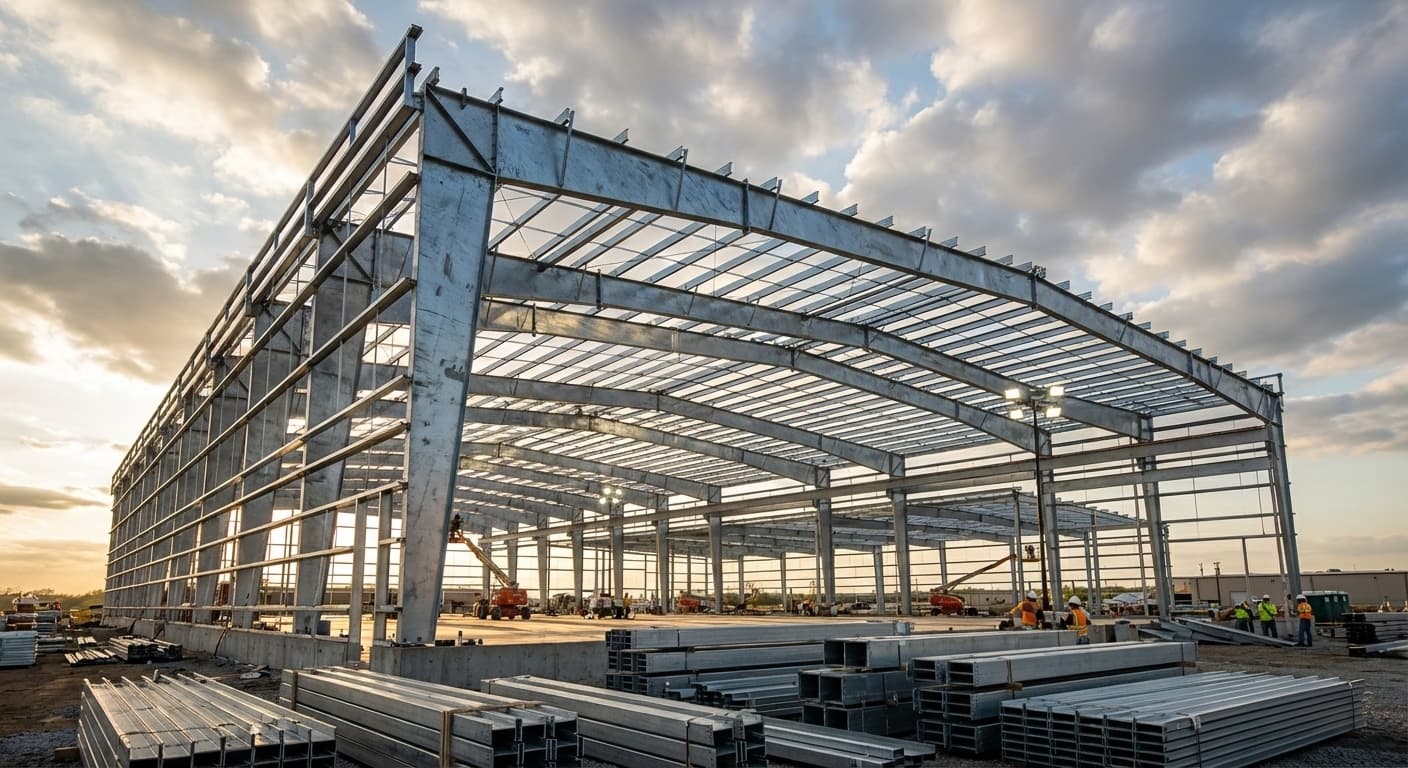

We show you how to match a metal prefab building to your warehouse, hangar, or processing plant and shave months off construction. The payoff is immediate cashflow–earlier occupancy, lower loans, and up to $100k saved over 20 years.
Why Metal Prefab Buildings Dominate 2026 Projects
Steel buildings pass the 2026 wind and snow code requirements that reject wood and concrete, cutting permit delays and expensive redesigns.
Built for Speed: 50% Faster Occupancy
You know the drill–rain delays, missing crews, materials stuck in transit.
Your project stalls while costs keep climbing.
Engineered for 100-Year Storms
Building codes just got tougher–and your choice of materials now determines whether you pass permit review. The new 2026 standards hitting nationwide change how engineers calculate wind loads completely. It's not just about higher wind speeds anymore. The code now requires separate calculations for corners, edges, and roof peaks where wind hits hardest. For critical buildings–hospitals, schools, emergency shelters–you now need tornado-specific engineering too, accounting for the upward pull that rips roofs off. [5] If your building supplier is still using old 2016 standards, you'll face permit rejection and expensive redesigns. [5]
Steel passes these new tests where other materials fail. Wood gives out at 135 mph winds. Steel keeps standing at 150 mph and beyond–FEMA confirms steel buildings survive winds 60-80 mph stronger than what destroys wood structures. [4] In earthquake zones, steel bends instead of breaking, spreading the force through the frame while concrete cracks and wood connections pull apart. [6]
Snow loads changed too. The new code ditches generic regional guidelines for site-specific calculations, plus a new requirement for rain-on-snow weight–the exact scenario that collapsed roofs across the Midwest last winter. Your steel building can handle 100+ pounds per square foot in heavy snow zones when properly engineered. [5]
Then there's fire. Steel won't burn–period. Not during construction, not during use, not ever. [4] In wildfire country, that matters more each year. Metal roofs and steel frames stop the radiant heat that actually spreads fire building to building. Your insurance company prices this correctly: one hotel project saved $1.32 million in construction insurance alone by choosing steel over wood, then kept saving $66,000 every year on property coverage. [4] That's real money staying in your pocket because you built with materials that can't catch fire.
7 High-ROI Uses Proven in the Field
Steel buildings eliminate the maintenance cycle that drains farm budgets, with no rot, pests, or repainting needed for decades.
Commercial Warehouses & Distribution Centers
Your warehouse budget works harder with steel. Pre-engineered shells start at $45-$75 per square foot, while turnkey facilities with offices, HVAC, and full electrical run $60-$130 depending on your location and finishes. [7] [8] Compare that to tilt-up concrete–higher upfront cost plus ongoing expenses for crane rentals, joint repairs, and insulation fixes. Since the building shell eats up 65% of your total construction budget, picking steel over concrete sets the tone for the whole project. [9]
For your daily operations, clear-span steel framing changes everything. No interior columns means you configure rack systems however you want. Your forklifts move freely. Need to adjust for seasonal inventory? Add a mezzanine or expand your dock doors without tearing anything down–just bolt on the extension. [7] A 75,000-square-foot Calgary fulfillment center built for $92 per square foot with steel paid itself back in 5-10 years through faster occupancy and lower operating costs. The bigger you build, the faster that payback hits. [7] [9]
Agricultural Barns & Cold-Storage Units
Farm operators know the maintenance trap of wood barns–endless repainting, rot repairs, termite treatments. Steel ends that cycle. No rot, no pests, no repainting for decades. [10] Smart farmers are switching fast–the metal buildings market grows 8.4% annually because the lifetime math is undeniable. [12] When you're protecting $300,000 combines, precision seed stock, or temperature-sensitive livestock, a drafty wood barn costs you money every day.
Cold storage shows steel's real advantage. Your building gets engineered for your exact site–local snow loads, wind patterns, humidity levels all factored in. [10] Wood warps and gaps over time, killing your temperature control. Steel stays tight, keeping your crops, feed, or veterinary supplies at stable temperatures with less HVAC runtime.
Auto Shops & Aircraft Hangars
Your auto shop faces unique challenges–hydraulic lifts need clearance, service bays require open spans, and gasoline vapors demand fire-resistant construction. Steel delivers on all three. Clear-span framing means no posts between bays, so your techs position lifts anywhere and move vehicles freely. Need height? Steel gives you 42-foot eaves for full-size truck lifts. Multiple overhead doors? The frame handles them without compromise. [13] Most important–steel won't burn. In a space storing solvents and fuel, that non-combustible rating protects your investment and cuts insurance costs. With steel framing 65% of new commercial construction, insurers know the value. [13]
Aircraft hangars take those requirements higher. Your aircraft dimensions drive the design–wingspan and tail height set your door opening before anything else. Steel makes that simple. Configure bi-fold doors, custom spans, and column-free interiors for one private plane or an entire fleet. [14] [15] Operating costs drop too. Energy Star metal roofing cuts cooling demand 10-15%, saving up to 40% annually on climate control–critical when you're protecting avionics year-round. [15] Same footprint works for maintenance bays, parts storage, and offices without structural gymnastics. [14]
Smart Customization & Size Guide
The 40-100 foot range delivers your best cost-per-square-foot value while handling most warehouse, barn, hangar, and retail applications without custom engineering.
Clear-Span Options: 20′ to 300′+
Clear-span framing eliminates every interior column between your exterior walls–all structural loads transfer directly to the perimeter. You get 20 to 300 feet of unobstructed space to work with. The sweet spot for your budget? The 40-100 foot range, which delivers the best cost-per-square-foot performance and handles most warehouse, barn, hangar, and retail applications without special engineering. [16]
When you push beyond 150 feet, you'll need custom structural calculations to manage deflection and lateral forces–and those deeper columns and rafters can reduce usable clearance beneath the haunches, sometimes requiring taller eave heights to compensate. [18] That's where choosing the right frame style pays off:
- Straight-column rigid frames: Your go-to for offices and retail stores under 80 feet wide
- Tapered-column frames: Built for heavy loads in aircraft hangars, indoor arenas, and large agricultural storage
- Single-slope frames: Perfect for retail strips and drive-through configurations, most economical in the 60-120 foot range [17]
Your eave heights can run 10-60 feet, with frame bays spaced 20, 25, or 30 feet on center–we'll recommend the right spacing based on your load requirements and interior layout plans. [16]
Insulation & Energy-Efficient Panels
Steel conducts heat 300-400 times faster than wood–skip the insulation, and your operating costs will remind you every month. Without proper insulation, your metal building loses 35-40% of its conditioned air through the envelope, with exterior walls hitting 150 degreesF in summer. [19] The culprit? Thermal bridging, where heat flows through your steel purlins and girts like a highway, completely bypassing the insulation between them.
To stop it, install continuous rigid polyisocyanurate board installed across those structural members cuts thermal bridging losses by 30% compared to fiberglass alone. Buildings combining exterior polyiso with interior batt insulation typically pay back that investment within five years in Climate Zones 4-7. [19] If you're building up north, the 2021 IECC now requires R-30+ for commercial applications–and properly insulated metal structures deliver 38-42% annual energy savings compared to uninsulated buildings. [19]
Your insulation choices break down by budget and application:
- Fiberglass batt: Costs 15-30% less upfront, works fine for warehouses and dry storage–but seal those vapor barriers wrong and R-values drop by nearly half [19]
- Closed-cell spray foam: At R-6.5-7 per inch, reduces energy leaks by 45% versus fiberglass and keeps 98% of its thermal rating after 20 years [19]
- Radiant barriers: Thin aluminum systems that reflect 97% of infrared radiation, cutting summer heat gain by 40-50% when installed with proper air gaps [19]
- Insulated metal panels (IMPs): The premium solution–factory-assembled panels with R-values from R-5 to R-72, installing in half the time of built-up systems [20]
For cold storage applications, those IMP cores reach R-9 per inch at operating temperature, solving the insulation failures that plague conventional refrigerated buildings. [20]
Quote, Finance & Build Process
Get instant approval with no credit check, put down 12-20%, and defer payments until your building is installed and generating revenue.
3-Step Custom Quote in 24 Hours
Getting an accurate price takes minutes, not meetings.
You already know your building size and use — that's all you need to
Flexible Financing & RTO Programs
Forget everything you know about commercial construction loans. Rent-to-own programs for steel buildings work differently — instant approval, no credit check required, down payments between 12% and 20%, and here's the key: no payment due again until your building is installed. [24] You're not carrying monthly payments while we fabricate your components and you prep your site. Terms run up to 60 months depending on program and location, with no early payoff penalties — pay it off tomorrow or next year, your choice. [24] Traditional financing through partner banks is available too, with approvals up to $20,000 for qualified buyers. [24]
The qualification bar sits refreshingly low. Most RTO programs require minimum orders around $3,000 and cap at $25,000 without additional down payment. Both property owners and renters qualify — renters just need a signed landlord waiver. [26] On a typical $5,000 agricultural building with 24-month terms, you're looking at roughly $295 monthly after a $750 down payment. [26] Terms stretch from 24 to 60 months, with longer terms sometimes carrying a small origination fee for bypassing the credit check. [26] One restriction worth noting: RTO contracts typically exclude occupied living spaces like barndominiums, so residential-commercial hybrids need different financing routes. [26]
The real advantage for your business isn't just easy approval — it's cash flow timing. Your new warehouse starts generating revenue before you've paid it off. Your expanded auto shop brings in customers while you're still making payments. Your cold-storage barn protects this year's harvest and pays for itself from the profits. [25] That's why smart operators choose RTO: the building works for you from day one, earning its keep instead of draining your reserves.
Factory Precision, On-Time Delivery & Full Install Support
Your building's quality gets locked in at the factory, not the job site. Every steel component is cut and test-assembled to tolerances of +/-1.0 mm — precision that eliminates the field fixes and budget surprises that plague stick-built construction. [28] Each piece ships with material certificates, and we verify every delivery against your order before it leaves the dock. [29] Problems get caught in shipping, not during your crane rental.
This is where single-source accountability pays off. We coordinate everything — from factory floor to your foundation. Real-time tracking tells you exactly where your building is, automated updates keep everyone informed, and our team communicates site requirements early: truck access, ground prep, foundation status. [29] [27] When steel arrives, it's labeled and sequenced for assembly. Your erection crew isn't wasting time sorting pieces; they're building.
Our in-house erection teams follow the same discipline as the factory. First bay goes up with connections finger-tight, then we verify alignment before final torque — catching any issues before they multiply across your building. [29] Every phase follows proven protocols: primary frame, secondary steel, panels, openings. Safety supervisors oversee every elevated operation. [29] The project wraps with documented inspections of every system, and you receive the complete package: as-builts, certificates, welding records, QA reports. [28] Keep it all — your insurance company, lender, and future buyer will ask for it.
That's the difference when you work with a team that's delivered 1,480+ buildings: we know what matters, we handle what's hard, and we document what counts. From quote to closeout, you get exactly what you ordered, exactly when promised.
- Metal prefab buildings cut construction time 30-50%, saving ~$75k interest on a $5M build.
- Steel buildings cost $15-43/sq ft vs $35-85 for wood/concrete, plus 1% annual upkeep vs 2-4%.
- Clear-span frames up to 300 ft eliminate interior posts, optimizing workflow and floor usage.
- Proper insulation (spray foam or IMPs) slashes energy loss 38-42% and prevents condensation.
- Add mezzanines or canopies later by bolting to the existing steel frame–no new foundations.
- https://metalcon.com/blog/prefabricated-metal-building-systems-how-off-site-fabrication-improves-construction-timelines/
- https://www.alliedbuildings.com/time-savings-of-pre-engineered-metal-buildings/
- https://www.buildingsguide.com/build/advantages-of-pre-engineered-steel-buildings/?srsltid=AfmBOooiB3NEindfgM-rCAptFDHA8daJFzN-3SWrm-5qbUh_-kSNBh6i
- https://buildsteel.org/why-steel/cold-formed-steel-101/steel-framing-for-homes-facing-hurricanes-wildfires-and-other-hazards/
- https://titansteelstructures.com/steel-building-engineering/designing-for-disaster-2026-wind-and-snow-load-requirements-for-metal-buildings/
- https://pbsbuildings.com/metal-buildings-vs-environmental-disasters/
- https://metalprobuildings.com/steel-industrial-building-cost-roi/
- https://www.foxblocks.com/blog/cost-to-build-a-5000-sq-ft-warehouse
- https://www.cbre.com/insights/reports/warehouse-and-distribution-construction-cost-trends-2023-2024
- https://armstrongsteel.com/blog/2025-outlook-why-agricultural-steel-buildings-stand-out
- https://matadorstructures.com/blog/pole-barns-increase-property-value/
- https://www.vikingbarns.com/blog/why-metal-buildings-are-the-best-investment-for-farm
- https://www.rigidbuilding.com/aviation-steel-buildings/
- https://cdmg.com/building-faqs/metal-aircraft-hangars
- https://www.buildingsguide.com/build/clear-span-buildings/?srsltid=AfmBOorkDbarldyPivQpZg2V5EcY7CY4pla9TfhmeEliU2GVLVrDpgLU
- https://www.alliedbuildings.com/open-span-steel-buildings/
- https://steelcommandercorp.com/clear-span-steel-buildings-guide/
- https://www.prefabsteelpro.com/what-insulation-options-work-for-metal-building-structures
- https://www.kingspan.com/us/en/products/insulated-panel-systems/wall-panel-systems/
- https://alansfactoryoutlet.com/metal-building-prices/?srsltid=AfmBOorVSnHOHCLYZhZR_NWI09GCorCD2-HYpGF1ttilw6rzWNZ3EFdF
- https://bulldogsteelstructures.com/rent-to-own/
- https://americanmetalgarages.com/rent-to-own-metal-buildings/
- https://www.eaglecarports.com/financing/rent-to-own
- https://www.msuite.com/the-2024-ultimate-guide-to-prefabricated-construction/
- https://www.meichensteel.com/a/news/large-scale-steel-structure-fabrication-installation-plan.html
- https://www.hcsteelstructure.com/step-by-step-delivery-installation-prefabricated-steel-building/