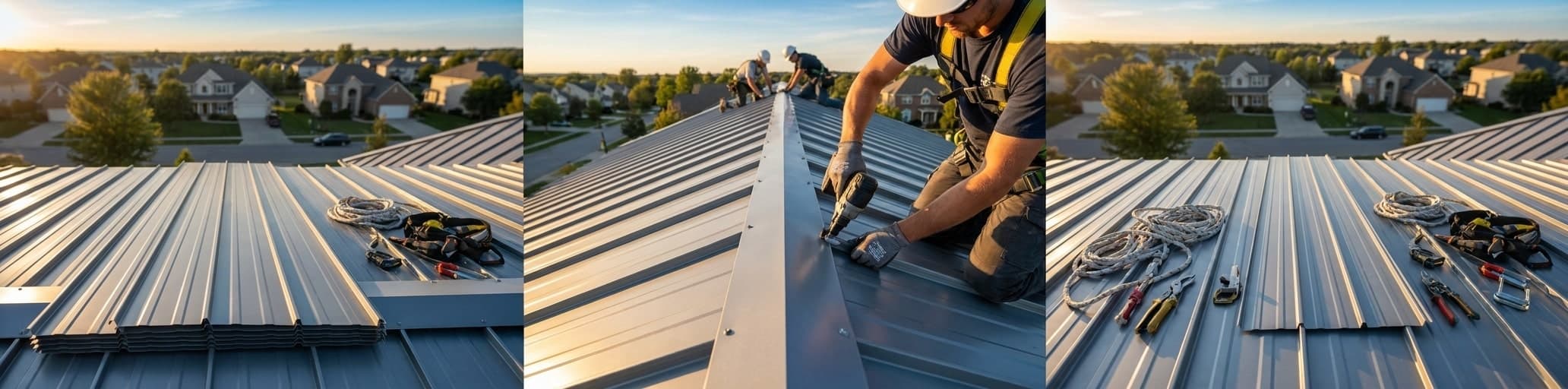

Metal roof labor costs typically run $2 to $6 per square foot nationally, representing 50 to 60 percent of your total installation bill. We help you understand regional pricing differences and identify qualified contractors so you can budget accurately and protect your investment with certified installation.
How Much Is Labor to Install Metal Roofing in 2026?
Metal roof installation labor costs $2 to $6 per square foot nationally, representing roughly 50 to 60 percent of your total project expense.
Current labor rates per square foot across the United States
The labor cost to install metal roofing runs $2 to $6 per square foot nationally for standing seam systems, according to Angi data sourced from the U.S. Bureau of Labor Statistics.[1] For general metal roofing — including corrugated and exposed-fastener profiles — installation labor typically adds $3 to $5 per square foot on top of materials.[2] What these numbers mean in practice: labor represents 50% to 60% of a standing seam project's total bill, which averages roughly $7,000 for a standard residential roof.[3] The wide per-square-foot spread exists because regional labor markets differ sharply. States with higher costs of living charge significantly more, and specialty profiles like standing seam command a premium over simpler exposed-fastener work because the concealed-clip system demands more precision and time.[1] The table below shows average total metal roof costs by state — a useful proxy for understanding where labor rates for metal roofing land across the country, since labor accounts for the majority of the total bill.[3]
| State | Average Total Installed Cost |
|---|---|
| California | $16,800 |
| New York | $14,300 |
| Pennsylvania | $11,100 |
| North Carolina | $11,400 |
| Texas | $10,700 |
| Georgia | $10,600 |
On a cost-per-square-foot basis, corrugated and sheet metal profiles come in at $3.50 to $15 per square foot fully installed, while standing seam runs $7 to $30 per square foot — with labor making up the bulk of that gap.[3] If you are budgeting a DIY approach, setting aside $3,400 to $10,500 represents the approximate labor cost you would eliminate, though most manufacturers void warranties on non-professionally installed systems.[3]
Why metal roof labor costs vary by region and contractor experience
The gap between a low labor quote in rural Kansas and a high one in coastal California traces back to three concrete forces: local cost of living, skilled-labor scarcity, and contractor experience level. In high-cost metros like Los Angeles, roofing labor runs $300 to $400 per square (100 sq ft), while the same scope of work in a smaller Midwest market can come in at roughly half that rate.[5] Urban areas compound this effect independently of state-level averages — demand in dense population centers keeps contractor schedules full, which allows crews to charge more simply because they don't need to compete as aggressively for work.[5] Beyond geography, the construction industry's ongoing skilled-labor shortage pushes rates higher across all regions, with no near-term relief in sight; stricter jobsite safety regulations mean crews spend more time on harness setup, scaffolding, and safety compliance, slowing installation and adding billable hours that get passed to you.[5]
Contractor experience adds another pricing tier on top of regional baselines. Labor costs depend directly on a roofer's experience level, local demand for their services, and the warranty coverage they can back their work with — meaning a seasoned crew offering a labor warranty will legitimately quote more than an entry-level operation offering none.[5] That premium is not padding; it reflects lower risk of callbacks, leak repairs, and voided manufacturer warranties. A contractor experienced with concealed-clip standing seam systems, for instance, commands higher rates than one who primarily installs exposed-fastener corrugated panels, because the skill ceiling — and liability exposure — differs significantly between the two profiles.[4]
Total labor cost breakdown for common residential and commercial roof sizes
Because labor averages 60% of total metal roof installation cost, you can derive a reliable labor estimate directly from published total-cost ranges.[4] For a 1,500-square-foot roof, total installed costs run $10,500 to $43,500, putting the labor portion at roughly $6,300 to $26,100.[6] Scale up to a 2,000-square-foot home and the total rises to $17,500 to $72,500 — meaning labor alone accounts for approximately $10,500 to $43,500 of that bill.[6] Larger commercial footprints push figures sharply higher: a 3,000-square-foot roof carries a total installed cost of $25,200 to $104,400, with labor representing $15,100 to $62,600 of that range depending on metal type and profile complexity.[6] The table below isolates estimated labor cost by roof size using the 60% labor ratio.
| Roof size | Total installed cost range | Estimated labor cost (60%) |
|---|---|---|
| 1,500 sq ft | $10,500 – $43,500 | $6,300 – $26,100 |
| 2,000 sq ft | $17,500 – $72,500 | $10,500 – $43,500 |
| 2,500 sq ft | $21,875 – $90,625 | $13,100 – $54,375 |
| 3,000 sq ft | $25,200 – $104,400 | $15,100 – $62,600 |
The wide labor ranges within each size tier reflect the spread between corrugated steel at the low end and copper or standing seam systems at the high end — not just regional wage differences.[4] A 2,000-square-foot standing seam project in a high-cost metro can push total costs toward the This Old House average of $57,661, while the same footprint in a moderate-labor market with corrugated panels stays near the HomeAdvisor average of $11,743.[7][4] The practical takeaway: roof size sets the floor on labor hours, but material and profile selection determines which end of the range you land on.
Factors That Drive Metal Roof Installation Labor Costs
Local labor availability can swing your metal roof cost by thousands of dollars, so comparing bids from contractors in your specific market reveals what you'll actually pay.
Roof complexity, pitch, and structural requirements affecting labor hours
Local labor availability and union vs. non-union contractor pricing Local labor availability is one of the most direct forces behind the spread you see in metal roof quotes for the same size and profile.
Where skilled metal roofing crews are scarce — rural markets, rapidly growing metros with more work than workers — contractors can charge toward the top of their regional range simply because demand outpaces supply.[12] Areas with dense roofing contractor pools create more competitive bidding, which pulls quotes toward the lower end of what the market will bear.
The practical consequence: a 1,500-square-foot metal roof that runs $13,500 in one market can reach $36,000 in another for identical materials, with local labor rates accounting for a significant share of that gap.[13] When you are collecting bids, the labor rates in your area — not just the material list — determine which end of any published cost range applies to your project.[13] A quote that looks low relative to national averages is not necessarily a bargain; it may simply reflect a lower local wage baseline, or it may reflect a crew cutting corners on safety compliance and installation precision.[12] Getting three or more bids from contractors active in your specific market is the fastest way to understand where local labor rates actually sit — and to spot outliers in either direction before you sign.
Metal Roof Labor Cost Estimates and Pricing Examples
Labor typically accounts for 60% of your metal roof cost, ranging from $8,100 to $21,600 on a 1,500-square-foot home depending on material and complexity.
Labor cost estimator for 1,000 sq ft to 10,000 sq ft roofs
Real-world pricing: 1,500 sq ft house vs. 2,000 sq ft house vs. commercial building The numbers shift meaningfully across building types, and understanding what each scenario actually costs — not just the per-square-foot rate — is where budgets either hold or break. For a 1,500-square-foot house, total metal roof installation runs $13,500 to $36,000, or $9 to $24 per square foot installed, depending on metal type and pitch.[13] HomeAdvisor's survey data puts the average for a standard 1,500-square-foot home at $12,700, with a typical range of $7,500 to $18,000 for corrugated and basic tin profiles.[14] Since labor accounts for 60% of total metal roofing cost — averaging roughly $7,000 across all residential projects nationally — the labor share on a 1,500-square-foot roof lands between $8,100 and $21,600 depending on where in that range the total project falls.[3] Scale up to a 2,000-square-foot home, and total installed cost using the $4 to $30 per square foot national range reaches $8,000 to $60,000, with labor consuming approximately $4,800 to $36,000 of that total.[3] The gap between low and high on a 2,000-square-foot project is not noise — it is the difference between corrugated steel with exposed fasteners installed by a mid-market crew and premium copper or standing seam installed by a certified specialist in a high-cost metro.[3] Commercial buildings introduce a different cost structure entirely: larger flat or low-slope footprints typically favor exposed-fastener R-panel or corrugated steel at $3 to $5 per square foot in labor, while commercial standing seam projects with concealed clips push toward the top of the $4 to $30 per square foot fully installed range, and permit costs, underlayment specifications, and code compliance add line items that residential projects often sidestep.[14][3] The table below shows how these three scenarios compare side by side using the labor ratio and installed cost ranges from current market data.
| Building type | Total installed cost range | Estimated labor cost (60%) | Labor per sq ft |
|---|---|---|---|
| 1,500 sq ft house | $13,500 – $36,000 | $8,100 – $21,600 | $9 – $24/sq ft total; labor $3-$5/sq ft |
| 2,000 sq ft house | $8,000 – $60,000 | $4,800 – $36,000 | $4 – $30/sq ft total; labor $3-$5/sq ft |
| Commercial building (5,000+ sq ft) | $20,000 – $150,000+ | $12,000 – $90,000+ | $4 – $30/sq ft total; labor varies by profile |
For commercial owners budgeting a warehouse, agricultural facility, or hangar, the corrugated or R-panel end of that range is where practical projects land — exposed-fastener systems at $3 to $5 per square foot in labor move fast, require less specialized tooling, and keep total project cost within reach without sacrificing durability on large footprints.[14][3]
How to bid a metal roofing job: what contractors include in labor quotes
A metal roof labor quote that arrives as a single lump sum is one you cannot evaluate accurately. Professional contractors build their estimates around three distinct buckets — materials, labor, and overhead plus profit — and within the labor bucket, several separate scopes should be itemized, not merged.[16] Panel installation is only one of them. Tear-off runs $1 to $2 per square foot for asphalt shingle removal and $1.50 to $3 per square foot for metal-over-metal tear-off, which demands more time and care depending on the profile being stripped.[15] Underlayment installation adds $0.50 to $1 per square foot and is sometimes bundled into the panel rate, sometimes priced as a separate line — confirm in writing which applies before you sign.[15] Decking replacement, if tear-off reveals rot or delamination, runs $80 to $150 per 4×8 sheet installed including materials; a transparent quote states the per-sheet rate upfront even though the final count won't be known until the old surface comes off.[15] The table below shows how a complete labor quote should look when broken out by scope.
| Line item | Typical rate |
|---|---|
| Panel installation — corrugated or exposed fastener | $3-$6 per sq ft |
| Panel installation — standing seam | $5-$10 per sq ft |
| Tear-off — asphalt shingles | $1-$2 per sq ft |
| Tear-off — metal over metal | $1.50-$3 per sq ft |
| Underlayment installation | $0.50-$1 per sq ft |
| Decking replacement | $80-$150 per sheet |
| Complexity add-on (valleys, dormers, skylights) | +15%-35% over base |
Pitch premium and complexity charges are where contractor quotes most often become incomparable. Ask every bidder to separate these as explicit line items rather than absorbing them into a flat per-square-foot rate.[15] A contractor quoting $4 per square foot with no stated pitch premium and a second quoting $5 with the steep-slope charge already built in for your 8:12 roof may produce identical actual invoices — or the first contractor's number may balloon once the pitch factor surfaces mid-project.[15] Every valley, dormer, skylight, and chimney transition adds custom flashing work that consumes measurable hours, and a quote that does not itemize complexity is one that can legally attach those charges later as change orders.[16]
Two questions protect you before you commit. First, ask whether the crew performing the work is employed directly by the contractor or will be subcontracted — subcontracting is common and not automatically a problem, but you have a right to know whether that crew holds certification on the specific panel system being installed, since some manufacturers void warranty coverage when installation is not performed by a certified contractor.[15] Second, collect at least three written quotes that each cover the same complete scope: panels, trim, underlayment, tear-off, permits, and cleanup.[1] Any quote that lands significantly below the others on a complex or steep roof deserves a direct conversation about what was omitted — not acceptance as a deal. On installation-sensitive systems like standing seam metal roofing, a labor rate 30% below market almost always means time is being cut somewhere, and on metal roofs, rushed installation creates leaks, failed fasteners, and voided manufacturer warranties that cost far more to remedy than the original labor premium would have.[15]
Reducing Labor Costs Without Compromising Quality or Safety
Single-source metal roofing eliminates costly hand-offs between parties, reducing labor expenses that typically represent two-thirds of project costs while maintaining quality standards.
Why single-source design-build projects lower total labor expenses
When roofing is part of a full metal building package from a single-source manufacturer, the economics shift measurably in your favor. Metal roofing has proven to be quite economical during design and construction, particularly when it is delivered as part of a complete package from one source — because design, fabrication, and installation are coordinated by the same entity rather than handed between separate parties working from different assumptions.[18] Materials arrive pre-engineered and precisely made, which enables faster installation, more accurate production schedules, and more predictable labor needs.[18] As a single-source building company eliminates the hand-offs between architect, fabricator, and erection crew, the gaps where rework and change orders accumulate simply disappear.
Labor accounts for roughly two-thirds of total metal roof project cost,[17] so any efficiency gained at the installation stage — fewer scope conflicts, less on-site waste, faster building enclosure — converts directly into a lower total bill without cutting corners on materials or workmanship. Metal's lighter weight relative to traditional shingles or tiles means less support structure is required, enabling simpler roof framing that reduces both material and labor expenses, while the lower slope designs common to commercial and industrial facilities use fewer materials overall compared to steep-slope residential work.[19] On large agricultural, warehouse, or hangar footprints where roof area runs into thousands of square feet, those per-square-foot savings compound into meaningful budget relief — and the single-source structure keeps accountability clear if anything needs to be resolved after installation.[18]
Choosing pre-engineered metal systems that minimize on-site assembly time
Pre-engineered metal buildings reduce construction timelines by 20 to 40% compared to traditional methods — and the labor cost reduction follows directly from how little fabrication work lands on the jobsite.[22] Every structural component is manufactured off-site to exact tolerances, so the crew arriving at your site is assembling parts engineered to connect precisely, not cutting and fitting from raw stock.[22] That distinction matters for your budget: PEMBs deliver cost savings of 10 to 20% over wood, concrete, or conventional steel construction, with an average of 20% saved on overall project cost — savings driven largely by fewer billable labor hours, not by substituting cheaper materials.[22] Shop fabrication also concentrates on-site activity close to the building footprint rather than spreading it across a sprawling staging area, and components that arrive pre-finished eliminate on-site finishing trades and the slower pace they introduce.[21] Because all parts are manufactured to a standardized system, the erection crew knows exactly how each component assembles before they arrive — on-site training is eliminated and downtime between installation phases compresses.[22] On large warehouse, hangar, or agricultural footprints where idle crew time compounds across multiple days, that efficiency converts directly into a lower labor invoice.[20]
Partnering with experienced erection teams to avoid costly rework and delays
A poorly installed metal roof produces leaks, improper ventilation, and in serious cases structural damage — problems that cost far more to remediate than the labor premium a qualified crew commands upfront.[23] The most common source of that risk is hiring a contractor whose experience is in asphalt shingles rather than metal: the installation process, required tools, and fastening techniques differ substantially between the two systems, and a crew unfamiliar with the specific profile they are installing will introduce errors that may not surface until water reaches the building interior.[24] Vetting for metal-specific experience is direct — reputable metal roofing contractors will readily provide at least three recent local references, and contacting those references to ask about installation quality, timeline accuracy, and how the crew handled complications gives you an actual performance record rather than a marketing claim.[24] Communication quality during the bidding process is also a reliable predictor of project execution: contractors who respond promptly, answer technical questions clearly, and document pricing and warranty terms without ambiguity before the contract is signed almost always run cleaner projects than those who are slow or vague during the quote stage.[24] Most manufacturer warranties are only valid when installation is performed by certified contractors, which means an uncertified crew does not just increase the probability of rework — it eliminates the coverage that protects your investment for the full lifespan of the roof.[23] On commercial, agricultural, or hangar footprints where a roof failure carries operational consequences, that warranty gap alone justifies the premium a certified, metal-experienced erection team charges over a generalist crew working outside their profile expertise.
- Metal roof installation labor costs range from $2-$6 per square foot for standing seam systems, representing 50-60% of total project cost nationally.
- Regional labor rates vary dramatically based on cost of living, skilled labor scarcity, and contractor experience, with coastal California rates double those of rural Midwest markets.
- For a 1,500 sq ft residential roof, total installed costs run $13,500-$36,000 with labor comprising $8,100-$21,600 depending on metal type and profile.
- Detailed labor quotes must itemize separate scopes including panel installation, tear-off, underlayment, decking replacement, and complexity add-ons rather than providing single lump sums.
- Single-source metal building packages reduce labor costs 10-20% by coordinating design, fabrication, and installation without hand-offs between separate parties.
- Hiring uncertified crews outside their metal roofing expertise risks installation errors, voided manufacturer warranties, and costly leak repairs exceeding any labor savings.
- Obtain at least three written quotes covering identical complete scope and directly question any bid significantly below market rates, as rushed installation causes major problems.
- https://weathershieldroofers.com/blog/standing-seam-metal-roof-cost/
- https://barrierbossusa.com/blogs/news/metal-roofing-cost-usa-2026-your-complete-price-guide-savings-breakdown?srsltid=AfmBOoq53L5CZcagW6JAT8wEyPpYIqC86jOYa9m6kH13CiwNMek3hHh3
- https://www.angi.com/articles/how-much-does-metal-roofing-cost.htm
- https://www.homeadvisor.com/cost/roofing/metal-roof-installation/
- https://polyglass.us/blog/understanding-roofing-replacement-costs-what-to-expect-in-2025/
- https://modernize.com/roof/metal/cost
- https://www.thisoldhouse.com/roofing/metal-roofing-cost
- https://jamarroofing.com/factors-that-drive-up-roof-replacement-costs-in-2026/
- https://jagmetalsllc.com/blog/how-much-does-a-metal-roof-cost/
- https://roofquotes.com/blog/metal-roof-cost
- https://www.squaredash.com/cost/metal-roof/
- https://www.westernstatesmetalroofing.com/metal-roof-cost
- https://paccsolutions.com/blog/metal-roof-cost-per-sqft/
- https://www.homeadvisor.com/cost/roofing/install-tin-roof/
- https://affordableroofingcontractorssanantonio.com/blogs/metal-roofing-labor-cost/
- https://piedmontroofing.com/metal-roofing-estimates-explained-pricing-materials-and-labor-breakdown/
- https://www.roofingcontractor.com/articles/94958-the-true-cost-of-metal-roofing
- https://www.cecobuildings.com/blog/benefits-metal-roofing/
- https://sunshinemetalsupply.com/2024/11/06/low-slope-metal-roof/
- https://www.advancedbuildingcorporation.com/blog/pros-cons-pre-engineered-metal-buildings/
- https://www.mbci.com/tag/sustainability/?srsltid=AfmBOooDyPMLWplqTW6RmT2uaYNfQYcQgcAY2QheFiZ5jydKa6NPQPCH
- https://bluescopebuildings.com/the-efficiency-behind-pre-engineered-metal-building-construction/
- https://eaglewatchroofing.com/metal-roofing/metal-roof-installation-benefits-costs-and-what-to-expect/
- https://www.decra.com/blog/how-do-i-find-a-reliable-metal-roofing-contractor-in-my-area