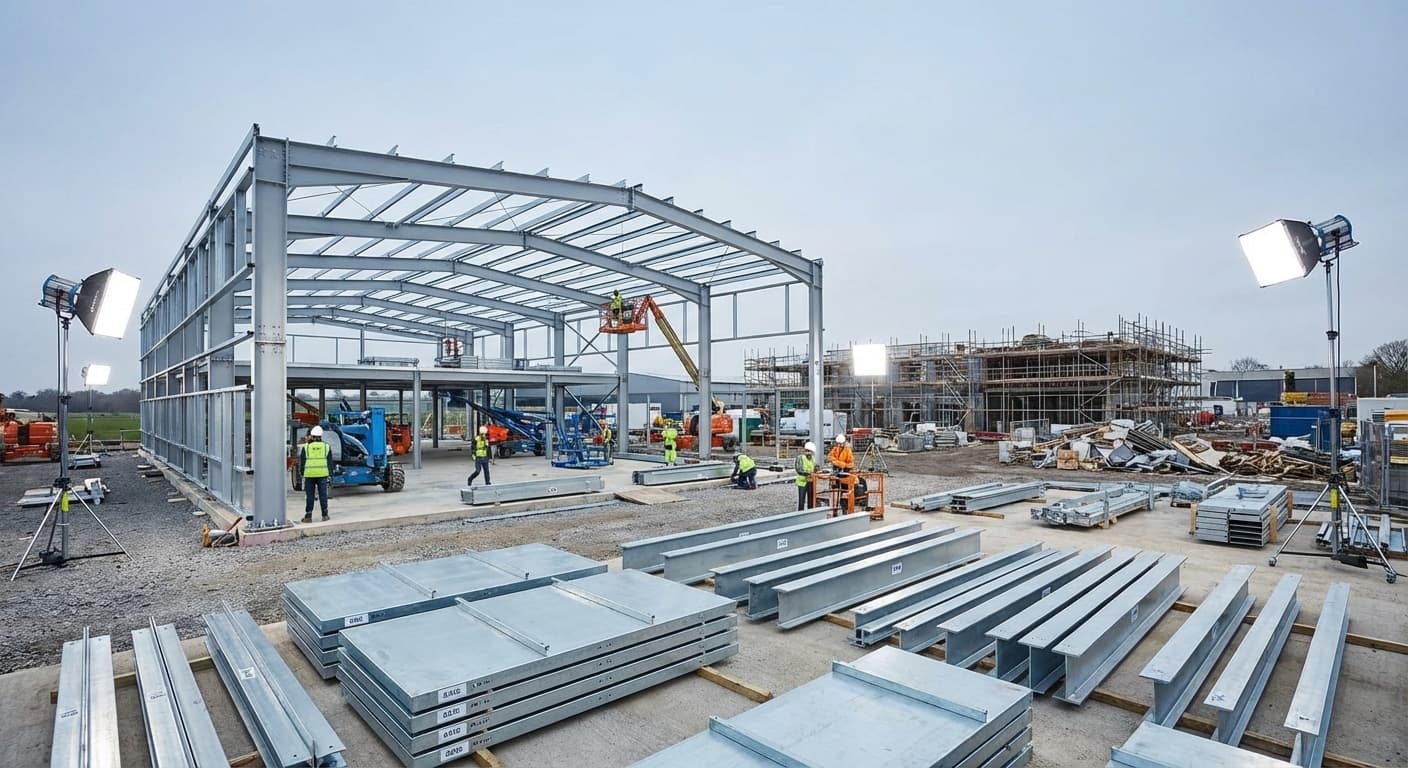

Plan your 2026 prefab steel build with confidence using our cost and timeline data so you can budget accurately and move in months sooner. You'll lock the price up-front, cut total ownership costs by up to 50 percent, and collect rent or productivity gains while traditional projects are still pouring concrete.
2026 Prefab Building Prices & What Controls Them
Build bigger and your per-square-foot costs drop significantly–a 10,000 sq ft warehouse runs $20-$45/sq ft depending on your choices for insulation, height, and doors.
Price-per-Square-Foot for 5 Popular Sizes
When you're budgeting for steel, the math works in your favor–the bigger you build, the less you pay per square foot. That 600 sq ft workshop you need for equipment storage?
You're looking at $11,000-$16,000 turnkey, or about $18-$27/sq ft, because fixed costs like engineering and delivery pack into a smaller footprint. [1] Jump to 900-1,000 sq ft–perfect for farm storage or a starter retail space–and you'll see $16-$20/sq ft for the kit, giving you more building for your dollar. [1] Your mid-size projects make the economics even clearer: that 5,000 sq ft equipment hangar, feed storage facility, or light industrial bay runs $97,300-$142,000 fully erected, dropping your cost to $19-$28/sq ft with site work and assembly wrapped in. [1] Need 10,000 sq ft for warehouse or distribution? You're in the $200,000-$450,000 range installed ($20-$45/sq ft), with the spread depending on your insulation needs, clearance height, and door count–all choices you control. [1] Go big with 15,000 sq ft–ideal for aviation hangars, multi-bay
Timeline: How Fast Can You Move In?
Move from contract to occupancy in 4 to 8 weeks for smaller structures, compared to 8 to 14 months with traditional construction.
Design-to-Delivery Schedule in 5 Steps
Your prefab steel building goes from contract to occupancy in 4 to 8 weeks for smaller structures, or 3 to 6 months for larger commercial and industrial builds. Traditional construction? That's 8 to 14 months minimum. [4] [4] The speed comes from smart process design, not cut corners. Step one: design and engineering. You start with a discovery call, then get detailed drawings, structural calculations, and permit packages if needed. Total time: 1 to 2 weeks. [4] Step two: permitting.
This runs parallel to other work when possible. While your local officials review plans, the factory starts production on approved elements–no waiting around. [4] Step three: factory fabrication. Your panels, frames, doors, and roofing components get cut, welded, and assembled indoors. No weather delays, no site surprises. [4] This takes 2 to 4 weeks for standard commercial builds, or 6 to 12 weeks for larger Step four: site preparation. Here's where you save serious time. Foundation work, utility rough-ins, and grading happen while your building gets built in the factory.
That overlap cuts months off your schedule. [4] [4] Step five: delivery and assembly. Trucks arrive with your completed components. The frame goes up in days, not weeks. Mechanical, electrical, and HVAC connections take another 1 to 3 days. [4] Your farm equipment hangar or industrial warehouse? It's operational before a traditional contractor would finish pouring the foundation.
On-Site Assembly: Days vs. Weeks
With your foundation ready and permits in hand, assembly time depends on two things: building size and crew experience. Small workshops, garages, or carports go up in 3-5 days with an experienced crew. The clear-span pre-engineered frame arrives ready to assemble–no cutting, no custom fabrication. [5] Standard enclosed garages with roll-up doors, walk doors, and windows take 1-2 weeks.
The extra days? That's panel layout, trim alignment, and flashing details–not structural complexity. [6] Agricultural buildings with clear-span equipment bays take a few days to three weeks, depending on bay count. Mid-size commercial structures (50,000-100,000 sq ft) typically go up in 2-4 weeks. [5] Two things can stretch your timeline: weather and crew experience.
High winds or rain stop crane work cold. And crews familiar with your specific building system work significantly faster than general contractors figuring it out as they go. [6]
Prefab Buildings vs. Traditional Build: Side-by-Side
Cut your construction timeline by 30-60% with prefab steel and lock your price before production starts, eliminating costly change orders and budget overruns.
Speed & Labor Savings in Dollar Terms
You cut your timeline by 30-60% with prefab steel. That speed saves real money. [7] Your construction loan drops by $3,000-$8,000 when you shave 3-5 months off the schedule. If you're building income property–cold storage, retail, industrial bays–you start collecting rent months sooner. [8]
The numbers back it up: Harvard tracked a 193-unit project that went modular. Timeline dropped from 24 months to 14. Those 10 months meant early rental income the traditional build would have missed completely. Plus zero cost overruns. [8]
Traditional builds run 20% longer and up to 80% over budget. Prefab? You lock your price before we start cutting steel. No change orders. No weather delays eating your budget. [8]
The labor savings stack up fast. Traditional construction needs 15-20 different trades on your site. Each one faces the same problem: the industry is short 501,000 workers. [8] With prefab steel, you need just 8-10 trades, mostly for foundation and utilities. Our factory crews stay put, work indoors, and deliver 25-30% higher productivity than field crews fighting weather. [8]
What's that worth? Factory precision saves you $15,000-$30,000 in materials alone. Add $2,000-$4,000 you don't spend hauling construction waste to the dump. [8] For your warehouse, hangar, or farm storage project, that's money back in your pocket–not budget padding.
Long-Term Maintenance & Energy Spend
Steel beats traditional construction harder each year you own it. Your annual maintenance on a 10,000 sq ft steel building? About $1,500-$2,500, or 1% of initial cost. Steel doesn't rot, attract pests, or weather like wood and concrete do. [9]
Wood and brick buildings? You're looking at $7,000-$20,000 annually–that's 2-4% of construction cost. And that's before surprises. One termite invasion in a wood building can hit $30,000. Your budget never saw it coming. [9]
Energy costs tell the same story. Our insulated metal panels cut heating and cooling by 10-20%. That's $2,000-$5,000 back in your pocket every year–double what traditional buildings save. [9] Your insurance company notices too. Steel's fire resistance means lower premiums. [10]
Run those numbers over 20 years: Your 10,000 sq ft steel building costs about $350,000 total to own and operate. The traditional alternative? $670,000 to $1.1 million. [9] That gap pays for your next building.
Customize Without Slowing Down
Lock your structural shell early, then customize interior walls, colors, and roof options while steel production keeps moving without delay.
Steel Frame Options That Add Zero Days
Your frame choice drives performance, not delays.
Interior Layouts You Can Still Change Late
Interior walls stay flexible because they don't hold up your building–the clear-span frame does that work. Move your office-to-warehouse ratio, shift the break room, add or delete a mezzanine divider. None of it touches the structural steel.
What you must lock early: column spacing, ceiling height, and exterior door locations. Change these after production starts and you don't slow down–you stop cold. [12] Late dimensional changes trigger rejected components and rework that blow both budget and timeline. [12]
The rule is simple: structural shell first, interior details later. Your foundation dimensions, connection points, and load paths need early commitment. [13] But partition walls, interior doors, and finishes? Decide those while the steel goes up. [13] That's the difference between a $500 field adjustment and a $15,000 change order–knowing what's carved in steel and what's written in pencil.
Color, Panel & Trim Choices Ready to Ship
Colors don't slow you down. Pick from 14 wall colors and 10 trim options–they all ship on the same schedule. [14] Your kit includes 26-gauge steel panels with siliconized polyester paint that won't chalk or fade, plus all the J-trim, base trim, and covers to finish it right. [14]
Standard roofs come in AZ55 Galvalume–a coating that stops rust without paint and needs virtually zero maintenance. [14] Want a colored roof to match your brand or meet municipal requirements? Choose any wall color for the roof without adding a single day to delivery. [14]
Meeting HOA guidelines? Matching your existing warehouse? With millions of standard combinations ready to ship, you get the look you need without custom delays. [15]
- Prefab steel cost drops to $16-20/sq ft once you pass 900 sq ft.
- Move-in ready in 4-8 weeks for small builds, 3-6 months for large–half traditional time.
- Factory fabrication and parallel site prep cut months off schedules.
- Steel buildings save $3k-8k on loans and start rent months earlier.
- Lifetime ownership cost for steel is ~$350k vs $670k-1.1M for wood/brick.
- Only lock column spacing, height, and door spots early; interior walls can shift later.
- https://metalprobuildings.com/how-much-do-prefabricated-steel-buildings-cost/
- https://alliedmodular.com/how-long-does-it-take-to-install-a-modular-build/
- https://moduulize.com/how-long-does-it-take-to-build-a-modular-home/
- https://nestadu.com/how-long-does-a-prefab-adu-take/
- https://www.mtnssb.com/how-quickly-can-a-metal-building-be-erected-when-done-correctly/
- https://www.eaglecarports.com/blog/how-long-does-metal-building-installation-take
- https://www.s2amodular.com/2026/01/30/modular-vs-traditional-construction-in-2026-cost-speed-roi-compared/
- https://www.mesocore.com/blog/modular-home-cost-savings
- https://www.summitsteelbuildings.com/20-year-cost-comparison
- https://trusteelbuildings.com/cost-benefit-analysis-of-steel-vs-traditional-construction/
- https://www.quicksteelbuildings.com/steel-buildings/
- https://www.base-4.com/why-modular-construction-projects-slow-down/
- https://finfrock.com/what-is-modular-construction/
- https://norsteelbuildings.com/us/buildings/metal-building-kits/
- https://www.worldwidesteelbuildings.com/steel-building-kits/