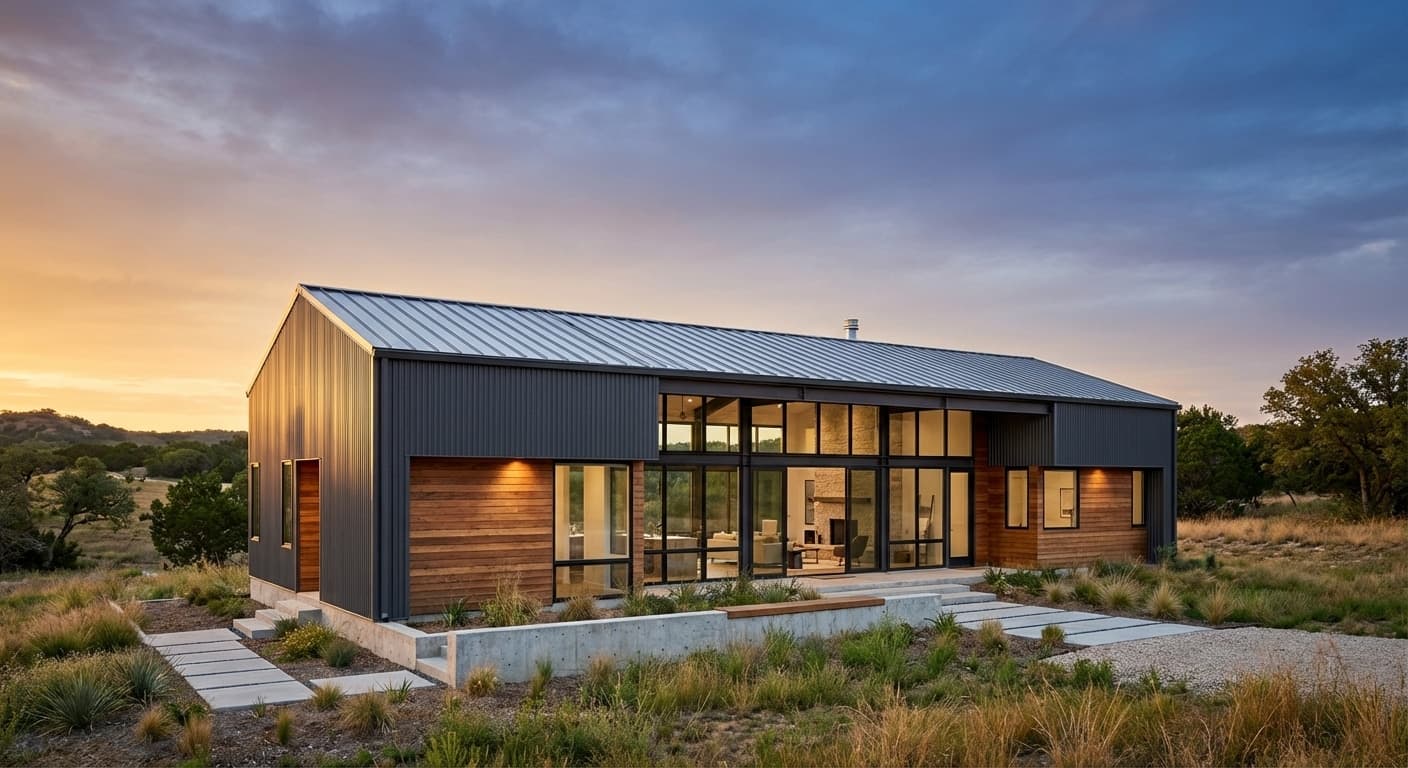

Prefab metal homes are rapidly gaining ground as a faster, greener, and up-to-30%-cheaper alternative to stick-built construction, letting owners move in months sooner while slashing labor needs, material waste, and lifetime maintenance. The article walks readers through every stage–from choosing between truss-arch or I-beam frames, designing with 3-D tools, and locking in the right supplier, to navigating zoning, climate-specific codes, and foundation engineering–so they can confidently price, permit, and personalize a home that withstands fire, termites, 150-mph winds, or heavy snow. It details how factory precision, clear-span flexibility, and expandable steel frames deliver open floor plans, future remodels, and easy vertical additions, while integrated insulation, reflective coatings, and solar-ready roofs cut energy use up to 50% and earn lower insurance premiums. Realistic cost ranges, financing options, DIY vs. professional assembly trade-offs, and 40- to 60-year warranties are laid out to show why a $200-$450-per-square-foot turnkey investment can appreciate like conventional homes yet save tens of thousands in upkeep and utilities over decades.
Why Prefab Metal Homes Are Gaining Momentum
The prefab metal building market is expanding 7.4% annually, with the U.S. market projected to grow from $41 billion to $61 billion by 2031.
Market growth and consumer demand in 2025‑2026
The prefab metal building market is booming–up 7.4% this year alone [1]. In real terms, that means more builders, homeowners, and businesses are choosing steel over stick-built construction. The U.S. market alone will nearly double from today's $41 billion to $61 billion by 2031 [2].
Why the surge? Simple math. With contractors short 439,000 workers, you need construction methods that require 30-50% less on-site labor [2]. Federal net-zero rules and corporate sustainability mandates are pushing budgets toward factory-built solutions that prove their environmental credentials and get you occupancy faster [2].
Regional demand tells the story clearly. Texas leads with nearly 14% of national demand–plenty of land, reasonable regulations, and quick permitting make steel buildings practical [2]. California's seeing the fastest growth at 7.62% annually, driven by wildfire rebuilds and strict energy codes that steel easily meets [2]. While residential projects dominate at 42% of the market, commercial applications are growing even faster [2].
Smart technology is changing what's possible. Today's metal buildings incorporate monitoring systems, optimized designs, and factory precision that traditional construction can't match [3]. For disaster-prone areas needing quick deployment with minimal site disruption, prefab steel makes the most sense [3].
Defining prefab metal homes and core components
Think of prefab metal homes as precision-engineered building systems. Your home arrives as a complete kit–steel columns, beams, wall panels, roofing, even the nuts and bolts [4]. Everything's manufactured in controlled factory conditions, then assembled on your prepared site [5].
The process breaks down into three straightforward phases: design your floor plan, manufacture the components, and assemble on-site [5]. You choose between two proven frame systems. Truss Arch Frames use triple-galvanized steel to create clear spans up to 300 feet wide–no interior columns blocking your space [6]. I-Beam frames, built from grade 55 steel, transfer loads efficiently from roof to foundation through vertical columns and horizontal beams [6].
For exterior finishes, you pick what works for your climate and style. Options range from polyethylene fabric covers that flood interiors with natural light to grade 80 steel panels in dozens of colors and profiles [6]. Your building kit includes pre-cut openings for doors and windows, plus connection points for insulation and utilities–everything designed to speed assembly and reduce on-site complications [5].
Key advantages over traditional construction
Speed matters when you're building. Prefab metal homes go up 30-50% faster than traditional construction [7]. While your foundation cures, the factory builds your components in perfect conditions–no rain delays, no material shortages [8]. This parallel process, combined with precision manufacturing, cuts your total construction costs by 20-30% [9].
Steel outlasts wood, period. No termites, no rot, no warping. Fire can't consume it. Storms can't break it [7]. Your maintenance checklist shrinks to almost nothing, and insurance companies reward that durability with lower premiums [8]. During extreme weather events, steel's ability to flex without failing keeps your building standing when others don't [9].
Energy efficiency comes built in.
Alignment with sustainability and energy‑efficiency goals
Your metal home meets today's sustainability demands without breaking your budget. Factory construction cuts waste to nearly zero–every piece is cut to exact specifications, nothing gets tossed in a dumpster [10]. Steel itself is 100% recyclable, and most new steel buildings already contain high percentages of recycled content [11].
Energy performance starts with smart design. Strategic insulation placement eliminates thermal bridges where heat escapes [12]. High R-value panels and foam systems keep your heating and cooling inside where it belongs. Metal roofing naturally reflects heat, cutting air conditioning demands significantly [12]. Together, these features reduce energy consumption by 30-50% compared to traditional homes [10].
Adding renewable energy? Steel buildings make it simple. Solar panels mount easily on metal roofs. Advanced ventilation systems integrate seamlessly [10]. And because steel structures last generations without decay, rot, or pest damage, you're not replacing materials every few decades [11].
For homebuyers and developers facing stricter energy codes, prefab metal homes check every box–efficient construction, lower operating costs, and environmental responsibility that pays dividends year after year.
Choosing the Right Metal Building Kit
Metal building kits arrive precision-cut from the factory with all structural components, fasteners, and engineered plans included, so you're assembling rather than measuring and cutting.
Overview of metal building kits for residential use
You're looking at metal building kits because you want your home up fast, built strong, and priced right. Today's residential kits come complete–steel framing, roofing, wall panels, fasteners, even the assembly instructions that make sense [13].
These aren't your grandfather's metal buildings. You can build a traditional family home, a barndominium with soaring ceilings, or a shop house that puts your workspace steps from your living room [13]. Open floor plans, vaulted ceilings, plenty of natural light–the cold, industrial look is history [14].
Your kit arrives precision-cut from the factory. That means you're assembling, not measuring and cutting. You'll have walls up while traditional builders are still framing [13]. The math is simple: metal homes run about 30% less than stick-built, and they shrug off weather, fire, termites, and mold without breaking a sweat [13].
Add proper insulation, and you'll cut heating and cooling bills while keeping temperatures steady year-round [15]. Want a workshop attached to your home? Need specific colors or finishes? Your kit adapts to how you live, not the other way around [15].
What's included in a complete prefab metal home kit
As covered in our core components overview, your kit arrives with everything structural–the bones of your building. Here's what you're getting and what you'll need to add.
In Your Kit:
- Primary frame components (columns, rafters, eave struts, cross bracing) [16]
- Secondary framing for walls and roof support [17]
- Metal roof and wall panels in your chosen style and color
- All bolts, nuts, and fasteners sized for your specific building
- Engineered plans stamped for your local codes [17]
- Framed openings for doors and windows
- Trim pieces to seal every edge and corner [17]
You'll Handle Separately:
- Foundation (we'll help you spec it right)
- Doors and windows (unless you add them to your order)
- Insulation (though
Digital design tools and 3‑D visualization
Skip the guesswork. Today's 3D design tools let you see exactly what you're building before you spend a dime.
Start with templates for homes, barndominiums, or commercial spaces–or build from scratch [19]. Drag walls, drop in windows, change roof pitch, swap colors. You're not reading blueprints; you're walking through your future building on screen [19]. These tools put you in control of dimensions, layouts, even interior placement. See it from every angle in real time [20].
Once you nail down your design, submit it for pricing from multiple suppliers with one click [19]. No phone tag, no waiting for callbacks. Pick your supplier, and their design team fine-tunes the engineering details for your site and codes [19].
The best part? You don't need CAD experience or expensive software. If you can browse the web, you can design your building [20][21]. It's how we keep projects moving fast–you make decisions with confidence because you've already seen the result.
Evaluating price, quality, and reputable suppliers
Let's talk real numbers. Kit prices run $15-20 per square foot–that's $24,000 for a 30×40, $43,200 for a 40×60, or $75,000 for a 50×100 [22]. Add foundation, delivery, and assembly, and you're looking at $24-43 per square foot turnkey [22]. Steel prices shift, local codes vary, but these ranges hold steady [23].
Picking the Right Supplier:
Know who you're buying from. Manufacturers build their own products–brokers just mark up someone else's work. Brokers mean communication delays, finger-pointing on warranties, and nobody owning your problems [23].
Check the frame quality. Real suppliers use commercial-grade I-beams made in North America. Budget suppliers push tubular frames that won't take the loads [22]. Ask to see the steel specs.
Do Your Homework:
- How long have they been building? (We've completed 1,480+ projects)
- Where's their facility? Can you verify the address? [24]
- What do customers say? Check Google Reviews for patterns, not single complaints [24]
- What warranty comes standard? Industry minimums are 10-year panels, 20-year rust-through [24]
- Can they provide stamped engineering docs for your local codes? [23]
Remember–the kit price is just the start. Factor in delivery, foundation specs, and assembly costs. Get everything in writing. A quality supplier (like us) gives you complete pricing upfront, no surprises [23].
Design Flexibility and Customization
Steel frames eliminate load-bearing interior walls, letting you redesign your space freely and save thousands on future renovations.
Architectural styles and adaptable floor‑plan options
Your prefab metal home doesn't have to look like a warehouse. Today's steel buildings deliver the architectural style you want–whether that's a modern barndominium with soaring ceilings and exposed beams, a sleek glass-and-steel contemporary design, or a mixed-material home that combines steel's strength with wood accents and concrete features [25].
The real advantage? No load-bearing interior walls. Your steel frame handles all the structural support, giving you complete freedom to design your space exactly how you need it [25]. Want to knock out a wall next year? Go ahead. Need to add a home office or expand the kitchen? Simple. This flexibility saves you thousands in future renovation costs [26].
As covered in our metal building kits section, digital design tools let you visualize your options before construction starts. But here's what matters most: you can create specialized zones that work for your lifestyle–workshop spaces that connect to living areas, integrated garages, built-in storage solutions, even mezzanine levels for extra square footage without expanding your footprint [26][27].
Whether you're planning a
Exterior finishes, colors, and roofing selections
Your metal home's exterior should match your vision–and your budget. You'll choose from over 100 color options, from standard finishes to specialty textures that mimic wood grain or deliver sophisticated matte looks [28].
Two paint systems give you control over cost versus longevity. SMP coatings cost less upfront and perform well for most applications. PVDF (Kynar) coatings cost more but come with 35-year warranties against fading and peeling–often the smarter long-term investment [29][30].
Here's a money-saving tip: lighter colors can cut cooling costs by up to 15%. They reflect more heat, keeping your home cooler and your AC bills lower [29]. Match your color choices to your region for best results–earth tones work in the Southwest, coastal blues and grays suit oceanside properties, while bold whites and blacks create striking modern designs anywhere [29].
Before you finalize your selection, get physical color samples. Screen colors never match reality perfectly, and you're making a decision that affects your home's appearance for decades [28]. Whether you prefer high-contrast combinations (dark roof, light walls) or subtle tone-on-tone schemes, your choice shapes both curb appeal and resale value [29].
Interior layout, insulation, and smart‑home integration
Your interior layout works exactly how you need it–no compromises. The clear-span advantage we discussed earlier means you design around your life, not around support posts [31]. Create that dream open-concept kitchen. Build a workshop that flows into your living space. Add a home gym without worrying about load limits [31].
Smart insulation choices make or break your comfort and energy bills. Structural Insulated Panels (SIPs) deliver the best thermal performance–they create an airtight seal that keeps your heating and cooling costs low while maintaining consistent temperatures year-round [32]. Need serious soundproofing for a home theater or recording studio? Insulated Concrete Forms (ICFs) provide both thermal efficiency and noise control [32].
Today's steel homes come ready for smart technology. Pre-installed conduit paths and low-voltage wiring mean you can add automation without tearing into walls [32]. Control your lighting, security, HVAC, and energy management from your phone–and update systems as technology evolves [33].
Pro tip: If Wi-Fi coverage matters, combine steel framing with fiber cement or engineered wood interior walls. They allow better signal propagation than all-metal interiors [32]. Add low-emissivity windows that work with daylight sensors, and you've created a home that practically runs itself while cutting energy use by up to 50% [32][33].
Future expansion and multi‑use possibilities
Your needs will change. Your metal home can change with them–without breaking the bank.
Plan for expansion from day one by requesting expandable end walls. When you're ready to grow, we simply remove the end panels, pour additional foundation, and attach your new section. No structural compromises, no engineering headaches [34]. You can expand straight out, create an L-shaped addition, or build a connected but separate structure for that home business or mother-in-law suite [36].
Limited lot size? Go vertical. Stackable designs let you double your square footage without buying more land [35]. This works perfectly for adding rental units, creating separate work-from-home spaces, or accommodating growing families [35].
The real value shows up in versatility. Start with a residential space, then add a commercial workshop later. Build living quarters above your business. Create income-producing accessory units. Your steel structure handles these transitions easily because the frame carries all the loads–interior modifications don't affect structural integrity [35].
Smart planning today saves thousands tomorrow. Include oversized door openings, strategic window placement, and universal connection points in your initial design [36]. These small additions cost little now but make future changes simple and affordable. That's thinking ahead–and it's how smart owners maximize their investment over decades, not just years.
Planning, Permits, and Site Preparation
Skip permits and risk fines, demolition, no insurance coverage, and liability–but quality suppliers provide pre-stamped drawings that streamline approval.
Zoning, building codes, and permit requirements
Before you break ground on your prefab metal home, zoning and building codes demand your attention. These regulations protect you–ensuring your structure is safe, legal, and insurable [37].
The International Building Code (IBC) sets nationwide standards, but your local area adds its own requirements [37][38]. Florida demands hurricane-ready wind ratings. California requires earthquake provisions. Your town might restrict metal structures in certain neighborhoods or HOA communities [37].
Here's what you'll need for permits:
- Detailed blueprints and site plans
- Engineered foundation designs
- Structural specifications for your area
- State-licensed engineer stamps on all drawings [38]
Quality suppliers make this easier. They provide pre-stamped engineering drawings that meet your state's requirements–saving you weeks of back-and-forth with building departments [38]. At National Steel Buildings, we handle these technical details so you can focus on your project vision.
Permit costs vary wildly: $150 in rural areas to $7,500 in major cities. Most residential projects land between $500-$2,000 [37][38].
Skip permits at your own risk. Without them, you face:
- Heavy fines and forced demolition
- No insurance coverage
- Property sale nightmares
- Personal liability for accidents [37]
For complex projects, work with contractors who know your local codes inside out. They'll handle the permit maze as part of their service [37].
Foundation choices and soil considerations
Your foundation is where precision matters most. Prefab metal buildings demand exact specifications–even minor foundation errors can compromise your entire structure [39]. That's why you need your manufacturer's precise requirements before pouring concrete [39].
Know Your Soil Your soil type determines everything:
- Clay: Strong support, but swells and shrinks with moisture [40]
- Sand/Gravel: Great drainage, less stability [40]
- Rock/Bedrock: Maximum strength, expensive excavation [40]
- Loam: Perfect balance–ideal for standard foundations [40]
- Peat: Unpredictable settling, needs special techniques [40]
- Silt: Decent drainage but erosion-prone like clay [40]
Choose Your Foundation Type Three options handle different conditions:
- Slab Foundations (3-6 inches thick)
- Best for: Stable soil, flat sites
- Cost: Most economical
- Limitation: Poor on unstable ground [39]
- Pier Foundations (pillars 8-10 feet apart)
- Best for: Varied soil types, uneven terrain
- Cost: Higher material and labor costs
- Advantage: Adapts to challenging sites [39]
- Perimeter Wall Foundations
- Best for: Large structures, high-wind areas
- Cost: Premium option
- Advantage: Maximum support and stability [39]
Weather's Long-Term Impact Your local climate affects foundations over decades:
- Freeze-thaw cycles cause shifting in cold regions [41]
- Heavy rain erodes soil and causes settling [41]
- Constant wind creates vibration and erosion [41]
Professional soil testing isn't optional–it reveals your land's true capacity and saves you from costly foundation failures down the road [41].
Utility connections and energy‑efficient systems
Your prefab metal home must meet energy codes–ASHRAE 90.1 and IECC set the baseline for heating, cooling, lighting, and water systems [43][44]. But here's the catch: your local area probably has stricter rules. Research before you dig [42].
Energy-Saving Technologies That Pay You Back Smart upgrades slash your utility bills:
- Reflective panel coatings: Cut cooling costs and extend building life [44]
- R-Boost insulation systems: Double your insulation capacity [44]
- Insulated metal panels: No gaps, no thermal bridges [44]
- Prismatic skylights: Natural light means lights off during the day [44]
Yes, these systems cost more upfront. But properly insulated metal buildings pay you back within a few years through lower energy bills. Plus, you might qualify for local green incentives [42].
Before construction starts, professionals run your specs through COMcheck software to verify code compliance. No surprises, no failed inspections [44].
Weather‑resilience and climate‑specific design
Your location dictates your building design. Prefab metal homes excel everywhere–when engineered for your specific climate challenges.
Hurricane Country (Gulf Coast, Southeast)
- Withstands 150+ mph winds
- Reinforced connections and anchoring
- Aerodynamic roofs that resist uplift [45]
Earthquake Zones (California, Pacific Northwest)
- Steel bends without breaking
- Lateral bracing distributes seismic forces
- Precise anchoring absorbs ground movement [46]
Snow Belt (Northeast, Upper Midwest)
- Engineers calculate exact snow loads
- Sloped roofs shed accumulation
- Prevents catastrophic failure [45]
Wildfire Regions (Western States)
- Non-combustible steel won't ignite
- Exceeds strict fire codes
- Zero contribution to flame spread [46]
Temperature Extremes
- Hot climates: Reflective coatings cut interior temps by 15%
- Cold regions: Vapor barriers and SIPs create thermal envelopes [47]
Flood-Prone Areas
- Elevated foundations keep you dry
- Galvanized steel resists corrosion
- No swelling, rotting, or mold growth [45]
These aren't suggestions–they're requirements. Building codes update every three years to address climate realities. The International Code Council and federal agencies keep raising the bar [46].
Working with experienced steel building professionals ensures your structure meets every regional requirement.
Construction, Costs, and Long‑Term Value
Professional installation ensures factory-trained crews get alignment and sealing right the first time, directly protecting your building's 50-plus year lifespan.
Professional installation versus DIY assembly
Your choice between DIY assembly and professional installation comes down to time, tools, and risk tolerance. DIY can save you 15-30% on labor costs if you have construction experience, the right equipment, and reliable helpers [48]. But here's the reality: professionals erect a metal frame in 1-2 days, while DIY projects often stretch across multiple weekends [48].
Professional installation means factory-trained crews who get the alignment, sealing, and structural connections right the first time–details that directly impact your building's 50+ year lifespan [48]. For smaller structures under 1,000 square feet with standard designs, DIY makes sense. Larger homes with custom features or challenging sites? You'll want professional expertise [49].
Consider your equipment needs carefully. DIY assembly requires scaffold systems, impact drivers, forklifts or cranes, and laser levels–rental costs add up fast [50]. You'll also shoulder all responsibility for structural integrity, code compliance, and warranty validation. Professional installation includes insurance coverage, permitting assistance, and full manufacturer warranty protection [49].
Many owners choose a hybrid approach: handle site prep and finishing touches yourself, but bring in experienced steel erection crews for the frame assembly. You stay involved while ensuring the critical structural work meets specifications [49].
Step‑by‑step build timeline and project management
Your prefab metal home goes from concept to completion in 6-16 weeks–significantly faster than traditional construction. Here's your realistic timeline:
Concept and Design (1-3 weeks): You define your building's footprint, use, and features. Engineers transform your vision into structural plans and fabrication drawings [51].
Fabrication (3-6 weeks): The longest phase happens in climate-controlled factories while you handle permits and site prep. Components are precision-manufactured to your exact specifications [52].
Delivery and Staging (1 week): Your building arrives organized by assembly sequence. Proper coordination here prevents costly delays [51].
Erection (1-3 weeks): Crews set columns and beams first, then add bracing, purlins, panels, doors, and windows in sequence [51].
Smart scheduling saves weeks. Start permits during engineering. Pour foundations while steel fabricates. Schedule inspections to avoid downtime. Weather, permits, and crew availability remain your biggest timeline variables [52].
Expect 6-8 weeks total for small workshops or garages (under 3,000 sq ft). Larger residential or mixed-use buildings need 12-16 weeks [52]. Want to shave time? Finalize designs early, choose pre-designed configurations over full custom, and maintain weekly coordination with all parties [52].
Cost breakdown, financing, and ROI for prefab metal homes
Let's talk real numbers. Your prefab metal home base structure runs $150-250 per square foot. Turnkey costs–including foundation, site prep, utilities, and finishes–land between $200-450 per square foot [53].
Example: 1,500 Square Foot Home
- Base structure: $225,000-$375,000
- Foundation, permits, utilities: $75,000-$90,000
- Total investment: $395,000-$555,000 [53]
That's 27% less than traditional construction–the same savings mentioned in our overview of metal building advantages [54].
Watch for Hidden Costs Site prep, foundation work, permits, delivery, and utility connections can add tens of thousands. One buyer discovered soil remediation and municipal permits added $19,000 to their budget–a 10% overrun [53].
Financing Your Metal Home Traditional mortgages work when your structure is:
- Permanently affixed to owned land
- Built on permanent foundation
- Code-compliant with factory certification [53]
Alternative financing includes construction-to-permanent loans (funds released in stages, converting to mortgage at completion), personal loans, home equity lines, or combination approaches [53].
Your Long-Term Return Metal homes appreciate like traditional homes–location and market conditions matter more than construction method [54]. As discussed earlier, energy efficiency drives significant ROI through 30-50% lower utility costs over your building's lifetime [53].
Maintenance, warranty, resale value, and manufacturer support
Your annual maintenance budget for a prefab metal home? Just 1% of initial cost–$1,500-$2,500 for a 10,000 sq ft structure. Compare that to 2-4% ($7,000-$20,000) for wood or concrete buildings [55]. As covered in our durability discussion, metal resists the termites, rot, mold, and fire that trigger $30,000 surprise repairs in traditional homes [55].
Warranty Protection That Matters Quality metal buildings come with:
- 40-year rust-through perforation coverage
- 60-year structural guarantees [56]
These aren't marketing promises–steel frames last over a century, and metal roofing maintains integrity for 40-80 years with just occasional repainting [57].
Resale Value Stays Strong Metal homes appreciate 20-30% over 20 years beyond standard property gains [55]. Future buyers value the low maintenance, energy efficiency, and design flexibility. For mixed-use properties like family operations with storage needs, well-built metal structures particularly boost property value [57].
Your 20-Year Financial Picture The numbers tell the story:
- Metal building (10,000 sq ft): $350,000 total cost
- Traditional construction: $670,000-$1.1 million [55]
That advantage combines lower initial investment, minimal maintenance, energy savings, and reduced insurance claims.
Manufacturer Support Services Reputable suppliers provide comprehensive design assistance, engineering verification, delivery coordination, and installation guidance. Professional erection crews typically guarantee their work for 90 days beyond manufacturer warranties [57].
- Prefab steel homes cost 20-30% less and erect 30-50% faster than wood.
- Factory-built steel cuts on-site labor by 30-50%, solving contractor shortages.
- Steel framing is 100% recyclable, termite-proof, fire-resistant, and lasts 60+ years.
- Energy-smart insulation and reflective roofs slash utility bills 30-50%.
- DIY saves 15-30% on labor, but pros erect frames in 1-2 days with warranties intact.
- Soil testing and stamped engineering plans are mandatory for code-compliant foundations.
- Whole-project timeline: 6-16 weeks, with fabrication and site prep running in parallel.
- https://www.globenewswire.com/news-release/2026/01/27/3226202/0/en/Prefabricated-Buildings-Industry-Report-2026-250-Bn-Opportunities-Trends-Competitive-Landscape-Strategies-and-Forecasts-2020-2025-2025-2030F-2035F.html
- https://www.mordorintelligence.com/industry-reports/united-states-prefabricated-buildings-market
- https://www.linkedin.com/pulse/prefabricated-metal-building-market-mr0uf/
- https://www.scottsdalesteelframes.com/residential/steel-frame-house-a-complete-guide-to-best-engineering-practices
- https://pebsteel.com/en/understanding-prefabricated-steel-buildings-what-are-they/
- https://www.clearspan.com/news/guide-to-metal-frame-buildings-steel-frame-structure/
- https://waldropmetalbuildings.com/the-benefits-of-metal-buildings-over-traditional-construction/
- https://armstrongsteel.com/blog/metal-buildings-vs-traditional-construction-a-comparative-analysis
- https://www.hcsteelstructure.com/pros-cons-prefabricated-steel-buildings-vs-traditional-construction/
- https://www.cecobuildings.com/blog/5-reasons-pre-engineered-metal-buildings-are-the-future-of-sustainable-construction/
- https://jagmetalsllc.com/blog/why-metal-buildings-are-the-future-of-sustainable-construction/
- https://www.fswest.com/energy-efficiency-of-metal-buildings/
- https://www.buildingsguide.com/metal-building-kits/residential/?srsltid=AfmBOooCTfjkO7hfPUPqI9ezI1aZsvbJQux_9IpUvhbj5IiWs1xBySWw
- https://iconsteelbuildings.com/the-ultimate-guide-to-steel-building-kits-from-residential-homes-to-commercial-and-agricultural-use/
- https://www.probuiltsteel.com/blog/a-complete-buyers-guide-to-metal-building-kits/?srsltid=AfmBOoqFZRESiHAlUdTTGQwdCg-jtzU2ci6Ir54U6mmN72iwuyImn8fk
- https://tripleasteelstructures.com/blog/what-are-the-basic-components-of-a-metal-building-kit
- https://www.uspatriotsteel.com/blog/whats-included-in-a-steel-building-kit/
- https://steelbuildingszone.com/whats-included-in-a-metal-building-kit-2025-buyer-expectations/
- https://www.buildingsguide.com/design/3d-metal-building-designer/?srsltid=AfmBOorG3F-FWOK9EmheE8oyimdil2XPcRsGIyNJdT9O2Q9gfgUn-JQf
- https://www.vikingsteelstructures.com/metal-building-3d-estimator?srsltid=AfmBOoqSgPsq2wAOafMoEF2jhxMjlRiNZItCtQTX6gesUkpdVoG6BJtD
- https://centralstatesco.com/resources/3d-building-designer/
- https://www.buildingsguide.com/metal-building-prices/?srsltid=AfmBOoqzZDzmDwjeSDR2K9MztWYwarn-l0RnM3O93Nx4eHmdg3MKfv7v
- https://armstrongsteel.com/blog/how-to-compare-pricing-on-pre-engineered-metal-buildings
- https://www.vikingsteelstructures.com/blog/best-tips-to-compare-metal-building-companies-before-you-buy?srsltid=AfmBOopD07LgauGhZn9kjalTc0AO5gVec0N3VP0xPbJhvRu-xwvUozG1
- https://iconsteelbuildings.com/metal-building-design-ideas/
- https://acadianaportablebuildings.com/blog/metal-building-customization/
- https://www.universalsteel.com/custom-metal-homes-a-modern-take-on-efficiency-and-style/
- https://www.westernstatesmetalroofing.com/metal-siding-colors
- https://www.buildingsguide.com/design/metal-building-colors/?srsltid=AfmBOopmeMLZ5XxA4KRzsEFyP3AcCzqjJCsOtBCcGK5JaoY5MGPE1SZj
- https://www.pac-clad.com/specs/color-availability-chart/
- https://www.metalbuildingoutfitters.com/top-5-custom-metal-building-design-options/
- https://www.signaturehomes4u.com/best-materials-for-custom-home-construction-with-smart-home-integration/
- https://www.xgzbuilding.com/news/Modular-Houses-That-Blend-Comfort-and-Efficiency.html
- https://www.buildingsguide.com/metal-building-kits/homes/?srsltid=AfmBOooMYFdA2VK9VLITGvrRhUEe8sSRnkFUhII1ZRVasY1b39UeRnsa
- https://comstruc.com/stackable-modular-buildings/
- https://www.worldwidesteelbuildings.com/blog/planning-a-metal-building-addition/
- https://www.buildingsguide.com/build/metal-building-codes-permits/?srsltid=AfmBOoo7qeG9usnUOHoo3nDpt-SlopiSgATXkKgMjJznfTj5kM0zOV5X
- https://titansteelstructures.com/metal-structure-tutorials/permits-and-building-codes-what-you-need-to-know-before-installing-your-metal-building/
- https://futurebuildings.com/blog/prefab-steel-building-foundation-guide.html
- https://www.rosehillbuilders.com/article/how-do-soil-types-impact-metal-building-installations
- https://armstrongsteel.com/blog/how-weather-and-soil-conditions-affect-the-installation-of-metal-buildings
- https://www.buildingsguide.com/build/metal-building-codes-permits/?srsltid=AfmBOopXYgwe4qEHQZraxV30vQyi64CslYe3C_ss7YhrBoEOjuXWz9JT
- https://www.americanbuildings.com/capabilities/energy-resources/
- https://www.nucorbuildingsystems.com/capabilities/energy-resources/
- https://lionbuildings.com/can-metal-buildings-withstand-extreme-weather-what-you-need-to-know/2/
- https://directmetalstructures.com/blog/how-climate-resilience-is-driving-steel-building-codes-in-the-united-states/?srsltid=AfmBOoqfytAaXWnRoMAV5F9qSPYBSXQ0yVQLEmo2HppEVXJ214UvF9Tt
- https://armstrongsteel.com/blog/weatherproofing-your-steel-structure-tips-for-extreme-climates
- https://metalprobuildings.com/diy-vs-prefab-storage-sheds/
- https://www.buyabp.com/diy-vs-contractor-built-metal-kits-which-is-right-for-you
- https://tagsteelhouseframes.com.au/steel-frame-home-kits-diy-installation-vs-hiring-a-pro-whats-right-for-you/
- https://www.alliedbuildings.com/metal-building-buyers-guide/the-steel-building-construction-process/
- https://metalprobuildings.com/pre-engineered-steel-building-timeline/
- https://metalprobuildings.com/prefab-vs-traditional-homes/
- https://prefabcatalog.com/blog/prefab-vs-traditional-construction-cost-comparison-2025
- https://www.summitsteelbuildings.com/20-year-cost-comparison
- https://steelcommandercorp.com/steel-building-home-kit/
- https://www.metalcarports.com/blog/long-term-value-metal-building/