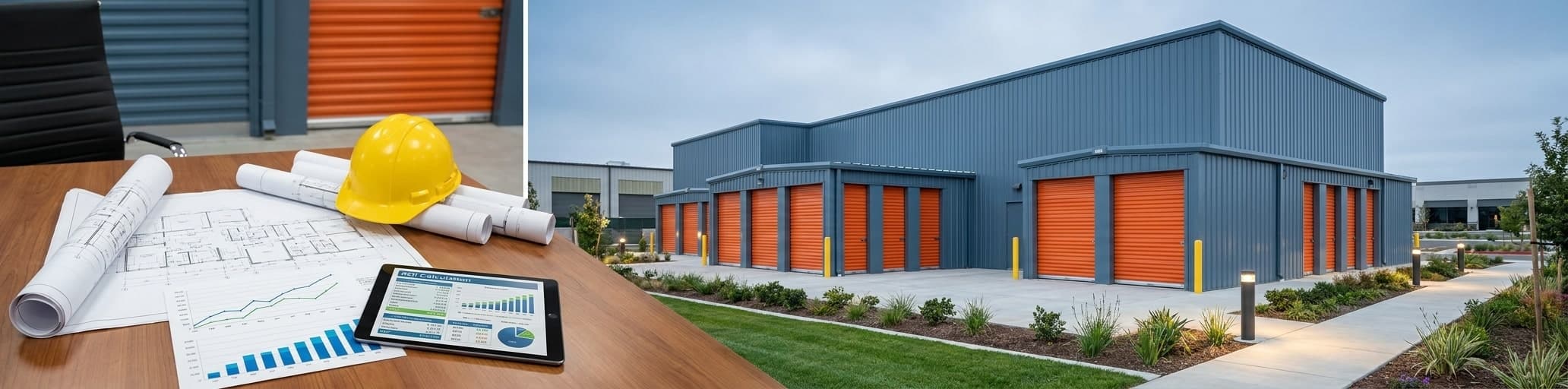

We help you calculate ROI for prefab mini storage. Key benefits include faster break-even and stronger returns.
Why 2026 Is the Break-Even Year for Prefab Mini Storage
Prefab mini storage pencils out fastest in 2026 when steel costs fall and rental rates finally recover simultaneously, compressing your payback window by months.
Market gap: 1.2 sq ft per capita vs 7+ sq ft in boom towns
The national self-storage benchmark sits at roughly 7 to 8 net rentable square feet per capita, but the spread across individual markets is dramatic–dense urban areas like San Francisco register as low as 2.7 square feet per capita, while high-usage markets such as Orlando approach 30 square feet. [1] A market below that national average is conventionally treated as undersupplied, meaning new inventory absorbs faster and operators carry more pricing power. [2] That gap between undersupplied submarkets and the national norm is precisely where a prefab mini storage building pencils out most convincingly, because faster lease-up directly compresses the payback period and strengthens your IRR from day one.
Steel price dip and rising rent create a 38-month payback window
The payback window for mini storage buildings in 2026 narrows because two separate cost curves are moving in your favor at the same time: a multi-year steel price correction and a rental rate recovery that only turned positive year-over-year in September 2025, the first uptick in nearly three years. [3] By Q4 2025, CubeSmart's new move-in rate trend had shifted from -10% year-over-year in Q4 2024 to +2.8%, while Extra Space Storage reported new-customer rental rates up more than 6% in the fourth quarter–the revenue side of your pro forma is materially stronger than it was twelve months prior. [4] The supply picture reinforces this: the construction pipeline had fallen to 2.6% of existing inventory by October 2025, which means fewer competing facilities coming online to undercut your rates or slow your lease-up. [3] When you're sourcing self storage building kits at corrected steel prices and projecting rents onto an accelerating trajectory rather than a declining one, the break-even math closes faster than in any year since the post-pandemic construction surge began.
NSB's turnkey model shortens pre-leasing by 4 months vs stick-built
With stick-built mini storage, permitting and construction pile onto each other before the first unit ever opens — a sequence that can stretch well beyond a year in many jurisdictions. [5] Prefab storage unit kits, by contrast, arrive roughly 10 to 14 weeks after order, flat-packed and ready for fast assembly, so your facility moves from concept to cash flow far faster than traditional construction allows. [5] Every month of pre-leasing you capture before a stick-built competitor opens is rent that compounds through the payback period — which is why a turnkey model that bundles engineering, kit delivery, and erection under one contract reduces execution risk as much as it reduces the calendar. [6]
NSB ROI Calculator: From Dirt to Dollars in 3 Steps
Anchor your mini storage pro forma on four market-tested inputs–land cost, unit mix, local rent, and cap rate–then stress-test occupancy and rent sensitivity before committing capital.
Input variables: land cost, unit mix, local rent, cap rate
Every ROI model for a mini storage building starts with four numbers: land cost, unit mix, local rent, and target cap rate.
Land cost sets your total capital deployed and therefore your cap rate denominator — for self-storage, that rate typically falls between 5.5% and 7.5% depending on market class, location, and asset quality. [7] Local rent drives gross income, and well-run facilities generate roughly $8 to $15 per net rentable square foot annually, while operating expenses typically consume 30% to 40% of gross income before you arrive at the NOI that feeds your cap rate calculation. [8] Get these four inputs grounded in real market data before you commit to a site, and your pro forma will hold up when a lender runs their own underwriting numbers alongside yours. [9]
Live sheet: 30×120 four-bay model at $109k kit + erection
For a four-bay, 30×120-footprint mini storage building, translating a kit-and-erection price into a complete development budget requires accounting for several additional cost tiers.
Industry benchmarks place single-story drive-up construction at $45 to $55 per square foot excluding land and site work, [11] while soft costs–engineering, permits, and construction interest–typically add another 15% to 25% on top of hard costs. [12] Operating expenses then consume 30% to 40% of gross income before you reach the NOI line that drives exit valuation at your target cap rate. [10] Plugging all these inputs into a live sheet alongside local rent comps–rather than stopping at the self storage building kit price alone–shows exactly where break-even occupancy falls before you commit capital to a site.
Sensitivity toggle: see how every $1 of rent moves IRR by 0.9%
A sensitivity toggle transforms rent from a static assumption into a testable variable, which matters because self-storage NOI is operationally sensitive — small shifts in achieved rent versus street rate flow directly into your NOI line and then multiply through cap rate valuation at exit. [13] IRR sensitivity analysis in real estate means examining how changes in key assumptions affect the overall return, so you can evaluate risk across multiple scenarios rather than anchoring to a single-point projection that may not survive contact with actual lease-up conditions. [14] Sweeping rent across a realistic range — from below current market comps to above — gives you a defensible IRR floor and ceiling before you commit capital, so the decision to move forward on a prefab mini storage building rests on a range of outcomes, not an optimistic midpoint. [13]
Building Mix That Maximizes Rent per Square Foot
Smaller units generate 2.5x more revenue per square foot than larger ones, so a balanced mix with upsell potential can boost returns without requiring higher occupancy.
5×10, 10×10, 10×20, 10×30 ratios that hit 92% occupancy fastest
Hitting high occupancy in a mini storage building comes down to unit mix calibration, not total square footage alone.
National data shows smaller units command more per rentable square foot — 5×5 units average $2.24/sf versus $0.88/sf for 10×30 units — so weighting toward 5×10 and 10×10 sizes can lift revenue even at similar occupancy levels. [15] Suburban and rural markets absorb 10×20 and 10×30 units fastest, driven by homeowners and RV or boat owners who need depth for vehicles and household overflow. [15] A range that spans all four size tiers also creates a natural upsell path, since tenants who start in smaller units often upgrade over time — improving average length of stay and stabilizing occupancy across the entire mix. [15]
Drive-up vs interior hallways: revenue difference in secondary markets
In secondary markets–suburban and rural locations where land is inexpensive and most tenants arrive by truck or trailer–drive-up mini storage buildings typically outperform interior hallway layouts on a cost-adjusted basis. [17] Interior hallway systems do command meaningfully higher rents: climate-controlled units generate premiums of 15-35% over comparably sized drive-up space, [16] but sustaining those premiums is harder where the tenant base skews toward contractors and homeowners who prioritize direct vehicle access over an enclosed environment.
Drive-up units also perform particularly well in dry or moderate climates where weather protection matters less to renters. [17] The most revenue-efficient secondary-market facilities often run a hybrid layout–drive-up rows covering most of the footprint with a smaller interior section to capture the fraction of tenants storing furniture, electronics, or documents that justify the rate premium. [17]
NSB's partition clip system lets you resize units in 90 minutes
Modular partition systems in mini storage buildings use galvanized steel panels that can be removed and reconfigured without permanent construction, letting you respond to demand shifts without a major capital outlay. [18] When 10×10 units are running near-full occupancy while 10x20s sit half-empty, a demountable partition system lets you rebalance the mix by splitting or combining bays rather than waiting out a lease cycle. [19] These panels are designed to be installed, reconfigured, or removed as storage needs change, so the downtime between layouts is measured in hours of labor rather than days of contractor time. [20] That built-in flexibility means your initial unit-mix decisions aren't permanent–you can fine-tune the configuration as actual occupancy patterns emerge rather than locking in sizing choices made purely on a pre-opening pro forma.
Tax, Insurance & Exit Strategies That Add 11% to Net ROI
100% bonus depreciation and steel's 30% insurance discount combine to reduce your first-year operating costs and strengthen NOI-based valuations throughout your hold period.
2026 100% bonus depreciation schedule for steel structures
The One Big Beautiful Bill Act permanently restored 100% bonus depreciation for qualifying property acquired after January 19, 2025, reversing a phase-down that would have cut the deduction to 20% in 2026 and eliminated it entirely by 2027. [21] For a mini storage project, components with useful lives under 20 years can be fully expensed in year one rather than stretched across decades of straight-line depreciation, front-loading the tax benefit into the same year you bring the facility online. [22] The IRS issued Notice 2026-11 in January 2026 providing interim guidance, largely preserving the existing Section 168(k) framework with updated effective dates to reflect the new law. [23] State conformity varies, so confirm with your tax advisor before assuming the full federal deduction flows through to your state return. [22]
Fire-resistance credits that cut premiums 12-18% with NSB's UL-rated panels
Steel mini storage buildings fall under ISO Classification 3 (Noncombustible), which typically generates insurance discounts of about 30% compared to wood-frame (Classification 2) structures — the direct result of steel framing that can't combust and add fuel to a fire, lowering the insurer's projected replacement cost. [24] That base classification is the floor, not the ceiling: adding sprinkler systems on top of the noncombustible structure can push premiums down further, since insurers price each fire-mitigation layer separately. [25] When you're building out your operating expense assumptions, the fire-resistance advantages of a steel storage building reduce one of your largest recurring line items, which flows straight into NOI and strengthens your cap-rate valuation every year you hold the asset. [26]
Sale-leaseback and REIT exit: how steel framing boosts cap-rate valuation
When you exit a mini storage building through a sale-leaseback or REIT acquisition, the buyer's cap rate directly sets your price — a half-percentage-point move on a $500,000 NOI facility represents nearly $1 million in valuation difference. [7] Steel-framed assets attract the institutional buyer pool that trades at tighter cap rates, because buyers with access to lower-cost capital pay more per square foot for higher-quality assets with lower projected capital expenditure. [27] That buyer pool remains active: Extra Space Storage alone deployed $826 million across 69 acquisitions in 2025, with development projects in its pipeline targeting stabilized yields around 8%. [4] Keeping ongoing CapEx low through steel's durability protects your NOI from the maintenance drag that causes buyers to widen their cap rate assumptions at underwriting — and every point of cap rate compression at exit multiplies across your entire income stream. [7]
- Prefab mini storage breaks even in 2026 due to steel price correction and rental rate recovery
- National self-storage benchmark is 7-8 net rentable square feet per capita
- Prefab storage units arrive 10-14 weeks after order, reducing construction time
- Unit mix calibration is key to high occupancy, with smaller units commanding more rent per square foot
- Steel mini storage buildings qualify for 100% bonus depreciation, front-loading tax benefits
- Steel framing reduces insurance premiums by 30% compared to wood-frame structures
- Low maintenance costs of steel-framed assets attract institutional buyers and compress cap rates
- https://www.stortrack.com/news/how-big-is-the-self-storage-industry-in-the-us/
- https://selfstorage.loan/investor-glossary/key-metrics-in-self-storage/
- https://www.steelbluebc.com/news-posts/self-storage-industry-2025-recap-and-2026-outlook
- https://skyviewadvisors.com/q4-2025-self-storage-industry-report/
- https://boxwell.co/building-costs-for-storage-units-traditional-vs-relocatable/
- https://advancedsteelllc.com/blog/roi-of-portable-mini-storage-units/
- https://www.insideselfstorage.com/facility-value/understanding-the-self-storage-cap-rate-how-its-calculated-and-how-it-impacts-facility-value
- https://myrealestatecalculator.com/self-storage.html
- https://toolcr.com/self-storage-unit-investment-roi-calculator/
- https://propertymetrics.com/self-storage-proforma-template/
- https://www.trachte.com/resources/cost-calculators/
- https://www.insideselfstorage.com/self-storage-construction/building-a-dependable-repeatable-construction-budget-for-your-self-storage-projects
- https://self-storageanalysis.com/self-storage-investment-analysis
- https://www.smarthelping.com/2023/04/irr-sensitivity-real-estate-template.html
- https://listselfstorage.com/us/industry-insights/how-to-optimize-your-self-storage-unit-mix/
- https://forgebuildings.com/is-climate-controlled-self-storage-worth-the-investment/
- https://boxwell.co/drive-up-or-indoor-storage/
- https://psllimited.co.uk/self-storage-partition-systems-for-maximum-space-efficiency
- https://justmcp.co.uk/self-storage-unit-construction/self-storage-partition-walls/
- https://sasprojects.com/partitioning-systems-for-self-storage/
- https://gensteel.com/resources/infographics/steel-building-tax-advantages-
- https://warrenaverett.com/insights/one-big-beautiful-bill-bonus-depreciation/
- https://www.calt.iastate.edu/post/bonus-depreciation-updates-2026-filing-season
- https://www.rhinobldg.com/blog/why-steel-building-insurance-costs-less
- https://bullbuildings.com/metal-building-insurance-what-you-need-to-know/
- https://futurebuildings.com/blog/is-insurance-cheaper-for-commercial-metal-buildings.html
- https://www.reliant-mgmt.com/self-storage/self-storage-cap-rate-target