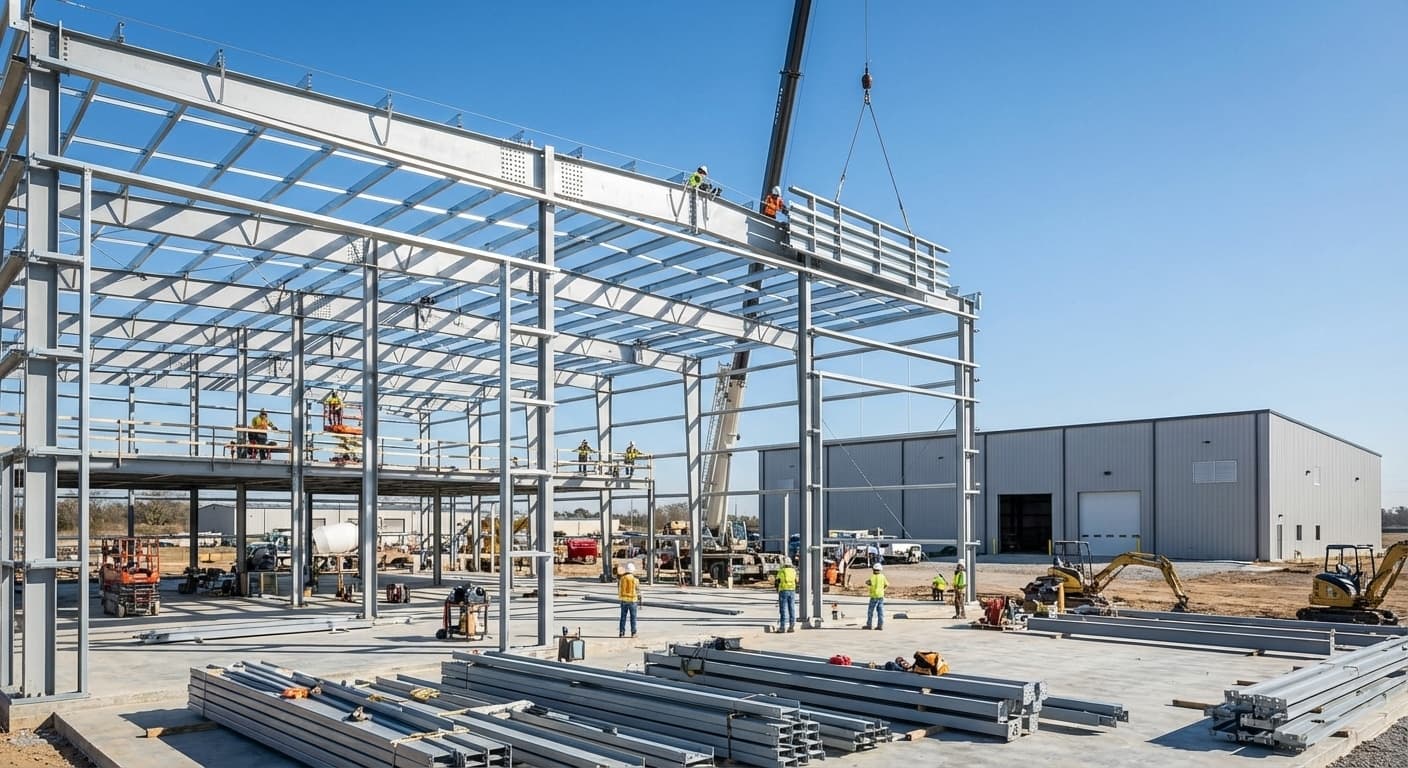

We help you compare true 2026 costs so you can lock steel pricing before tariffs push it higher. Over fifteen years you will keep up to $22,000 in your pocket thanks to faster install, zero pest or rot bills, and lower insurance.
2026 Cost Comparison: Prefab Steel vs Wood Building Kits
Steel building kits cost just 1% more than wood framing overall, but save you 50% on installation labor and eliminate decades of repainting and pest control expenses.
Up-front material and labor price snapshot
You'll pay $15-$20 per square foot for steel building kit materials–about $24,000 for a 30×40, $43,200 for a 40×60, and $75,000 for a 50×100 structure. Add the concrete slab, delivery, and installation, and your turnkey investment lands between $24 and $43 per square foot. [1] That's where national buying power matters–we leverage volume purchasing to keep your material costs at the low end of that range.
Wood looks cheaper at the framing stage, but the detail most buyers miss: structural steel panels cost just 5% more than wood trusses. Since framing is only 20% of total construction cost either way, you're looking at a 1% difference on your overall project. Where steel saves you real money is labor. Your installation runs up to 50% less than wood framing because our prefabricated members arrive ready to connect–no measuring, no cutting, no fitting adjustments eating up contractor hours. [2]
Three hidden wood costs that surface after year 3
Repainting cycles. Year three hits, and you're looking at paint failure on any wood structure facing real weather. Minor checking starts on south-facing walls. By year five, you need a full exterior repaint–$1,200 to $2,500 for a contractor, or your entire weekend if you DIY. [3] Then the cycle repeats. Meanwhile, your neighbor's steel building still sports its original factory finish. In the Southeast or Gulf Coast, you'll hit that repaint threshold by year four. [4]
Pest control and structural rot. Budget $200 to $400 every year for termite treatment if you're in the Southeast, Gulf Coast, or Southwest. Skip it? By year eight you're writing checks for structural repairs–$800 to $1,500 for minor damage, much more if it spreads. Formosan termites along the Gulf can compromise your load-bearing framing in three years without showing a single surface symptom. [3] Steel? Termites can't eat it. Moisture won't rot it. That line item disappears from your budget entirely. [4]
Roof replacement and insurance premiums. Year twelve brings the big hit: $4,000 to $8,000 for new shingles on your wood structure. [3] But the ongoing drain is insurance. Steel gets classified as non-combustible, wood as combustible. That classification difference saves you 5-15% on premiums every single year. Over 15 years of ownership, you pocket $750 to $2,250 just from lower insurance rates. [3] Add it up: wood building owners spend $8,000 to $22,000 on maintenance by year fifteen. Steel owners? Under $600. [3]
Forecasting 2026 price indexes for steel and lumber
Steel and lumber prices are heading opposite directions in 2026–and that split matters for your timing. Metal products jumped 16.6% year-over-year, with trim alone up 61.7%. [7] Section 232 tariffs started it. Domestic mills kept raising prices through 2025 into 2026. [6]
What tightens the squeeze: major fabricators are booked through late 2026. Capacity is maxed. Lead times stretch longer while prices climb higher. Your window to lock current pricing is closing. [6]
Popular Building Types & Standard Kit Prices
Steel agricultural structures cost just 1-3% annually to maintain, while wood barns demand endless rot repairs and pest treatments.
Garages, workshops and RV storage kits
Your garage, workshop, or RV storage needs dictate your price point–and the spread is wider than you might expect. Need basic equipment shelter? Open-sided carports run $8.20 to $12.50 per square foot, averaging $9.52. [8] Want full enclosure with doors and windows? You're looking at roughly double that rate. As noted in our cost comparison above, a 30×40 enclosed workshop kit hits around $24,000 for materials alone. [9] Your roof choice impacts both price and performance. Regular (rounded) roofs cost least. Boxed eave A-frames sit mid-range. Vertical panels cost most–but shed water and snow fastest, making them worth every penny for year-round equipment storage. [8]
Where you build changes everything. Florida? You need 26-gauge sheeting instead of standard 29-gauge for wind resistance. Minnesota? Your frames must handle 50 psf snow loads versus the standard 35 psf. These code requirements shift your bottom line–know them before you compare quotes. [8]
Farm, barn and equestrian structures
Agricultural buildings demand more–and cost accordingly. Basic hay storage starts at $17 per square foot. Need ventilation for livestock or clear spans for equipment? You're looking at $20 per square foot. [10] Your operation creates moisture–hay storage, livestock breathing, equipment washing. Wood absorbs it. Steel doesn't. That's why steel ag structures average just 1-3% of construction cost in annual maintenance, while wood barn owners face endless rot repairs and pest treatments. [10]
Yes, turnkey installation lands in that same $24-$43 per square foot range mentioned earlier. [11] But you're buying expansion flexibility too. Need to add an equipment bay next year? Your steel frame accepts additions without major structural rework. Try that with a wood post-and-beam barn. [10]
Barndominium shells and hybrid home packages
Barndominium shells sit at a different price point than pure agricultural or commercial kits because they're engineered to meet residential code requirements–insulation values, egress windows, load paths for interior walls–while still using the same pre-engineered steel framing. Kit shell pricing runs $20-$35 per square foot for the bare structure, and $30-$50 per square foot once the prefabricated package includes all exterior components. [12] That's the starting point before foundation, mechanical systems, and interior finishes. Full turnkey costs with a contractor land at $60-$160 per square foot, compared to $150-$400 per square foot for a traditionally stick-built home of comparable size. [14] The gap is real: a 2,400-square-foot barndominium shell assembled with a kit and finished professionally typically lands well below what the same footprint costs in conventional wood-framed construction.
The price advantage comes directly from the build process. Prefabricated components arrive cut to spec. Your crew connects them–no measuring, no waste, no delays. Most barndominium builds wrap in three to six months total. [13] That factory precision creates a tighter envelope too. Install your insulation properly, and you'll see utility bills 50% lower than comparable stick-built homes. [13]
Need dual-purpose space? Living quarters on one end, workshop on the other? Hybrid packages handle both. The same clear-span framing that keeps warehouses column-free works just as well for your open-concept living area or attached equipment bay. These structures handle 150 mph winds and last 50 to 150 years with basic maintenance. [13] [14] You get a home and working facility in one package–without the endless repair cycle that plagues wood barns.
What's Included in a National Steel Building Kit
Every component arrives pre-formed, pre-punched, and pre-welded so your crew assembles engineered pieces rather than cutting and fitting raw materials.
Primary framing, secondary members and fasteners
Your steel building kit arrives as a complete structural system, not a pile of raw materials. The primary framing–steel columns, rafter beams, x-bracing, and endwall frames–forms your building's main skeleton. [16] These components come pre-formed and clearly marked, whether you've chosen hot-rolled or cold-formed steel–each piece pre-punched and pre-welded so your crew connects engineered components instead of cutting and fitting raw stock. [15]
Secondary members complete the framework: girts run horizontally to support your wall panels, purlins span the roof to carry roofing loads, and base angle plates anchor everything to your concrete slab. [16] Door and window openings? Already framed into this secondary structure at the factory to your exact specifications–no field modifications needed when you order the right dimensions from the start. [15]
Your kit includes every fastener needed: high-strength structural bolts and nuts for primary connections, self-drilling screws for panel attachment. [16] The result? A 2,500-square-foot building goes from delivery to weathertight shell in about three days with a four-person crew–that's the efficiency of pre-engineered precision. [17]
Sheeting, trim and engineered foundation drawings
Your roof panels and wall cladding arrive factory-cut to your building's exact dimensions–no on-site trimming needed. You choose the panel profile (R-panel, standing seam, or others), roof pitch, and surface coating like Galvalume or factory-applied color finishes. [15]
Trim pieces seal every transition point: edges, corners, and panel joints stay watertight and pest-proof. We ship longer trim pieces–often 20 feet 3 inches–to minimize seams and create a tighter building envelope. [19] For climate-controlled warehouses or agricultural facilities, fewer seams mean lower HVAC costs and better interior conditions.
One detail many buyers overlook: engineered foundation drawings. These aren't generic templates–they're licensed-engineer-stamped plans showing exact anchor bolt layouts, slab thickness requirements, and load paths calculated for your specific site's wind, snow, and seismic conditions. [15] [19] Your building department needs these stamped drawings for permit approval, and your concrete contractor needs them to pour the slab correctly.
One critical detail: the foundation drawings come with your kit, but the concrete slab doesn't. Your concrete contractor pours based on those anchor bolt layouts, and any mismatch between plans and pour creates assembly headaches. [15] [18] When evaluating suppliers, confirm they provide site-specific stamped drawings–it's the difference between sailing through permits and getting stuck in revision cycles.
Optional add-ons: insulation, doors, windows, gutters
Four add-ons make the biggest difference in your building's performance and operating costs: insulation, doors, windows, and gutters. Yes, each increases your upfront investment, but retrofitting later costs more time and money–if it's even practical. [20]
Insulation delivers the highest return for climate-controlled spaces. It determines your HVAC sizing, monthly energy bills, and whether you'll battle condensation issues. For warehouses, workshops, or agricultural facilities with temperature-sensitive storage, insulation isn't optional–it's operational necessity.
Doors and windows need deciding upfront. Walk doors, overhead doors, and window openings are pre-engineered into your kit at the factory. Change your mind after delivery? You're looking at field modifications that cost extra and potentially compromise your building envelope. [21] Get your door and window placement right the first time.
Gutters and downspouts cost less but protect more than you'd expect. On larger buildings, uncontrolled roof runoff undermines foundations and creates drainage problems. The investment is minor compared to fixing water damage later.
Budget tight? Aesthetic upgrades can wait. But insulation, proper doors and windows, and water management protect your investment from day one. [21] Prioritize function over finish–you can always add cosmetic touches later without compromising structural integrity.
Pre-Engineered Steel Advantages in 2026
Pre-engineered steel's clear spans up to 300 feet eliminate interior columns, letting you reconfigure your facility from storage to production without structural modifications.
Clear-span strength with zero load-bearing walls
Clear-span construction means the roof load transfers entirely through the exterior walls and steel trusses–no interior columns anywhere on the floor plan. Pre-engineered steel frames support clear spans up to 300 feet, which is why this framing type dominates warehouses, aircraft hangars, indoor arenas, and large agricultural storage facilities where a single misplaced column would block equipment movement, interrupt workflow, or break up the usable floor area. [22] The practical difference shows up immediately in operations: forklifts, tractors, and wide-body aircraft can maneuver without obstruction, livestock pens can be arranged to optimize airflow and access, and production lines can run the full depth of the building. [23] What commercial and agricultural buyers often underestimate is the long-term planning value.
A clear-span structure built for equipment storage today can be reconfigured as a production facility, training space, or event venue tomorrow–without structural modifications, because there are no interior load paths to work around. That reconfigurability is built into the system from day one, not retrofitted later. [23]
30-year rust perforation warranty and lower insurance
The insurance math on steel versus wood is no longer a marginal difference–it's a line item that changes your project ROI.
Most US carriers classify pre-engineered steel structures as noncombustible, placing them in a fundamentally different risk tier than wood-framed buildings, which are rated combustible and priced accordingly. [24] In practice, non-CAT wood-framed projects are currently running $0.30-$0.40 per $100 of insured value, while steel-framed projects–including our noncombustible-rated kits–are coming in closer to $0.15-$0.20 per $100 of insured value. [25] In high-peril CAT zones–coastal markets exposed to hurricanes, tornado corridors across the Midwest, and wildfire-prone regions in the West–that spread widens further, because underwriters are explicitly pricing combustion risk in markets where catastrophic losses on wood-framed projects have already reset their actuarial tables. [25] For commercial and agricultural owners who hold a building for ten or more years, a 30-50% reduction in annual premiums doesn't just offset a portion of the steel premium–it restructures the pro forma entirely.
One commercial developer, after seeing builder's risk pricing come back on a cold-formed steel project, immediately began reviewing their pipeline to shift more projects to steel framing specifically because the insurance delta changed the ROI calculation for their full hold period. [25] The same classification advantage that lowers builder's risk during construction carries over to permanent property insurance once a certificate of occupancy is issued–meaning the savings compound every year the building is in service, not just during the build window. [25]
Quick DIY assembly that cuts contractor hours
Prefabricated steel kits are purpose-built for reduced on-site labor–every primary column, rafter beam, and panel arrives factory-cut, pre-punched, and marked for position, so assembly is closer to connecting engineered components than building from raw stock. That precision eliminates most of the measuring, cutting, and fitting that drives contractor hours on wood-framed projects, and it's what makes a genuine DIY build feasible for property owners who are handy, have access to basic tools, and can organize a crew of helpers.
For commercial, agricultural, or industrial buyers who want to reduce labor spend without taking on the full framing themselves, the hybrid approach is worth serious consideration: handle site prep, concrete finishing, and interior details yourself, then bring in a specialist erector only for the steel frame–capturing the highest-cost savings while keeping the most technically demanding portion of the build in experienced hands. Because components slot together with documented tolerances rather than field judgment, smaller crews can move through assembly faster than comparable wood framing, which directly compresses both the project schedule and the total contractor invoice.
- Steel framing costs only 1% more than wood overall but saves 50% on labor.
- Wood needs $8-22k in maintenance by year 15; steel needs < $600.
- Steel's non-combustible rating cuts annual insurance 5-15%, saving $750-2,250 over 15 years.
- Prefab steel kits go weathertight in ~3 days with a 4-person crew.
- Clear-span steel frames up to 300 ft eliminate interior columns, maximizing usable space.
- https://www.buildingsguide.com/metal-building-prices/?srsltid=AfmBOopZya3TyI7SHLDnLC-RQLbt4LKvpMTmt6dAUgrhTsOSekxR-Xek
- https://bulldogsteelstructures.com/blog/wood-vs-steel-buildings/
- https://garagebuildings.com/steel-garage-vs-wood-garage-an-honest-2026-breakdown
- https://americansteelinc.com/blog/steel-building-vs-wood-concrete/
- https://www.nahb.org/blog/2026/01/building-material-price-growth
- https://interactive.usa.skanska.com/2026-winter-construction-market-trends
- https://eyeonhousing.org/2026/03/building-material-price-growth-remains-entrenched-above-3/
- https://alansfactoryoutlet.com/metal-building-prices/?srsltid=AfmBOooKg96FBnXeJkXr-P10z7T3EyicZPdAyvRBYONdNplkFV1OXKrW
- https://www.buildingsguide.com/metal-building-prices/?srsltid=AfmBOorrop1VaAicvSVRALyhipH3oYIlH2BNUSJLMsvEQ-YWl0sj4khb
- https://www.steelcobuildings.com/steel-agricultural-buildings-prices/
- https://www.buildingsguide.com/metal-building-prices/?srsltid=AfmBOoqpWPeGaVBwiusMsuw9GUZL4PAyg2ggrJUbUzosCEdq2FhtyvHq
- https://alansfactoryoutlet.com/blog/barndominium-cost/?srsltid=AfmBOoohU50UGAxlfD9_WQKOYcp_xB5SHNbMLsIYTZDrsYwXaeYkXAsY
- https://www.angi.com/articles/barndominium-cost.htm
- https://www.houseplans.com/blog/is-it-cheaper-to-build-a-house-or-barndominium-in-2025
- https://www.uspatriotsteel.com/blog/whats-included-in-a-steel-building-kit/
- https://www.rhinobldg.com/blog/what-is-a-metal-building-kit
- https://www.buildingsguide.com/metal-building-kits/?srsltid=AfmBOoqI8bLWmH7cuGcHo4POymCU7VDK39-cu911h2DS_3AYqyp9Dhdp
- https://www.buildingsguide.com/metal-building-kits/?srsltid=AfmBOoru5GndSD-fT4-q8KCEqIBaIOIVbAYWOU_ghrbTIBaDoPFkwG4b
- https://pbsbuildings.com/metal-building-kits/
- https://metalprobuildings.com/how-much-do-prefabricated-steel-buildings-cost/
- https://prometalbuildings.com/metal-building-cost-2025/?srsltid=AfmBOorpFENNlX0L_qZVwQwGRxTpxpQ2-QuVBe54wZfu6yIUEmoHUcSc
- https://www.buildingsguide.com/build/advantages-of-pre-engineered-steel-buildings/?srsltid=AfmBOoqutXVDyhNR9e4IAj83S2G1bVY4ismtAIrsUOaOjp9oNaa5kSsg
- https://midweststeelerector.com/blog/f/clear-span-metal-buildings-why-open-space-matters
- https://miracletruss.com/why-metal-buildings-can-decrease-the-cost-of-your-insurance-premium/
- https://buildsteel.org/technical/fire/insurance-costs-are-re-shaping-construction-choices-and-the-data-speaks-for-itself/
- https://www.buyabp.com/diy-vs-contractor-built-metal-kits-which-is-right-for-you
- https://www.advancedbuildingcorporation.com/blog/pros-cons-pre-engineered-metal-buildings/
- https://www.boomandbucket.com/blog/best-metal-building?srsltid=AfmBOooFJzq0u3I5hBeiq-PNhL3GUBg4ZDgTo_ijXHWi-UJi8B6JuiDc