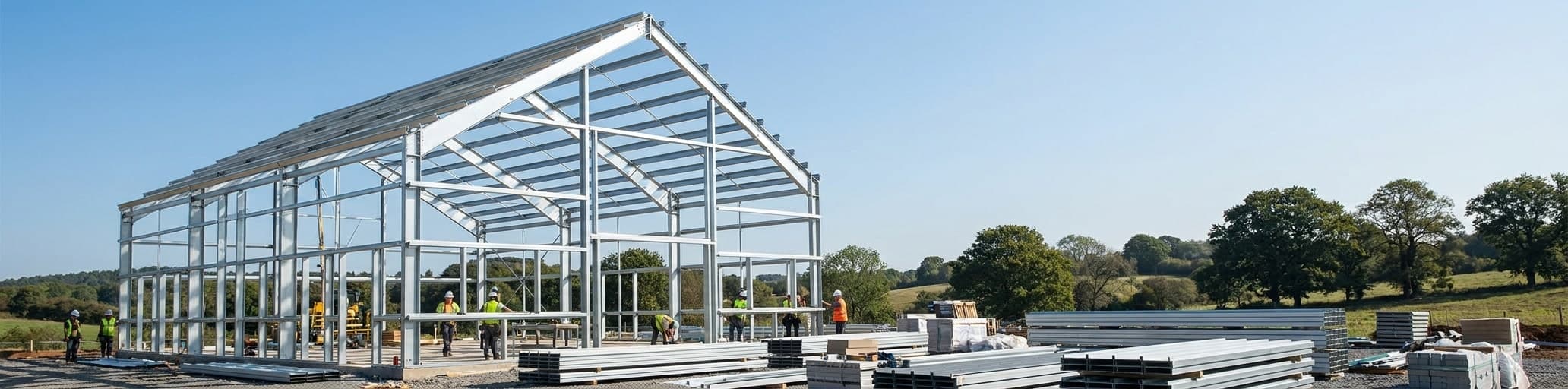

We help you understand prefab worship buildings. You save time and money with our turnkey solutions.
What Is a Prefab Church Building in 2026?
Prefab church buildings ship factory-engineered steel components ready for bolt-up assembly, cutting construction time by up to 30% while reducing costs 10-20% versus traditional wood-frame sanctuaries.
Definition: Pre-engineered steel worship shells vs. traditional sanctuariesA prefab church building starts as a set of factory-engineered steel components–primary frames, purlins, roof and wall panels–designed to your exact footprint before a single shovel breaks ground. Those components ship to your site ready for bolt-up assembly, with no on-site cutting or welding required.
A traditional sanctuary, by contrast, is built piece by piece on location using wood framing, concrete masonry, or structural brick, with each trade sequencing behind the last. That site-dependent process exposes your project to weather delays, skilled-labor gaps, and cost overruns that compound week by week. [1] The structural difference matters for ministry budgets: pre-engineered steel worship shells typically cost 10-20% less than conventional construction for low-rise projects, and industry data shows they can reduce construction time by up to 30%–weeks your congregation doesn't spend in a parking-lot tent or rented hall. [2] Steel is also non-combustible, which directly lowers your insurance premiums compared to wood-framed sanctuaries. [3] The core trade-off is simple: traditional construction gives you total design freedom from day one, while a pre-engineered metal prefab building gives you a faster, cost-effective shell you can finish to any aesthetic–brick veneer, stone facade, steeple included–once the structure is watertight and secure.
Key components NSB delivers under one contract
Most church building committees get burned the same way: they receive a steel kit quote, present that number to the congregation, then discover mid-project that the kit covers only 15-35% of the total build cost. [4] The rest–foundation, insulation, interior buildout, HVAC, electrical, and plumbing–arrives as a separate set of contracts, separate vendors, and separate headaches you have to coordinate yourself.
The NSB turnkey model collapses all of that into a single contract.
That means your primary rigid frames (factory-welded columns and rafters that bolt together on site), secondary framing members like roof purlins and wall girts, 26-gauge steel roof and wall panels, color-matched trim, flashing, gutters, and all fasteners ship as one engineered package. [4] Beyond the steel shell, the contract also covers the foundation design, insulation system, interior framing and finishes, HVAC sized for your actual occupant load rather than just square footage, full electrical service with circuits for audio-visual and stage lighting, and assembly-occupancy-compliant plumbing including ADA restrooms and baptistry rough-in. [4] Every set of engineer-stamped erection drawings–including the anchor bolt plan your foundation crew needs weeks before steel arrives–is included too, so there's no outside architect to hire and no permit-drawing gap to fill. [4] You get one point of contact, one schedule, and one number that reflects what your church building actually costs to occupy–not just what the steel weighs.
Why congregations now choose steel over wood or masonry
The deeper case for steel over wood or masonry comes down to what happens after you move in. Clear-span steel framing eliminates interior support columns, giving your sanctuary unobstructed sightlines and flexible seating arrangements that wood trusses or masonry bearing walls simply cannot match without expensive structural workarounds. [6] That openness also makes it practical to reconfigure interior spaces as your ministry evolves–removing partition walls, extending a stage, converting classrooms into fellowship overflow–without touching the structural frame itself. [7] Masonry cracks under seismic shifts and heavy snow loads; wood develops rot and termite damage that compound silently over decades of heavy congregational use.
Steel resists all of it, engineered to meet hurricane-force wind ratings and seismic zone requirements without the six-figure repair bills that can sideline a church building mid-ministry. [5] The maintenance gap is where 20-year budgets diverge most sharply: no painting cycles, no pest treatments, no structural deterioration to schedule around. Every dollar those line items would have consumed can go toward programs, missions, or your next campus phase instead–which is exactly the kind of long-term prefab steel vs. wood cost advantage that building committees tend to underestimate until they've owned both. [6]
2026 NSB Turnkey Timeline: Dirt-to-Door in 120 Days
Running design lock-in, permit filing, and site prep in parallel–rather than sequentially–cuts your church building timeline from nine months to 120 days.
Week-by-week Gantt chart from contract to occupancy certificate
The 120-day path from signed contract to occupancy certificate breaks into five overlapping phases. Running them in parallel–not sequentially–is what separates a 17-week church building project from a 9-month one.
Weeks 1-2: Contract, design lock-in, and purchase order. Contract execution triggers your concept design approval and steel package purchase order. Every decision you defer here costs equal time at the back end–fabrication, permitting, and crew scheduling all wait on a finalized floor plan and elevation set. Industry data consistently shows that design and permitting consume roughly the first 15% of the total schedule, so locking decisions early is the highest-leverage action you can take. [9]
Weeks 3-6: Engineering drawings, permit filing, and site prep (parallel track). Engineer-stamped drawings–including the anchor bolt plan your foundation crew needs before steel ever ships–go to the municipality for permit review while site clearing, grading, and compaction happen on-site simultaneously. Running these two tracks in parallel is the single biggest schedule lever in the project. Permit timelines vary sharply by jurisdiction: some counties issue approvals in one to two days, while others take months to process a church building application. [8] Submitting permit paperwork the same week engineering begins is non-negotiable if you want to hit the 120-day target. [9]
Weeks 5-10: Factory fabrication. Primary rigid frames, purlins, roof and wall panels fabricate under controlled shop conditions while your permit clears and your site takes shape. A moderately sized pre-engineered package–the kind that covers a 150- to 300-seat sanctuary footprint–typically requires three to six weeks in fabrication, arriving site-ready with no field cutting or welding required. [9] Overlap this phase with foundation work to eliminate idle time when the steel truck rolls in.
Weeks 9-12: Foundation pour, cure, and open-foundation inspection. Concrete needs five to seven days to cure to specification. Your open-foundation inspection must pass before steel arrives on-site–so book that municipal inspection slot early, because inspection calendars fill fast and a missed slot costs days, not hours. [10] Accurate anchor bolt placement is critical here: misaligned bolts often force a complete column teardown when discovered after erection begins. [10]
Weeks 11-14: Steel erection and mid-erection frame inspection. Steel delivery and crew arrival align on the same day. Columns go up first, plumb and braced, with girts and purlins following outward from the centerline–an experienced crew of six to eight erectors can install roughly 400 linear feet of purlins per day. [10] Roof sheeting follows at approximately one to two panels per man-hour for standard 26-gauge metal, with ridge caps, eave trim, and gutters closing out the weather envelope. [10] A structural engineer review at mid-erection catches bolt-torque adjustments and shim requirements before they compound into rework. [10]
Weeks 14-17: Interior buildout and systems rough-in. With the shell watertight, interior framing, insulation, HVAC sized for your actual occupant load, electrical service with AV and stage-lighting circuits, and ADA-compliant plumbing including baptistry rough-in all run concurrently. Sequencing mechanical trades against interior framing–rather than waiting for walls to close before calling in HVAC–compresses this phase by three to five days on a typical prefab buildings cost & speed project.
Weeks 17-18: Final inspection and certificate of occupancy. Book your final municipal inspection two weeks in advance–most jurisdictions run packed inspection calendars, and a same-week request routinely means a same-week delay on your occupancy certificate. [10] Pass that inspection and your congregation moves in on schedule, within budget, every step of the way.
Permit-ready engineering stamps included–no outside architect needed
How ProTrades crews keep the schedule when weather or labor is tight Weather and labor are the two variables most likely to derail a church building timeline–and neither one is a surprise if you plan for them before the contract is signed. The U.S. construction industry is short more than half a million workers, making any project that depends on large, traditional framing crews vulnerable to that gap from day one. [14] The ProTrades model reduces that exposure structurally: the most labor-intensive work–primary frame fabrication, panel cutting, and connection engineering–happens in a controlled factory environment before a single crew member mobilizes to your site. [15] That factory-first approach means your on-site erection window requires a smaller, more specialized crew than conventional framing ever would, which makes scheduling against a tight labor market far more predictable.
When weather threatens critical phases, ProTrades crews treat it the way experienced schedulers recommend: as a known variable, not a surprise. NOAA seasonal outlooks are checked before the baseline schedule locks, foundation pours are staged with contingency days built into the sequence rather than borrowed from float, and steel erection–which tolerates wind and cold far better than wet concrete or open lumber framing–stays on the calendar while weather-sensitive work pauses. [16] Daily crew-level productivity tracking closes the loop: when output runs behind target, a foreman can resequence or reallocate labor the same afternoon instead of discovering the gap at a weekly meeting. [14] That combination–factory fabrication, smaller on-site crew requirements, weather-informed scheduling, and daily output monitoring–is what keeps your project moving within budget even when conditions push back.
Cost Reality Check: NSB Prefab vs. Stick-Built Sanctuaries
Use cost-per-seat rather than total project cost to align your building budget with your congregation's actual giving capacity and financing reality.
Price-per-seat calculator (live spreadsheet link) for 150-, 300-, 500-person layouts
The number your building committee actually needs isn't total project cost–it's cost per seat, because that figure maps directly to per-member giving capacity and your financing ceiling.
Industry data gives you a reliable starting point: accommodating 500 seats requires roughly 5,000 to 6,000 square feet of total building space including offices and classrooms, while seating calculations generally run 7 to 24 square feet per person depending on whether you use fixed pews or movable chairs. [17][18] For a 150-person church building, that translates to a footprint in the 1,500-2,500 square foot range; at the pre-engineered steel turnkey rate of $110-$175 per square foot, your all-in shell cost runs $165,000-$437,500 before interior buildout–roughly $1,100-$2,900 per seat. [17] Step up to a 300-person layout and you're in small-church territory: a basic 5,000-square-foot build runs $500,000-$1.25 million at $150-$250 per square foot, putting per-seat cost between $1,667 and $4,167. [17] The 500-person layout sits squarely in medium-church range–10,000 to 20,000 square feet, $1.5 million to $5 million total–where economies of scale begin to compress the per-seat figure even as the absolute budget grows. [17] The NSB live price-per-seat spreadsheet plugs your zip code, seating count, and finish level into those ranges so you see a localized, current-year number before you present anything to your board–not a national average that ignores your regional labor market or local material costs.
Traditional wood-frame construction for the same occupant loads runs $150-$200 per square foot, meaning the pre-engineered steel option saves $40-$90 per square foot on the structural shell alone, a gap that compounds across every seat you're budgeting for. [17] Use the prefab buildings cost guide to cross-check your per-seat estimate against current regional benchmarks before the spreadsheet number goes into a capital campaign presentation.
Line-item comparison: steel frame, insulation, interior build-out, audio/visual rough-in
Knowing what each line item costs–and what share of the total it represents–is the only way to protect your budget from the mid-project surprises that derail more church building projects than any other single factor. The structural steel package (primary rigid frames, secondary purlins and girts, roof and wall panels, trim, and fasteners) typically accounts for 40-50% of your total project cost. [19] On a $750,000 sanctuary, that means roughly $300,000-$375,000 goes to the structural envelope before interior work begins–a figure that aligns with the $110-$175 per square foot range for pre-engineered metal systems with architectural enhancements. [17] Site preparation adds another 10-20% on top of the steel package cost, depending on soil conditions, drainage requirements, and grading complexity. [19] Interior build-out–insulation, interior framing, drywall, flooring, HVAC, and ADA-compliant plumbing–fills the next largest budget block, and this is precisely where single-package pricing saves you: instead of negotiating each trade separately, the NSB turnkey contract locks all of it at signing.
The line item that most building committees underestimate is audio/visual rough-in. Sound systems and acoustic treatment alone run $10,000-$50,000 depending on the size of your worship space and the quality standard you need; comprehensive lighting systems add $15-$25 per square foot installed; and stage or theatrical lighting for contemporary worship formats can stack another $25,000-$75,000 onto that figure. [17] Pre-pricing the AV rough-in–conduit runs, dedicated circuits, speaker blocking in walls, and stage-lighting grid supports–at the contract stage costs far less than cutting into finished walls six months after occupancy.
You get one number that covers all four line items, with no change-order exposure from trades you forgot to budget.
Financing pathways NSB pre-qualifies that bridge 90 % of congregation pledges
Most banks approach a church building loan the same way they'd approach any commercial real estate deal–profit-and-loss analysis, standard LTV caps, personal guarantees from board members–and most church projects don't survive that underwriting model intact. Faith-based specialty lenders and denomination extension funds operate on different logic: they underwrite giving trends, congregational stability, and pastor tenure rather than rental income, and they typically don't require personal guarantees. [20] That difference matters enormously when 90% of your project equity sits in pledge cards rather than a bank account. Construction lenders will credit pledged giving toward your equity requirement, but they discount those pledges–usually to 75-85% of total pledged dollars, reflecting historical collection rates. [21] A $1.2M capital campaign at an 80% discount rate delivers $960K in credited equity, which means your building committee needs to know that number before presenting a project budget to any lender.
The financing structure that fits most prefab church building projects is a construction-to-permanent loan: interest-only draws during the build phase, converting automatically to a fixed-rate mortgage once you receive your certificate of occupancy–no second closing, no second set of legal fees. [20] During construction, you pay interest only on the cumulative amount drawn, not the full loan balance. On a $2.4M loan at a 9% construction rate, your first month after the foundation draw costs roughly $3,060; by the time mechanical rough-in is funded, that monthly interest carry climbs to around $10,620. [21] Many construction loans let you roll that interest carry into the loan itself as an interest reserve, so it doesn't hit your operating budget while you're still building. Construction-phase rates in 2026 run 7.0-10.0%, dropping to 6.0-8.5% after permanent conversion–and denominational extension funds typically price 50-150 basis points below bank rates for affiliated congregations. [21]
Lenders size your loan against three ratios your building committee should calculate before the first lender conversation. Debt service coverage (DSCR)–net income after expenses divided by your annual loan payment–needs to clear 1.25x for full approval; anything below 1.0 means your current giving can't cover the note. [21] Loan-to-value on the completed building is capped at 65-75% by most church-specific lenders, which means your pledged equity, cash reserves, and any land the congregation already owns free and clear all count toward closing the gap. [21] Multiple of income is the third lever: most lenders will finance up to 4x your gross annual giving, with strong profiles reaching 5-6x. [20] A congregation giving $350,000 annually can typically support a $1.4M-$2.1M loan–which, paired with a $500K capital campaign at 80% collection, gets you within range of a 300-seat prefab sanctuary without requiring your pastor to personally guarantee the note. NSB's pre-qualification review maps your congregation's giving history against all three ratios and identifies the church building financing structure most likely to close before you spend a dollar on design work.
Designing for Ministry: 3 NSB Floor Plans That Scale
A 60x100x20 steel building gives you three-section sanctuary seating for 200-250 people, plus classrooms, offices, and fellowship space–all under one roof with unobstructed sightlines.
Sanctuary + fellowship hall combo under one 60'-clear roof
The 60x100x20 footprint is the most frequently specified steel church building size for congregations of 200 to 300 members–and it's easy to see why once you look at what fits under that single roof. [22] The 60-foot clear span is the minimum width at which a sanctuary achieves genuine three-section seating–two side sections flanking a center aisle–with egress-compliant aisle widths that don't eat into your seat count. [22] Pair that with the 100-foot depth and you get meaningful physical separation between the sanctuary zone and the fellowship and education wing behind it, which reduces noise bleed between concurrent worship services and weekday programming. [22] At 15 to 17 square feet per seat, the sanctuary accommodates 200 to 250 chairs or pews; the remaining floor area distributes across a lobby, two to three classrooms, a nursery suite, pastoral offices, and ADA-compliant restrooms–all under one roof, on one foundation, permitted as a single structure. [22] The 20-foot eave height is the other number your ministry team will appreciate: it gives you enough vertical clearance for full-height projection screens, a speaker array positioned for even coverage, and acoustic ceiling treatments scaled to a 250-seat room–without the compromise that a 14- or 16-foot eave forces on your AV design. [22] Because steel clear-spans up to 300 feet without interior columns, none of that square footage gets consumed by posts breaking up sightlines or dictating where rows have to start and stop–every seat has an unobstructed view of the platform. [23]
Future-ready 40×80 shell that accepts classroom add-ons without welding
The 40×80 footprint delivers 3,200 square feet of column-free worship space–enough for a 150-seat sanctuary with a nursery suite and ADA restrooms tucked in the rear half, all under one structural frame. [24] The longer, narrower shape is the practical advantage here: it naturally separates sanctuary and support functions without requiring interior load-bearing walls, so you're not forced to demolish anything when your ministry outgrows the original layout. [24] The future-ready feature that makes this footprint worth specifying for a growing congregation is in the sidewall column connections.
Pre-engineered steel building kits arrive pre-punched and pre-cut at the factory, with standardized bolt patterns already built into the primary frames–meaning lean-to classroom wings attach to existing sidewall columns using bolted connections, not field welds. [25] No hot-work permits, no structural disruption to an occupied building, no welding crew to schedule.
When Sunday school enrollment pushes past what the rear support rooms can hold, you add a 20- to 30-foot lean-to classroom wing against one or both sidewalls, and it bolts directly to the column connection points that were engineered into the original package from day one. [25] That kind of clear-span, column-free expandability–steel framing systems can span up to 300 feet without interior columns–is what lets your 40×80 metal building kit serve a 150-seat church today and anchor a multi-building campus five years from now, without ever revisiting the structural design you locked in at contract. [23]
Acoustic, HVAC, and steeple packages pre-priced in 2026 catalog
Acoustic treatment, HVAC sizing, and steeple installation are the three line items most building committees leave off the initial budget–then scramble to fund after the steel is already up. The NSB 2026 catalog pre-prices all three as defined packages so your congregation sees the full cost before a purchase order is signed.
On the acoustic side, pre-engineered steel frames are built to accept sound-absorbing wall and ceiling panels without structural retrofitting, and the deep wall cavities inherent to rigid steel construction accommodate insulation thick enough to cut outside traffic noise from penetrating the sanctuary–addressing both interior reverberation and exterior noise intrusion in one scope of work. [26] Morton's acoustical steel panels, which install directly against the interior framing, are one example of a low-maintenance finish that solves the acoustic problem without specialized subcontractors or custom millwork. [27] HVAC follows the same pre-engineered logic: large roof-mounted units sized for assembly-occupancy loads–not just square footage–are accommodated in the primary frame calculations from day one, with point loads for equipment weight built into every column and rafter before fabrication begins. [26] Adding a roof-mounted unit to an under-engineered frame after erection requires expensive structural reinforcement that a pre-priced package eliminates entirely. Steeples and bell towers are handled identically–point loads for crosses, bell towers, and steeples are calculated into the original structural design, which means your steeple attaches to a frame engineered for it from the start rather than one that has to be field-modified later. [26] Pre-pricing all three in the catalog gives your building committee one complete church building number to present to the congregation–acoustic treatment, HVAC, and steeple included–with no change-order exposure from systems that looked optional at contract and became mandatory at move-in.
- Prefab church buildings are 10-20% less costly than conventional steel for low-rise projects
- Construction time is reduced by up to 30% with pre-engineered buildings
- Steel buildings are resistant to fire, wind, and seismic loads, resulting in lower insurance premiums
- The 120-day construction schedule overlaps phases to save time
- Prefab buildings have a lower total ownership cost compared to wood-frame or masonry alternatives
- Cost-per-seat calculations can help congregations make informed decisions about building size and design
- A clear-span frame removes interior columns, allowing for flexible partitioning and reconfiguration
- https://www.tylerbuilding.com/post/pre-engineered-metal-buildings-vs-traditional-builds-a-comprehensive-comparison
- https://www.steelcobuildings.com/difference-between-peb-and-conventional-steel-structures/
- https://armstrongsteel.com/blog/metal-buildings-vs-traditional-construction-a-comparative-analysis
- https://www.metal-buildings.org/church-building-kit/
- https://www.universalsteel.com/why-prefab-steel-church-buildings-are-the-perfect-choice-for-modern-congregations/
- https://www.arcosteel.com/why-modern-churches-are-choosing-steel-construction/
- https://simpsonsteel.com/2025/07/14/why-modern-churches-are-choosing-metal-construction/
- https://incosteelbuildings.com/timeline-metal-building-construction/
- https://metalprobuildings.com/pre-engineered-steel-building-timeline/
- https://www.alpha-labor-co.com/blog/pemb-erection-timeline
- https://www.worldwidesteelbuildings.com/blog/pe-stamped-drawings-for-metal-buildings/
- https://simpsonsteel.com/steel-building-features/engineering-options/
- https://www.rhinobldg.com/blog/does-a-steel-building-require-an-architect
- https://www.planradar.com/us/manage-delays-construction/
- https://www.constructionowners.com/insights/how-prefabricated-steel-construction-is-reshaping-project-timelines-and-budgets-across-north-america
- https://www.conexpoconagg.com/news/7-proven-strategies-for-construction-scheduling-re
- https://chinasteelbuildsales.com/cost-to-build-a-church/
- https://www.fellowshipdevelopment.com/blog/how-much-does-it-cost-to-build-a-church/
- https://www.robertsonbuildings.com/blogpost/2025-steel-building-cost-estimator-a-contractors-guide-to-pemb-pricing/
- https://ascendstewardship.com/church-loans/
- https://churchlend.com/resources/church-construction-loan-guide
- https://www.uspatriotsteel.com/product/60x100x20-community-church-building/
- https://gensteel.com/recommended-use/sanctuary/
- https://www.rhinobldg.com/40×80-metal-building
- https://sunwardsteel.com/building-type/church/
- https://www.rhinobldg.com/blog/the-little-steel-church-in-the-vale
- https://mortonbuildings.com/projects/church