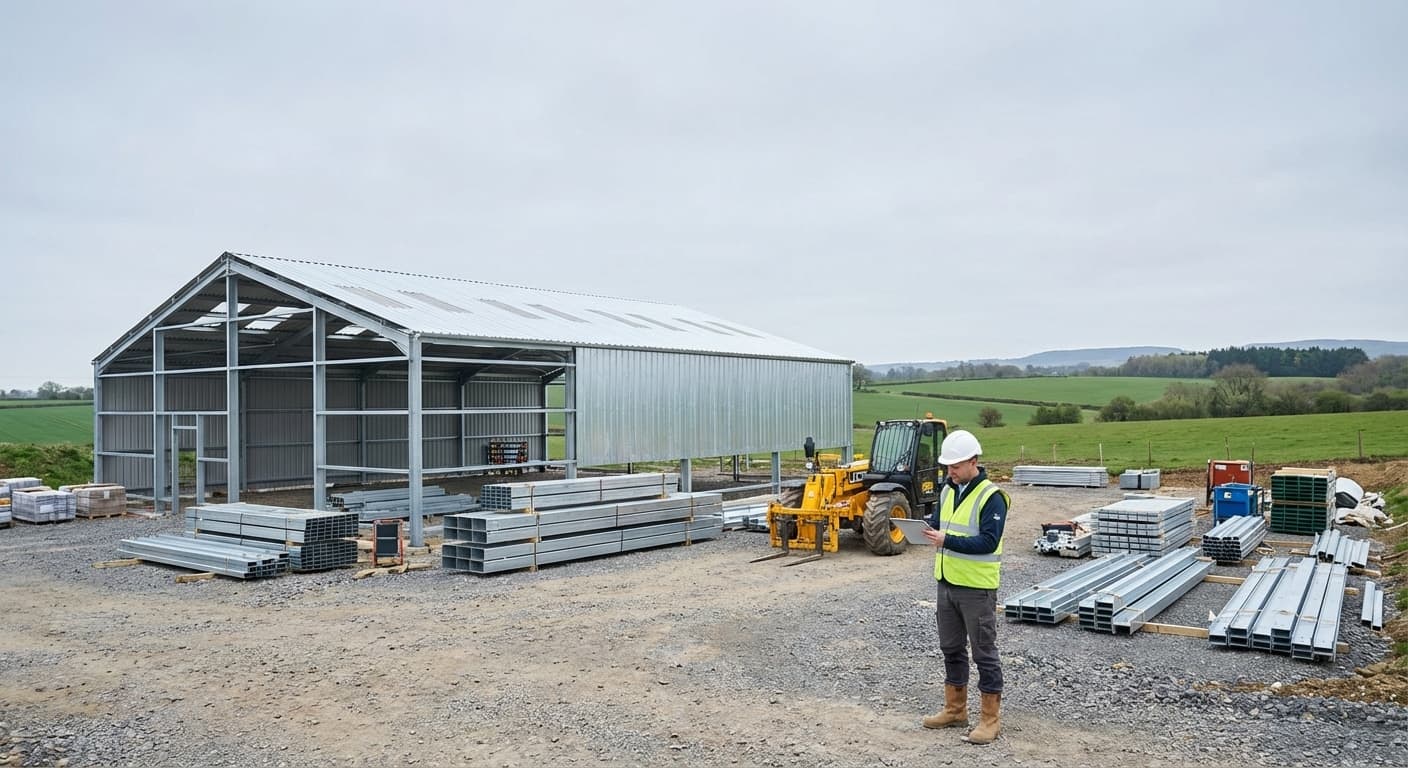

Farmers who once juggled designers, steel mills, erectors and a dozen invoices are discovering that handing the whole agricultural-building process to one source collapses months of phone-tag, rework and idle crews into a single, streamlined timeline. The article shows how a unified team–sharing one BIM model, one CPM schedule and one procurement pipeline–cuts design clashes before steel leaves the factory, delivers pre-punched components in the exact install sequence, and updates owners in real time through cloud dashboards, trimming delays up to 30 % and holding the $24-$43-per-square-foot turnkey price quoted on day one. Readers learn why eliminating finger-pointing also eliminates the hidden cost overruns that plague multi-vendor jobs, how clear-span, expandable steel frames go up in days not months, and why built-in IoT sensors and smart maintenance plans protect the structure for decades. Ultimately, the piece makes the case that single-source construction isn't a convenience–it's a strategic tool that lets farmers scale from 50 to 500 head, preserve capital through rent-to-own options, and keep their operation sheltered and profitable without ever becoming a project manager.
Why Choose a Single-Source Agricultural Building Company
One company managing your entire project eliminates the communication breakdowns and rework costs that plague multi-vendor farm building construction.
Clear communication eliminates coordination errors
Split your farm building project between multiple vendors, and you've just signed up for a communication nightmare. Industry data shows poor communication drives over half of all construction rework — that's millions in wasted materials and labor hours. [2] Picture this: your designer specs one thing, your steel supplier interprets it differently, and your installation crew shows up with their own plan. Now you're playing referee between three companies that barely talk to each other.
A single-source provider ends that chaos. You deal with one company, one contact, one accountability chain. [1] Your agricultural steel building moves through design, fabrication, and erection with the same team overseeing every step. When questions arise, they're answered internally before they become your problem. When schedules shift, adjustments happen across all phases automatically. [3] No finger-pointing, no conflicting timelines, no surprise rework bills.
Integrated quality control from design through installation
Quality control breaks down when design and construction are handled by separate teams — each working from their own version of the plan. When one firm manages the entire scope, from initial consultation through fabrication and final erection, that gap closes. Design and construction teams sharing the same environment means drawing errors get caught before they're built into the structure, keeping the project within budget rather than triggering expensive field corrections. [4]
Your steel components arrive pre-fabricated to exact specifications using CNC machines and robotic welders — no field cutting, no guesswork, just assembly. [5] Digital modeling catches structural conflicts before steel ever leaves the factory, turning potential headaches into simple plan adjustments. The bottom line: when one company owns every phase, they can't pass the buck. Drawing errors drop dramatically, and the financial risk of design mistakes shifts away from you entirely. [4]
One point of contact delivers consistent service excellence
What farmers gain from a single point of contact isn't just convenience — it's a structural advantage that changes how problems get handled throughout the project. Rather than chasing answers across multiple vendors, you have one person who tracks progress, resolves issues, and keeps your project on target without you needing to manage any of it. [6]
That contact knows your project inside and out. They consolidate input from design, fabrication, and erection teams, then bring you informed recommendations — not a pile of conflicting opinions. [6] Need a timeline update? One call. Hit an unexpected site condition? One call. Want to adjust the door configuration? One call. This person bridges the gap between you and every trade involved, ensuring your building arrives on time, within budget, and built to the quality you expect. [7]
The result is refreshingly simple: you always know who to call, who owns the problem, and who's accountable for fixing it. [6] No runaround, no "that's not our department," no waiting while contractors point fingers at each other.
Streamlined Project Management for Farm Structures
Unified scheduling and procurement eliminate the disconnected timelines that delay farm builds, cutting project delays by up to 30% compared to multi-vendor approaches.
Unified planning reduces schedule delays
Construction projects already run over schedule by an average of 27%, and that gap widens when planning is split across disconnected vendors working from separate timelines. [8] When information lives in silos — spreadsheets, email chains, disconnected systems — field teams and office staff operate on different versions of reality, and supplier delays don't surface until crews are already standing idle. [8] A single-source provider eliminates this by applying Critical Path Method (CPM) scheduling, which maps every task dependency across the project so managers can see exactly which activities drive the overall timeline and position resources accordingly. [9] This foresight means a delayed concrete pour gets flagged and rerouted before it stalls the steel erection scheduled three weeks out — not after. [9] When change does happen (and it always does), a unified team can automatically recalculate downstream impacts across the entire schedule rather than waiting for separate contractors to sync up, cutting delays by up to 30% compared to manually managed, multi-party projects. [8] The result is a farm build that moves on a single shared timeline — one where milestones reflect actual sequencing, not optimistic guesses from vendors who don't talk to each other. [10]
Coordinated procurement of steel and ancillary materials
Procurement is where fragmented projects lose the most ground. When structural steel, roofing systems, insulation, and erection hardware are ordered through separate vendors, components arrive on mismatched timelines — leaving crews waiting on a door package while a crane sits idle.
A single-source provider eliminates that gap by sourcing steel structure and all supporting materials through one coordinated procurement plan. Pre-fabricated components are manufactured to precise specifications before they reach the site, arriving pre-punched and numbered so installation crews assemble rather than improvise. [11] That precision extends to material usage: components cut to exact specification generate minimal waste, which means farmers pay only for what's actually used rather than absorbing the overages that inflate traditional contractor pricing. [12] The downstream effect is a tighter, more predictable material pipeline — primary steel, insulation packages, ventilation systems, and overhead doors arrive in sequence rather than trickling in from disconnected suppliers — so each trade on site has what it needs when the schedule calls for it. [12]
Real-time digital updates keep farmers and contractors informed
The traditional construction update model — a morning briefing followed by hours of phone tag — breaks down the moment a delivery runs late or a crew hits an unexpected site condition.
Modern task management software eliminates that gap by giving both farmers and contractors a live view of project status without requiring anyone to track down a field supervisor.
When a crew member completes a task or logs a site update in the app, the project dashboard reflects it instantly — no end-of-day paperwork, no delayed reporting, no version mismatch between what's happening on site and what the office believes is happening. [13] This shifts project oversight from reactive — discovering problems after they've already caused delays — to proactive, where the farmer can see progress across the entire build from a phone or office computer and flag issues before they cascade. [13] Platforms built for agricultural environments go further, enabling direct messaging between field workers and managers, automatic work order generation from logged field data, and task-level tracking tied to specific locations and crew members — so every trade on site stays aligned without requiring constant manual check-ins. [14]
Tailored Design and Pricing for Every Farm Need
Start with a 30×40 shed for $24,000 today and expand tomorrow without teardowns, knowing your complete costs upfront between $24-$43 per square foot.
Scalable building options from 30×40 barns to mega dairies
Your farm's needs change — what works for 50 head won't work for 500. Steel buildings grow with you. Start with a 30×40 equipment shed today, add height or square footage tomorrow. No teardowns, no starting over. Your hay storage barn becomes your machinery shop with simple modifications that cost a fraction of new construction. [15] You get options from 20×20 utility sheds to 60×60 multi-purpose structures. Clear-span framing means no interior columns — your entire floor stays open for tractors, livestock, or feed storage.
Move equipment freely. Use every square foot. [16] You're not limited to basic boxes. Need space for oversized combines? Continuous-roof designs give you multiple bays. Running horses?
Raised-center barns provide the clearance. Building on a slope? Step-down roofs follow your terrain. [17] Whether you need a family hay barn or a 500-head dairy facility, our
Transparent, cost-effective pricing models
You know the story — construction starts at one price, ends at another. Not here. You get real numbers upfront: steel building materials run $17-$20 per square foot.
Complete turnkey installation — including kit, slab, delivery, and erection — lands between $24-$43 per square foot. [15] Size and features affect the final number, but you'll know it before we break ground. Here's what you're looking at: a 30×40 kit costs about $24,000. A 40×60 runs $43,200. A 50×100 approaches $75,000 for materials. [18] Save 20-30% more with pre-engineered packages — you still get the ventilation, doors, and insulation you need, just without custom-design pricing. [15] Maintenance stays predictable too — figure 1-3% of building cost annually for inspections, cleaning, and minor touch-ups. [15] No surprise structural repairs. Need to preserve working capital?
Rent-to-own financing turns your building into a monthly operating expense instead of a massive upfront hit. [19]
Simplified construction phases accelerate time-to-use
Every week your building sits unfinished costs you money — livestock without shelter, equipment exposed to weather, grain at risk. Steel changes that equation. Once your site's ready and permits are signed, small buildings go up in days. Larger multi-bay structures? Two to three weeks on-site. [20] Your components arrive pre-cut, pre-drilled, ready to assemble.
No on-site fabrication. No measuring twice. Your crew assembles instead of problem-solving, cutting labor hours and eliminating the delays that plague stick-built projects. [21] No concrete cure times. Minimal weather delays. Your building progresses through framing, panels, and inspection on a tight, predictable schedule. [21] Total timeline?
Three to six months from design to move-in for most farm builds. Smaller structures finish faster. [22] Single-source coordination compresses this further — permits, manufacturing, and crews align perfectly. Each phase flows into the next. No waiting for the concrete guy to call the steel guy back.
Future-Ready Practices and Innovations
Real-time BIM and IoT sensors catch structural problems while they're still cheap to fix, not during expensive inspections weeks later.
Sustainable steel solutions and energy-efficient designs
Advanced BIM and IoT tools for project transparencyBuilding Information Modeling (BIM) and IoT sensors take the guesswork out of your project. Sensors track everything — concrete curing, structural conditions, equipment location — and feed it straight to the digital model everyone works from. [26] Problems surface before they cost money. When planned and actual don't match, you know instantly — not during an expensive inspection weeks later.
Smart algorithms analyze the data and suggest better sequences, material specs, or site layouts to keep things moving. [26] Equipment tracking prevents double-booking between trades and reduces theft. Every stakeholder sees the same real-time information, so decisions happen fast and stay on budget. [27]
As covered in our project management approach, this technology extends the real-time visibility that keeps farmers informed throughout their build. The difference here? These tools catch problems before humans would — flagging issues while they're still cheap to fix. [27]
Proactive problem-solving for long-term building performance
Fix small problems before they become big bills. That rust spot you ignore today costs thousands tomorrow. [28] Smart maintenance targets steel's weak points: cut edges, screw holes, roof valleys, ground-level panels. Check twice a year and you'll catch issues while they're still cheap fixes. [29]
When inspections find problems, act fast. Clean rust to bare metal, treat it, prime it, paint it — done. Tighten loose screws before panels work free in storms. [28]
Take it further with IoT sensors that monitor your building 24/7. They catch problems before any inspection would — sending alerts when conditions threaten your structure. [30] Keep detailed records of every repair, every weather event, every maintenance action. You'll need them for warranty claims, and they'll show you patterns that prevent future failures.
Your building performs for decades when you stay ahead of problems. That's not hope — that's management. [28]
- Single-source providers cut rework costs by eliminating vendor finger-pointing.
- Pre-fabricated CNC parts arrive ready to bolt together, slashing on-site labor.
- Real-time task apps shrink 27 % average schedule overruns to 30 % fewer delays.
- Steel building kits cost $17-20/sq ft; turnkey install runs $24-43/sq ft.
- Step-down roofs and clear-span frames adapt to terrain and herd size changes.
- IoT sensors catch rust or loose screws early, avoiding thousands in repairs.
- https://www.elkayinteriorsystems.com/blog/the-benefits-of-a-single-source-general-contractor
- https://pollackpeacebuilding.com/blog/construction-communication/
- https://www.procore.com/library/construction-communication
- https://amkinggroup.com/guide/benefits-of-integrated-design-build/
- https://suburbanpipeandsteelinc.com/2025/06/from-design-to-installation-complete-steel-construction-services/
- https://www.websters.co.uk/newswhy-a-single-point-of-contact-is-key-to-project-success
- https://www.strongholdengineering.com/general-contractor-vs-construction-company/
- https://www.linkedin.com/pulse/how-construction-project-automation-reduces-timeline-delays-ifkdf
- https://www.hsecontractors.com/blog/construction-project-efficiency/
- https://www.patersondevelopment.com/2024/09/16/the-role-of-project-management-in-reducing-construction-delays-and-cost-overruns/
- https://www.simpsonsteel.com/2025/08/12/why-farmers-are-switching-to-steel-agricultural-buildings/
- https://planfix.com/blog/industry-insights/real-time-monitoring-of-agricultural-projects-using-task-management-software/
- https://www.myeasyfarm.com/en/features-contractors/
- https://www.steelcobuildings.com/steel-agricultural-buildings-prices/
- https://gensteel.com/recommended-use/agricultural/
- https://www.americanmetalbuildings.com/metal-barn-prices/?srsltid=AfmBOooiSTt4Fc4CR4Lk81argAsmqbav544Z3SS4gDDB5GiCqDoD_qPb
- https://www.buildingsguide.com/metal-building-prices/?srsltid=AfmBOopbcXoif6cY6BSHMASFoE0wM9G_qzILxb84G8sw55h1mMFR6a-8
- https://www.eaglecarports.com/blog/how-long-does-metal-building-installation-take
- https://idadevelops.com/how-long-does-steel-building-construction-take/
- https://gravitycontractors.com/how-long-does-it-take-to-erect-a-steel-building/
- https://www.springfieldsteelbuildings.com/blog/the-role-of-agricultural-buildings-in-sustainable-farming/?srsltid=AfmBOopAe7JwtN6JXC1JtjMFthpLrWXutqwHAFOZ38VlzsX_YEg5Zs-K
- https://www.ny-engineers.com/blog/energy-efficient-farm-buildings-6-key-design-elements
- https://www.augi.com/articles/detail/how-can-integrating-bim-with-iot-revolutionize-smart-construction-management
- https://www.pentagonsolutions.com/blog/the-role-of-iot-in-bim/
- https://steelriver.com.au/farm-shed-maintenance-protecting-your-investment-year-round/
- https://www.aametalbuildings.com/blog/how-to-extend-the-life-of-your-metal-building-12-maintenance-tips?srsltid=AfmBOorq5JOcxMrCGGIqAgCXr8bbXFI_ir6isUeYI9QH_4N3H3JpExha
- https://mirinbuildingsystems.com/importance-of-steel-building-durability-in-agriculture/