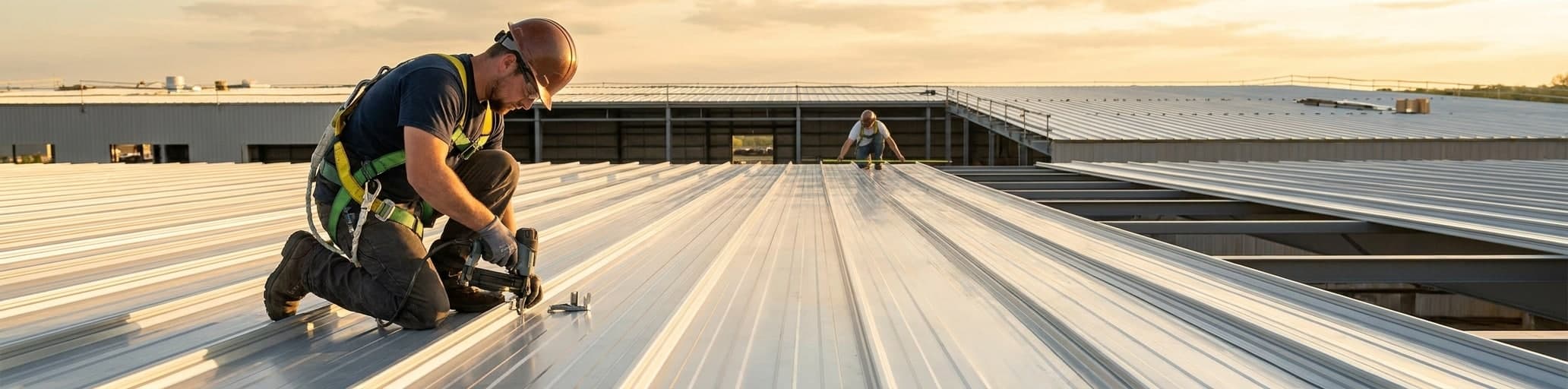

We help you understand how standing seam and exposed fastener roofs compare across budget, pitch requirements, maintenance needs, and warranty coverage. Choosing the right system ensures your building stays protected while maximizing long-term value and performance.
Metal Roof That Looks Like Shingles Price and ROI: What You'll Actually Spend and Recover
Metal roofs typically reduce your homeowners insurance premiums by 5% to 35%, with savings averaging around 20% on dwelling coverage alone.
Does Homeowners Insurance Go Down with a Metal Roof? Documented Savings and Premium Reductions The short answer is yes — but the range is wide enough to matter. Metal roofs reduce homeowners insurance premiums by 5% to 35% depending on your location, carrier, and roof specifications, with the national average landing around 20%.[22][23] The discount doesn't apply to your entire bill; it attaches specifically to the dwelling coverage portion of your policy, leaving liability and other components unchanged.[22] Even so, the math compounds favorably over time: a homeowner saving $270 annually on a 50-year metal roof accumulates $13,500 in premium reductions — a meaningful offset against the higher upfront installation cost.[22] Insurance companies lower rates for metal because their claim data supports it. Metal panels rated to withstand 110 to 140 mph winds generate fewer wind-damage claims than asphalt shingles, which begin lifting at 60 to 70 mph.[22] Class 4 impact resistance — the highest UL rating, verified by a 2-inch steel ball dropped from 20 feet without panel cracking — makes metal roofs substantially less likely to generate hail claims, which are among the most frequent residential insurance payouts nationally.[22] Class A fire resistance adds another risk-reduction factor that insurers price directly into premiums, particularly in wildfire-exposed states where some carriers refuse to write policies on wood shake roofs at any price.[22] To qualify for maximum discounts, your roof needs to document all three: Class 4 impact rating, Class A fire rating, and professional installation by a licensed contractor — budget panels without proper certifications frequently disqualify entirely.[22]
Location shapes the discount more than any other single variable. Hail-prone states — Texas, Colorado, Kansas, Oklahoma — tend to offer the largest reductions because metal roofs demonstrably reduce claims in those markets, giving insurers a direct financial incentive to lower your rate.[22] Milder climates may yield smaller savings or none at all.[22] There is also a documented exception worth knowing: in Florida specifically, standing seam metal roofs have in some cases *raised* premiums by several hundred dollars annually, because insurers calculating replacement cost value — not risk reduction — price policies against the cost of replacing metal with metal, which runs two to three times higher than asphalt replacement cost.[23] Florida's insurance fraud crisis amplified this dynamic by accelerating carrier exits from the state and compressing available coverage options, producing premium structures that don't reward durability improvements the way most other states do.[23] Outside Florida, the risk-reduction logic generally holds and produces real premium savings. Contact your insurance agent before installation, not after — get the discount percentage and eligibility requirements in writing, verify your chosen panel carries the required ratings, and submit full manufacturer documentation and contractor certification immediately after the job closes, since most carriers require updated documentation to apply any premium adjustment.[22] Roofs installed over existing shingles rather than full tear-off frequently disqualify from metal roof discounts, since the underlying deck condition cannot be verified.[22] Do all of that correctly, and the insurance savings become a documented annual return that compounds across the same 40- to 70-year service window the roof itself provides.
Choosing the Right System for Your Building: National Steel Buildings's Custom Engineering Approach
The decision between standing seam and exposed fastener comes down to four variables you can evaluate before the first panel is ordered: budget, roof pitch, maintenance tolerance, and weathertight warranty requirements.[26] Budget sets the floor — exposed fastener systems cost at least 50% less upfront than standing seam, making them the practical default for agricultural, industrial, and cost-sensitive commercial projects where capital isn't available to absorb the standing seam premium.[25] Pitch eliminates options immediately: exposed fastener systems require a minimum 3:12 slope to prevent water pooling at fastener penetrations, while mechanically seamed standing seam performs as low as 0.5:12 with proper underlayment and sealant details — opening it to low-slope commercial and warehouse applications where exposed fastener simply isn't viable.[26] Maintenance tolerance separates the two systems over decades of service: if your facility cannot absorb routine fastener inspections every two to three years, exposed fastener is the wrong choice regardless of its cost advantage, because deferred fastener upkeep converts minor washer failure into major interior water damage with a bill far exceeding the original savings.[26] Weathertight warranty eligibility closes the decision for many commercial projects — no manufacturer currently offers a weathertight warranty on an exposed fastener system, so any building with a lender, investor, or insurance requirement for documented leak protection defaults to standing seam by necessity.[26][25] What custom engineering adds to that framework is site-specific load data — your local snow load, wind speed, seismic zone, and code jurisdiction — mapped against tested panel performance ratings before a single component ships, so the system selected actually performs under the weather conditions your building faces across its full service life rather than simply clearing a minimum code threshold on paper.[26]
- Metal roofs reduce homeowners insurance premiums by 5-35% nationally, averaging 20% on dwelling coverage with savings compounding over 50 years.
- Metal roofs qualify for maximum insurance discounts only with Class 4 impact rating, Class A fire rating, and licensed contractor installation.
- Florida is an exception where standing seam metal roofs have raised premiums due to high replacement costs and insurance market conditions.
- Exposed fastener systems cost 50% less than standing seam but require minimum 3:12 roof pitch and biennial maintenance to prevent water damage.
- Standing seam metal roofs work on low-slope applications down to 0.5:12 pitch and are the only option with manufacturer weathertight warranties.
- Insurance discounts are largest in hail-prone states like Texas, Colorado, and Kansas where metal roofs demonstrably reduce claims frequency.
- Roof installation over existing shingles disqualifies most metal roof insurance discounts due to inability to verify underlying deck condition.
- https://sheffieldmetals.com/learning-center/standing-seam-metal-roofing/
- https://www.westernstatesmetalroofing.com/blog/standing-seam-architect-guide
- https://sheffieldmetals.com/learning-center/standing-seam-vs-exposed-fastener-metal-roofing/
- https://jamarroofing.com/standing-seam-metal-roof-vs-exposed-fastener-metal-roof/
- https://www.squaredash.com/cost/metal-roof/
- https://www.westernstatesmetalroofing.com/blog/metal-roof-vs-shingles-resale-value
- https://www.eastlakemetals.com/metal-roofing-and-property-values/
- https://brewsterroofing.com/will-metal-roofing-add-value-home/
- https://weathershieldroofers.com/blog/standing-seam-metal-roof-cost/
- https://www.jrh-construction.com/compare/standing-seam-vs-corrugated-metal-roofing
- https://www.alertroofsystems.com/whats-the-average-cost-of-a-standing-seam-metal-roof/
- https://nationalroofingauthority.com/metal-roofing/
- https://homeguide.com/costs/standing-seam-metal-roof-cost
- https://rockland-builders.com/blog/lifetime-cost-comparison-metal-versus-shingle-roof/
- https://www.energyefficientmetalroofing.com/2025/11/16/the-true-cost-of-a-metal-roof-savings-longevity-and-lifetime-value/
- https://foxhavenroof.com/metal-roof-cost-per-square-foot-2026-complete-pricing-guide/
- https://paramountbuildinginc.com/blogs/how-long-exposed-fastener-metal-roof-lasts/
- https://www.supersealroofing.com/how-much-to-replace-screws-on-metal-roof/
- https://systemswestinc.com/how-long-does-a-metal-roof-last/
- https://rockland-builders.com/blog/how-long-does-a-metal-roof-last/
- https://jagmetalsllc.com/blog/how-much-does-a-metal-roof-cost/
- https://roofquotes.com/blog/metal-roof-insurance-discount
- https://premier-roofing.com/blog/roofing-impact-on-insurance-premiums/
- https://www.protoolreviews.com/adding-metal-roof-raised-insurance-rate/
- https://www.westernstatesmetalroofing.com/blog/exposed-fastener-metal-panels-v.-standing-seam-pros-cons
- https://mycovenantroofer.com/standing-seam-vs-exposed-fastener-roofing/