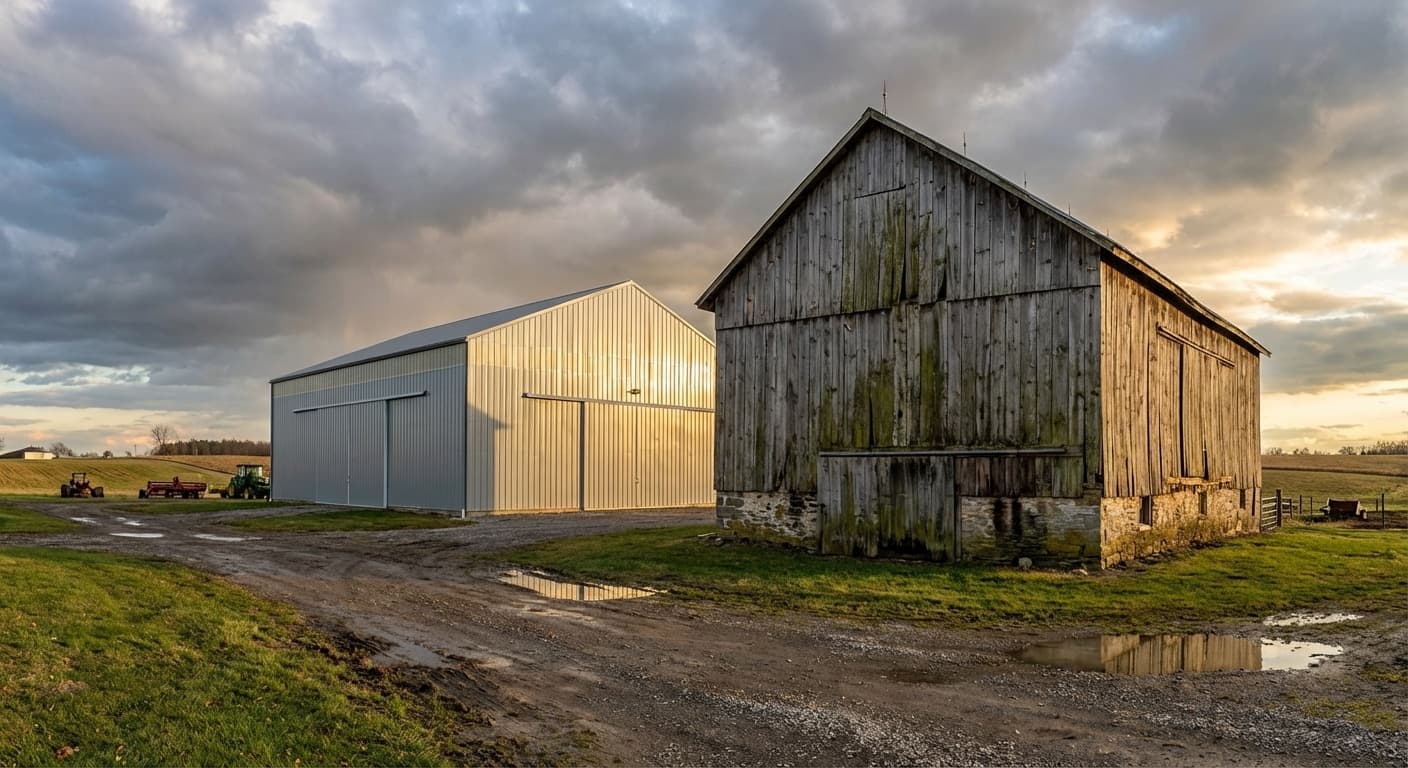

The article delivers a decisive, data-driven verdict for farmers weighing a steel barn against a wood frame: steel wins on every metric that matters over the life of the building. Readers learn how temperature swings, moisture, pests, mold, fire risk, and extreme-weather codes punish wood with chronic movement, rot, termite damage, and soaring upkeep bills, while galvanized steel stays dimensionally stable, needs only a quick winter fastener check, and arrives pre-engineered to meet local wind, snow, and seismic loads. Up-front kit prices already favor steel ($15-$35 vs. $30-$45 per square foot for wood), but the real payoff is in the lifecycle math–lower insurance premiums, zero annual sealing or pest treatments, airtight energy efficiency, and 40-year warranties that keep the building an appreciating asset instead of a depreciating liability. The piece also spotlights National Steel Buildings' single-source design-through-erection service, eliminating supplier finger-pointing and harvest-season delays by providing one phone number for every question, replacement part, or future expansion. In short, farmers walk away knowing why choosing steel not only shields livestock, feed, and equipment from climate and fire, but also locks in predictable costs, protects cash flow during peak seasons, and preserves resale value–turning the barn from a maintenance headache into a low-risk, high-return cornerstone of the operation.
Assessing Climate Factors for Steel Barn vs Wood Barn Agricultural Decisions
Steel stays structurally sound through freeze-thaw cycles that make wood expand, contract, and weaken, while galvanized coatings protect against the moisture that demands annual waterproofing on wood.
Temperature extremes and material performance
Your barn faces temperature swings every season — and how your building handles them determines whether you're repairing or operating next year. Steel transfers heat differently than wood, which matters if you need climate control for an office or temperature-sensitive storage. [1] For open machine sheds and livestock shelters, the heat transfer difference matters less since these spaces aren't sealed anyway. [1]
Wood's real problem with temperature? It moves. Every freeze-thaw cycle makes wood expand and contract, creating gaps, weakening joints, and setting up future decay — especially if your region sees hard temperature swings between seasons. [2] Steel stays put. Its high strength-to-weight ratio keeps your building square through heavy snow, wind stress, and summer heat without the warping that hits wood frames after a few harsh seasons. [2] Yes, steel faces corrosion risk in humid or coastal areas, but galvanized coatings handle that with minimal upkeep — we'll cover maintenance specifics in the next section. [1]
Humidity, precipitation, and corrosion risk
Moisture hits your maintenance budget harder than any other climate factor. Galvanized steel shrugs off rain, humidity, and ground splash — no rot cycle, no swelling, no annual waterproofing bill. [5] Wood needs that waterproofing every year just to stay functional; miss a season and you're looking at accelerated decay and mounting repair costs. [5]
Steel's vulnerability in wet climates is corrosion, but it's manageable. Galvanized coatings paired with good airflow handle most agricultural moisture reliably. [4] The exception? High-ammonia environments near manure storage, wash bays, or swine housing — these areas need hot-dipped galvanized components and coated fasteners to extend service life. [4] If you're farming coastal, salt air adds another layer of challenge, but the same galvanized and painted finishes that work inland also perform well against marine exposure. [5] We'll detail the full maintenance comparison in the next section.
Wind loads and snow accumulation impact
Here's where steel and wood separate completely: extreme weather engineering. Pole barns max out at 90 mph wind resistance and aren't recommended for hurricane zones. More concerning — many pole buildings aren't designed to meet local building codes because no prescriptive code exists for them. [6]
Steel buildings come pre-engineered to meet your local codes for wind, snow, and seismic loads right from the start. [6] Your
Durability and Maintenance Across Climate Zones
Steel buildings protect your operation from hidden threats–mold, termites, rodents, and fire–that wood structures can't defend against.
Metal barn resistance to pests, fire, and mold
The threats that don't show up in weather forecasts — mold, termites, rodents, and fire — hit your bottom line just as hard as any storm. Steel stops them cold. Because steel is inorganic, mold has nothing to eat. [8] That matters when you're housing livestock or storing feed — mold in wood structures triggers respiratory problems in animals and workers, cuts productivity, and drives up vet bills. [8] In agricultural steel buildings, where moisture from animals and waste is constant, you need materials that won't harbor health hazards. Wood absorbs that moisture and feeds mold growth deep in structural members where you can't see it or treat it effectively. [8]
Termites cost farm operations thousands in damage and treatment — but they can't eat steel. [9] Same goes for rodents that chew through wood siding to reach your feed stores. As wood ages and gaps open up, you're fighting a losing battle against pests that contaminate supplies and spread disease. [9] Steel panels stay sealed. No entry points for coyotes pushing through rotted boards. No mice nesting in walls. Your feed stays clean, your equipment stays protected. [9]
Fire resistance might save your entire operation. When you're storing hay, fuel, and equipment under one roof, combustibility matters. [9] Wood barn fires spread fast — by the time you spot smoke, it's often too late to save livestock or machinery. Steel won't fuel that fire. You get critical extra minutes to evacuate animals and move equipment. [9] For operations where one barn houses your entire harvest or breeding stock, that difference is everything.
Wood barn upkeep requirements in wet and dry regions
As covered in the climate assessment section, moisture creates different maintenance demands across regions — but wood barns face an uphill battle everywhere.
In wet climates, you're fighting rot from day one. Rain splash keeps your lower siding wet, and that moisture works its way up. [11] Even pressure-treated posts break down when they're sitting in saturated soil month after month. [11] Your annual to-do list never shrinks: painting, sealing, termite treatments, board replacements, rot inspections. [10] Skip one season and problems compound fast. Miss two and you're looking at structural repairs that shut down operations.
Dry climates swap rot for sun damage. UV exposure cracks wood along the grain — those aren't just surface blemishes. [11] Each crack becomes a highway for water during flash storms and insects year-round. Once pests get in those cracks, they hollow out beams from the inside where you can't see the damage until it's too late. [11] You're still painting and sealing regularly, but now you're racing against wood that's literally falling apart at the molecular level. [12]
Maintenance planning to minimize downtime
Your maintenance schedule shouldn't dictate your operations — but with wood barns, it does. Emergency repairs hit during harvest. Rot discoveries shut down livestock areas. Board replacements compete with planting season.
Steel flips that equation. You pick your maintenance window — typically a slow week in late winter — and knock out the whole checklist: fastener checks, drainage clearance, touch-up painting if needed. [13] That's it. No surprises, no scrambling for contractors during peak season, no equipment sitting outside because half your storage is torn apart for repairs. [13]
Wood barn owners live differently. Miss one paint job and next year's repair bill doubles. Skip termite treatment and you're replacing whole wall sections. [13] The maintenance never stops, and it always seems to peak when you need that space most. When every delay costs money — moving hay in the rain, housing equipment outside, relocating livestock — those "routine" wood barn repairs become profit killers.
Cost and Lifecycle Comparison for Your Farm Climate
Steel barns recover their modest upfront cost premium through lower insurance premiums and minimal maintenance, often appreciating as solid assets while wood structures depreciate within 20 years.
Upfront investment versus long‑term savings
You'll find steel's upfront costs often beat wood right from the start. Steel barn kits run $15-$35 per square foot, while wood barn construction averages $30-$45 per square foot — and that's before lumber prices spike or your carpenter discovers the foundation needs extra reinforcement. [14] Even when steel runs slightly higher upfront, you'll recover that difference fast through lower insurance premiums and minimal maintenance costs. [15] Your insurance company sees steel's non-combustible rating and drops your premium accordingly — often by enough to notice every payment cycle.
Those maintenance costs covered in detail earlier? They compound year after year with wood, often exceeding the original build cost before the 20-year mark. [15] Steel barns carry warranties up to 40 years and hold their value without the steady depreciation that hits wood frames as they age. [15] When you're ready to expand, refinance, or sell, that steel barn still appraises as a solid asset — not a liability needing thousands in remediation work.
Energy efficiency and insulation considerations
Your insulation only works as well as your building envelope allows — and steel delivers the tight seal that makes efficiency possible.
Pole barns leak air through every nail hole and wood joint, forcing your HVAC system to work overtime compensating for gaps instead of maintaining temperature. [16] Steel buildings bolt together with precision-engineered connections on a concrete slab, creating the sealed envelope your insulation needs to perform. [16] That sealed design pays off immediately if you're climate-controlling an office, heated shop space, or temperature-sensitive storage — your system maintains the temperature you set instead of fighting structural air leaks.
Metal buildings maximize this advantage when designed with natural light and ventilation patterns that work with your climate, not against it. [17] Yes, proper insulation adds to your upfront investment — the exact specs depend on your location and building use — but factor those costs against years of reduced energy bills to see the real comparison. [17]
Total cost of ownership over 20‑year horizon
Run the numbers over 20 years and steel's advantage becomes undeniable.
Construction costs favor steel from the start: $17-$30 per square foot for steel versus $25-$100 for wood pole barns. [19] But the real savings kick in after year one.
Those annual maintenance tasks detailed earlier — waterproofing, pest control, board replacement — hit your budget every single year with wood, and the bills get bigger as the structure ages. [18] Steel needs a touch-up paint job maybe once in two decades. [3] Your insurance company recognizes the difference too: steel's permanent foundation and non-combustible rating qualify for lower premiums than pole barns that shift and settle over time. [3] Add it all up — construction savings, minimal maintenance, reduced insurance — and steel's total cost over 20 years runs significantly below wood's, even if you paid a slight premium upfront. [18] That's money staying in your operation instead of going to contractors and insurance companies.
Selecting the Best Solution with National Steel Buildings
One call solves every problem from design through erection, keeping your project moving when delays cost real money.
Single‑source design‑to‑build process
You don't have time to juggle multiple suppliers, chase missing parts, or referee finger-pointing when something goes wrong. That's why National Steel Buildings handles everything — design, engineering, supply, and erection — under one roof. [20]
Your barn arrives as a complete kit with every component labeled and bundled. No sorting through mystery piles. No calling three different vendors to track down a missing beam. Your packing list arrives before the truck does, so you can verify everything's there before crews start. [20]
Need an answer mid-build? You call one number. Component damaged in shipping? One call handles the replacement. Planning an expansion next year? Same team that knows your original structure helps you grow. [20]
For farms running on tight schedules — harvest waits for no one — this single-source approach saves weeks of coordination headaches and keeps your project moving when delays cost real money.
Custom engineering for local codes and weather
Your county's snow load requirement isn't your neighbor county's — and getting it wrong means failing inspection or worse, structural failure.
National Steel Buildings engineers every
Clear communication and service support for seamless installation
You need answers when steel meets soil, not three days later in an email. National Steel Buildings keeps the same team on your project from first call through final bolt — no handoffs, no "let me transfer you," no starting over with someone new. [23]
When your excavator hits unexpected rock or the inspector wants a different anchor detail, you call us direct. Real people who know your project answer immediately. No scripts. No runaround. Just solutions that keep crews working.
This matters after your building's up too. Questions about adding a lean-to next year? Concerns about a component after a storm? Planning to expand? You call the same team that built your original structure. [23] [24]
With 1,480+ buildings completed nationwide, we've seen every site condition and solved every construction puzzle. That experience translates to faster answers and fewer delays on your project — because your operation doesn't pause for construction problems.
- Steel barns resist warping and maintain structural integrity through extreme temperature swings, unlike wood which expands and contracts, creating gaps and decay.
- Galvanized steel eliminates rot, annual waterproofing, and pest entry, cutting maintenance to a single winter check versus constant wood repairs.
- Pre-engineered steel meets local wind, snow, and seismic codes out of the box, while pole barns top out at 90 mph and often lack code compliance.
- Steel's non-combustible rating lowers insurance premiums and prevents fast-spreading fires, protecting hay, fuel, and livestock housed inside.
- Over 20 years, steel's lower upkeep, insurance savings, and retained value make its total cost significantly below wood, even if upfront price is slightly higher.
- https://metalbuildermagazine.com/the-rise-of-steel-framed-farm-buildings/
- https://www.universalsteel.com/why-agricultural-steel-frame-buildings-are-the-best-choice-for-modern-farms/
- https://www.alliedbuildings.com/steel-barn-or-wooden-barn-how-do-they-compare/
- https://www.lesterbuildings.com/blogs/how-to-choose-the-right-materials-for-a-livestock-barn/
- https://directmetalstructures.com/blog/weatherproof-farming-and-how-metal-farm-buildings-withstand-extreme-climates/?srsltid=AfmBOopCJV82JTOEW_nHPwlETo7diXIyu7oF_Qy_VXPV0iVlwfuUwk4F
- https://www.buildingsguide.com/build/pole-barn-vs-metal-building/?srsltid=AfmBOoqp4f0F_zpEbXVkm5us04uOakzBVxmjEjY7bPdkImj4YXffa6MP
- https://www.vikingbarns.com/blog/comparing-metal-red-barns-to-traditional-wooden-structures
- https://www.americanmetalbuildings.com/blog/steel-farm-buildings-and-wooden-structures-vs-mold-and-fungus/?srsltid=AfmBOoon6m53Gbad4omfEE_qwT-3CjY_wkmU-Xa8wNdK6aTxMv4V5oAg
- https://futurebuildings.com/blog/why-metal-barns-are-the-safest-option-for-agriculture.html
- https://easttexascarports.com/news/metal-buildings-vs-wood-buildings-which-lasts-longer-in-southern-climates/
- https://www.kypolebuildings.com/what-weather-can-do-to-your-pole-barn-over-time
- https://www.premierstructures.biz/blog/pole-barn-maintenance-tips/
- https://idadevelops.com/why-metal-barns-are-the-best-choice-for-florida/
- https://www.vikingbarns.com/blog/a-cost-comparison-between-metal-barn-buildings-and-wood-barns
- https://idadevelops.com/are-metal-barns-cheaper-to-build-than-wood-barns/
- https://www.buildingsguide.com/build/pole-barn-vs-metal-building/?srsltid=AfmBOopk8c066l6km_HuAfJ57F6nk5TXahEmWNcej-gWAu45frCY32Zd
- https://www.hardsteelbuildings.com/post/are-metal-buildings-cheaper-than-wood
- https://www.nationwidesteelstructures.com/post/metal-horse-barns-vs-wooden-barns
- https://www.americanmetalbuildings.com/blog/steel-barn-buildings-vs-wood-barns-a-cost-comparison/?srsltid=AfmBOopQPAsUPhTJPqogAcZXy28-izHFgzi9uC7hBYynqAu4UWiVdK_O
- https://norsteelbuildings.com/advantages-of-steel-series/advantages-single-source-responsibility/
- https://directmetalstructures.com/blog/snow-loads-and-building-codes/?srsltid=AfmBOooghWMu2JIvcRjb0I2o0RjBPq1EJf15lGyZIpM_8nrwfoZyYgT0
- https://www.aametalbuildings.com/blog/snow-load-wind-speed-requirements-for-metal-buildings-with-codes-pricing-impact?srsltid=AfmBOoownePTIc-ZxeDoorOiAxq_MsUpolrNoDoRuQwUkOX9igDYWbVO
- https://www.rhinobldg.com/blog/rhino-promises-amazing-customer-service-for-our-steel-building-customers
- https://www.elephantstructures.com/customer-service-and-support/