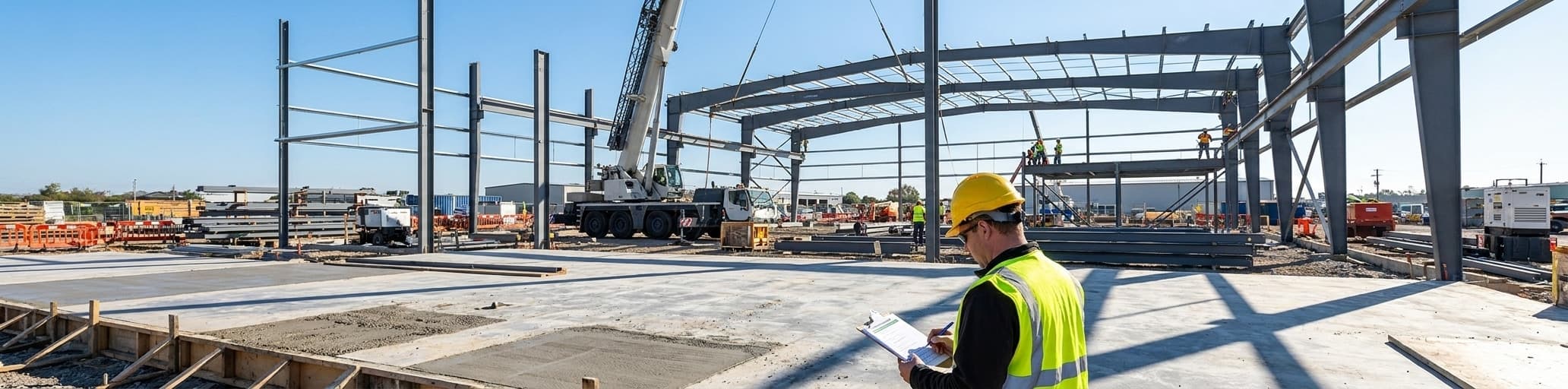

We help you structure staged payments tied to verified project milestones so your builder stays incentivized to complete each phase properly. Clear draw schedules, milestone verification, and strategic retainage give you financial control while keeping subcontractors paid and your project on track.
Why payment structure matters more than you think when budgeting a 30×40 metal building with slab
Staged draws tied to verified work phases protect both you and your builder by ensuring money flows only for completed progress, not promises.
How draws and milestones protect both you and your builder
A draw is a staged release of funds from your construction loan or project budget, disbursed only after a specific phase of work is independently verified as complete.[1] On a project where you're calculating the full 30×40 metal building with slab cost, there are several distinct phases–site prep, concrete pour, steel erection, roofing, and finish work–each representing a separate draw trigger.
The structure creates aligned incentives on both sides of the contract: you never advance money for work that hasn't happened, and your builder never has to fund completed phases out of pocket while waiting for a lump-sum payment at the end.[1] For the builder, predictable draw funding keeps subcontractors and material suppliers paid on schedule; for you, it means each dollar released is backed by inspected, verifiable progress rather than a promise.[1] Subcontractors benefit too–draw verification documents that their work was included in each payment cycle, reducing the risk of non-payment disputes that can stall a project mid-erection.[1] You can explore how this plays out specifically on a 30×40 metal building project before you finalize your payment terms.
The real cost impact of retainage on your total project timeline
Retainage–typically 5% to 10% withheld from each draw–accumulates continuously throughout the project and is released only at substantial completion or final closeout.[2] On a $120,000 steel building contract with 10% retainage, up to $12,000 sits withheld at the project's peak, capital the contractor cannot use to fund crew wages or the next material order.[2] Most commercial contracts release a portion of held retainage at substantial completion and the remainder once all punch-list items are resolved, final lien waivers are submitted, and closeout documentation is in hand.[2] The cash-flow pressure this creates is real: subcontractors wait an average of 56 days after submitting a pay application to actually receive funds, and a weak draw structure is one of the most common reasons that window stretches even longer.[2] State law also shapes your options here–California caps retainage at 5% on private commercial projects, and prompt payment statutes in 49 states establish interest penalties for late disbursement, making a state-specific legal review a necessary step before signing any contract.[3]
Why a transparent payment schedule reduces financing surprises
A draw schedule agreed upon before work begins is the financial roadmap for your entire project, specifying which milestone triggers each disbursement, what percentage of the contract total each draw represents, and what inspection documentation is required before funds are released.[1] This document–commonly called a schedule of values–allocates the total contract price line by line across every scope of work and becomes the reconciliation point for every pay application, retainage calculation, and change order through project close.[2] When that schedule is vague or front-loaded, architects and lenders push back, approval cycles lengthen, and your construction timeline absorbs the delay.[2] A single-source builder who designs, fabricates, and manages erection under one contract can produce a draw schedule where every line item maps directly to an inspectable phase of the actual build–eliminating the coordination gaps between separate vendors that typically produce payment disputes, stalled draws, and unexpected financing costs on projects of this size.[3]
Retainage–typically 5% to 10% withheld from each progress payment–accumulates continuously and is released only at substantial completion or once specific contractual conditions are met.[4] Nearly 70% of construction projects involve retainage, yet its cash flow impact catches many owners off guard when they first encounter it.[5] On a $120,000 steel building contract carrying 10% retainage, up to $12,000 sits withheld at the project's peak–capital your contractor cannot use to fund crew wages or incoming material orders, which in turn creates pressure on subcontractors who may have finished their own scope weeks earlier but must still wait for the overall project to reach substantial completion before seeing those funds.[5] That cash-flow strain is not abstract: payment cycles in construction routinely stretch 60 to 90 days, and a vague or contested draw schedule extends the window further, directly slowing how fast a contractor can mobilize resources on the next phase of your build.[6] State law also shapes what you can negotiate–California caps retainage at 5% on private commercial projects, Texas mandates 10% on private work where mechanics lien rights apply, and New Mexico prohibits retainage entirely on most construction contracts–meaning a state-specific review before you sign is not optional paperwork but an actual cost-control step.[5] Prompt payment statutes in most states add financial teeth to release deadlines: Kansas charges 18% annual interest on wrongfully withheld retainage, and Missouri allows up to 1.5% monthly interest plus attorney fees, so understanding the statutory floor in your jurisdiction gives you leverage during contract negotiations that can meaningfully reduce total project carrying costs.[5]
Why National Steel Buildings's transparent payment schedule reduces financing surprises
Documentation gaps are among the most preventable causes of financing delays, yet they remain routine: incomplete paperwork extends approval timelines by 30 to 45 days while forcing owners to pay higher closing costs or lose locked-in loan terms before a single piece of steel is erected.[8] Front-loaded payment schedules create a separate but equally damaging problem — when draws are weighted toward early phases, you can pay for work that isn't yet complete, a structure that banks specifically reject and that leaves you exposed if a contractor's cash flow deteriorates mid-project.[7] Both problems share a common root: vague or poorly structured payment documentation that gives lenders nothing concrete to approve against.
A single-source builder who controls design, fabrication, and erection under one contract can produce a draw schedule where every line item corresponds to an independently inspectable phase of the actual build, eliminating the vendor coordination gaps that routinely generate disputed draw amounts, delayed approvals, and unplanned bridge financing costs.[1] Most projects don't stall because of bad building — they stall because builders underestimate the coordination required between draw requests, inspection scheduling, and lender review cycles.[8] A schedule of values issued before ground is broken, structured around objective completion milestones rather than vague percentage-complete estimates, gives your lender a clean, repeatable approval path at every phase and gives you the budget predictability to stay within your original financing terms.
If you're weighing how to structure project funding alongside your build contract, reviewing financing options for a 30×40 build before you sign can close gaps before they become delays.
Understanding Draw-Based Payment Schedules for Steel Building Projects
Define your draw triggers as objective, inspectable milestones–not vague percentages–so lenders approve disbursements on schedule and your cash flow stays predictable.
What is a draw and when does it get triggered during fabrication and erection
A draw is a staged disbursement from your construction loan or project budget, released only when a defined phase of work is verified complete — and on a steel building project, the trigger point is always a phase boundary, not a calendar date.[9] The phase structure is what makes draw timing predictable: procurement and mobilization trigger the first draw when permits are secured and long-lead material deliveries are staged; active erection generates progress draws as fabricated steel components are set and trades execute scope on the critical path; and the final draw releases at commissioning and closeout once substantial completion, punch-list resolution, owner training, and warranty handover are fully documented.[9] Lenders don't treat draw schedules as administrative paperwork — draw schedule structure and surety bonding requirements directly determine which project delivery model a lender will accept, meaning how you define draw triggers in the contract shapes your financing options as much as your cash flow.[9] A vague trigger definition ("when framing is substantially started" versus "when all primary steel columns are set and anchor-bolt inspections are signed off") can stall a draw approval for weeks, because lenders require objective, inspectable milestones, not percentage-complete estimates.[9]
Typical draw percentages: 30×40 metal buildings with concrete slab broken down by phase
On a 30×40 metal building with concrete slab, the installed turnkey cost runs $24 to $43 per square foot, putting the full project budget for 1,200 square feet somewhere between $28,800 and $51,600 depending on site conditions, local codes, and finish specifications.[10] That range matters because draw percentages are applied against the total contract value, not the kit price alone — so understanding what each phase represents as a share of the whole is what lets you align your draw schedule to your construction loan disbursement calendar before work begins.[11] Most suppliers structure the upfront commitment as a deposit of 10% to 15% required to place the order and initiate engineering, with the building delivered and mobilized against that initial payment.[12] From that point, draws track directly to inspectable phase boundaries: concrete slab work is its own trigger, kit delivery and staging is another, erection is a third, and final payment releases only when installation is fully complete and the crew has signed off.[12] The table below maps each phase to its typical draw share of the total contract value for a standard 30×40 steel building with slab.
| Phase | Typical draw % | What triggers release |
|---|---|---|
| Order deposit / mobilization | 10-15% | Signed contract, permits initiated, materials ordered |
| Slab preparation and concrete pour | 15-20% | Foundation inspected and poured to spec |
| Kit delivery and material staging | 20-25% | Steel components delivered and verified on site |
| Erection and panel installation | 30-35% | Frame set, panels installed, doors and trim complete |
| Final closeout | 10-15% | Installation complete, final walkthrough signed off |
The concrete slab phase carries its own distinct draw because it is a standalone scope — minimum 4-inch thickness at 3,000 PSI concrete strength, with perimeter footers, rebar, and any underslab plumbing completed before the pour — and lenders require a separate inspection sign-off before releasing funds for the next phase.[12] Kit delivery triggers the following draw because the fabricated steel components represent the largest single material cost in the project and cannot be restocked if a draw dispute stalls the job mid-delivery.[10] The erection draw is the largest single disbursement in the schedule because it covers the highest concentration of skilled labor — column setting, truss installation, purlin and girt work, panel application, and all trim — compressed into what is typically a one-to-three-day installation window.[12] Final payment releases only when the crew completes the full installation and you confirm that all doors operate correctly, panels are aligned, and trim is properly finished, at which point no further punch-list items remain to justify withholding funds.[12]
How to verify work completion before releasing each draw payment
Releasing a draw without independent verification is the single fastest way to get ahead of your contractor on payments–and once you're ahead, your leverage disappears. The verification sequence follows a defined order: the contractor submits a draw request with invoices, photos, and lien waivers from subcontractors documenting completed scope, then a third-party inspector physically visits the site to confirm that the work described in the request actually exists in the field.[7] Banks routinely charge $50 to $100 per draw inspection and hire that inspector independently, precisely because they don't trust percentage-complete estimates without eyes on the job.[13] On a steel building project, each draw trigger corresponds to a phase boundary you can observe and photograph yourself–anchor bolts in place and signed off, concrete poured and cured, steel columns set, panels installed–so your own site visit before approving any payment provides a meaningful cross-check even when a lender's inspector is also scheduled.[7] Two documentation items gate every draw regardless of how confident you feel about progress: a signed lien waiver from the general contractor confirming subcontractors and material suppliers have been paid for work included in the current draw, and updated title insurance reflecting the increased value of the structure.[1] Without the lien waiver, a supplier or sub who didn't receive payment can file a mechanics lien against your property even after you've already paid the contractor for that phase.[1] The one draw that requires a stricter standard than "substantial completion" is the final payment–punch-list items must be fully resolved, all documentation must be in hand, and no funds should be released until a walk-through confirms everything operates correctly, because the final check is your last meaningful point of leverage to get any remaining work corrected.[13]
A practical draw verification checklist for each phase looks like this:
- Contractor submits a draw request with itemized invoices and receipts tied to completed scope
- Photos of completed work are included with the request and match the phase milestone in the schedule of values
- Third-party inspector visits the site and issues a written report confirming work completion
- Signed conditional lien waivers are collected from the general contractor and any major subcontractors or suppliers
- Any change orders affecting the draw amount are documented in writing before the payment is approved
- Title insurance is updated to reflect funds disbursed to date
- Final draw adds: punch-list sign-off, unconditional lien waivers, and your own walk-through confirmation[7][13][1]
Milestone Payments: Linking Progress to Cash Flow for Your 30×40 Project
Each milestone payment is legally tied to inspection approval, ensuring work cannot proceed until the prior phase passes verification and protects your project from costly deficiencies.
Key milestones from design approval through final inspection and slab curing
On a steel building project, milestones are not administrative checkpoints — they are hold points where work legally cannot proceed until the prior phase is inspected and approved.[14] Missing one, or performing phases out of sequence, produces failed inspections, structural deficiencies, or costly remediation before an occupancy permit is issued.[16] The sequence below covers every major approval boundary from design sign-off through final closeout, mapped to the specific verification required before each draw can be released.
| Milestone | What gets verified | Who signs off |
|---|---|---|
| Design approval and permits issued | Architectural drawings finalized, permit applications submitted and approved by local authority | Authority having jurisdiction (AHJ), engineer of record |
| Site preparation complete | Clearing, grading, erosion controls, and layout surveying finished; site meets safety and logistical requirements | General contractor, site inspector |
| Pre-pour foundation inspection | Subgrade verified, formwork set, reinforcement placed and positioned per spec — no concrete placed until this passes | AHJ inspector |
| Slab poured and cured | Concrete placed to specified thickness and PSI, curing period complete, post-pour drainage and backfill verified | AHJ inspector, special inspector where IBC applies |
| Structural framing complete | All primary steel columns set, trusses installed, connections and bracing confirmed; engineering sign-off received before enclosure | Engineer of record, AHJ |
| Roofing and enclosure complete | Roof installed, exterior openings closed, building sealed against weather | General contractor, AHJ |
| Substantial completion | Building fit for intended use, major systems functional, critical punch-list items resolved | Owner, general contractor |
| Final inspection passed | All required authority inspections completed, code compliance confirmed | AHJ |
| Certificate of occupancy issued | As-built drawings, test reports, and compliance certificates submitted; legal occupancy authorized | AHJ |
The slab phase carries two distinct inspection hold points — pre-pour and post-pour — because the foundation checklist is not a single document but a sequenced series of approvals that span excavation through curing and drainage verification.[16] For a standard slab-on-grade, the pre-pour inspection must confirm subgrade condition, formwork placement, and reinforcement layout before a single yard of concrete is placed; the post-pour inspection then verifies curing completion and drainage before structural framing can begin.[16] On projects where the geotechnical report identifies expansive soils, an additional subgrade moisture conditioning verification step is added before the pre-pour sign-off — a detail that can add days to the schedule and should be reflected in both the milestone timeline and the draw release calendar.[16] Missing or conflating these two hold points is the most common cause of failed foundation inspections on steel building projects, because many owners and builders treat the slab as one milestone rather than two.[16] Steel framing completes the critical-path milestone sequence: once columns are set and engineering sign-offs confirm structural stability, enclosure, finishes, and commissioning can proceed in parallel — compressing the remaining schedule significantly compared to projects where structural sign-offs are left until the last moment.[15]
How milestone-based payment protects against cost overruns and delays
Only 31% of construction projects stay within 10% of their original budget, and just 25% finish on schedule — numbers that reflect how quickly financial control erodes when payment structure loses its grip on project progress.[19] Milestone-based payment attacks the root problem: by tying each disbursement to an independently verified phase completion rather than a calendar date or a contractor's self-reported percentage, the structure eliminates the financial incentive to rush past incomplete work or front-load invoices with costs that haven't yet been incurred.[17] Change orders are among the most common budget-breach triggers, and a milestone framework forces every scope change to be documented and priced before the next payment cycle opens — because a disputed change order that isn't resolved before a milestone boundary will stall the draw, not just the conversation.[19] That constraint has real teeth: when a contractor knows payment for the erection phase won't release until columns are set, connections are inspected, and engineering sign-offs are in hand, the sequence of work self-enforces, and cost surprises don't accumulate silently until final closeout when your leverage to require corrections is lowest.[17] Late or disrupted payments compound the problem further — cash flow strain cascades from owner to general contractor to subcontractor, and when any link in that chain breaks, work stoppages follow, pushing completion dates and triggering penalty clauses that add costs no budget originally accounted for.[19] Milestone payments short-circuit that cascade by giving every party a predictable funding horizon: contractors can commit to material orders and crew schedules with confidence, and you retain the ability to review completed work and resolve conflicts at each phase boundary rather than inheriting a single, undifferentiated dispute at the end.[17]
National Steel Buildings's milestone tracking system: what you'll see and when
Milestone tracking is only useful if you can actually see it — not just receive a contractor's verbal confirmation that a phase is done.
A structured tracking system produces five categories of documentation at each phase boundary: a daily erection log recording pieces set, connections completed, and weather conditions; photographic evidence of completed scope tied to specific draw triggers; inspection sign-off sheets from the authority having jurisdiction; lien waivers from any subcontractors whose work was included in the phase; and a written quality control checkpoint report verifying that the build meets the tolerances specified in the erection drawings.[20] Each of these documents corresponds directly to a milestone in the schedule of values, so when a pay application is submitted, every line item in the draw request is already backed by field-generated evidence rather than a percentage-complete estimate your lender will reject.[21] Quality control holds are built into the sequence at five observable points: anchor bolt survey before any steel goes up, frame plumb and alignment after each bay, bridging completion before deck goes on, deck fastening before any rooftop loads are applied, and final panel and trim inspection before closeout — each one an independently verifiable condition, not a subjective assessment.[20]
How communication flows between the field and the owner
The gap between field progress and owner awareness is where budget surprises originate, and closing that gap requires a reporting cadence that runs on the same schedule as erection itself.
Daily briefings from the erection foreman push schedule updates to all stakeholders so mobilization dates for downstream trades can be adjusted in real time rather than discovered too late.[20] Cloud-based collaboration platforms allow the office team, field crew, and owner to access current project data simultaneously, so when a frame alignment inspection clears or a concrete post-pour sign-off comes in, every party sees it at the same time — eliminating the lag between field completion and draw approval that routinely extends payment cycles by 30 days or more.[22] Mobile field tools connect directly to the project management system, meaning photos, inspection reports, and connection verification records are uploaded from the site rather than compiled days later from handwritten notes, giving you an auditable, timestamped record of every completed phase that satisfies both lender draw requirements and your own quality review.[22] Construction milestones function as the anchor points in that communication flow — clear reference events that summarize complex field progress into a format stakeholders can act on without reviewing hundreds of underlying task completions.[21]
Component tracking from fabrication through erection sign-off
For a pre-engineered steel building, the tracking system begins before a single piece of steel arrives on site.
Individual building components can be tracked from fabrication through delivery and erection using barcoding systems that confirm each piece is on the truck, staged in the correct sequence, and installed in the right order — because pre-engineered systems require exact erection sequences, and any deviation from the manufacturer's intended order creates structural dependencies that cascade into failed inspections and schedule compression.[22] When components arrive on site, every piece should be inspected against the shipping list and any damage or fabrication discrepancy photographed and documented before the delivery ticket is signed, since a signed clean ticket eliminates your leverage to recover replacement costs from the manufacturer without a paper trail.[20] The erection log then captures each piece as it transitions from staged material to installed structure, creating a complete chain of custody from the fabrication shop to the final inspection sign-off that backs every draw request, supports warranty claims, and resolves disputes before they require outside intervention.[20]
Retainage Explained: Why It's Held, How Much, and When You Get It Back
Retainage typically withholds 4.8% to 10% of progress payments, split into two releases: half at substantial completion and the remainder after defects are corrected.
Industry-standard retainage percentages and what they're protecting you against
Retainage traces its origins to the 1840s British railway boom, when inexperienced contractors flooded the market and a high rate of insolvencies left railway companies with incomplete projects and no financial recourse — so they began withholding 20% of contractor payments as security until work was finished.[4] The percentage has compressed significantly since then: the industry standard today sits at 5% to 10% withheld from each progress payment, and a 2017 Pye Tait review of actual construction contracts found the average retention held in practice was 4.8%.[23] What those percentages are guarding against is specific and worth understanding before you negotiate: retainage protects the owner against a contractor who completes early phases but walks away before punch-list resolution, against latent defects that surface after the crew demobilizes but before the defects liability period closes, and against the cash flow collapse that can occur when a contractor becomes insolvent mid-project — leaving subcontractors unpaid and mechanics liens piling up against your property.[4] The typical release structure splits the held funds into two tranches: half releases at substantial completion, and the remainder releases only after the defects liability period closes and the contractor certifies that all identified deficiencies have been corrected.[23] Retainage is negotiable in most U.S. jurisdictions, and past performance matters here — a contractor with a documented track record of delivering clean closeouts on similar projects has a legitimate basis to negotiate a reduced rate or propose an alternative such as a performance bond or letter of credit, both of which provide the owner equivalent financial protection without requiring the contractor to fund the gap between completed work and withheld payment out of operating cash flow.[4]
Retainage timelines: final walkthrough, punch-list completion, and release conditions
The sequence from substantial completion to final retainage release follows a defined order, and the speed at which you move through it determines how quickly frozen funds land back in the contractor's account.
Substantial completion — the point at which the building is fit for its intended use and major systems are functional — is the most common first release trigger, but it rarely releases everything at once.[24] The typical structure splits held funds into two tranches: the first portion releases at substantial completion, and the remainder releases only after the defects liability period closes and all punch-list items are corrected and confirmed.[24] The punch list itself is not a formality; it is the contractual condition gate that sits between your final walkthrough and your last retainage check, and owners can legally withhold retained funds to cover the cost of uncompleted items or defective work even when the rest of the project is finished.[5] Contractors who treat the closeout package as an afterthought routinely create their own delays — product warranties, operation manuals, as-built drawings, and testing reports that should have been collected concurrently with progress billings instead get scrambled together at the end, extending the administrative window before any release request can even be submitted.[25] Lien waivers add a second condition layer: project owners will not release retention until they have documented certainty that no mechanics liens will be filed against the property, which means conditional lien waivers — structured so that rights are waived only upon actual receipt of the retention payment — must be exchanged as part of the final payment sequence, not after it.[25] State law sets the outer boundary on how long an owner can sit on those funds once conditions are met.
California requires retainage release on private projects within 45 days of completion; Georgia mandates release within 30 days of the contractor's invoice following substantial completion; and Kansas sets a 30-day release deadline for public projects after substantial completion, except where specific punch-list items remain unresolved.[5] Where statutory deadlines are missed, the financial penalties are concrete: Kansas charges 18% annual interest on wrongfully withheld retainage, Missouri allows up to 1.5% monthly interest plus attorney fees, and Vermont imposes 12% annual interest alongside 1% monthly penalties — making familiarity with your jurisdiction's prompt payment statute a direct cost-control tool, not just legal background knowledge.[5]
Negotiating retainage terms with your steel building supplier and contractor
Retainage is negotiable in the majority of U.S. jurisdictions, which means the rate, structure, and release conditions are all open for discussion before you sign — not fixed obligations you accept by default.[4] The negotiation itself turns on two levers: past performance and the existing relationship between the parties.[4] A supplier or contractor who has delivered clean closeouts on comparable steel building projects carries a documented basis to argue for a lower rate or a step-down structure, where retainage starts at 10% and reduces to 5% once the project crosses 50% completion — a structure owners and contractors can agree to explicitly in the prime contract before work begins.[4] If you've worked with the same builder before and the prior project closed without disputes, unresolved punch-list items, or unpaid subcontractors, that track record is a legitimate contractual argument for reduced holdback on the current job.[4] When a contractor agrees to forgo or reduce retainage, the two most common owner requests in exchange are a performance bond — issued by a surety company that guarantees project completion and pays out if the contractor defaults — or a letter of credit from a financial institution that functions as an on-demand financial guarantee if the contractor fails to perform.[4] A retention bond offers a third path: instead of withholding cash, the contractor pays premiums on a bond whose beneficiary is the owner, meaning any deficiency in the work can be claimed against the bond rather than deducted from withheld funds.[4] The ASA has long advocated that retainage reforms — including percentage reductions, interest charges on held funds, and broader adoption of bond alternatives — reduce project costs and attract more competitive bidding, since retainage that ties up contractor capital for months gets priced into bids as a financing cost the owner ultimately absorbs.[27] Subcontractors who remain unpaid on retention also retain the right to file a mechanic's lien against your property for the withheld amount, since retainage represents money owed for improvements to real property — making prompt and properly structured release not just a contractor benefit but a direct protection for your own title.[4]
- Draw schedules release funds only after independent verification of completed work phases, protecting both owner and contractor from payment disputes.
- Retainage of 5-10% withheld from each payment can accumulate to significant amounts (e.g., $12,000 on a $120,000 contract), creating cash flow strain for contractors and subcontractors.
- State laws vary significantly on retainage caps and prompt payment penalties, with some states charging 18% annual interest on wrongfully withheld funds.
- A detailed schedule of values mapping each project phase to specific draw percentages and inspection requirements is essential for lender approval and payment predictability.
- Milestone-based payments tied to objective, inspectable completion criteria eliminate vague percentage-complete estimates and reduce budget overruns and schedule delays.
- Proper documentation including lien waivers, inspection sign-offs, and photographic evidence must accompany each draw request to prevent mechanics liens and payment delays.
- Retainage is negotiable based on contractor track record, and alternatives like performance bonds or letters of credit can provide owner protection without tying up contractor cash flow.
- https://www.sekady.com/sekady-blog/what-is-a-construction-draw
- https://www.corpay.com/resources/blog/schedule-of-values
- https://nationalcommercialcontractorauthority.com/commercial-contractor-payment-structures/
- https://www.procore.com/library/retainage
- https://blog.eb3construction.com/construction/project-management/retainage-in-construction/
- https://www.theaccessgroup.com/en-us/construction/resources/construction-cash-flow/
- https://buildingadvisor.com/project-management/finance/draw-schedules/
- https://cascaracapital.com/blog/5-construction-financing-mistakes-to-avoid/
- https://terrapincg.com/commercial-construction-process-project-delivery-2026
- https://www.buildingsguide.com/metal-building-prices/?srsltid=AfmBOoo0lxeN2oOW2PT8YAle_MuayubsIiJjEQi2hN6ntuQGcidtHPxD
- https://torosteelbuildings.com/
- https://metal-america.com/complete-guide-to-metal-buildings/
- https://esub.com/blog/how-to-effectively-review-a-construction-draw-request
- https://www.projectmanager.com/blog/construction-milestones-milestone-schedule-example
- https://www.procore.com/en-au/library/construction-milestones
- https://foundationauthority.com/new-construction-foundation-checklist
- https://www.netsuite.com/portal/resource/articles/accounting/construction-payment.shtml
- https://www.rhumbix.com/blog/time-and-materials-vs-fixed-price-contracts
- https://www.sage.com/en-us/blog/construction-project-cost-overruns/
- https://projul.com/blog/construction-steel-joist-metal-building-erection-guide/
- https://www.projectmanager.com/blog/make-a-construction-schedule
- https://steelestimatingsolutions.com/structural-steel-erection-project-management/
- https://www.designingbuildings.co.uk/wiki/Retention%20in%20construction%20contracts
- https://archdesk.com/blog/2026-guide-construction-retainage
- https://www.atheneumcfo.com/blog/surviving-construction-retainage-cash-flow-tips-for-contractors
- https://www.nigp.org/blog/understanding-retainage
- https://www.slideshare.net/slideshow/negotiating-retainage-2015-webinar-asa/43508332