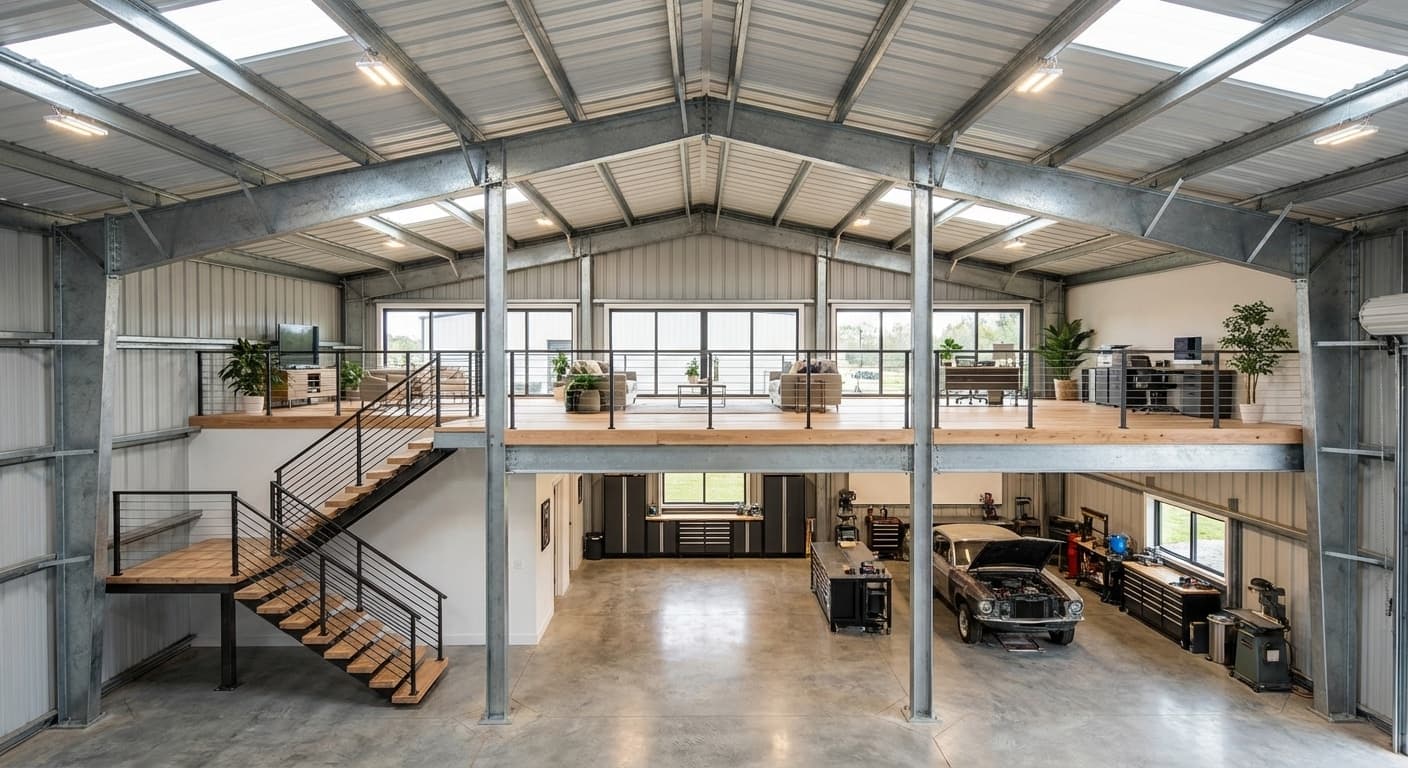

We help you add a code-ready loft inside your steel shell, turning open air into rentable square footage without new foundations or zoning headaches. The payoff is fast: 30-40 % lower cost than stick-built additions, rental income in under two years, and a future-proof asset that boosts property value 60-90 %.
Why Add a Loft to Your Steel Building?
Add a loft to your steel building and capture unused overhead volume without expanding your foundation, changing zoning setbacks, or extending construction timelines.
Instant Square-Footage Without Expanding the Footprint
A loft adds usable square footage without pouring a larger foundation or pushing zoning setbacks. By building upward inside the clear-span steel frame, you capture the volume already enclosed by the roof, turning idle air space into functional area. This vertical expansion keeps the building's footprint intact, preserving yard space for equipment, parking, or future growth.
The structural efficiency of pre-engineered steel makes the upgrade straightforward: factory-welded moment frames and purlin/girt systems accept a secondary floor or mezzanine without field modifications. Because the shell is already engineered for live and dead loads, adding loft framing is a matter of bolting joists and decking to the primary steel–no new footings, no extra concrete, no weather delays. The result is finished space delivered in weeks, not months.
Cost per square foot drops sharply when you eliminate excavation, additional slabs, and extended utility runs. Owners routinely report 30-40 % savings versus stick-built additions of comparable size, while the steel loft itself adds only pennies per square foot to the original building price.
Zoning departments typically treat interior lofts as mezzanines rather than stories, so height restrictions rarely change and permits process faster. In agricultural, aviation, and light-industrial districts where ground coverage is capped, the loft strategy unlocks capacity that a ground-level expansion would simply prohibit.
From Storage to Studio: Versatility by Design
The functionalities and utilities of a metal building with a loft are unstoppable. One buyer needs seasonal hay storage above a tractor bay; the next wants a climate-controlled office overlooking a showroom. Because steel accepts any finish–drywall, plywood, or open framing–the same loft can pivot from warehouse to apartment without structural rework.
Open loft platforms let you stage inventory, hang kayaks, or roll in pallet racks. Add partition studs and you have a private bedroom, podcast studio, or customer conference room overlooking the shop floor. The only fixed element is the steel deck; everything else is movable furniture or demountable walls.
Height and daylighting options expand the playbook. A 4-on-12 roof pitch with ridge skylights floods the loft for an artist's retreat, while a low-slope roof with insulated panels keeps a seed-storage loft cool and dry. Stairs can land at the sidewall for a narrow observatory loft or center-span for a symmetrical studio feel.
Because steel is impervious to moisture and pests, the loft environment stays stable for sensitive uses–wine storage, archival records, or a hobby electronics bench–without the seasonal swelling and shrinkage that compromise wood mezzanines. The result is a space that adapts as quickly as your business or lifestyle changes.
Built-In ROI: Rental Income & Property Value Boost
A finished loft turns a single-use steel shell into a dual-income asset. Contractors regularly lease the upstairs as a garage apartment or Airbnb while running a service business below; farmers house seasonal workers above equipment storage. Rental rates for small loft apartments in rural markets start at $800 per month, paying off the mezzanine package in under two years.
Even when the space remains owner-occupied, appraisers treat the heated and plumbed loft as full living area, bumping the building's value by 60-90 % of local residential square-foot pricing. On a 30 x 40 ft shop that adds 1,200 sq ft of loft, the rise in assessed value often exceeds the original loft package cost by 2-3x.
Energy incentives sweeten the deal. Insulating the loft deck and walls qualifies the entire envelope for higher R-value tax credits, while reflective roofing and vapor barriers attached to the steel structure lower HVAC loads. Owners report annual utility savings of 15-25 % after loft completion, compounding the cash-on-cash return.
Finally, the steel loft future-proofs the investment. Should zoning shift or the business expand, the clear-span bay below remains unobstructed for heavier equipment, while the loft can be re-leased as office, storage, or residential space without structural alteration–an adaptable revenue stream that wood-framed additions simply can't match.
Smart Design Choices That Maximize Loft Functionality
Pre-punched stringers and engineered clips eliminate field welding, keeping your loft stair rock-solid under full load without costly on-site work.
Stair Placement & Style: Front-, Side- or Spiral-Access Solutions
A staircase is more than access–it sets the tone for the entire loft. Front-entry straight runs invite guests up and become a visual centerpiece, while a side-mounted switchback tucks traffic against a wall and keeps the ground-floor layout wide open. Spiral kits ship pre-welded and bolt to a steel mezzanine beam in under two hours, perfect for tight bays where every square foot counts.
Whatever the footprint, we pre-punch stringers and provide engineered clips that land directly on the primary frame, eliminating field welding and keeping the flight rock-solid under 100-psf loft loads. Wood treads warm up the look; bar-grate treads give an industrial edge and let debris fall through in ag or aviation uses. A 42-inch rail with 4-inch picket spacing satisfies both IRC and commercial codes, and we ship it pre-galvanized so you're painting color, not rust.
Remember headroom: a 7-foot 6-inch clearance above the nosing prevents bruised knocks and satisfies most inspectors. If your eave height is shy, we can shift the landing outside the wall with a stub balcony–one more way steel's modularity keeps the loft legal without jacking the whole building.
Stair placement also drives future flexibility. A rear exit stair leaves the front bay clear for an overhead door or showroom glass, while an interior double-run creates a natural partition between shop and office below. Tell us how you'll use the ground level now and ten years out; we'll position the stair once and avoid costly retrofits later.
Ceiling Height, Roof Pitch & Skylight Integration for Natural Light
Steel lofts rarely suffer from low headroom–our standard scissors truss adds 24-inch heel height that nets 8 feet at the center while keeping the outside profile low for zoning. A 4:12 pitch is the sweet spot: shallow enough for standing-seam panels, steep enough for a half-story loft without a costly mansard.
Light is what sells the space. We factory-install curb-mounted skylights on 24-inch centers between purlins, so the opening lands between rafters and trims out clean. Dual-pane Low-E acrylic caps cut summer heat gain by 60 % compared to corrugated fiberglass, and the curb is already flashed to our 26-gauge roof panel, eliminating leak-prone field caulk.
Need even more daylight? Raise the eave height 18 inches and drop a clerestory on the long wall. It's a $3-per-square-foot upgrade that floods the loft with south-facing sun and turns the upper cube into rentable square footage–guests pay a premium for windows they don't have to duck to see through.
Insulation strategy rides hand-in-hand with roof geometry. A 6-inch blanket R-19 fits the purlin cavity without compressing, and a 2-inch thermal break at the eave stops condensation at the steel transition. The result: a loft that stays 15 degreesF closer to set-point year-round, cutting HVAC load by 25 % versus a flat-deck mezzanine.
Customizable Floor Plans: Open Loft vs. Partitioned Rooms
The beauty of a pre-engineered rigid frame is clear-span: no knee walls, no load-bearing partitions. An open loft gives you 100 % usable area–perfect for a studio apartment, yoga retreat, or bulk storage that changes shape with the season. We simply size the mezzanine joists at 10 psf live load and ship the steel plank deck in sections you can lift through a man door.
Walls still go up fast when you want them. 18-gauge track screws to the joists, and light-gauge studs drop in on 24-inch centers. Because the primary steel carries the roof, interior walls are non-bearing; move them next year without calling an engineer. Want a bath up there? We pre-locate a 2×6 wet wall on the plans so plumbing vents line up with the main stack and you're not drilling through beams later.
Clients often split the difference: three-quarter height bookcase dividers define office and sleeping zones while keeping the loft airy, or a 6-foot pony wall hides a kitchenette without blocking clerestory views. Floor loads can be upgraded to 40 psf residential for a full apartment, or kept at 125 psf commercial if the loft is pallet storage above a shop–same steel, different deck gauge.
Finally, future-proof the footprint. Specify an extra bay of mezzanine now and infill the deck later; the steel is already paid for and painted. Whether you're housing seasonal inventory or an Airbnb queen suite, our 3-D modeler shows every option in real time so you pick the layout that pays for itself.
Engineering Essentials: Insulation, Utilities & Code Compliance
Factory-laminated insulated metal panels deliver R-20 to R-42 in a single lift, sealing your steel loft's walls and roof cavities without thermal bridging.
Insulated Panels & Vapor Barriers for Year-Round Comfort
Steel lofts demand continuous insulation to stop thermal bridging through the framing. Factory-laminated insulated metal panels (IMPs) deliver R-20 to R-42 in a single lift, sealing wall and roof cavities in one pass. For budget builds, 6" fiberglass or mineral-wool batts fit between girts, but they must be paired with a smart vapor retarder–polypropylene on the warm side, perforated poly on the cold–to keep moisture from condensing on the steel skin.
A vented rain-screen channel behind the exterior sheathing adds 20-year durability insurance in humid zones. Spray-foam enthusiasts can apply 2" closed-cell directly to the steel, locking out air and boosting R-13 while acting as its own vapor barrier. Whichever stack-up you choose, blower-door testing to ≤ 0.25 CFM 50/ft² keeps energy bills predictable and loft temperatures within 3 degreesF of conditioned downstairs zones.
Skylight curbs need the same thermal respect: pre-insulated aluminum frames with thermally broken struts prevent the condensation rings that ruin drywall ceilings. Tie the roof IMPs to the curb with factory-supplied gasketed trim; the warranty depends on it.
Running Electrical, Plumbing & HVAC in a Steel Shell
EMT conduit clips neatly to steel purlins, but plan your circuits before the sheeting goes on–retrofitting means popping screws and voiding wall warranties. Run 2" conduit stubs to the loft during erection; later you can pull 12 AWG for outlets and 14 AWG for LED cans without crawling the girt bays. Surface-mount raceways painted to match trim keep the industrial look while satisfying NEC 358.
Loft baths require 3" DWV drops; bore the bottom chord of bar joists with a 3.5" knockout sleeve, never torch-cut. PEX lines snap into aluminum C-channels fastened to web stiffeners–expansion loops every 32" prevent the click-clack of hot-water surge. Mini-split cassettes hang from 14 ga. backing plates welded to column flanges; spec a condensate line tied to the gutter soffit and you avoid wall penetrations altogether.
Service clearances matter: maintain 30" front access for panels and 18" for duct runs below the loft floor. A ¾-hp inline fan at 0.5" WC static pressure handles 400 cfm through 8" flex wrapped in 2" fiberglass–quiet, efficient, and out of head-bump territory.
Wind, Snow & Seismic Loads: Certified Steel Framing Rules
Lofts add 15-25 psf live load plus partition weight; engineers bump the tributary joist load by 40% and upsize knee-brace bolts to A325-X. For 120 mph Exposure C zones, a 24' x 40' gabled loft needs lateral anchors every 8' to the foundation–screw-in helicals or wet-set rods per AISI S100. Snow drifting on the leeward upper roof increases loads 1.6x; specify 26 ga. PBR with 1.5" major ribs and 12" o.c. sub-purlins to keep deflection under L/240.
Seismic categories D and above require flexible diaphragms: ¾" plywood or 22 ga. steel deck screwed to joist top chords at 6" o.c. edge, 12" o.c. field. The loft floor must act as a collector, so stitch-plate the joist splices with 3/16" x 4" fillet welds and match the column cap plates to the anchor-bolt schedule–no substitutions, no value-engineering. When the stamped plans call for 2x .105 self-drill screws, swapping to .080 voids the 20-year structural warranty and the occupancy permit.
Final inspection hinges on a letter of certification from the manufacturer's engineer; keep a PDF on site. Inspectors will spot-check weld symbols, bay spacing, and uplift straps–have a spray-paint can ready to mark approved connections. Miss one clip angle and you'll be renting a lift twice.
Budget Breakdown: Construction, Finish-Out & Long-Term Savings
Pre-engineered steel lofts cut material waste below 2%, labor hours roughly in half, and total costs 15-20% below conventional framing while compressing schedules from months to weeks.
Material vs. Labor: Where Pre-Engineered Kits Cut Costs
Pre-engineered steel loft kits trim material waste to under 2 % by rolling every purlin, girt and joist to length at the factory, eliminating job-site sawing and the dumpster fees that go with it. Because each piece is stamped and pre-punched, erection crews bolt rather than field-measure, cutting labor hours roughly in half compared with conventional stick framing.
National buying power locks in galvanized coil pricing months ahead of delivery, buffering owners from the weekly spikes that plague lumber yards. The savings show up in the final bid: on a 30 x 40 ft building with a 400 ft² loft, pre-engineered systems typically run 15-20 % below red-iron weld-up quotes and finish ready for finish trades weeks sooner.
Cold-formed C-shapes weigh up to 30 % less than hot-rolled beams yet meet the same uplift and snow-load tables, so freight charges drop and smaller cranes–or sometimes none–are needed on site. Add the speed factor and owners save interest carry on construction loans, turning what used to be a six-month project into a six-week one.
DIY Friendly Options vs. Turn-Key Installation Packages
Owner-builders who supply their own concrete and doors can order a gasket-marked loft frame kit shipped with a color-coded manual and knock 25-30 % off total cost; the average 500 ft² loft goes up over a long weekend with two skilled friends and a telehandler. Every connection is slip-bolt and self-aligning, so no on-site welding or specialty tools are required–just torque wrenches and a screw gun.
Turn-key packages swap sweat equity for certainty: ProTrades crews arrive with the same pre-engineered steel, but they also handle permits, anchor-bolt layout, insulation, trim and final sweep. The premium runs roughly $6-8 per square foot of loft area yet compresses schedule risk and wraps workmanship under a single-source warranty, a trade-off most commercial clients gladly take.
Hybrid routes let owners finish the shell and hire certified crews only for stairs, electrical rough-in or spray-foam insulation, letting budgets flex without sacrificing engineering sign-off. Whichever path you choose, the kit is identical–only the labor line moves, so you can scale involvement to match cash-flow or season.
Maintenance-Free Perks: Pest, Fire & Weather Resistance Savings
Steel lofts never tempt termites, carpenter ants or rodents, wiping out the cyclical $1,200-$1,800 treatment and repair bills that plague wood-framed attics. Galvanized zinc coating plus factory-baked paint film carry 25- to 40-year warranties, so the only annual ritual is a hose-down of the gutters.
Non-combustible framing drops insurance premiums 10-15 % in most states and eliminates the need for sprinkler drops in many agricultural or storage lofts under 3,000 ft². Over a decade the savings alone can fund spray-foam insulation or skylight upgrades that further cut operating costs.
The same tight envelope that blocks air leaks also keeps out wind-driven rain and snow, so loft interiors stay dry and odor-free–no seasonal swelling, shrinkage or drywall cracks. Add it up and the lifetime ownership cost of a steel loft routinely runs 30 % below wood, turning yesterday's budget decision into tomorrow's profit center.
Conclusion: Is a Loft-Equipped Steel Building Right for You?
Quick Decision Checklist: Zoning, Use-Case & Timeline
Before you commit, confirm your local zoning allows accessory dwelling units or second-floor occupancy–some counties restrict loft living in agricultural zones. Map your primary use-case: storage-only lofts need 40 psf live-load framing, while sleeping quarters trigger 30 psf plus egress windows and a staircase wide enough for rescue access.
Next, line up your timeline. A pre-engineered steel loft package ships in 6-8 weeks and erects in under a week; finish-out adds another two weeks if you pre-plan electrical stub-ups and rough plumbing. If permits or financing could stretch past 90 days, lock steel pricing now–NSB's weekly market tracking protects you from surprise surcharges.
Top Scenarios: Barn Loft, Garage Apartment, Home Office & Airbnb
Pole-barn owners convert the upper bay into a hay loft during harvest and a hunter's bunkroom during season–one shell, two revenue cycles. Garage apartments above a three-car footprint rent for $1,200-$1,600 in most Sunbelt metros, paying off the loft upgrade in under four years.
Home offices tucked into a loft separate work from family life without the commute; steel acoustical panels keep Zoom calls free from downstairs power-tool noise. Airbnb hosts favor loft studios for their quick flip between guests–galvanized steel walls wipe clean and never swell like wood when mountain humidity spikes.
Next Steps: Ordering a Custom Quote from National Steel Buildings
Send NSB your site address and intended use–our in-house engineers pre-check wind and snow loads so the quote arrives stamped for your exact county. You'll receive floor-plan options, staircase layouts, and a turnkey price that bundles steel, insulation, fasteners, and ProTrades erection in one contract–no hidden GC markup.
Lock your slot once the quote meets budget; production drawings are approved within five business days, and materials ship shortly after. From first click to final walk-through, NSB keeps you updated weekly so the only surprise is how quickly your new loft is ready to use.
- Lofts add 30-40 % cheaper space without new foundations or zoning issues.
- Interior lofts dodge extra height rules, keeping permits fast and simple.
- Galvanized steel lofts cut lifetime costs 30 % versus wood, skipping pests and rot.
- Pre-punched steel kits erect in weeks, slashing labor hours and loan interest.
- A 400 ft² loft can rent for ~$800/month, paying off its package in under two years.
- Continuous IMP or spray-foam insulation stops thermal bridging and trims HVAC use 15-25 %.
- Upgraded 40 psf live-load framing and egress windows convert storage lofts to legal apartments.