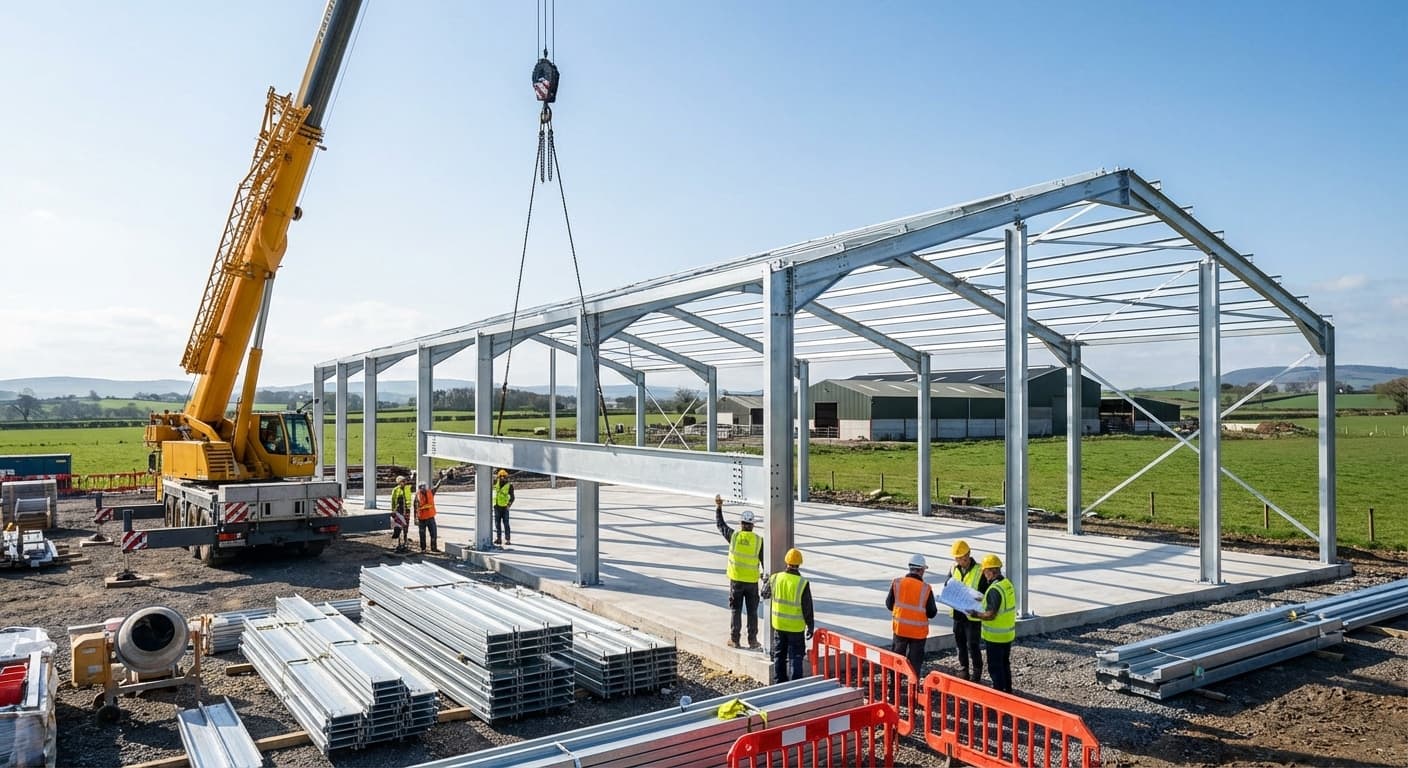

A single-source design-and-erect team eliminates the finger-pointing, rework, and 4-12% cost overruns that plague split-contract farm projects by keeping welding tolerances, load paths, and safety anchor points under one accountability structure, while digital BIM models, off-site prefab, and 4D crane scheduling cut erection time 30-50% and overall completion 14%. The article walks readers through a start-to-finish 2026 process–soil testing, early permit locking, utility mapping before concrete, and drone-verified precision–so every 30×40 starter shed or 80×100+ livestock barn is sized, priced, and buffered for supply-chain or OSHA delays up front, not during harvest season. It demystifies real costs (steel kit 40-50%, site prep 10-20%, freight 10%) and reveals why adding width or height later costs "full price," making build-bigger-now the smartest capital expense. Post-erection, readers learn to protect 20- to 40-year warranties with systematic inspections, document baselines, and maintenance rhythms that keep upkeep under $0.15/ft²–60% less than wood–and how the same crew returns for HVAC, roof coatings, or expansions at 40% savings because they already know every load path and connection. Ultimately, farmers gain a faster, safer, warrantied steel building that scales with their operation and preserves cash flow for crops, not callbacks.
Why Our Steel Farm Building Erection Services Excel When the Same Crew Designs and Builds
When one team designs and builds your farm structure, quality standards stay consistent from blueprint to field, eliminating the costly rework that separate firms typically create.
Seamless transition from design to erection eliminates miscommunication
Consistent quality control throughout every construction phaseQuality failures in construction carry a measurable cost: rework due to quality issues typically accounts for 4-12% of total project costs. [4] In traditional separate-team delivery, that rework traces back to predictable sources–incomplete information transfer between firms, undocumented field modifications, and coordination conflicts that weren't resolved before steel hit the site. These problems don't disappear through better intentions; they disappear when you have one team setting quality standards across design and construction simultaneously–not two teams interpreting requirements differently. [5] When the crew erecting a building also designed it, welding tolerances, connection acceptance criteria, and load path verification all fall under a single accountability structure–what's acceptable on paper is the same standard measured in the field.
The early collaboration between designers and builders also catches constructability problems before fabrication begins: designs that are structurally sound but difficult to execute as drawn get resolved at the drawing stage rather than through field improvisation or mid-erection RFIs bouncing between separate firms. [6] For your farm building where structural performance is non-negotiable–grain loads, snow loads, livestock ventilation systems all depend on precise execution–you need inspections that confirm expected results, not discover problems. That's the practical difference our unified team delivers.
Single‑source responsibility reduces rework and delays
The real payoff of single-source responsibility becomes clear when inevitable challenges arise during your project. While traditional delivery methods create finger-pointing between separate design and construction contracts, our unified approach means problems get solved internally–fast.
The numbers back this up: design-build projects complete 14% faster than traditional methods [8], with dramatically fewer change orders eating into your budget [9]. For your farm operation, where every day of delay means lost production capacity, this streamlined accountability structure keeps your project moving forward instead of stalling in dispute resolution.
Step‑by‑Step Steel Farm Building Erection Services Process for 2026
Coordinate permits with procurement from day one so material deliveries and crews are ready when approvals come through, eliminating costly timeline delays.
Pre‑construction site analysis, permitting, and digital planning
Your building starts with the ground beneath it. We test your soil first–if it can't handle the load, we'll stabilize it with deeper footings or gravel before pouring concrete. [10] Next comes drainage. Water pooling under your building means rust and foundation problems down the road, so we grade everything to shed water away from the structure. [10] We also map out underground utilities now–water lines, electrical runs, drainage pipes. Why?
Because adding conduit after concrete sets costs ten times more than running it beforehand. [10]Permits start day one, not after site prep. Your farm building needs zoning approvals for setbacks, height limits, and land use–find problems early, not after steel's ordered. [11] Here's why timing matters: one permit delay pushes everything back. Steel deliveries shift. Crews reschedule.
Your timeline compresses at the worst possible moment. [11] We coordinate permits with procurement from the start, so when approvals come through, materials and crews are ready to roll. [11]Digital planning ties everything together–your site conditions, permit requirements, and build sequence all sync up before steel gets cut. When plans match permits on load ratings and safety standards from the start, you avoid costly reorders later. [12] We organize your building kit before delivery–every column, beam, and fastener gets numbered and stored off-ground to prevent damage. Less sorting on-site means faster assembly. [12] Before trucks roll, we walk your site to verify crane access and staging areas. No surprises on day one. [12]
Advanced erection techniques: BIM coordination, drones, and modular assembly
BIM modeling solves problems before steel arrives. Our crews work from the same digital model that designed your building, catching connection conflicts and fit issues on screen–not on your site where fixes cost real money. [13] For farm buildings, precision matters.
Column spacing, door placement, and roof loads all need perfect alignment. Our 4D scheduling sequences every crane pick and crew movement, so parts arrive when needed and staging areas stay clear. [14] Modular assembly cuts your timeline even more.
We prefab entire wall sections and structural bays off-site, then install complete modules instead of assembling piece by piece. Result? 30-50% faster erection, fewer weather delays, and safer working conditions. [15] Drones verify everything as we build–if something's off by even an inch, we catch it before the next phase starts, not after walls are up and fixes get expensive. [13]
Rigorous safety protocols and compliance with industry standards
Steel erection is dangerous work–35 fatalities per year prove it. [16] OSHA's rules set the baseline: concrete must hit 75% strength before steel goes up, anchor bolts get inspected first, and fall protection kicks in at 15 feet. [17] But following rules isn't enough. Your site needs its own safety plan. Where's the soft ground that creates slip hazards? How does your site layout affect fall protection placement? What's the exact sequence that keeps the frame stable as it goes up? [17] Our crews train on every safety system–fall arrest gear, perimeter cables, control lines–before they touch your project. [16] Only certified riggers run lifts. Cranes stay within rated limits. Every hook has a safety latch. These aren't suggestions–they're what keep workers safe above and below. [17]
Here's the difference when your design-build team handles erection: fall protection anchor points are engineered into the steel from day one. No improvising. No retrofitting. Safety built in, not bolted on. That's what our
Custom Sizing, Pricing, and Scheduling for Every Steel Farm Building Project
Build bigger now because operations grow faster than expected, and adding length later costs far less than changing width or height.
Accurate sizing guide from 30×40 barns to mega dairies
Start with a 30×40 building if you need basic storage for a tractor and implements. That's your entry point–no wasted space, no excess heating costs. Your operation type determines where you go from there. Running combines and balers? You'll want 60×100 ft or larger. Housing livestock? Plan on 80×100 ft minimum to fit stalls, feed storage, and equipment lanes. [18]
Here's what farm owners tell us they wish they'd known: build bigger now. Operations grow faster than you expect. You can add length later without much hassle, but changing width or height means starting over–at full price. Those extra 5-10 feet cost pennies now compared to an addition later. [19]
Height matters too. Standard 16 ft eave height handles most farm equipment and keeps your costs reasonable. Dairy operations and larger livestock facilities need 16-24 ft for proper ventilation and feeding equipment clearance. [20] We help you size it right the first time with our
Transparent cost estimation tools and financing options
You deserve to know exactly where your money goes. Here's the breakdown: your steel building kit (frame, panels, trim, fasteners) runs 40-50% of total cost. Site prep adds 10-20% depending on your soil and drainage. Freight typically adds another 10%. [21] No surprises, no hidden fees.
Smart estimating tools like the Metal Building Bid Wizard take the guesswork out. Enter your specifics, get an itemized quote. Simple as that. [22]
Realistic timelines, milestones, and risk‑mitigation strategies
Building in 2025? The landscape has shifted. Experienced crews are harder to find. Supply chains still hiccup. Material costs can jump between quote and delivery. [24] [25] We've adapted, and here's how we keep your project on track.
First, we lock in your steel pricing early. No surprises when it's time to build. We maintain backup suppliers too–if one source fails, we pivot without missing a beat. That's the advantage of our national buying power working for you. [25]
New OSHA rules mean more paperwork–daily digital inspections, real-time reporting. We've built that time into our schedules so compliance doesn't eat into your construction timeline. [24]
Smart scheduling means building in buffer time for permits, deliveries, and inspections from day one. Not scrambling to make up time later. When our design team also handles your erection, those buffers are already in the plan. No handoff delays. No miscommunication. Just steady progress toward your move-in date.
Long‑Term Support and Upgrades for Your Steel Farm Building
Document your post-erection inspection systematically to protect your warranty coverage for the next several decades, since undetected installation issues can silently void claims.
Comprehensive post‑erection inspection checklist and warranty coverage
Once steel is up and the crew has left, the building's warranty clock starts–and what you document in the first days after erection determines how protected you are for the next several decades.
Post-erection inspection should systematically cover the same components that warranties actually protect: frame connections and anchor points for alignment and seating, panel surfaces for chipping or cracking at seams and fastener locations, roof panels for proper overlap and seal integrity, and any welded or bolted connections for workmanship accuracy. [26] These aren't cosmetic checks–workmanship warranties specifically cover installation-related failures including improper sealing, misalignment, and fastener problems, meaning undetected issues at this stage can silently void coverage if they compound before a claim is filed. [26] Warranty structures across the industry tier coverage by component longevity: frame rust-through warranties commonly run 20 years, panel chipping and cracking warranties range from 10 years on standard gauges to 40 years on premium 26-gauge steel, and workmanship coverage typically runs 30 to 180 days post-installation. [27] [28] What falls outside coverage matters just as much–natural disasters, red surface rusting (as distinct from structural rust-through), modifications made after installation, and improper maintenance can all void applicable warranties, which is why establishing a baseline inspection record immediately after erection is the foundation of any valid future claim. [26] When a problem does surface, the process is straightforward but sequential: pull written warranty documents (verbal warranties are not legally enforceable), photograph the issue in high resolution, contact the manufacturer or dealer promptly–delays can invalidate time-sensitive claims–and retain all records of the interaction. [26] Because manufacturer warranties cover fabrication defects and installer warranties cover workmanship separately, knowing which applies to a given failure determines who you contact and what documentation you need; buying from a design-build team means both warranties trace to the same source, removing that ambiguity entirely. [26]
Ongoing service support, rapid problem‑solving, and maintenance plans
A steel farm building's durability is conditional on structured upkeep–not periodic attention when something looks wrong. The inspection schedule that protects both the structure and its warranty runs on three distinct rhythms: monthly or quarterly walk-around checks that catch surface-level issues before they compound, an annual professional inspection that identifies structural concerns not visible from ground level, and post-weather inspections after high winds, heavy snow, or severe storms that can shift components or loosen fasteners without leaving obvious surface damage. [29] Each inspection tier targets different failure modes.
Routine checks catch loose or deteriorating fasteners–among the most common maintenance failures in steel structures–because thermal expansion and contraction cycles gradually back screws out of panel connections until water finds a path through. [30] Annual professional inspections go deeper: sealant degradation from UV exposure, corrosion developing near moisture entry points, insulation damage from pests or condensation, and drainage conditions that pool water against the foundation all require trained eyes and access to areas that ground-level checks miss. [29] Skipping documented inspections carries a direct financial consequence beyond the structural risk–many panel and coating warranties require proof of consistent upkeep to remain valid, meaning deferred maintenance doesn't just allow problems to develop; it eliminates the coverage that would pay to fix them. [29] When the crew that erected your building stays involved through a maintenance plan, they're not relearning the structure at each visit–they know which connections required special detailing, where drainage was engineered around site constraints, and which components have the tightest tolerances. That context is what converts a scheduled inspection into rapid problem identification rather than investigative guesswork, and it's what keeps a minor fastener issue from becoming a roof leak before the next scheduled visit. [https://futurebuildings.com/blog/steel-building-maintenance.html]
Single‑source upgrades, retrofits, and lifecycle management
Your steel building's needs change predictably over time–and we're here for every phase:
Years 1-10: Smart additions without structural changes
- HVAC systems for climate control
- Insulation upgrades for energy savings
- Security reinforcements
Years 11-20: Protection and expansion
- Roof coatings to prevent UV damage
- Insulation inspections for thermal gaps
- Building expansion (40% cheaper per square foot than new construction)
Years 20+: Structural health checks
- Connection inspections
- Foundation assessments
- Code compliance updates
Cost-effective retrofits that extend your building's life:
- Powered ventilation for better air quality
- Skylights to cut lighting costs
- Walkway systems to protect roof panels during maintenance
- New metal panels for fresh appearance and better insulation
The payoff? Agricultural steel buildings maintained this way cost under $0.15 per square foot annually–60% less than wood structures. Over 50+ years, that savings adds up fast.
Here's the real advantage: Since we designed and built your structure, every upgrade decision starts from complete knowledge of your building's load paths, connections, and site-specific engineering. No expensive investigation phase. No surprises. Just smart improvements that keep your building working as hard as you do.
- Design-build crews cut rework costs and finish 14% faster than split teams.
- Lock steel pricing early; freight and site prep add 20-30% to total cost.
- Build wider now–adding width later costs full price; length is cheap to extend.
- Post-erection inspection within days secures 20-40 yr frame/panel warranties.
- Mandatory upkeep: quarterly fastener checks, annual pro inspection, storm follow-ups.
- Prefab modular bays shave 30-50% off erection time and reduce weather delays.
- OSHA mandates 75% concrete strength before steel, fall protection at 15 ft.
- https://www.ranneyblair.com/blog/benefits-of-design-build/
- https://billd.com/blog/design-build-construction/
- https://marbuildingsolutions.com/7-benefits-of-design-build-construction/
- https://cmicglobal.com/resources/article/Quality-Control-in-Construction-An-Overview
- https://www.hm-ec.com/blog-posts/when-to-use-the-design-build-approach-choosing-the-right-delivery-method-hm
- https://www.mccarthy.com/insights/understanding-the-design-build-delivery-method-in-construction
- https://blog.eb3construction.com/construction/project-management/single-source-accountability-construction/
- https://www.paulhemmer.com/more-than-a-project-how-design-build-creates-long-term-value-in-u-s-construction/
- https://dbianycmetro.org/about-dbia-nyc/what-is-design-build/
- https://www.metfraa.com/blog/site-preparation-requirements-for-pre-engineered-metal-building-installation/
- https://www.permitflow.com/blog/preconstruction
- https://www.alpha-labor-co.com/blog/pre-engineered-metal-building-installation-guide
- https://www.mdpi.com/2075-5309/15/5/765
- https://www.united-bim.com/bim-for-prefabrication-in-construction/
- https://www.ijraset.com/research-paper/integrating-bim-with-modular-construction
- https://trdsf.com/blogs/news/steel-erection?srsltid=AfmBOoq0NnMncl7Cs84UzxlvwIwZr1zBQvcRJzdYqQry8ZCjtv6t49XP
- https://stevensec.com/blog/steel-erection-safety-key-protocols-and-standards
- https://harrisconstructorsinc.com/what-are-common-steel-building-sizes/
- https://metalprobuildings.com/popular-steel-building-sizes/
- https://info.fbibuildings.com/blog/farm-building-size
- https://www.cecobuildings.com/blog/steel-building-cost-estimator-a-contractors-guide-to-pemb-pricing/
- https://steelestimatingsolutions.com/metal-building-cost-estimator-tool/
- https://www.steelcobuildings.com/steel-building-financing/
- https://www.citrincooperman.com/In-Focus-Resource-Center/Recent-Construction-Delays-Mitigating-Challenges-Amidst-Uncertainty
- https://gp-inc.com/5-critical-construction-challenges-in-2025-and-how-top-companies-are-solving-them/
- https://premierbuildings.com/metal-building-maintenance-guide/
- https://bungersteel.com/blog/news/annual-routine-maintenance-on-your-steel-buildings/
- https://roimetalbuildings.com/lifecycle-of-a-metal-building/
- https://www.summitsteelbuildings.com/steel-systems-are-the-cost-effective-solution-throughout-a-lifecycle
- https://www.designcomponents.com/retrofit-ready-how-to-upgrade-aging-steel-buildings/