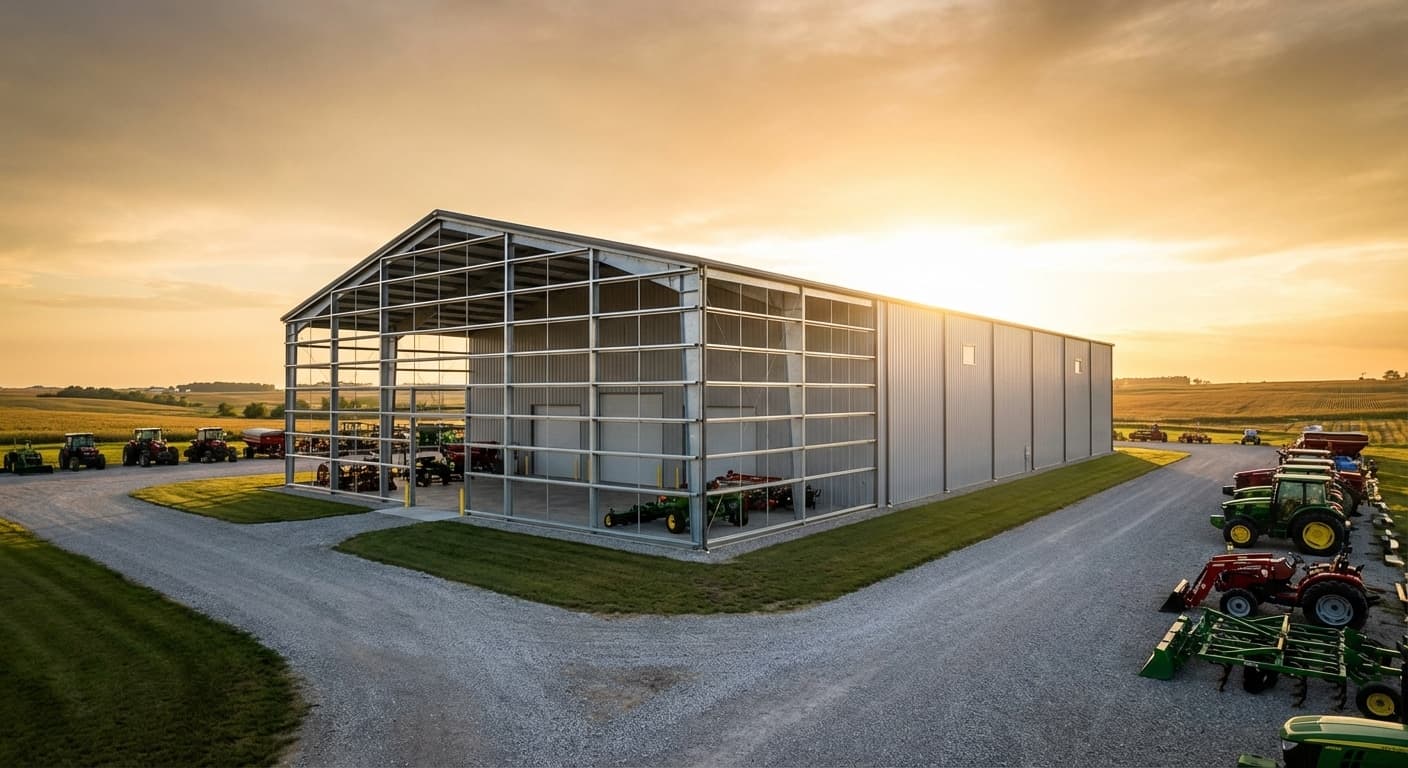

Steel-framed farm buildings can cut insurance premiums by up to 75 percent because the non-combustible frame never feeds a fire, a critical advantage as U.S. farm-fire payouts hit $978 million last year. The article shows how cold-formed steel qualifies for the most fire-resistive IBC construction types, unlocks larger footprints without height limits, and, when paired with intumescent coatings, IMPs, or dry-pipe sprinklers, creates layered protection that underwriters reward with immediate discounts. Readers learn exactly which 2026 code paths–from Ontario's new hazard-based rules to MBMA-tested UL assemblies–deliver the certifications carriers want, and how folders of material stamps, third-party inspections, and maintenance logs turn those certifications into the lowest possible rate. It details the upfront 20-30 percent steel premium (about $24-$43 per square foot turnkey) but proves the break-even arrives within 7-10 years through 70 percent lower lifetime maintenance, 15-20 percent energy savings, and a 5-10 percent resale boost, while in California's fire zones steel is often the only way to get coverage at all. By calling agents early, documenting every fire-resistant upgrade, and submitting proof 60-90 days before renewal, farmers lock in credits that compound yearly and shield both their barns and their balance sheets from the spark that turns wood into total loss.
Understanding Steel Farm Building Fire Resistance and Its Financial Impact
Steel's non-combustibility means your farm building won't amplify fires, and insurers reward that protection with immediate discounts on your premiums.
Assessing fire risk in modern agriculture
Your farm faces a $978 million problem. That's what U.S. insurers paid out in farm fire claims last year alone. [1] You store fuel next to machinery. Fertilizer sits beside electrical panels. One spark meets one combustible, and you're looking at total loss.
The good news? Technology now catches fires before they start. Thermal imaging spots hot machinery components. Electrical monitors flag overloaded panels. [1] You can shift from fighting fires to preventing them–and insurers notice.
How steel's non‑combustible properties compare to wood and alternatives
Steel doesn't burn. Wood does. That's the difference that drives your insurance costs.
Wood framing feeds fires–turning small incidents into total losses. Steel stays non-combustible. It won't ignite or spread flames. [4] But fire is just one risk wood brings to your premium:
- Lightning strikes ignite wood barns. Steel conducts electricity safely to ground.
- Wood rots, warps, and attracts termites–each a separate claim waiting to happen.
- Mold grows on wood, not on steel's inorganic surface. [4]
Every vulnerability adds dollars to your premium. Meanwhile, construction fires in wood-framed buildings keep climbing, pushing insurers to charge even more for combustible structures. [4]
Your farm stores fuel, chemicals, and machinery under one roof. Steel framing ensures the building itself won't turn a containable fire into catastrophe. [4] (For detailed fire-resistance specifications in steel construction, see Section 3.)
Linking fire‑resistance to insurance premium reductions
Your insurer prices combustibility directly into your rate. More combustible materials mean higher premiums–it's that simple. [6]
Steel buildings qualify for immediate discounts.
Design Strategies that Deliver Certified Fire Resistance
Steel framing satisfies non-combustible code requirements throughout your building envelope, meaning the frame itself will never contribute to fire spread.
Non‑combustible steel framing and structural considerations
Choosing cold-formed steel (CFS) framing for a farm building isn't just a material decision — it's a building classification decision with downstream effects on what you can build, how large, and what it costs to insure. Under the International Building Code, construction types are defined by whether structural elements are non-combustible or combustible.
Types I and II require non-combustible materials — steel, concrete, masonry — while Types III through V permit wood. [7] A steel-framed farm building that qualifies as Type I or II carries no height restrictions at the most fire-resistive level (Type I-A) and can be designed at larger footprints than its wood-framed equivalents. [7] One distinction worth understanding before talking to an underwriter: "non-combustible" and "fire-resistance-rated" are not the same thing. A wood-frame wall can achieve a 2-hour fire-resistance rating through gypsum and treatment, but it cannot be substituted where the code requires a non-combustible element — and insurers treat these differently when pricing risk. [7] For structural design specifically, CFS framing satisfies non-combustible requirements throughout the building envelope, meaning the frame itself will never contribute to fire spread — a property that holds whether the fire starts inside from stored fuel or ignites externally. [2] This is the foundational structural argument for steel in agricultural settings: the frame stays inert while other fire-control systems do their work.
Fire‑rating coatings, intumescent paints, and insulated panel systems
Steel's non-combustibility is a structural advantage, but it doesn't make steel invulnerable. Above 550 degreesC — temperatures a barn fire can reach within minutes — steel begins losing structural strength rapidly, risking collapse before the fire is suppressed. Intumescent coatings directly address this gap: when exposed to heat, they expand and form a dense, insulating char layer between the flame and the steel surface, slowing heat transfer and extending the time before the frame reaches critical temperatures. Independent testing puts that protection window at up to 120 minutes — enough time for evacuation and fire suppression in most agricultural scenarios. [8]The coating category has expanded well beyond a single product type, and the differences matter for farm applications.
Water-based formulations have significantly reduced VOC output without sacrificing fire performance, which matters in enclosed storage buildings where ventilation during application is limited. Epoxy-based intumescent coatings offer stronger adhesion and better resistance to chemical exposure — relevant in settings where fuel, fertilizer, and agrochemicals are stored nearby. Nano-enhanced formulations incorporating graphene push thermal resistance and coating durability further than conventional options, extending effective service life in conditions with humidity and temperature swings. [9] Thin-film intumescent paints represent another practical option: applied like standard paint, they add no structural load and don't require the bulk of concrete encasement, making them straightforward to specify on both new construction and retrofit projects. [8]Insulated metal panels (IMPs) approach the problem differently. Rather than treating the frame after construction, IMPs integrate fire-resistant insulation — typically stone wool or mineral-based cores — directly into prefabricated panel assemblies that form the building envelope.
This means fire resistance is built into the structure from the start, not added as an afterthought. Fire-resistant cladding systems using non-combustible materials like fiber cement and mineral wool serve a similar function, specifically blocking external fire spread from reaching the structural frame. [9] The strongest protection strategies combine these passive systems — intumescent coatings on structural members, fire-rated panels at the envelope — with active suppression, and insurers increasingly price this layered approach differently than single-measure protection, recognizing that redundancy reduces the probability of total loss. [9]
Integrated fire‑stop, sprinkler, and detection solutions for farms
The passive fire resistance built into steel framing only goes so far — active suppression and detection systems are what contain fires once they start. For farm buildings, sprinkler selection depends directly on what's stored and whether the space is heated.
Wet pipe systems — the most common commercial option, running $1.50-$4.00 per ft² for new construction — are reliable but fail in unheated barns and equipment storage where pipes can freeze. Dry pipe systems solve this by keeping lines pressurized with air rather than water until a head activates, making them the default choice for unheated agricultural structures per NFPA 13. [11] Where flammable liquids are stored — fuel, oils, chemical concentrates — a single suppression type isn't enough.
Deluge systems discharge simultaneously across an entire zone, providing the rapid full-area coverage that chemical storage areas require under NFPA 15 and 16, while foam-water systems go further by smothering flammable liquid fires that water alone can't fully extinguish — cooling and suffocating the fire simultaneously, as NFPA 11 mandates for fuel-handling environments. [11] Detection ties these layers together: integrating smoke and heat detection with suppression means the system responds faster and with less collateral damage than suppression alone. Maintaining that integration matters as much as installing it — inspection programs covering fire extinguishers, alarm testing, sprinkler checks, and fire and smoke damper testing keep every layer functional and create the documented maintenance record insurers increasingly require when underwriting agricultural properties. [10]
Navigating 2026 Codes, Standards, and Certification Pathways
Updated 2025 codes in Ontario and the MBMA Fire Resistance Design Guide give you tested assembly specifications that satisfy insurers and work across Canada.
Key U.S. and Canadian fire‑resistance codes for agricultural buildingsYou're building in 2026, not 2006. The codes have changed, and they matter for your insurance rates. The U.S. IBC breaks down metal building requirements by category — framing, walls, roofs, openings, and hazard levels. Each has its own rules based on what you're building. [12]
Canada went further. Ontario rewrote its Farm Building Code on January 1, 2025. No more one-size-fits-all rules. Your building gets classified by size, use, and hazard level. [14]
Here's what hits your wallet: Build a farm equipment shed over 6,500 square feet? You need tighter truss spacing and reduced stud spacing. House livestock or store chemicals? Fire alarms and sprinklers are now mandatory. Run a farm store? Add exit signs, emergency lights, and fire extinguishers. [14] These aren't suggestions — they're requirements that turn a $50,000 project into $75,000 if you retrofit later.
The good news: steel-framed
Ontario Building Code updates and MBMA Fire‑Resistance Design Guide
Ontario simplified everything in 2025. They scrapped 1,730 differences between provincial and national codes. Now one set of rules works across Canada. [17] For you, that means your engineer knows the code whether you're building in Ontario or Alberta. Your fire-resistance documentation works everywhere. Your insurance paperwork stays consistent.
Need proof your steel building meets fire codes? The MBMA Fire Resistance Design Guide has you covered. They tested at three major labs — UL, Intertek, and FM Global. Results? Metal buildings hit one- and two-hour fire ratings easily. [15]
The guide spells out exactly what works:
- Gypsum board configurations
- Mineral wool options
- Fire caulk systems
- Insulation arrangements for walls and roofs
It's 103 pages of tested assemblies, co-branded with the International Code Council. [16] When your insurer asks for UL-rated assembly numbers, you hand them the page. That's the verification that moves you from "we'll review your application" to "here's your discount." [15]
Obtaining certifications and documentation for insurer approval
You need two types of certification for the best insurance rates: material proof and building designation.
For materials, look for CFS framing with SFIA's Certified for Code Compliance stamp. This tells your underwriter the steel meets non-combustible standards — no custom review needed, no delays in getting your quote. [2]
For the whole building, programs like IBHS FORTIFIED carry weight. In California especially, where insurers won't touch wood-frame buildings in fire zones, a FORTIFIED designation is the difference between getting coverage and getting rejected. [18]
The 2024 code updates help you here. Everything needs labels now — garage doors show manufacturer, model, pressure ratings, and test standards right on the product. That's permanent documentation that stays with your building. [19]
Before you submit anything to your insurer, check which code version applies where you're building. The IBHS National Building Code Adoption Tracker tells you exactly what standard your underwriter expects to see. Match your documentation to their requirements — it's the difference between a quick approval and weeks of back-and-forth. [19]
Translating Fire Resistance into Tangible Insurance Savings
Steel framing cuts your insurance premiums by 25 to 75 percent compared to wood, with proper documentation pushing your savings toward the higher end.
Documented premium reductions and insurer expectations in 2026
Your steel building's fire resistance translates directly into dollars saved on insurance. Builders risk insurance savings for CFS-framed buildings range from 25 to 75 percent compared to wood — a spread wide enough that the documentation you present can mean thousands in savings. [20] Add metal roofing to your steel frame and you'll typically see another 5 to 35 percent knocked off your property insurance. [21] In California's fire zones, it's even more stark: many insurers won't cover wood buildings at all anymore.
Steel isn't just a discount — it's your ticket to coverage. [18] Here's what moves the needle with insurers in 2026: documentation. They want installation records, material certifications, manufacturer specs, and inspection reports.
Your discount depends on proving compliance, not just claiming it. Add maintenance records to your package and you'll push your premium toward the bottom of that 25-75 percent savings range. [21]
Calculating ROI: construction costs versus long‑term savings
Steel framing carries a 20-30% upfront cost premium over wood construction, with pre-engineered building kits priced at roughly $17-$20 per square foot for materials and another $6-$10 per square foot for labor — putting most farm builds in the $24-$43/sq ft turnkey range. [22] That upfront premium? It's the wrong number to focus on.
Your steel building needs 70% less maintenance over 30 years — no rot, no warping, no termites eating your investment. [22] Energy bills drop too. High-performance insulation in steel framing cuts your heating and cooling by 15-20% every year. [22] Add up the insurance savings (up to 75%), energy savings (15-20%), and reduced maintenance (70% less) — your break-even hits within 7-10 years. [22] After that, it's pure profit.
Plus, when you sell, steel buildings command a 5-10% premium over wood. [22] Pro tip: Build a 5-10% contingency into your budget for site prep surprises and steel price moves. Better to plan for it than explain it later. [23]
Step‑by‑step communication plan to present fire‑resistance proof to insurers
Call your agent before you collect a single paper. Ask exactly which fire-resistance features trigger discounts and what proof they need. Every carrier wants something different — guessing wastes time and money. [24] Here's a money-saving detail: some insurers apply fire credits to just the fire-risk portion of your premium. Others apply them to your whole policy. That difference can double your discount. Ask. [25] Once you know what they want, organize your proof into three folders:
- Material certifications — CFS compliance docs, UL assembly numbers, product labels
- System records — sprinkler inspections, alarm tests, fire damper certs
- Visual proof — dated photos of your fire-resistant upgrades and defensible space [25] Get a third-party inspection.
A certified report carries ten times the weight of your own documentation. Underwriters see it as verified fact, not just your claim — and that moves you into higher discount tiers. [25] Submit everything 60-90 days before renewal. Give them time to process without rushing. [25] Then verify. Check your renewal declarations for the line-item credit. Missing or low? Call immediately.
Don't wait. [24] Keep those maintenance records coming. Insurers can yank your discount at renewal if you can't prove ongoing maintenance. Worse, they can deny claims on poorly maintained systems — even if the original install was perfect. Document everything. [24]
- Steel framing can cut insurance premiums 25-75% versus wood.
- IBC Types I/II steel farm buildings have no height limits and lower rates.
- Intumescent coatings give steel 120 min of collapse protection in fires.
- Ontario's 2025 Farm Code mandates sprinklers and alarms for chemical storage.
- Up-front steel cost premium breaks even in 7-10 yrs via lower claims, energy, upkeep.
- https://agentblog.nationwide.com/agriculture/safety/fire-risk-reduced-during-design-construction-phase-of-ag-buildings/
- https://www.steelframing.org/fire-safety
- https://www.rhinobldg.com/blog/agricultural-building-trends-part-2
- https://buildsteel.org/technical/fire/this-wildfire-season-cold-formed-steel-leads-the-way-in-building-fire-resilient-homes/
- https://metalbuildermagazine.com/fire-prevention-equals-cost-savings/
- https://www.meltplan.com/blogs/what-materials-are-permitted-for-each-construction-type-under-the-ibc
- https://www.charcoat.com/blog/why-intumescent-coatings-are-essential-for-structural-steel/
- https://metalcon.com/blog/emerging-trends-in-fireproofing-metal-construction/
- https://www.jfahern.com/industries/agriculture
- https://firetron.com/fire-sprinkler-systems/best-fire-sprinkler-systems/
- https://grokipedia.com/page/Fire_Resistance_in_Metal_Buildings_IBC
- https://canada.constructconnect.com/dcn/news/projects/2026/01/enhanced-fire-protection-for-buildings-and-occupants-part-one-cold-formed-steel
- https://www.ivesinsurance.com/2025/01/20/farm-building-code-changes/
- https://mbma.com/fire-protection
- https://metalbuildermagazine.com/mbma-releases-2nd-edition-of-fire-resistance-design-guide-for-metal-building-systems/
- http://www.ontario.ca/page/2024-ontario-building-code
- https://futurebuildings.com/blog/steel-buildings-fire-insurance.html
- https://ibhs.org/building-codes/building-codes-progress/
- https://buildsteel.org/why-steel/durability/steel-framing-mitigates-fire-risks-reduces-insurance-costs-and-improves-building-resilience/
- https://www.midfloridametalroofingsupply.com/lowering-business-expenses-the-impact-of-metal-roofing-on-commercial-insurance-rates
- https://www.scottsdalesteelframes.com/building-with-steel/steel-framing-system
- https://www.steelcobuildings.com/metal-building-cost-a-comprehensive-guide-to-budgeting-and-planning/
- https://resources.impactfireservices.com/fire-protection-systems-lower-insurance-premiums
- https://fbia.com/blog/insurance-discounts-fire-mitigation/