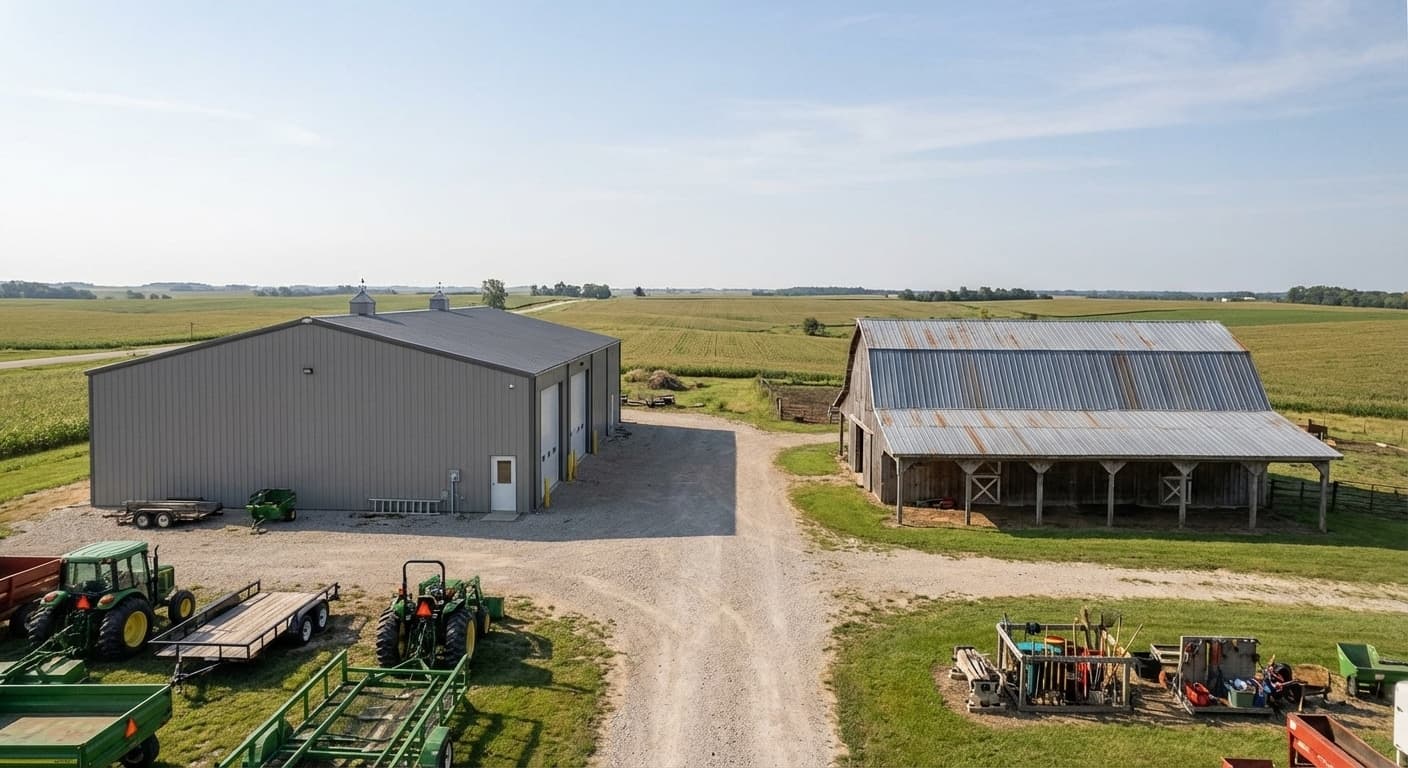

Compare 20-year upkeep costs for steel farm buildings versus pole barns so you can budget with confidence. We show how factory-engineered steel saves tens of thousands in maintenance, insurance, and resale value while pole barns keep charging you again and again.
Up-Front Design & Material Differences That Drive Long-Term Costs
Factory-engineered steel buildings eliminate field variations that turn into costly repairs, while pole barns accumulate small mistakes that compound into water damage and structural failures.
PEB precision engineering: how factory tolerances cut future repair bills
Your future repair bills start in the factory–or in the field. That's the core difference between pre-engineered steel buildings and pole barns.
Pole barns go up piece by piece on your property. Weather hits, crews change, decisions get made on the fly. Those small variations add up. A beam sits slightly off. A panel doesn't seal right. Five years later, you're paying for water damage nobody saw coming.
Steel buildings? Every component is cut, drilled, and coated in a climate-controlled factory before it ships. [1] Your beams fit. Your panels seal. Your fasteners line up exactly where the engineer planned them. No gaps for moisture. No stress points waiting to fail. [2]
We use Building Information Modeling (BIM) to catch problems before steel gets cut. Structural conflicts, electrical runs, mechanical clearances–all coordinated in advance. [1] No surprises. No change orders. Just consistent quality that performs the same way 20 years from now as it does on day one. [2]
For operations that can't afford downtime–livestock facilities, chemical storage, equipment housing–that predictability matters. You budget for maintenance once and stick to it. [3]
Building codes, insurance breaks, and resale value: why steel earns better appraisals
The real wallet hit: pole barns have no prescriptive building code. They're often built without engineering for your local wind, snow, or seismic requirements. [4]
Steel buildings? Engineered to meet every local code before we load the truck. Wind loads, snow loads, seismic requirements–all calculated for your exact site. [5]
That engineering pays you back three ways:
Permits — You sail through approval because the math is already done.
Insurance — Steel doesn't burn. Add code compliance, and insurers cut your premiums. (Details on the 30% savings in our ROI section below.) [6]
Resale — Banks and buyers see engineered structures backed by 40-year warranties as solid investments. [4] Pole barns get classified as semi-permanent–a label that drops appraised value no matter how well you maintain them.
The code gap isn't paperwork. It's real money leaving your pocket every year through higher insurance, lower appraisals, and buyers who won't pay full price for a structure without engineering behind it.
Year-by-Year Maintenance Checklist & Cash Outlay (Years 1-20)
Just 2-4 hours yearly of simple inspections and $15 touch-ups prevent thousands in damage to your steel farm building.
Steel farm buildings: annual inspection routine, fastener schedule, and recoating timeline
You'll spend just 1-2 hours twice a year keeping your steel farm building in top shape–that's it. [7] Spring inspection is simple: check the bottom foot of wall panels for mud buildup, make sure gutters drain away from the building, and test door seals for winter damage. [7] Fall prep takes even less thought: wash down the exterior with dish soap to clear off bird droppings and pollen, then do a quick roof check from ground level before cold weather hits. [7] After any major storm, add a 24-hour walk-around to catch issues early–but that's your entire maintenance routine right there. [7]Your biggest maintenance task?
Tightening a few loose screws.
Wind and temperature changes can work fasteners loose over time, but you'll spot them easily during your walk-around–look for screws sitting slightly proud or washers that look cracked. [7] [9] Twenty minutes with a drill twice a year prevents those loose screws from becoming expensive water damage inside your walls. [7] If you're in a high-wind area, check roof panel edges quarterly–it costs nothing but saves thousands. [9]Touch up scratches immediately–$15 in spray paint today saves you from a $500 panel replacement in two years. [8] Every five years, budget $1,500-$3,000 for a 40×60
Pole barns: treating ground-line decay, re-roofing cycles, and siding replacement realities
Pole barn posts rot from the ground up–and you won't see it coming. Those pressure-treated posts might last 20-30 years in perfect conditions, but add livestock traffic, irrigation runoff, or clay soil, and decay starts eating away at the base. [10] By the time you notice soft spots, leaning walls, sticking doors, or a sagging roofline, you've got years of hidden damage. [10] Replacing one bad post costs $300-$800, but when multiple posts fail on a 40×60 building, you're looking at $3,000-$6,000 once you factor in lifting, shoring, and backfill. [11] Sure, protective sleeves and gravel backfill help–if you installed them at the start. Retrofitting means excavation, which means you're already behind the curve. [10]Your pole barn roof starts nickel-and-diming you early.
Minor repairs–patching leaks, replacing damaged panels–run $300-$2,500. [12] But once rot hits the wood purlins underneath, you're into $2,500-$8,000 territory, and suddenly you're debating whether to patch or replace the whole thing. [12] Here's the kicker: screws through metal into wood purlins lose grip as the wood softens, speeding up panel failures. Plan on re-roofing every 15-20 years–that's at least one major roof project in your 20-year ownership window. [12]Siding problems look cosmetic until you realize the structure behind is rotting. When wood girts–the horizontal boards between posts–soak up moisture and rot, your metal panels lose their anchor points.
They start waving, gapping, pulling away at edges. Now you're not just replacing siding; you're rebuilding the frame behind it. Interior damage from roof leaks adds another $1,000-$3,000 to fix wet insulation and electrical problems. [11] Add up post repairs, roof work, and siding replacement over 20 years, and you've got the maintenance reality pole barn sellers don't mention–but you'll definitely feel it by year 10.
Cost tracker tables: average annual spend, inflation-adjusted, for 40'x60' and 60'x120' structures
Here's what these maintenance differences mean for your budget over 20 years. Steel buildings need about 1% of your initial investment annually for upkeep. Pole barns?
You're looking at 2-4% each year for painting, treating wood, and replacing parts–as explored further in our lifetime value comparison. [13] Steel building kits for the sizes below run $20-$45 per square foot installed, while pole barns start about 15% cheaper. [14] But watch what happens when maintenance costs compound–that initial savings disappears fast. All figures include 3% annual inflation from 2024, showing real dollars you'll actually spend. [13]Table 1: 40'x60' Structure (2,400 sq ft) — Inflation-Adjusted Annual Maintenance Spend
| Year | Steel Building (est.) | Pole Barn (est.) | Annual Difference |
|---|---|---|---|
| 1 | $780 | $1,990 | $1,210 |
| 5 | $880 | $2,240 | $1,360 |
| 10 | $1,020 | $2,600 | $1,580 |
| 15 | $1,180 | $3,010 | $1,830 |
| 20 | $1,370 | $3,490 | $2,120 |
| **20-yr total** | **~$21,000** | **~$53,500** | **~$32,500** |
| Year | Steel Building (est.) | Pole Barn (est.) | Annual Difference |
|---|---|---|---|
| 1 | $2,340 | $5,970 | $3,630 |
| 5 | $2,720 | $6,920 | $4,200 |
| 10 | $3,150 | $8,020 | $4,870 |
| 15 | $3,650 | $9,290 | $5,640 |
| 20 | $4,230 | $10,780 | $6,550 |
| **20-yr total** | **~$62,900** | **~$160,300** | **~$97,400** |
Inflation at 3% annually from 2024 baseline.* [13] [14]Bigger buildings magnify the maintenance gap–that 60'x120' operation running livestock or heavy equipment sees the difference multiply fast. [13] These tables show maintenance only, not the insurance savings covered in our ROI section, where steel's fire resistance advantage compounds year after year. [14] [6] Consider these numbers your minimum–pole barns in real farm conditions with livestock, chemicals, and heavy traffic typically hit the high end of that 2-4% maintenance range. [13]
Hidden Costs That Surprise Owners After 8-12 Years
Ammonia vapor from livestock attacks every panel and beam in your structure, but G-90 galvanized steel with proper ventilation stops corrosion before it starts.
Moisture wicking in wood columns: concrete collar repairs and lift-pole releveling
Livestock & chemical exposure: interior corrosion in steel vs. post rot in pole barns Livestock changes everything. Forget weather–it's the ammonia vapor from animal waste that kills buildings. It doesn't stay at floor level. It rises, hitting every panel and beam in your structure. [21] Unprotected steel? You'll see rust in just a few years. [21] Don't avoid steel–specify the right steel.
G-90 galvanized and straight zinc coatings beat Galvalume in livestock environments every time. This matters for your cattle barn, dairy, or poultry house. [21] Ventilation is your other weapon. Open-curtain sidewalls with ridge venting exhaust ammonia before it attacks your panels. Keep air moving year-round–sealed buildings corrode faster. [21] Poultry operations need special consideration. Insulated metal panels with exoskeleton framing–columns outside, panels inside–give you smooth walls that resist chemicals and wash down easy between flocks. [21] Compare that to pole barns where animals chew the wood posts, weakening your structure while ingesting preservative chemicals. [22] Now you've got two problems hitting the same posts: chemical damage from inside, rot from below.
Steel frames stop both. No chemical treatments needed. Nothing for livestock to chew. No biological decay–period. Your building performs the same whether it's housing hay or housing cattle. [22]
20-Year ROI & Lifetime Value Comparison
Write off your entire steel building cost in year one through Section 179 expensing, then save 30% on insurance premiums over 20 years.
Depreciation & tax treatment: Section 179 and bonus depreciation advantages for steel
Most pole barn buyers miss this: the tax code heavily favors steel buildings from day one. If you're building for agricultural use–livestock housing, equipment storage, processing facilities–your steel building can qualify for Section 179 expensing. That means writing off the entire cost in year one, not spreading it over 39 years. [23] The 2025 limit? $2,500,000, with phase-out starting only after $4,000,000 in total equipment purchases. [23]
Even if your building doesn't qualify for full Section 179 treatment, the reinstated 100% bonus depreciation (for property acquired after January 19, 2025) opens another door. A cost segregation study can identify components–electrical systems, specialty flooring, mechanical equipment–that qualify for immediate write-off. [23] [25] The difference between steel and pole construction? Documentation. Pre-engineered steel buildings come with detailed fabrication records, component specs, and BIM files that make these studies straightforward and audit-proof. [25] Pole barns? Good luck finding consistent documentation from field assembly.
Work with your tax advisor early. Structure the purchase correctly, and your first-year deductions can offset much of steel's higher upfront cost–sometimes entirely. [23][24] That's before you factor in 20 years of maintenance savings.
Insurance premium differentials: fire, wind, and snow-load credits favoring steel frames
As covered in our design comparison, steel buildings earn insurance premium savings up to 30% versus pole barns–and this is exactly how that breaks down. [6] [26]
First, fire resistance. The National Fire Protection Association tracked 830 farm building fires annually from 2006-2010, causing $30 million in property damage–almost all in wood structures. [27] Your steel frame eliminates that entire risk category. Insurers price accordingly.
Second, engineering compliance. Every steel building meets your site's specific wind, snow, and seismic requirements before shipping. Pole barns? No prescriptive code means many skip engineering entirely. [26] When insurers see stamped engineering drawings versus "built to local practice," the premium difference is automatic.
Third, the compounding effect. Steel qualifies for discounts in all three risk categories–fire, wind, and structural. Pole barns typically qualify for none. [26] [6] Over 20 years, those annual savings add up to serious money that maintenance-only comparisons miss entirely.
Buy-once mindset: why steel owners report 30% lower total cost of ownership
Forget the purchase price for a minute. Look at what you'll actually spend over 20 years.
As our maintenance tables showed, steel runs about 1% of initial cost annually. Pole barns? 2-4% every year for painting, wood treatment, and component replacement. [13] On a 10,000 square foot building, that maintenance gap alone saves $40,000-$100,000 over your ownership window. Total 20-year costs? Steel lands around $350,000 versus $670,000-$1.1 million for pole barns when you include everything. [13]
Then there's resale. Steel buildings with their modular expandability and code compliance see property values increase 20-30% over 20 years. Pole barns–with no code backing and a 15-20 year typical lifespan–don't carry the same value. [13] [22]
One cost most quotes hide: pole barn straightening. Every 5-7 years, posts shift and connections loosen. Budget thousands per cycle just to keep your building plumb. [22] Steel's factory-engineered connections? They hold alignment permanently. No releveling. No surprise invoices.
Add it all up–maintenance, insurance, taxes, energy, resale–and steel's 30% total cost advantage isn't one factor. It's every factor compounding over 20 years. That's what "buy once" really means. Build it right with our Agricultural Steel Buildings or commercial solutions, and stop paying for the same building over and over.
- Steel buildings cost ~1% of purchase price yearly to maintain vs 2-4% for pole barns.
- Over 20 years, a 40'x60' steel building saves about $32,500 in maintenance versus a pole barn.
- Pole barn posts rot unseen; replacing several can cost $3,000-$6,000 once walls lean or doors stick.
- Ammonia from livestock rots unprotected steel and wood; G-90 galvanized steel plus ventilation resists it best.
- Steel structures qualify for Section 179 or 100% bonus depreciation, often erasing the higher upfront price.
- Insurers cut premiums up to 30% for code-engineered, fire-resistant steel buildings versus unengineered pole barns.
- Total 20-year ownership cost for steel averages $350k vs $670k-$1.1M for pole barns including upkeep and lost value.
- https://www.buildingsguide.com/build/pole-barn-vs-metal-building/?srsltid=AfmBOoqGMA1iZpUotxNAKSYkYujcFUGvVhnO8llPUN1Li7etfFLFNVMx
- https://buzzpolebarnrepair.com/pole-barn-repair-cost
- https://hillsbororoofinstall.com/pole-barn-roof-repair-costs
- https://www.buildingsguide.com/build/pole-barn-vs-metal-building/?srsltid=AfmBOorif3XWXwfM0ZCsIgQ7H7zwV5B4Riqf3Ig43JQy8JcPeQLWdswm
- https://info.fbibuildings.com/blog/rotted-pole-barn-columns
- https://shermanpolebuildings.com/how-to-repair-pole-barn-posts-and-how-to-keep-them-from-rotting/
- https://www.midwestpermacolumn.com/blog/pole-barn-post-replacement
- https://blog.mcelroymetal.com/metal-roofing-contractors/how-to-talk-to-homeowners-about-paint-warranties-without-overselling
- https://www.reddit.com/r/metalbuildings/comments/1mvg69w/the_dirty_truth_about_metal_building_warranties/
- https://sheffieldmetals.com/learning-center/metal-roofing-paint-warranties/
- https://www.irs.gov/publications/p225
- https://astrobuildings.com/maximize-farm-building-section-179-farm-building-tax-write-off/
- https://www.bluej.com/answer/can-a-taxpayer-claim-section-179-expensing-or-bonus-depreciation-for-a-metal-steel-building-that-is-not-a-conventional-stick-built-structure
- https://www.buildingsguide.com/build/pole-barn-vs-metal-building/?srsltid=AfmBOoq07Oqt2E09kMZScHbYd8TMnseMoX5lrenxTHotXEodG-N3fRPk