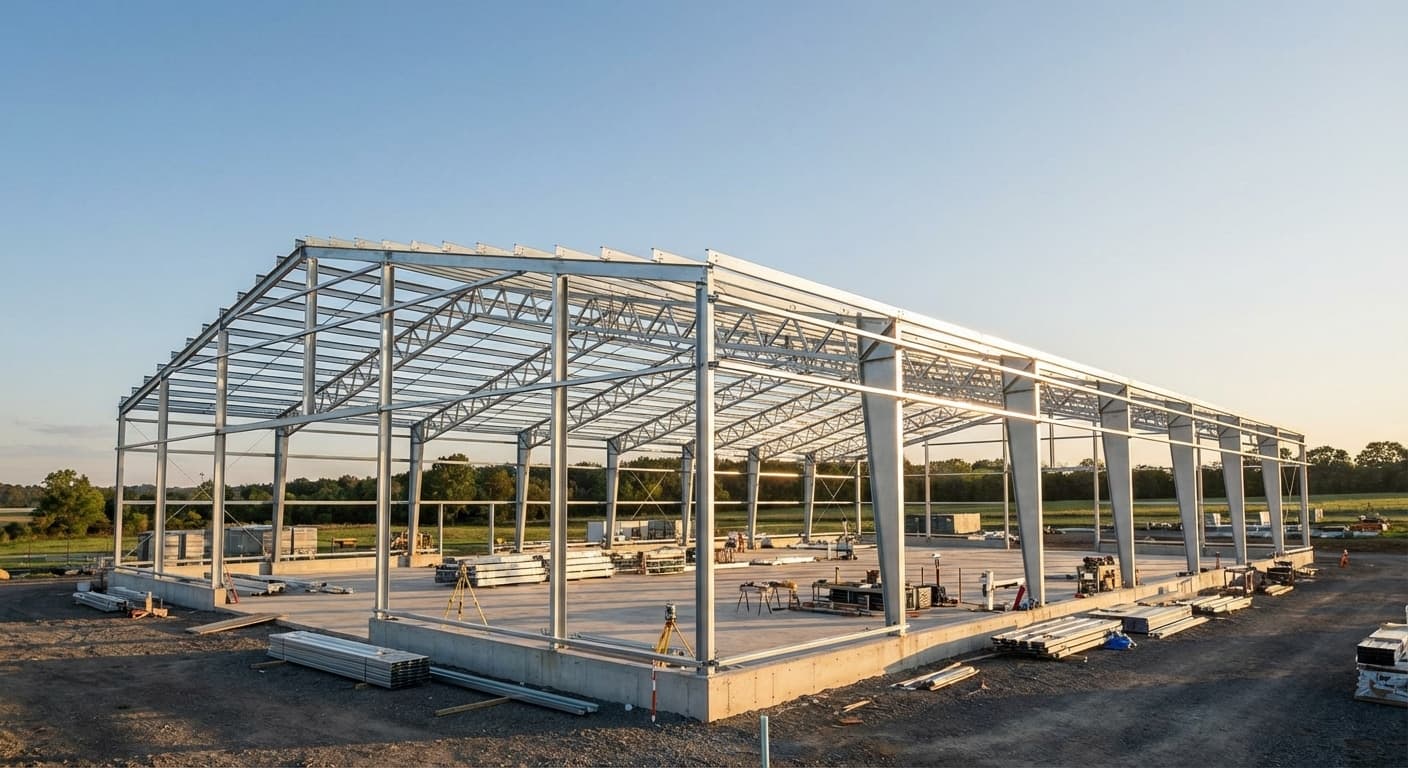

Prefabricated steel arenas deliver a faster, stronger, and more adaptable riding space than traditional builds, manufactured in controlled factories and assembled on-site in 30-40% less time with no interior columns, 40-year minimal maintenance, and built-in expansion options. This guide walks owners through every stage–selecting a well-drained, code-compliant site; choosing engineered foundations that anchor the lightweight yet wind-resistant frame; single-source procurement that locks in price, quality, and delivery sequencing; and BIM-driven design that sizes clear-span dimensions, ventilation, lighting, and discipline-specific footing for optimal horse and rider performance. Readers learn how precision fabrication, corrosion-proof coatings, and logistics with real-time tracking ensure millimeter-tight connections that slash assembly time, while smart insulation, skylights, and ridge vents cut lifetime energy costs. Final chapters cover safety inspections, lighting layouts, daily and seasonal footing maintenance, warranty activation, and modular expansion strategies that let the arena grow with the business. By following these best practices, owners secure a sustainable, code-ready arena that costs $10-$45 per square foot, withstands earthquakes and fires, and pays for itself through lower insurance, utility bills, and virtually zero structural upkeep.
Why Choose Prefabricated Steel for Riding Arenas
Get a complete riding arena with clear-span design, no interior columns, and modular flexibility to expand as your operation grows.
Understanding the prefabricated steel arena construction guide fundamentals
You get a complete riding arena manufactured in controlled factory conditions–no weather delays, no quality surprises. Your prefabricated steel arena arrives designed, cut, welded, and coated, ready for fast assembly [1]. The panels interlock without special tools, creating a weathertight building that goes up predictably [1].
The clear-span design gives you the most critical advantage: no interior columns. Your steel framework handles roof loads while leaving the entire arena open for riding [1]. That means safer training, better spectator views, and zero obstacles in your riding space.
You also get built-in flexibility. Need more space later? The modular design lets you remove an end wall and extend your arena as your operation grows [1]. Modern systems include mounting points for insulation, ventilation, and lighting–everything integrates cleanly [2].
Our
Key benefits: durability, speed, and cost-effectiveness for equestrian facilities
Prefabricated steel arenas deliver three advantages that matter to your bottom line:
Built to Last: Your steel arena is 25 times stronger than wood and immune to termites, rot, and decay [4]. It handles high winds, heavy snow loads, and even earthquakes–flexing instead of breaking [5]. Plus, steel won't burn like traditional materials [5].
Built Fast: You save 30-40% on construction time because we manufacture components while you prep the site [4]. No weather delays at the factory. When steel arrives, pre-engineered connections mean your crew assembles it quickly–even without specialized training [5].
Built Smart: At $10-$45 per square foot, steel beats wood construction that runs $20-$90 [4]. You get up to 300 feet of clear span without columns eating up riding space [4]. After that? Nearly zero maintenance. No painting, no termite treatments, just 40+ years of service with lower insurance costs [5]. Need to expand? The modular design grows with you (covered in detail in the maintenance section).
Sustainability and energy efficiency in modern steel arenas
Your steel arena works harder while using less. Most prefabricated steel contains recycled materials, and precision manufacturing means minimal waste at your site [6][8]. Fewer deliveries, less scrap, cleaner construction.
Energy efficiency comes built in. Strategic skylights and wall panels flood your arena with natural light–cutting electricity bills while giving horses and riders better visibility [8]. Modern insulation keeps temperatures comfortable year-round without breaking your heating and cooling budget [7]. In hot climates, reflective roof coatings knock down solar heat gain [7].
Smart ventilation keeps air fresh without running fans constantly. Ridge vents and adjustable panels use natural airflow, so you get good air quality at lower operating costs [7][8]. When your arena lasts 40+ years with minimal upkeep, you avoid the waste and expense of rebuilding every couple decades [6]. That's sustainability that pays.
Compliance with 2025 building codes and industry standards
Building codes keep getting tougher–we stay ahead of them. The 2025 updates demand stronger wind and snow load resistance, especially for clear-span arenas like yours [9]. You need at least 16 feet clearance for dressage, 18-20 feet for hunter jumper work [9].
Energy codes now require thermal barriers and specific R-values that change by climate zone [10]. Ventilation, emergency exits, accessibility–it all has to meet current standards [10].
Here's where experience pays off. We know these codes inside out and provide stamped engineering drawings, anchor bolt plans, and load calculations that sail through permitting [10]. No mid-project surprises when inspectors show up. We certify our designs meet both today's requirements and what's coming in 2025 [11].
Skip the code compliance headaches.
Preparing the Site and Planning the Project
Level sites with good drainage and proper geotechnical testing save you thousands in foundation costs before construction even begins.
Site selection criteria and zoning considerations for arena projects
You need the right site for your steel arena. Period. Start with drainage–your land should slope about 5'/100' away from the building to keep water moving where it belongs [12]. Skip sites with serious drainage issues unless you're ready to fix them completely. Steep slopes, swampy ground, and rocky terrain all mean extra costs before you even start building [13]. Nearly level sites save you money. Simple as that.Check your local zoning first. Every jurisdiction has its own rules for equestrian facilities–setbacks, height limits, permitted uses [14]. Here's what catches people off guard: building codes cover how you build, zoning covers what you can build, and health codes cover manure and pest management [13].
Look deeper than just municipal rules. Check for:
- Deed restrictions and easements
- HOA covenants on building appearance
- Watershed protection requirements
- Special manure management rules [13]
Plan 4-6 weeks for permits. Most areas require approval for covered arenas [14]. We've navigated these requirements for over 1,480 buildings–we know what inspectors look for.
Soil assessment, foundation design, and load‑bearing solutions
Get your soil tested. A geotechnical engineer runs $500-1,500, but that's pocket change compared to fixing a failed foundation later. They'll check what's under your site–composition, bearing capacity, moisture, and expansion potential [15]. Sandy and gravelly soils? You're golden. They support 2,000-3,000 pounds per square foot. Clay soils? That's where it gets tricky. Some clays handle loads fine. Others swell when wet and shrink when dry, cracking slabs and stressing connections [15]. High water tables need deeper foundations or drainage systems to keep things stable [15].Steel arenas need special foundations. Why? They create concentrated loads at column points and face serious wind uplift forces [16]. Your foundation must go below the frost line to prevent winter heaving [16].
Your main options:
- Monolithic slabs with thickened edges–great for stable soils
- Deep pier foundations–best for problem soils
- Stem wall foundations–ideal for moderate frost zones [16]
Here's what surprises people: steel buildings are lightweight. Your foundation acts as ballast against wind trying to lift the structure. Get this wrong and wind becomes your enemy [16].Your foundation engineer needs your manufacturer's anchor bolt plan–the exact blueprint for connecting steel to concrete [16]. Those anchor bolts do double duty: keeping columns aligned perfectly and transferring all loads into the foundation [15].
Get the bolt positions wrong by an inch? You've got problems. Misalignment prevents proper installation and creates stress points that compromise your whole structure [15].
For most
Budgeting, financing options, and single‑source procurement strategy
Materials eat 40-70% of your arena budget [17]. That's why your procurement strategy matters. Start with a detailed takeoff–every beam, panel, bolt, and specialty item. Build your budget with cushion for steel price swings. Markets change between planning and building [17]. Factor in:
- Site-specific needs
- Delivery timing
- Storage costs if materials arrive early [18]
- Cash flow gaps–vendors want payment before you're done building [17]Your financing options:
- Traditional construction loans
- Equipment leasing to reduce upfront costs
- Manufacturer financing programs
Established suppliers often offer extended payment terms to bridge cash flow gaps [17]. Smart money aligns procurement with construction phases–materials arrive when you need them, not before. Keep enough buffer stock for critical items, but don't pay to store steel for months [17].Single-source procurement changes everything. One vendor handles design, manufacturing, and supply. No finger-pointing. No coordination headaches. Just clear accountability [19].
The advantages stack up:
- Bulk purchasing power cuts costs
- Less administrative overhead
- Fewer change orders
- Components that actually fit together [17][18]
This approach makes sense for prefab steel–when every piece must fit precisely, you want one team controlling the whole process.Before choosing your single-source partner, check their track record:
- Manufacturing capacity for your project size
- Quality control processes
- History of meeting deadlines [19]
Set up inspection protocols before materials arrive. Catch defects at delivery, not during assembly [17]. Your contract needs teeth–performance metrics, quality standards, delivery milestones, and payment tied to verification points [19].
We've completed over 1,480 buildings as a single-source provider. Our in-house erection team (ProTrades) means design, manufacturing, and installation all answer to one phone number. Yours.
Project timeline development and risk‑management best practices
Map your project start to finish. Know your bottlenecks and dependencies before they bite you [20]. Realistic timelines look like this:
- Permits: 4-6 weeks minimum
- Add buffer for weather delays
- Build in material delivery windows [20]
Track milestones, not vague completion dates. Verification checkpoints keep you honest about real progress [20]. The big three risks: wrong materials, surprise costs, and planning gaps [20]. Create clear accountability–especially between excavation crews, steel teams, and specialty trades [21].
Budget for reality:
- Add 5-10% for steel price swings [22]
- Weather delays (high winds stop cranes, rain compromises foundations) [21]
- On-site adjustments that need quick decisions
Set up communication chains now. Who decides what when problems arise? Document your triggers for backup plans [22]. When issues hit–and they will–your team needs to move fast with clear authority.
After 1,480 buildings, we've seen it all. Single-source accountability means one call solves problems instead of three-way conference calls between vendors. That's how you stay on schedule.
Next, you'll move into designing your optimized arena layout, where the clear-span advantages of steel really shine.
Designing an Optimized Arena Layout
Steel's clear-span design eliminates interior columns, giving you safe, open riding space without obstacles that compromise performance or safety.
Dimension guidelines and configurable layouts for performance and safety
Your arena dimensions determine everything–safety, performance, and budget. Start with the basics: 60' minimum width and 16-18' clearance from ground to peak [23]. That's your foundation.
Most riders do fine with 80' x 200' or 60' x 120'. Your specific discipline drives the final call [23]. Here's what works:
- Standard multipurpose: 70' x 200'
- Driving arenas: 130' x 260'
- Competition jumping: Add 2-3' extra clearance above 16' standard [23]
- Rodeo/roping: 150' x 250' minimum [24]
Steel's clear-span design means no interior columns. No obstacles. Just safe, open riding space [24]. Your doorways matter too–13-15' high and 16' wide keeps mounted riders moving safely [23].
Don't forget rider guards along your walls. They protect knees and stirrups during tight work while keeping horses clear of the framing [23]. Planning multiple disciplines? An 80' x 150' arena handles flat work plus round pen activities [24]. Competition venues need 120' x 200' for full-speed riding with room for bleachers [24].
Here's the reality check: bigger arenas mean bigger bills. More footing. More lights. More maintenance. Balance what you need today with what you'll afford tomorrow [23].
Integrating ventilation, natural lighting, and utility routing
Good air and light make all the difference. Ridge vents plus adjustable side panels create natural airflow–no expensive mechanical systems needed [26][27]. You eliminate dead air zones that trap moisture and odors.
Windows do triple duty. Natural light cuts your electric bill. Horses stay calmer with outdoor views. Cold months? Free solar heating [26][27]. Plus, fresh air and sunlight kill off mold and bacteria naturally [27].
Plan your utilities right from the start. Run electrical conduits and water lines inside structural cavities during assembly [26]. Retrofitting later? That's downtime and extra cost you don't need.
Your lighting needs two jobs done right:
- Daytime fill for cloudy conditions
- Full nighttime illumination without shadows that spook horses [26]
Smart move: separate circuits for ventilation and lighting. No voltage drops when everything runs at once [27]. Get this right now, and your arena runs efficiently for decades.
Choosing interior finishes and high‑performance arena flooring
Your interior choices affect safety, performance, and long-term costs. Start with kickboards–4-8 feet up your walls to handle hoof strikes and protect horses in tight spots [14]. Wood works. High-density plastic lasts longer. Composites cost more but need less maintenance.
Insulation pays you back two ways. Comfortable temperatures year-round mean less heating and cooling expense. Plus, you stop condensation that damages steel and creates slippery surfaces [28].
Flooring starts simple: compacted soil base, then your riding surface [14]. Sand's cheapest and works fine. Want better? Engineered surfaces with rubber or fiber additives give you:
- Superior drainage
- Dust control
- Less joint stress on horses
- Consistent footing in all conditions [28]
Match your surface to your discipline:
- Jumping: 3-4 inches for cushioning
- Dressage: 1-2 inches for stability [28]
Critical tip: finish all overhead work–lights, ventilation, everything–before laying your footing [14]. Otherwise you'll compact or contaminate your surface. Build proper drainage underneath to prevent water problems that wreck both footing and structure.
Plan on regular maintenance. Dragging, watering, adding material as needed. Good footing stays good with attention [28].
Leveraging BIM and digital modeling for precise prefabricated steel design
BIM technology builds your arena digitally before we cut the first piece of steel. Think of it as a perfect 3D blueprint that controls our manufacturing robots [29]. No guesswork. No field fixes.
Here's what this precision means for you:
- Components fit perfectly on-site–no delays for modifications [30]
- 20% cost savings over traditional methods
- 30-50% faster construction [31]
- Every connection calculated and verified before manufacturing
Our
Prefabrication, Delivery, and On‑Site Assembly
Factory-controlled precision manufacturing ensures your arena components fit together with millimeter-level accuracy, delivering faster assembly and a structure that performs right the first time.
Factory workflow: cutting, welding, and coating of steel modules
Your arena starts taking shape long before it reaches your property. In our controlled factory environment, you get consistency and precision that field fabrication simply can't match. We select the right steel grade for your specific needs–Q235 for standard arenas or Q345B when you need extra strength for larger spans [34].
Here's how your components come together: Computer-controlled cutting equipment transforms raw steel into exact parts using flame, plasma, or laser technology [32]. You get clean edges and precise dimensions every time. Our welding teams combine automated systems for standard connections with skilled specialists for complex joints [33]. Before any component leaves the factory, it undergoes rigorous testing including ultrasonic inspection to catch any hidden defects [32].
Your steel gets the full protection treatment–shot blasting removes all contaminants, then we apply multi-layer coatings starting with zinc-rich primers and finishing with UV-resistant topcoats [32][33]. Each piece receives a unique ID marking so assembly crews know exactly where it belongs. The result? Manufacturing tolerances measured in millimeters, not inches [33]. That precision means faster assembly and a structure that fits together right the first time.
Quality assurance checkpoints and corrosion‑resistant treatments
You need quality checkpoints that protect your investment. We verify everything–material certifications, dimensional accuracy, weld integrity, and coating thickness–at each production stage [35]. Your arena's environment determines the protection level it needs. Most indoor arenas fall into C1 (dry conditions) or C3 categories (areas with moisture like wash bays) [35].
We prepare every surface to ISO 8501-1 standards before applying protective coatings [35]. For structures near the coast or facing weather exposure, you get heavy-duty protection with zinc-rich primers plus UV-resistant topcoats [37]. We pay special attention to vulnerable spots–joints, gaps, and edges where moisture likes to hide [37]. Different metals touching? We design connections that prevent galvanic corrosion [37].
Your protection system is engineered to last 50 years with less than 1mm of steel loss [35]. Before shipping, we test coating adhesion, check for any missed spots, and inspect everything one final time [36]. That's how
Logistics planning, component handling, and delivery coordination
Smart logistics keep your project on schedule and under budget. We start planning delivery routes during design, checking bridge clearances, road widths, and permit requirements [38]. Large arena components often need oversized load permits–we handle that paperwork weeks in advance so you're not waiting [38]. Setting up a staging area near your site gives you flexibility. Components arrive when you need them, not all at once [39]. Our teams use specialized equipment and IoT sensors that monitor your steel during transit, tracking movement and temperature to prevent damage [38]. We sequence deliveries so pieces arrive in assembly order–no sorting through piles of steel to find what you need next [38].
Building in a 24-48 hour buffer protects against weather or traffic delays while letting us speed up delivery if you're ahead of schedule [39]. One logistics manager oversees your entire shipment from factory to foundation [39]. Digital platforms keep everyone connected–factory, drivers, and your site supervisor all see the same real-time information [38]. No surprises, no gaps, just steel arriving exactly when and how you need it.
Step‑by‑step erection, panel installation, and structural verification
Your arena goes up fast when you follow the right sequence. First, columns go into position at anchor points, then connect with roof beams to create your main frame [40]. Our ProTrades erection teams use proper lifting equipment and maintain strict safety protocols–fall protection, proper PPE, no shortcuts [40]. Next comes secondary framing–purlins, eave struts, and diagonal bracing that lock everything square [42]. We verify alignment by measuring diagonals between columns before moving forward [42]. Getting this right now saves time later.
Wall and roof panels install from eaves to ridge in a specific sequence [40]. Each panel overlaps correctly with proper fastener engagement to keep weather out [40]. We pay extra attention to flashing at roof-wall transitions and around any utility penetrations [41].
Before calling it complete, we verify every connection. Each bolt gets torqued to spec in the right sequence to prevent distortion [42]. We check plumbness, straightness, and elevation against AISC standards [42]. Field welds get tested, coating thickness gets verified at connection points [42]. Only after passing every checkpoint does your arena receive final certification.
That systematic approach–combined with our experienced crews–typically cuts assembly time by 30-40% compared to conventional construction. You get a solid structure that's ready for footing and ready to ride.
Finalizing, Maintaining, and Upgrading Your Arena
Proper drainage, symmetrical lighting at 20-30 feet, and built-in safety features protect your investment and riders from day one.
Installing flooring systems, lighting, and safety equipment
Your arena footing installation builds on the foundation and interior finish decisions outlined in earlier planning phases. Focus on getting the drainage right first–that 4-6 inch aggregate base saves you from costly water problems down the road [20]. Consider modern base systems that cut material costs by 50% while delivering better stability [20]. Your discipline determines the ideal footing depth, but remember: poor maintenance turns any surface into a hazard [44].Good arena lighting starts with understanding your local permit requirements and pole height limits [43].
You'll need 20-30 foot candles of light intensity for most riding activities–multiply that by your square footage to determine total lumens needed [43]. Mount lights symmetrically at 20-30 feet high to minimize spooking shadows [43]. Metal halide fixtures deliver the cleanest light without the flicker that bothers horses [43]. Run all electrical conduit outside the arena walls where you can access it for repairs without tearing up your footing [43].Build safety features into your arena from day one to avoid expensive retrofits.
As covered in the design phase, angled sidewalls protect riders' knees and horses' shoulders during tight maneuvers [44]. Commercial facilities need emergency exits on each wall with proper lighting–don't wait for an inspector to tell you this [44]. Mount fire extinguishers at accessible heights and keep them current [44]. A sprinkler system pulls double duty: fire protection and dust control for your footing [44].
Final inspections, certification, and warranty activation
Your final inspection does two critical jobs: gets you that certificate of occupancy and activates your warranty protection. Schedule your building inspector early–they'll verify your foundation, connections, and alignment meet the engineered specs [10]. Smart builders also run their own quality check on panel seams and weatherproofing before the warranty clock starts [45].
Document everything with photos. You'll need them for insurance and any future warranty claims. Quality steel buildings come with serious warranty coverage–typically 40+ years on the structure itself, with shorter terms on coatings and accessories [10]. Submit your warranty paperwork within 30 days: inspection certificates, construction photos, and registration forms [45].
Consider preventative maintenance programs that include annual professional inspections. They catch small issues before they become expensive problems and often extend your coverage [45]. Keep both digital and paper copies of all documentation–you'll need them for insurance, property valuations, and when you're ready to expand [10].
Routine maintenance plan and smart monitoring technologies
Steel buildings need minimal structural maintenance, but your arena footing demands regular attention. Daily grooming takes just 20-30 minutes: drag out footprints, fill rail ruts, and keep the surface level [48]. Set your groomer tines shallow (1-1.5 inches) for daily work [48]. Heavy use or wet weather calls for weekly deep conditioning with more aggressive settings to break up compacted spots [48]. Plan an annual "flip" where you scrape down and remix everything–it prevents that annoying separation where rubber rises and sand sinks [46].
Water management makes or breaks your footing performance. The right moisture level stabilizes your surface, controls dust, and keeps materials bound together [48]. Automated watering systems pay for themselves through consistent coverage and reduced water waste [46]. Smaller operations do fine with movable sprinklers [46]. Your watering schedule depends on traffic, climate, and whether you're indoors or out–but getting it wrong costs you in either dust clouds or drainage problems [48].
Pick the right grooming equipment. Modern groomers with adjustable tines actually mix your footing instead of just dragging the top like old chain harrows [48]. Waxed surfaces need different care–no watering system required, but you'll need specific maintenance tools [47]. In freeze zones, adjust your winter maintenance to prevent surface damage [47].
Future upgrades and expansion options using the prefabricated steel arena construction guide framework
Your steel arena grows with your business. The modular design means expansion is straightforward–remove an end wall, add structural bays, and you've got more space without starting from scratch [14]. That clear-span design we discussed in planning pays off here: no interior columns to work around [14].
Smart operators plan for growth from day one. Position your utilities and foundation to accommodate future expansion. Run electrical conduits and water lines where you can extend them easily. Many facilities start with a basic arena, then add stalls, tack rooms, wash bays, or viewing areas as revenue grows [14].
- Prefabricated steel arenas cut build time 30-40% and last 40+ years with near-zero maintenance.
- Clear-span steel framing gives up to 300 ft of column-free riding space for safer training and unobstructed views.
- Factory precision and single-source supply eliminate weather delays, fit errors, and vendor finger-pointing.
- Foundations must handle wind uplift and anchor-bolt tolerances within 1 in; get soil tested early to avoid costly fixes.
- Plan 4-6 weeks for permits, check zoning, setbacks, and manure rules before you commit to a site.
- Install all lights, vents, and conduits before laying footing to avoid tearing up the finished surface later.
- Use ridge vents, side panels, and skylights for natural airflow and daylight to cut energy costs and improve horse comfort.
- https://atlanticsteelstructures.com/steel-buildings/prefabricated-steel-riding-arenas/
- https://armstrongsteel.com/blog/equestrian-dreams-to-reality-designing-a-riding-arena
- https://smartbuildsystems.com/6-benefits-of-an-all-metal-riding-arena/
- https://www.vikingbarns.com/blog/why-prefabricated-horse-barns-best-for-equestrian-facilities
- https://coastalsteelstructures.com/why-you-should-spend-more-time-thinking-about-steel-riding-arena/
- https://www.steelcobuildings.com/advantages-of-prefabricated-metal-buildings-potential-drawbacks/
- https://www.uspatriotsteel.com/blog/steel-vs-wood-riding-arenas/
- https://www.kaizenprefab.com/blogs/pre-engineered-buildings-for-riding-arenas
- https://coastalsteelstructures.com/uses/equestrian-metal-buildings-riding-arenas/
- https://sunwardsteel.com/building-type/equestrian/
- https://www.steelbuiltcorp.ca/blog/consider-building-horse-riding-arena
- https://precisebuildings.com/1183-2/
- https://mortonbuildings.com/blog/top-planning-tips-for-building-a-riding-arena
- https://www.steelcobuildings.com/steel-buildings/horse-arenas/
- https://mbmisteelbuildings.com/blog/steel-building-foundation/
- https://www.buildingsguide.com/build/metal-building-foundations/?srsltid=AfmBOopmqQ2tPH8BNd2rKbIvLsxhmnTLdVOzUu4MXMJTvlrtKrP4P-E0
- https://www.netsuite.com/portal/resource/articles/erp/construction-material-procurement.shtml
- https://www.projectmanager.com/blog/construction-procurement
- https://www.rib-software.com/en/blogs/procurement-strategies-construction
- https://www.performancefooting.com/blog/horse-arena-construction-guide/
- https://coastalsteelstructures.com/building-better-indoor-riding-arenas-tackling-challenges-in-construction/
- https://www.arenaworksinc.com/post/start-here-before-planning-an-arena-project-understanding-your-needs-setting-realistic-expectatio
- https://www.alliedbuildings.com/what-is-a-good-size-for-an-indoor-riding-arena/
- https://titansteelstructures.com/metal-building-types/prefabricated-steel-riding-arenas/
- https://coastalsteelstructures.com/planning-on-purchasing-a-riding-arena-read-here-before-you-do/
- https://torosteelbuildings.com/blog/how-to-build-an-indoor-riding-arena/
- https://coastalsteelstructures.com/14-pro-tips-for-planning-a-steel-indoor-riding-arena/
- https://reichconstructionllc.com/cost-of-pre-engineered-steel-indoor-horse-riding-arena/
- https://medium.com/@matt-sharon/bim-and-digital-prefabrication-revolutionizing-construction-workflows-0be7eddcf7e6
- https://www.autodesk.com/autodesk-university/ko/article/Integrated-BIM-Workflows-Modular-Prefabricated-Construction-Concept-Fabricate-2020
- https://www.bimservicesindia.com/blog/smart-bim-workflows-for-prefabricated-construction/
- https://peb.steelprogroup.com/steel-structure/fabrication/process/
- https://sanpetesteel.com/what-is-steel-fabrication-process/
- https://www.steelstructureworld.com/technology/manufacturing-process-of-steel-frame-structure/
- https://www.steelconstruction.info/Standard_corrosion_protection_systems_for_buildings
- https://www.calahan.com/a-guide-to-metal-building-quality-control-in-construction/
- https://www.icorr.org/iso12944-steel-structure-design-corrosion/
- https://velent.com/from-factory-to-site-the-logistics-of-prefabricated-steel-module-delivery/
- https://streammodular.com/blog/modular-construction-logistics-plans/
- https://www.steelcobuildings.com/how-to-build-steel-building/
- https://batimentsmetbec.com/en/blog/steel-buildings/a-step-by-step-guide-to-erecting-a-prefab-steel-building/
- https://pebsteel.com/en/steel-building-peb-guide-structure-codes-and-construction-steps/
- https://www.vitafloor.com/news/how-to-set-up-horse-arena-lights/
- https://www.horizonstructures.com/build-safety-horse-and-rider-when-building-indoor-arena/
- https://gnb.group/industries/horse-riding-arenas/
- https://www.performancefooting.com/blog/fundamentals-of-horse-arena-maintenance/
- https://thehorse.com/112571/arena-maintenance-what-to-remember/
- https://premierequestrian.com/maintenance-101/
- https://gensteel.com/recommended-use/riding-arena/