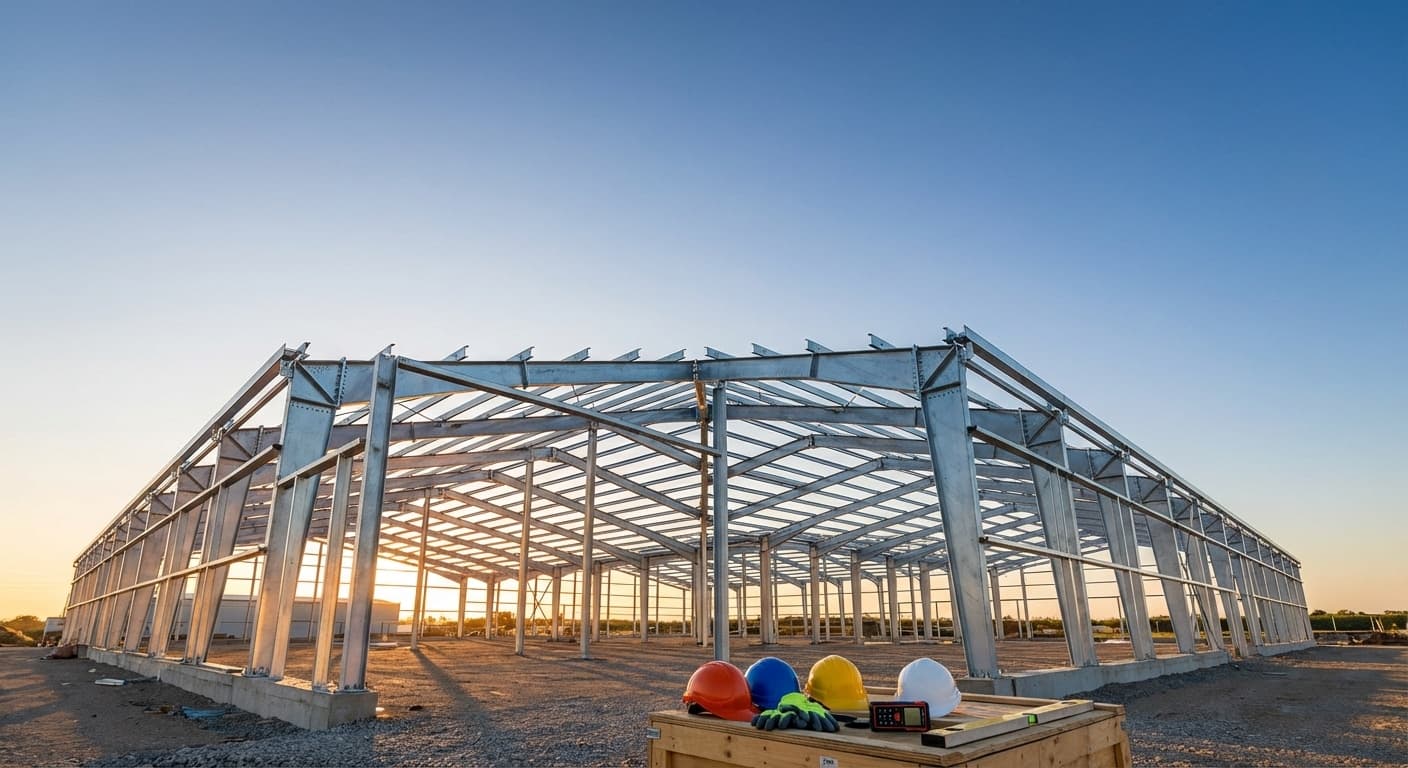

From day-one design to decades of maintenance, this guide shows owners, engineers, and contractors how to squeeze maximum safety, value, and longevity out of metal buildings by mastering the 2024 codes, smart materials, and IoT monitoring. Readers learn to translate AISC, IBC, ASCE 7-22, and ASTM rules into practical steps–right-sizing wind, snow, seismic, and fire requirements for their exact site, selecting corrosion protection that cuts life-cycle costs up to 80 %, and using third-party AC472 certification to speed permits while shielding against lawsuits, insurance denials, and forced demolition. Real-world erection Essentials–like keeping two bolts in every member and 50 % of rigid-frame connections tight before releasing cranes–prevent collapses and rework, while low-power sensors and digital twins now spot 96 % of problems early, turning maintenance from calendar guesswork into condition-based science that extends service life and can trim insurance premiums. The payoff: a fully documented, code-compliant structure that retains higher resale value, qualifies for coverage, adapts easily to future expansions, and keeps occupants safe through 200-year storms–proving that upfront compliance and smart monitoring are the cheapest, fastest route to a metal building that pays for itself for decades.
Your metal building safety standards guide: Introduction to Key Concepts
Understanding dead loads, live loads, wind loads, and snow loads helps you make informed decisions that protect your building's safety and market value.
Key definitions and terminology
You need to speak the same language as your engineers and contractors. Here's what matters for your metal building project.
A Metal Building System combines three key parts: primary framing (your main support structure), secondary framing (purlins and girts), and cladding (exterior panels). These components arrive ready for inspection and quick assembly [1]. Your primary framing–those rigid frames of columns and rafters–carries loads straight to the foundation. Secondary framing supports your roof and wall panels [2].
Your building faces four main forces. Dead loads? That's the weight of the building itself [3]. Live loads come from people, equipment, and maintenance activities [1]. Wind loads create uplift that can literally lift your roof–critical in storm-prone areas [3]. Snow loads pile up, especially where roof heights change [1]. Understanding these forces helps you make smart decisions about your
Why safety standards matter for metal structures
This complexity is exactly why you want experienced professionals who know your local requirements cold.
They'll navigate the design, permitting, construction, and inspection maze so you don't have to.
Benefits of compliance for owners and occupants
Compliance with metal building safety standards directly impacts financial outcomes for building owners. Properties with properly permitted structures maintain higher market value, while unpermitted buildings create serious obstacles when selling property as most buyers require proof that structures meet code requirements [10]. Insurance companies typically refuse to cover unpermitted structures or deny claims related to them, leaving owners financially vulnerable to damage costs [12]. Avoiding the substantial penalties associated with non-compliance–which can include fines, stop work orders, and even forced demolition–provides immediate economic protection [12].Structural safety standards deliver critical protection for both owners and occupants. Buildings engineered to local code requirements withstand region-specific environmental challenges such as wind loads, snow accumulation, and seismic activity [11].
These standards establish minimum requirements for materials, connections, and load capacities that ensure metal buildings can handle environmental stresses without failure [10]. The ongoing inspection protocols mandated by safety standards enable early detection of potential structural issues before they compromise building integrity or endanger occupants [10].Complying with building regulations provides significant legal protection. The Certificate of Occupancy issued after passing final inspections serves as legal documentation that your building meets all required safety standards [12]. This documentation shields owners from liability claims that often follow accidents in non-compliant structures [10]. Following accessibility laws such as the Americans with Disabilities Act prevents discrimination lawsuits while ensuring buildings remain usable by individuals with disabilities [10].
The comprehensive regulatory framework covering structural integrity, fire resistance, electrical safety, and energy efficiency creates multiple protective layers that reduce legal vulnerability [10].Long-term benefits of compliance extend throughout the building's lifecycle. Properly engineered metal structures typically have longer functional lifespans due to appropriate material selection, foundation design, and construction techniques required by code [11]. The energy efficiency standards mandated in building codes reduce operational costs through proper insulation requirements and climate control specifications [11]. Future modifications or expansions proceed more smoothly when working with a fully compliant original structure, avoiding complications from attempting to bring non-compliant elements up to code retroactively [12]. The documentation trail created through the permitting and inspection process proves invaluable for property transfers, insurance claims, and maintenance planning throughout the building's existence [12].
Core Safety Requirements and Code Compliance
AISC standards and pre-tested MBMA assemblies ensure your metal building meets fire and structural safety requirements without guesswork.
Structural load and design criteria
Your metal building needs to meet AISC standards–the gold standard for structural steel safety [13]. These standards ensure your building can handle everything from daily operations to extreme weather events. The requirements cover two design approaches that work together to maximize safety margins [13].
Here's what matters for your project: Every
Fire resistance and protection measures
Steel doesn't burn–that's your first advantage. But fire protection requirements depend on what you're building and where [14]. Most single-story metal buildings need minimal fire protection. Your specific requirements change based on:
- Building size and use
- Distance from property lines
- Number of stories
- Type of operations inside
The IBC typically requires one- to two-hour fire ratings for components that need protection–rarely more [14]. These ratings come from rigorous testing that proves assemblies can maintain their strength, block flames, and limit heat transfer [14].
Good news: The industry has already solved most fire protection challenges. MBMA provides pre-tested assemblies that meet code requirements without guesswork [14]. Keep your building 30+ feet from property lines, and you often eliminate exterior wall fire rating requirements entirely [14].
Modern solutions work smarter, not harder. New wall systems accommodate thicker insulation (up to 4 inches) while maintaining fire ratings–saving energy costs without compromising safety [14]. Installing solar panels on your
Wind, seismic, and environmental design standards
Your building faces different environmental challenges depending on where you build. ASCE 7-22 sets the standards for handling everything nature throws at you–and it's baked into every major building code [15].
Wind Design: Location Matters Wind requirements focus on three factors: speed, exposure, and how enclosed your building is [17]. The 2024 code brings major updates:
- New hurricane maps from the Carolinas to Texas
- Special Wind Regions in Southern California and Northern Colorado
- Risk-based requirements–critical facilities need stronger designs [16]
Building on the coast? You'll need reinforced framing and extra bracing. Building inland? Your requirements differ. The free ASCE Hazard Tool tells you exactly what your site needs.
Tornado Standards: New in 2024 For the first time, tornado design is mandatory–but only for essential facilities (hospitals, emergency centers) in tornado-prone areas east of the Continental Divide [16]. Design speeds range from 60-138 mph based on your location. These standards cover 97% of all tornadoes, providing real protection without overbuilding [16].
Seismic Requirements: Simplified Maps The 2024 code makes seismic design easier with new SDC maps. Find your location, get your category (A through F), know your requirements [16]. Remember: earthquake risk isn't just a West Coast issue. Coastal areas anywhere can have underwater fault lines [17].
Snow and Rain Loads: Updated Data Snow load maps now use 25 years of additional data, giving you more accurate requirements for your area [16]. Rain calculations account for roof deflection–water weighs 8.34 pounds per gallon, and ponding can collapse a roof. Your building's importance determines design standards: 200-year storms for important buildings, 500-year storms for critical facilities [16].
Every location has unique challenges. With nationwide experience, we know the local requirements that matter for your project–from Florida hurricane zones to Colorado snow country.
Corrosion control and material durability
Corrosion is steel's enemy–but it's a battle you can win. Your environment determines your protection strategy, rated from C1 (mild indoor conditions) to C5 (harsh coastal or industrial exposure) [20].
Basic Protection That Works Standard galvanized steel handles most situations just fine. Hot-dip galvanizing (ASTM A123) creates a tough zinc coating that protects your investment for decades [18]. For mild environments (rural areas, climate-controlled buildings), this basic protection is all you need [20].
Building near the coast or in an industrial area? You need more:
- Heavier zinc coatings
- PVC-coated steel for extreme conditions
- Aluminum coatings for specific applications [20]
Smart Choices Save Money Here's what a Department of Defense study proved: spending more on corrosion protection upfront cuts lifecycle costs by 62-80% [20]. That extra investment pays for itself many times over.
Cold-formed steel components get special coatings that can last nearly 700 years–even in salt spray conditions [19]. Modern EQ coatings add extra protection where traditional zinc isn't enough [19].
Critical Details Matter Watch for these corrosion triggers:
- Different metals touching (causes galvanic corrosion)
- Trapped moisture
- Damaged coatings
- Poor drainage [20]
Simple solutions prevent big problems: Use isolation materials between different metals. Seal penetrations properly. Design for drainage. Follow ASTM pre-galvanizing standards to prevent warping and ensure quality [18].
Your building faces unique corrosion challenges based on location and use. We specify the right protection level for your environment–not too much, not too little. Just what you need for decades of maintenance-free service.
Navigating Building Codes, Certifications, and Approvals
Metal buildings must comply with IBC Chapter 22, AISC 360, and AISI S100 standards, with seismic design requirements varying by your region's risk category.
International Building Code (IBC) essentials for metal buildings
The International Building Code (IBC) establishes uniform minimum requirements for metal building safety and structural integrity across most jurisdictions. Originally created to consolidate three separate codes, the IBC has been widely adopted with local variations addressing region-specific conditions like hurricane winds in Florida or earthquake risks in California [21]. Chapter 22 of the IBC specifically governs steel construction, covering structural design, fabrication, and erection requirements [22]. The code mandates that all metal buildings must comply with AISC 360 for structural steel design and AISI S100 for cold-formed steel components, which establish load capacity and connection specifications [22].
For seismic design, buildings must follow more stringent requirements based on their Seismic Design Category, with Categories D, E, and F requiring specialized detailing per AISC 341 [22]. The 2024 IBC introduces significant changes, including a reorganized Chapter 22 with new definitions and provisions specifically for metal building systems, defined as "an integrated set of fabricated components and assemblies that form a complete or partial building shell" [23]. This clarifies design responsibilities between manufacturers and project engineers–a critical distinction since metal building systems often contain various component types that require different regulatory approaches [23]. Most importantly, the IBC links to specific load requirements–dead loads from permanent construction elements, live loads from occupancy, wind loads (particularly uplift forces), and snow accumulation–that must be engineered into the structure before permitting [21].
Building officials require detailed construction documents showing compliance with these loads based on local environmental conditions, making IBC compliance the first critical step in the permitting process [21]. For metal building owners, understanding that the permit approval process verifies both safety standards and proper placement relative to easements, setbacks, and other site restrictions prevents potentially costly violations including stop-work orders, forced demolition, or future insurance denial [21].
ASTM, ISO, and industry‑specific standards
Metal building safety depends on compliance with rigorous material and performance standards that ensure structural integrity throughout a building's lifecycle. ASTM International provides comprehensive standards that define quality, performance, and safety requirements for construction materials, forming the foundation of trust in infrastructural development [24]. Key ASTM steel standards include A36 (carbon structural steel with specified minimum yield and tensile strength), A992 (high-strength steel for wide-flange beams with improved weldability), A514 (quenched and tempered alloy steel for high-strength applications), and A240 (stainless steel specifications for corrosion-resistant applications) [25].
Beyond material specifications, ASTM standards cover testing methods for structural performance, including E72 (strength tests for building construction panels), E2126 (cyclic load testing for shear resistance), and E564 (static load testing for wall shear resistance) [24]. Manufacturers demonstrate compliance through regular material testing, maintaining comprehensive documentation, implementing quality management systems, and utilizing accredited laboratories for certification [25]. These standards enhance structural safety, as metal buildings designed to ASTM specifications can reliably withstand environmental forces throughout their service life [25].
Standards encompass the complete building system, including sealants, insulation systems, foundations, walls, roofs, and connections – ensuring every component meets performance requirements [24]. Projects meeting these standards gain increased market competitiveness through enhanced reputation, reduced failure risk, and improved customer confidence in the building's long-term performance and safety [25].
Local authority permitting process
The local permitting process verifies that metal buildings meet safety standards, protect occupants, and comply with zoning restrictions. Before starting any construction work, you must obtain building permits–a legal requirement that ensures your metal structure conforms to current codes for structural integrity, fire safety, and environmental compliance [26]. The permitting timeline varies significantly by jurisdiction, with processing taking longer in metropolitan areas, regions with extreme environmental conditions (seismic activity or high winds), or for larger public buildings [26]. Most jurisdictions require multiple document submissions including detailed construction plans, site plans showing building placement relative to property lines and easements, structural calculations certified by an engineer, and complete specifications for materials and construction methods [27].
The review process typically involves multiple departments examining different aspects of your project–structural safety, fire protection, accessibility, and zoning compliance–with each potentially requesting revisions before approval [27]. Permit fees scale with project complexity and location, ranging from $150 in small towns to $7,500 in major cities, with most projects falling between $550-$2,000 [26]. After approval, building departments conduct mandatory inspections at critical construction phases including foundation work, framing, electrical/plumbing installations, and final completion [27]. Building without required permits carries severe consequences–local authorities can issue stop-work orders, impose substantial fines, or even demand demolition of non-compliant structures [26].
Additionally, unpermitted buildings typically cannot be insured against damage, create significant obstacles when selling the property, and leave owners personally liable for any injuries or damages resulting from structural failures [26]. The permitting process becomes particularly stringent for commercial metal buildings accessible to the public, requiring additional specialized permits for electrical systems, fire suppression, accessibility features, and sometimes even sidewalks and signage [26]. For agricultural structures in rural areas, some jurisdictions offer simplified permitting or exemptions, though these vary considerably by location [26].
Third‑party certification and quality assurance
Third-party certification programs provide independent verification that metal buildings meet safety standards and code requirements. The International Accreditation Service (IAS) Accreditation of Inspection Programs for Manufacturers of Metal Building Systems (AC472) serves as the industry benchmark for quality assurance, addressing requirements for code officials to designate manufacturers as approved fabricators [28]. This comprehensive program covers three critical areas: structural welding, cold-formed steel fabrication, and engineering design [28].
Manufacturers with AC472 accreditation can be exempt from special inspections required by International Building Code Section 1704.2.5.1, as their quality control programs already satisfy special inspection goals [29]. The accreditation process involves annual evaluations plus two unannounced on-site inspections of design and manufacturing facilities, ensuring continuous implementation of quality assurance processes [28]. For non-destructive testing (NDT), the program establishes clear guidelines on when and how manufacturers can perform their own inspections–including ultrasonic testing for complete joint penetration welds–provided they maintain properly qualified personnel [29].
NDT requirements vary based on building risk category, material thickness, and weld type, with risk category III and IV buildings requiring 100% inspection of specific welds [29]. The AC472 program, which replaced the AISC-MB certification in 2009, standardizes assessment across jurisdictions while creating a level playing field for manufacturers who demonstrate competence to supply code-compliant building systems [28]. This documentation trail allows owners to trace materials from steel production through final erection, providing crucial evidence of compliance for insurance, future modifications, or property transfers [28].
Design, Fabrication, and Construction Best Practices
Upfront planning with your engineer prevents costly redesigns while ensuring your building meets all safety requirements and local codes from the start.
Engineering design workflow and safety checks
Smart engineering design starts with understanding your building's purpose and location. Before any modeling begins, engineers review site conditions, local code requirements, and intended use to determine the right load specifications for your project [30]. This upfront planning prevents costly redesigns and ensures your building meets all safety requirements from day one.
The design process follows established structural steel standards–primarily AISC 360 in the US–using either Load and Resistance Factor Design (LRFD) or Allowable Stress Design (ASD) methodologies [30]. What matters to you: these approaches ensure your building has appropriate safety margins built in, accounting for everything from snow loads to seismic activity specific to your location [30].
Throughout design, engineers verify critical elements including connection details, material specifications, and member sizing [31]. For buildings with higher risk categories–like those housing hazardous materials or large occupancies–special attention goes to weld specifications and testing requirements [32]. Every decision gets documented, creating a clear record that protects you legally and simplifies any future modifications or expansions [31].
Material selection, quality control, and testing
Choosing the right materials makes the difference between a building that lasts decades and one that needs constant repairs. All steel components for your building should meet ASTM standards, which ensure consistent quality through rigorous testing of strength, durability, and performance characteristics [33].
Your structural steel undergoes multiple tests before it ever reaches your job site. These include tension testing to verify load capacity, hardness testing for wear resistance, and impact testing to ensure the steel can handle sudden loads–crucial for buildings in high-wind or seismic zones [33]. For critical connections and load-bearing members, nondestructive testing methods like ultrasonic examination detect any internal flaws without damaging the components [35].
Working with suppliers who use ISO/IEC 17025 accredited testing laboratories gives you documented proof of material quality [35]. This paper trail does double duty: it protects you legally and helps plan future maintenance by establishing baseline material properties. Bottom line–ASTM-compliant materials cost about the same but deliver consistent performance, longer building life, code compliance, and reduced liability [34].
Fabrication techniques and erection best practices
Safe, efficient steel erection starts with proper planning and ends with a building that goes up fast and stands strong. Your foundation must reach 75% of design strength before any steel goes up–rushing this step invites structural problems and safety hazards [36].
Connection procedures follow strict safety protocols that protect workers and ensure structural integrity:
- Every structural member gets at least two bolts before releasing the crane [37]
- Cantilevered sections require additional bolting as determined on-site [37]
- Double connections use temporary seats to stabilize the first member while connecting the second [37]
- Plumbing-up equipment stays in place until the structure is self-supporting [37]
Metal decking installation requires equal attention to detail. Bundles must land on stable supports, stay secured between shifts, and get fastened immediately upon placement [37]. For pre-engineered metal buildings, rigid frames need 50% of bolts installed and tightened before releasing hoisting equipment–this prevents frame distortion and maintains dimensional accuracy [37].
Working with an experienced erection crew makes all the difference.
On‑site inspection and verification protocols
Quality control during construction prevents problems before they become expensive fixes. Smart builders use a phase-based inspection approach that catches issues early and keeps projects on schedule.
Foundation verification comes first–dimensions must match drawings exactly, and anchor bolt patterns need to align precisely with column base plates [39]. Pro tip: create physical templates from your base plates to double-check bolt placement before concrete sets. This simple step prevents the nightmare of misaligned anchor bolts [39].
As steel arrives and goes up, inspect components for damage, verify weld quality against AWS standards, and confirm proper bolt torque [38]. Critical connections, especially moment connections that transfer both vertical and horizontal loads, deserve extra scrutiny [38].
Document everything with photos and detailed reports before subsequent construction hides critical elements [39]. This documentation trail proves code compliance, supports warranty claims, and simplifies future modifications. For comprehensive inspection protocols and maintenance schedules that protect your investment long-term, see our maintenance and monitoring guidelines in the following section [39].
Maintenance, Monitoring, and Ongoing Compliance
AI-powered sensors catch 96% of structural problems before failure, letting you maintain based on actual conditions instead of guesswork.
Routine inspection schedules and checklists
Structural health monitoring technologies and IoT sensorsToday's smart sensors watch your building 24/7, catching problems before they cost you money. These IoT systems track vibration, strain, and stress–spotting issues like fatigue, corrosion, or load shifts without shutting down operations [43].
What sensors do for you:
- Vibration sensors: Detect cracks or foundation shifts using low-power wireless tech [45]
- Tilt sensors: Catch tiny movements that signal instability [45]
- Crack monitors: Track crack growth automatically with strain gauges or fiber optics [45]
- Accelerometers: Spot unusual vibrations from wind, earthquakes, or equipment [45]
- Corrosion sensors: Find rust before you see it–critical near coasts or in industrial settings [45]
Advanced fiber optic sensors measure strain by detecting light wavelength changes. No electrical interference, just precise data [44]. Everything connects through modern networks (LPWAN, BLE, 5G) to cloud platforms that analyze your building's health in real time [43].
Here's where it gets powerful: AI learns your building's normal behavior and flags problems early. Some systems catch 96% of issues before failure [44]. Digital twin technology creates a virtual copy of your structure, updating constantly with sensor data to predict exactly when maintenance pays off [44].
Bottom line? You maintain based on actual conditions, not calendars. You prevent failures instead of fixing them. Your building lasts longer. Your insurance company sees documented safety protocols and may cut your rates [43]. Smart monitoring turns maintenance from guesswork into science.
Repair, retrofit, and lifecycle management
Your pre-2002 metal building still has decades of life left–if you upgrade it right. Old buildings used uniform roof loads. Today's codes divide roofs into zones with different requirements for wind and snow [46]. That means your roof corners and edges need extra framing to meet current standards [46].
Smart retrofit options that work:
- Steel plates or polymer wraps strengthen existing members [47]
- Load path restoration ensures forces transfer properly from roof to foundation [47]
- Foundation reinforcement handles today's heavier code loads [47]
*
Documentation, record‑keeping, and compliance reporting
Good records save money and protect you legally. Track every inspection, every repair, every dollar spent [41]. You'll spot problems early, make smarter repair decisions, and keep your building running longer.
Required documentation includes:
- OSHA forms (300, 300A, 301) for workplace incidents [48]
- Inspection reports with dates and findings [41]
- Repair records and modifications [41]
- Safety certifications and test results [41]
- Associated costs for budget planning [41]
This paper trail pays off. Inspectors see you're compliant. Insurance companies process claims faster. Future buyers trust your maintenance history. You have the data for smart modifications [41].
Go digital. Cloud storage keeps records safe and searchable. Automated reminders schedule maintenance. Everything backs up automatically [41]. Check your state requirements–some states require extra documentation beyond federal standards [48].
Quarterly safety checks with solid documentation create your best defense. You catch problems early. You prove due diligence. You avoid liability issues [41]. Think of documentation as insurance you never want to use–but you'll be glad you have when you need it.
Keep Your Steel Building Working for You
Regular inspections, continuous monitoring, strategic retrofits, and thorough documentation keep your steel building performing reliably for decades.
Smart maintenance isn't complicated. Inspect regularly.
Monitor continuously. Retrofit strategically.
Document everything. Your steel building was built to last–these practices ensure it does.
Emerging Trends and Future Directions in Metal Building Safety
Real-time sensors catch structural problems like corrosion and stress before they become expensive repairs, while paying for themselves through scheduled maintenance and extended building life.
Advanced simulation and performance modeling tools
Smart sensors, IoT, and real‑time monitoringSmart sensors turn your metal building into a structure that tells you what it needs. Instead of waiting for annual inspections, today's monitoring systems watch your building 24/7, catching problems while they're still small and cheap to fix [52].
Here's what these systems track:
- Steel stress levels during high winds or heavy snow
- Tiny movements that signal foundation shifts
- Corrosion before you can see it
- Temperature changes affecting structural integrity
- Vibrations from equipment or seismic activity [53]
RFID tags now track every steel beam from factory to installation. Once your building is up, embedded sensors alert you the moment something changes [52]. It's like having a structural engineer on duty around the clock.
The technology has already proven its worth. The 2018 Ponte Morandi bridge collapse could have been prevented–sensors would have detected the gradual changes happening over months [52]. For metal buildings, this means catching issues in long-span roofs or corrosion in coastal environments before they become expensive problems.
The best part? These systems pay for themselves:
- Schedule maintenance only when needed
- Extend your building's life by catching problems early
- Lower insurance premiums with documented safety monitoring
- Avoid emergency repairs and downtime [53]
Wireless sensors now run on minimal power and send data straight to your phone or computer [53]. Digital twin technology creates a virtual copy of your building that shows exactly how it's performing in real time. While building codes don't require smart monitoring yet, experts expect incentives soon–like higher allowable loads for monitored buildings [52].
Sustainable and resilient design innovations
Metal buildings save money and the environment at the same time. You'll use 30% less steel than conventional construction while getting the same strength [56]. Plus, your building contains at least 70% recycled steel–cutting both material costs and environmental impact [56].
The savings multiply:
- Lighter buildings need smaller foundations (less concrete, lower costs)
- Advanced insulation systems slash heating and cooling bills
- Cool
Upcoming regulatory updates and industry outlook
The 2024 building codes bring clarity that saves you time and money. For the first time, the International Building Code clearly defines what a metal building system is–ending confusion about who's responsible for what [23].
Key improvements for 2024:
- Clear accountability between manufacturers and your project engineer
- Specific standards for each building component
- Better inspection procedures that catch issues early
- More accurate construction documents [23]
The updated Metal Building Systems Manual–the industry bible since 1959–now includes more examples and drawings to guide your project [57]. It aligns perfectly with the new codes, making compliance straightforward.
Important updates you should know:
- AISC 360-22 for structural steel design
- AISC 341-22 for seismic requirements
- New standards for stainless steel buildings
- Updated steel deck design specifications [58]
What does this mean for your project? Clearer standards lead to:
- Fewer surprises during construction
- Better coordination between teams
- Smoother inspections
- More accurate bids
The new codes recognize that metal buildings are sophisticated systems, not just collections of parts. This means better safety, clearer documentation, and fewer headaches for you [23]. Working with
- Unpermitted metal buildings lose market value, insurance, and risk fines or demolition.
- 2024 IBC mandates tornado design for essential facilities in tornado zones east of the Divide.
- AC472-accredited manufacturers skip special inspections, saving time and cost.
- Upfront corrosion protection cuts lifecycle costs 62-80% and lasts decades.
- Smart IoT sensors detect 96% of structural issues early, preventing expensive failures.
- Records of permits, inspections, and retrofits shield owners from liability and speed sales.
- New IBC Chapter 22 clarifies design duties between metal-building suppliers and project engineers.
- https://www.starbuildings.com/resources/metal-buildings-101/
- https://www.buildingsguide.com/build/comprehensive-glossary-of-steel-building-terms/?srsltid=AfmBOopx9NGnDVCnMgZcrMavxMBjKCkzjAs3MmHqACo9WA1wGr6FeVSa
- https://steel-depot.com/metal-building-glossary/
- https://www.twi-global.com/technical-knowledge/faqs/structural-integrity
- https://isenj.com/the-importance-of-safety-in-structural-steel-construction/
- https://trusteelbuildings.com/understanding-building-codes-for-large-steel-buildings/
- https://www.foxblocks.com/blog/building-safety-standards
- https://mavericksteelbuildings.com/understanding-building-codes-for-steel-buildings/
- https://lionbuildings.com/what-you-need-to-know-about-laws-that-govern-building-metal-buildings/
- https://lionbuildings.com/what-you-need-to-know-about-laws-that-govern-building-metal-buildings/2/
- https://www.buildingsguide.com/build/metal-building-codes-permits/?srsltid=AfmBOorIB-DfuZ78Y2geVYJh-hMWDIdBZOMv–92yvEndoQ99PpBDpgM
- https://metalbuildingshop.com/building-permit-requirements/
- https://www.peaksteelbuildings.com/whats-aisc-standard-steel-building-structures-matter/
- https://www.metalarchitecture.com/articles/fire-protection-specifications/
- https://www.asce.org/publications-and-news/codes-and-standards/asce-sei-7-22
- https://www.structuremag.org/article/2024-ibc-significant-structural-changes-part-6-loads/
- https://norsteelbuildings.com/us/building-codes-permits-us/steel-building-codes-loads/
- https://galvanizeit.org/specification-and-inspection/coating-specifications/astm-specs
- https://www.steelframing.org/durability
- https://www.wbdg.org/dod/cpc-source/fencing-knowledge-area
- https://www.buildingsguide.com/build/metal-building-codes-permits/?srsltid=AfmBOopxolMqz4CByK0SuPz1q6z25FcDk_ekKqbAEm-cr-aeKnAmzQdf
- https://codes.iccsafe.org/content/IBC2021P1/chapter-22-steel
- https://www.structuremag.org/article/2024-ibc-significant-structural-changes-part-4-steel/
- https://jp.astm.org/industry/construction/
- https://eoxs.com/new_blog/steel-quality-and-astm-standards-effective-methods-for-compliance/
- https://www.buildingsguide.com/build/metal-building-codes-permits/?srsltid=AfmBOoobOkfkU0qhil1CatjcFDcqFftymJBHRpypEXXrtDU5Gx4VWMZb
- https://www.steelcobuildings.com/navigating-construction-permits-for-steel-buildings-requirements-and-things-to-know/
- https://www.iccsafe.org/building-safety-journal/bsj-technical/metal-building-systems-inspection-accreditation/
- https://www.iccsafe.org/building-safety-journal/bsj-technical/non-destructive-testing-building-code-requirements-and-ias-ac472-accreditation/
- https://sedinengineering.com/blogs/steel-design-standards-for-safe-structures/
- https://quollnet.com/article/structural-integrity-assessment-guide
- https://foundationsystemsengineering.com/the-essential-guide-to-structural-steel-special-inspections/
- https://www.nextgentest.com/blog/top-10-most-common-astm-standards-for-metal-testing/?srsltid=AfmBOoop6J-6nTogp0LR8aOzdTn4R3Keeb1_9sUJu9bYI5w2WVV6AG4B
- https://www.meadmetals.com/blog/what-are-astm-standards
- https://www.whlabs.com/understanding-astm-testing-standards-procedures-and-materials/
- http://www.osha.gov/etools/steel-erection/inspection-guide
- https://www.ecfr.gov/current/title-29/subtitle-B/chapter-XVII/part-1926/subpart-R
- https://www.proarcconsulting.com/navigating-codes-and-standards-for-structural-inspections
- https://iconsteelbuildings.com/construction-quality-control-checklist/
- https://www.gsa.gov/real-estate/historic-preservation/historic-preservation-policy-tools/preservation-tools-resources/technical-procedures/checklist-for-the-routine-inspection-of-buildings
- https://premierbuildings.com/seasonal-maintenance-guide-for-metal-buildings/
- https://www.metalconstructionnews.com/articles/metal-building-system-inspections/
- https://www.iotforall.com/how-iot-is-improving-structural-health-monitoring-shm
- https://pmc.ncbi.nlm.nih.gov/articles/PMC10575112/
- https://structuraltestingtools.com/structural-health-monitoring/
- https://roofhugger.com/building-code-requirements-for-roof-retrofitting/
- https://dopengineering.com/retrofitting-older-buildings/
- http://www.osha.gov/complianceassistance/quickstarts/construction
- https://www.autodesk.com/solutions/aec/bim/structural-engineering
- https://avestaconsulting.net/blogs/design/professional-programmed-steel-structure-design-software/
- https://www.autodesk.com/solutions/aec/structural-analysis-software
- https://continuingeducation.bnpmedia.com/courses/the-steel-institute-of-new-york/bright-beams-in-the-iot
- https://www.encardio.com/blog/sensor-based-monitoring-types-applications-infrastructure
- https://tacunasystems.com/knowledge-base/improving-the-safety-of-scaffolding-using-sensors/?srsltid=AfmBOoot-7nY1m4iDTFi9IRDYxrRUyBgA0DnDcAzFVIBI2_XghJlehAL
- https://www.cecobuildings.com/blog/understanding-leed-green-metal-buildings/
- https://continuingeducation.bnpmedia.com/courses/metal-building-manufacturers-association/sustainable-metal-buildings/
- https://mbma.com/news/2024-mbma-metal-building-systems-manual-now-available
- https://www.iccsafe.org/news-and-events-calendar/part-4-an-overview-of-the-structural-changes-to-the-2024-ibc/