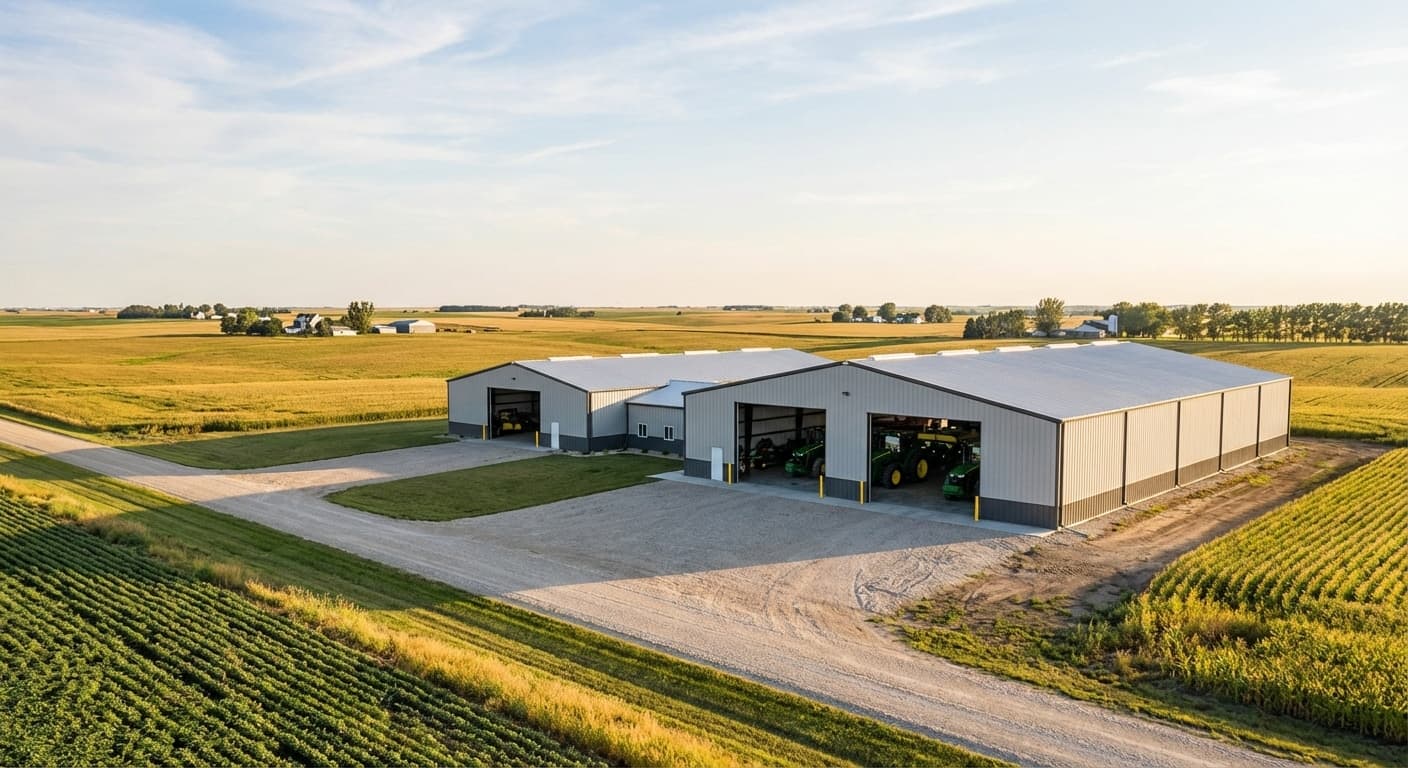

Steel agricultural buildings are engineered to outlast, out-save, and out-perform every alternative on the farm: they slash upfront costs 20-30%, eliminate the endless cycle of rot, termite, and fire repairs, and deliver 30-50 years of clear-span, column-free space that protects six-figure equipment, livestock, and harvests while cutting insurance premiums and energy bills. This guide walks you from site selection, permit navigation, and foundation anchoring through fast, 6-12-week pre-engineered assembly, then shows how to layer in smart-farm IoT, solar-ready roofing, modular expansions, and low-maintenance finishes that boost resale value and keep lifetime upkeep under 3 % annually. Readers learn to match building types–loafing sheds, hay storage, equipment arches, or multi-use hybrids–to exact loads, wind, and snow data; choose coatings, doors, and insulation for climate control and workflow; and tap financing, tax incentives, and recycled-steel sustainability to maximize ROI. Whether you need 40 ft of unobstructed width or a 300-ft grain hub, the article delivers the engineering specs, code-compliance shortcuts, and real-farm case studies that turn steel into the fastest, greenest, cheapest way to future-proof any agricultural operation.
Why Choose Steel for Agriculture – An agricultural steel buildings guide
Steel agricultural buildings resist termites, mold, rust, and fire while lasting decades with minimal maintenance, protecting your equipment and harvests through seasonal extremes.
Durability and Weather Resistance for Farm Operations
Steel agricultural buildings withstand the harshest farm environments while protecting valuable equipment, livestock, and harvests. Their high strength-to-weight ratio ensures stability under heavy loads from stored grain, hay bales, or machinery [1]. Unlike wooden structures that rot, warp, and attract pests, steel buildings resist termites, mold, and weather-related deterioration [1].
This resilience extends to extreme conditions – from heavy snowfall and high winds to torrential rain and scorching heat – without compromising structural integrity [2]. Protective coatings applied during manufacturing provide rust resistance, eliminating a common concern for outdoor farm structures [2]. Fire resistance offers critical protection for hay storage, where spontaneous combustion poses a significant risk [1].
The durability translates to practical benefits: galvanized coatings and rust-resistant finishes allow steel farm buildings to last decades with minimal maintenance beyond occasional cleaning [1]. This weather resistance isn't just about building longevity – it directly protects farm investments by creating secure environments for sensitive equipment, livestock, and harvested crops through seasonal extremes [3].
Cost‑Effectiveness, ROI, and Financing Options
Steel agricultural buildings deliver exceptional return on investment through significantly lower lifetime costs. Initial construction expenses typically range from $17-$20 per square foot–often 20-30% less than custom designs–with prefabricated components reducing both construction time and labor expenses [4]. The true financial advantage emerges over time, as these structures require minimal maintenance (just 1-3% of building cost annually) and resist damage from pests, rot, fire, and severe weather that would compromise traditional materials [4]. This durability translates into decades of reliable service with minimal repair costs. Energy efficiency provides additional savings, as steel structures with proper insulation reduce heating and cooling expenses through reflective coatings that minimize heat absorption [5]. Expansion capabilities add further value–metal buildings easily accommodate farm growth without requiring completely new structures [5].Farmers can access various financing pathways to fund steel agricultural building projects.
Traditional options include agricultural loans, equipment leases, and specialized construction financing from institutions familiar with farm operations [4]. Before pursuing financing, thoroughly research lending programs to secure favorable terms and interest rates aligned with your operation's cash flow. Many regions offer tax advantages and government incentives for agricultural infrastructure investments, particularly for buildings incorporating energy-efficient features [5]. These can significantly reduce overall project costs through deductions, credits, or accelerated depreciation schedules. Consult with agricultural lending experts who can navigate complex application processes and develop repayment plans tailored to seasonal income fluctuations typical in farming operations [4].Comprehensive insurance coverage represents an essential component of steel building ownership, protecting your investment against unforeseen damage. While steel structures withstand harsh conditions better than alternatives, coverage against natural disasters, fire, and theft provides crucial financial security [4].
Insurance costs vary based on building value, location, intended use, and chosen coverage levels. Working with insurers specializing in agricultural properties helps secure appropriate coverage at competitive rates [4]. The superior durability of steel construction often translates into more favorable insurance premiums compared to wooden structures, which carry higher fire and weather damage risks [6]. For maximum value, consider policies covering not just the structure itself but also valuable equipment, stored harvests, and livestock housed within [4].
Sustainability: Recyclability and Energy Efficiency
Steel buildings offer unmatched sustainability advantages for agricultural operations. Steel is 100% recyclable without quality degradation, creating a true cradle-to-cradle material with infinite reuse potential [7]. Current structural steel incorporates up to 93% recycled content, with recovery rates reaching 98% for structural components at end-of-life [8].
This closed-loop recycling delivers substantial environmental benefits: recycled steel production consumes 60-70% less energy and generates 70-80% fewer CO2 emissions than manufacturing from raw materials [9]. The energy efficiency extends beyond production–steel's high strength-to-weight ratio means less material needed for equivalent structural performance, reducing resource consumption throughout the supply chain [9]. Modern steel manufacturing has evolved dramatically, cutting energy requirements by half compared to four decades ago [7].
Cold-formed steel, commonly used in agricultural buildings, requires less processing energy because it's formed near room temperature, trapping carbon within the material rather than releasing it [8]. For farms incorporating renewable energy, steel buildings provide ideal mounting surfaces for solar panels while their thermal properties can be optimized through proper insulation to reduce heating and cooling demands. Agricultural operations benefit from steel's durability–buildings last decades with minimal maintenance, avoiding the environmental impacts of frequent replacement and repair cycles while supporting long-term farm sustainability goals.
Compliance with Current Building Codes and Safety Standards
Agricultural steel buildings must comply with a complex network of building codes that vary significantly by jurisdiction. While some agricultural structures may qualify for exemptions under state laws (like ORS 455.315 in Oregon), most substantial farm buildings require permits to ensure safety and structural integrity [10]. Buildings classified as Group U Agricultural must adhere to specific size limitations–with one-story structures permitted unlimited area only when surrounded by yards or public ways at least 60 feet wide [12].
Most jurisdictions require submitted plans, inspections, and compliance with agricultural-specific codes before construction begins. Non-compliance can result in severe consequences, including costly fines, mandatory demolition of non-compliant structures, and insurance coverage denial for unpermitted buildings [10]. The permitting process typically involves navigating federal regulations from agencies like the USDA (for food production standards) and EPA (for environmental protection), alongside state guidelines for structural integrity, fire safety, and accessibility [10].
Local county and municipal authorities handle most direct permitting processes, including plan reviews, inspections, and zoning compliance verification [10]. For complex projects, consulting building permit experts or professional permit services can prove invaluable–their established relationships with authorities and specialized knowledge of agricultural building requirements significantly streamline the compliance process [10]. Properly engineered steel buildings offer advantages for code compliance, as they naturally address many safety concerns through their fire resistance (withstanding temperatures up to 1,200 degreesF) and structural resilience against environmental threats like high winds and snow loads [11].
Building Types and Ideal Applications for Modern Farms
Steel farm buildings cost half as much, last 30-50 years with minimal maintenance, and give you 100% usable space without support posts blocking your equipment.
Traditional Barns vs. Modern Steel Structures
You know the frustration–watching your wooden barn rot, dealing with termite damage, painting every few years. That 2,400-square-foot wooden barn? It took 60 tons of trees to build. Your steel building? Zero [13].
Here's what matters to your operation. Steel costs half as much and goes up twice as fast [13]. No more support posts blocking your combine's path–clear-span steel gives you 100% usable space [14]. While your neighbor replaces their 20-year-old wood barn, your steel structure keeps working for 30-50 years with minimal fuss [15].
Your insurance company knows the score too. They'll charge you less for steel because it won't burn down or blow away [13]. Want the traditional barn look? Add brick facades or wood veneers–you get the appearance without the headaches [13].
Yes, you'll need proper insulation to control temperature and condensation [15]. But that's a one-time fix, not the endless cycle of repairs wood demands [14]. For modern agricultural steel buildings that work as hard as you do, the choice is clear.
Specialty Structures: Loafing Sheds, Hay Storage, Equipment Sheds
Your farm needs specialty structures that work. Let's talk specifics.
Loafing Sheds: Your livestock need shelter that breathes. Steel loafing sheds give you open sides for ventilation, drainage systems that actually work, and strength to handle high winds [16]. No rot, no rust–just reliable protection that lets you focus on your animals, not building repairs [16].
Hay Storage: You can't afford moldy hay or barn fires. Steel buildings naturally resist both, plus the pests that love wooden structures [11]. Add vapor barriers and proper ventilation–your feed stays dry, your operation stays safe [16]. Wide clearances mean you can stack high and access bales without gymnastics [16].
Equipment Sheds: That $300,000 combine deserves better than a tarp. Steel sheds protect your investment with customizable layouts for everything from tractors to tillers [16]. No posts in the middle means you can actually maneuver equipment without playing bumper cars [17]. Reinforced foundations handle the weight, oversized doors fit modern machinery, and integrated storage keeps implements organized [16].
Your insurance company will thank you–steel means lower premiums [16]. Your maintenance schedule will too.
Clear‑Span Designs for Large Machinery and Grain Handling
You need space–real space. Not the kind where you're dodging posts with your combine.
Clear-span steel buildings deliver 40-100 feet of unobstructed width (up to 300 feet for specialized needs) [19]. No columns. No constraints. Just wide-open space for your biggest equipment and grain operations.
Your building options match your needs:
- Straight columns: Perfect for standard equipment storage
- Tapered columns: Maximum efficiency for large machinery and grain systems [19]
These frames handle whatever nature throws–90 mph winds, heavy snow loads, the works [18]. Your grain stays protected. Your equipment stays safe.
Here's what speeds up your timeline: pre-engineered kits arrive ready to assemble. Pre-cut, pre-drilled, pre-welded, pre-painted. You're operational 60% faster than traditional construction [19]. During harvest season, that matters.
At $12-$19 per square foot, you get more than a building [19]. You get flexibility to reconfigure as your operation grows. Need to expand? The structure adapts. Remote location? Helical anchors drill right in–no massive foundation work required [18].
Clear-span means clear advantages for modern farming.
Multi‑Purpose Farm Complexes and Mixed‑Use Buildings
Multi-purpose agricultural steel buildings solve evolving farm needs by combining equipment storage, livestock housing, crop processing, and retail space under one roof [20]. Your farm isn't one-dimensional. Neither should your buildings be.
Today's operation might need equipment storage. Tomorrow's might add a farm store. Next year? Maybe processing facilities. Steel multi-purpose buildings adapt without drama [20].
Smart design makes it work:
- Traffic flows that make sense for trucks, tractors, and customers
- Ventilation systems that handle livestock today, retail tomorrow
- Natural light where you need it, loading access where it counts [20]
Modular components and movable partitions mean you reconfigure instead of rebuild [20]. The clear-span design we discussed earlier? It shines here–no posts limiting your options [21].
Your building grows with you. Need more space? Steel expands seamlessly–"limitless options for length and width extensions" without starting over [22]. Want it to look good for customers? Add exterior finishes that match your farm's character [22].
Think beyond storage. Water systems, electrical for smart farming tech, internet connectivity–it's all part of the package [20]. One building, endless possibilities. That's smart farming.
Planning, Design, and Permitting – Your agricultural steel buildings guide
Check with local officials first about setbacks, zoning, and permits to avoid expensive surprises and get your site preparation right from the start.
Site Evaluation, Soil, Zoning, and Access Considerations
You start with the site. Check with your local officials first–they'll tell you about setbacks, zoning, wetlands, and what permits you need [10]. Get this right upfront and you won't face expensive surprises later.
Your site prep checklist:
- Remove topsoil and add a raised gravel base extending past your building footprint [24]
- Install drainage to move water away from the structure
- Build access roads wide enough for your biggest equipment
- Lay underground utility conduits before concrete work begins
Farm sites bring unique challenges. You've probably been building on less-than-ideal ground to save your best cropland [24]. That's fine–just evaluate drainage patterns and soil stability before breaking ground. Face your longest wall north to cut summer heat and capture winter sun [23].
Think ahead about traffic flow. Your combines need room to turn. Your livestock need clear paths. Plan entrances wide enough for future equipment, not just what you own today [24]. If you're near wetlands or watersheds, budget extra time for environmental permits [10].
Structural Layout, Load Calculations, and Clear‑Span Engineering
Your building needs the right bones. Our engineers calculate exactly what your structure faces–snow loads up to 70 PSF up north, wind forces based on your exact location, even seismic requirements where needed [26]. No guessing, no overbuilding, no under-engineering.
Clear-span design gives you the space you need. We engineer column-free interiors from 40 to 100 feet wide (even wider with custom engineering) [25]. Your equipment moves freely. Your workflow stays efficient. Your floor plan adapts as your operation grows.
Choose your frame style based on what you're storing:
- Straight columns for smaller equipment sheds
- Tapered frames for heavy machinery and grain storage
- Single-slope for controlled drainage
Once you hit 32 feet wide, you need commercial-grade components–12 to 18-inch deep trusses that handle real agricultural loads [27]. Your foundation anchors it all, extending below frost line to secure concentrated column loads [27].
At $12-$19 per square foot, clear-span design pays for itself through operational efficiency and future flexibility [25]. As covered in our Building Types section, these column-free designs maximize every square foot of your investment.
Insulation, Ventilation, and Energy‑Saving Strategies
Integrating Farm Tech: IoT Sensors, Solar Power, and AutomationTurn your steel building into a smart farming hub. Mount sensors, install solar panels, automate controls–steel structures handle it all [31].
The numbers make the case: Sensor-guided irrigation cuts water use by 50% while boosting yields 25% [32]. That matters when agriculture uses 80% of our water. Your operational costs drop 30% through smart monitoring alone [32].
What works on real farms:
- LoRaWAN sensors transmit data 15 km–perfect for remote fields
- Batteries last 7-10 years with minimal maintenance
- Monitor everything: soil moisture, temperature, humidity, pests
- Track conditions through your phone or computer
- Get AI-powered recommendations when conditions change
Solar integration is straightforward on steel roofs. You generate your own power while automated systems maintain perfect growing conditions [31]. At $4-6 per sensor annually (half the cost of cellular), the ROI is clear [32].
As John Gates from CropX puts it: "The confidence of having data to make decisions is a huge value point. We can basically augment a farmer's experience so when he encounters an unusual situation that is less familiar, he has a trustworthy, guess-free source of information on how to handle it" [32].
Your building becomes more than storage–it's command central for data-driven decisions. Let technology handle routine monitoring while your team focuses on what matters most.
Customization, Smart Features, and Sustainable Solutions
Light-colored roofs reflect heat to cut cooling costs in hot climates, while dark roofs melt snow faster in northern regions, so your finish choice directly impacts your operating expenses.
Exterior Finishes: Color Palettes, Coatings, and Weatherproofing
Your agricultural steel building's exterior finish does more than look good–it's your first line of defense against weather and wear. Choose galvanized steel with zinc coating for humid or coastal areas where moisture and salt attack metal [33]. Need maximum protection? PVDF coatings resist fading, chalking, and corrosion better than standard finishes, especially near coastlines [33].
Color choice saves you money. Light-colored roofs (white, pebble beige, galvalume) reflect heat and cut cooling costs in hot climates. Dark roofs (brown, charcoal) melt snow faster in northern regions [34]. Got a gravel drive? Use two-tone designs with dark wainscoting on the bottom 3-4 feet to hide mud splash [34]. Earth brown roofs with beige or evergreen walls blend into rural landscapes while hiding everyday dirt [34].
Pick your finish based on your budget and needs:
- Standard SMP coatings: economical protection for most applications
- Textured finishes: hide surface imperfections, reduce glare
- Premium PVDF/Kynar: superior protection for coastal or high-UV areas [34]
Most finishes carry 10-year warranties against chalking or peeling–just remember this doesn't cover physical damage from farm operations [34]. Proper installation prevents moisture problems at connection points [35]. Keep your finish performing with occasional low-pressure washing to remove corrosive substances [34].
Doors, Windows, Overhead Doors, and Access Solutions
Smart access solutions turn your steel building into a working asset. Pick the right door for your operation:
Overhead Doors: Two types fit most needs–sectional doors (8'x8' to 32'x24') track along your ceiling, while roll-up doors save space by forming compact cylinders above openings [36]. Choose insulated versions to cut energy loss and reduce noise for livestock [38].
Large Equipment Access:
- Hydraulic doors (10'x10' to 80'x22'): Quick operation, create protective canopies when open [38]
- Sliding doors: Economical for wide openings, track-mounted inside or outside [38]
- Bifold doors: Span up to 90' wide for massive equipment bays [38]
Personnel Access: Standard walk doors come in 3'x7', 4'x7', and 6'x7' sizes. Include weatherstripping and proper thresholds to maintain building efficiency [38].
Windows: Fixed glass enhances security. Thermal windows cut energy costs in climate-controlled spaces [38].
Place doors where they make work easier–every access point affects your daily operations, equipment flow, and energy bills [37]. Your building design team can optimize placement for maximum efficiency.
Interior Fit‑Outs: Racks, Mezzanines, Utilities, and LED Lighting
Your building's interior determines how efficiently you work. Start with smart space usage–mezzanines add substantial square footage without expanding your footprint. These engineered platforms utilize overhead space for offices, breakrooms, or storage [39]. Built from recycled steel, they can earn LEED points while providing longer spans and enhanced performance [39].
LED Lighting Cuts Costs: LEDs last 50 times longer than incandescent bulbs while using less energy and generating minimal heat [40]. Mix your lighting for best results:
- Hanging bulbs: cost-effective general lighting
- Shatterproof tubes: durable work area illumination
- Panel lights: professional office/processing spaces
- Skylights: free natural light integration [40]
Essential Utilities: Plan your infrastructure for current needs and future growth:
- Water systems that meet local regulations [20]
- Electrical capacity for machinery, climate control, and expansion [20]
- Solar-ready roofing for energy independence [20]
- Internet infrastructure for smart farming tech and IoT monitoring [20]
As discussed in Planning and Design, proper insulation works with these systems to maximize efficiency. These integrated technologies transform your building into a responsive environment that enhances productivity while controlling costs [20].
Modular Add‑Ons, Future‑Proofing, and Smart Building Controls
Your farm changes–your building should too. Modular steel construction gives you "Lego-like" flexibility to expand, reconfigure, or add specialized components without starting over [41]. With 70% of construction happening in controlled factories, you get faster builds with fewer weather delays–up to 50% faster than traditional methods [41].
Expansion Made Simple: Add to your existing structure for just 30% of new construction costs. Modular systems attach seamlessly to your current framework when you need more space [41]. Our
Construction, Maintenance, and Long‑Term Value – The agricultural steel buildings guide
Proper site staging with level ground and clear access routes lets your construction crews maintain momentum without delays searching for components.
Pre‑Engineered Kit Delivery, Logistics, and Site Staging
Pre-engineered agricultural steel building kits arrive at your site ready to assemble, with components pre-cut, pre-welded, and pre-painted to exact specifications. Delivery and site staging typically occurs within a week after fabrication completion, assuming proper site preparation and access routes [44]. When materials arrive, they must be methodically unloaded, inventoried, and strategically staged for efficient assembly–a process taking from a few hours to a full day depending on building size and complexity [45].
Successful staging requires level, compacted ground with clear access for delivery trucks and equipment; insufficient access can completely halt your project [46]. For large agricultural structures, ensure the path to your site can accommodate heavy vehicles and has firm ground that won't become muddy or soft during seasonal weather changes [46]. The staging process directly impacts construction efficiency–proper organization of primary frames, secondary members, panels, and fasteners allows construction crews to maintain momentum without delays searching for components [45].
This careful coordination between site preparation and delivery timing represents a critical juncture in your project timeline–materials that arrive before foundation completion may risk damage, while delayed deliveries can leave crews idle and extend your overall construction schedule [44].
Foundation Systems, Anchoring, and Soil Stabilization Techniques
Foundation systems for agricultural steel buildings require specialized design based on building size, soil conditions, and loading requirements. Unlike traditional structures, steel buildings are lightweight and need robust foundations to resist wind uplift and lateral forces–essentially functioning as anchors for what behaves like a huge sail in strong winds [47]. A licensed structural engineer must design these foundations using the metal building engineered drawings from your supplier [48]. For larger commercial buildings, moment-resisting foundations work effectively by using a wide base similar to cantilevered retaining walls to prevent overturning and sliding [48]. Agricultural buildings without floor slabs typically benefit from deep pier foundations (also called drilled shafts or caissons) combined with perimeter-grade beams, providing economical solutions that don't depend on ground slabs [48]. These piers must extend below the frost line while accounting for local soil conditions, wind loads, snow loads, and potential seismic activity [48].Securing agricultural structures to the ground can be accomplished through various anchoring systems.
Earth anchors have gained popularity as an economical solution, with three main types available: screw anchors (Penetrators) installed with impact wrenches, bullet anchors for tough soil with roots or clay, and arrowhead anchors that perform exceptionally in softer, sandier conditions [47]. Proper anchor bolt placement is critical–modern standards require a minimum of four bolts per column rather than the previously acceptable two [48]. These anchors must be placed with extreme precision, as even one inch of misalignment will prevent columns from fitting properly on foundations [48]. This precision requires skilled professionals like surveyors or field engineers rather than general laborers [48]. The foundation must resist both horizontal loads from wind (which push sideways on the structure) and vertical uplift forces that attempt to lift the building during high winds [48].Soil stabilization techniques address problematic ground conditions that threaten structural integrity. When agricultural sites present unstable soil, various methods can improve bearing capacity.
Mechanical stabilization uses dynamic compaction to increase density by dropping heavy weights repeatedly onto the ground surface [49]. Chemical approaches include cement stabilization, which mixes Portland cement with soil to increase strength and durability, and lime stabilization, which reduces soil plasticity while improving moisture resistance [49]. For existing structures showing signs of foundation issues–such as cracks in walls, uneven floors, or doors that won't close properly–remediation options include creating stone columns of compacted gravel within weak soil, using ground freezing techniques, or applying preloading to consolidate compressible soils [49]. Vacuum consolidation accelerates this process in clayey soils by applying negative pressure through pipe systems to expel water and increase strength [49]. Selecting the appropriate stabilization method depends on soil type, environmental conditions, project timeframe, available equipment, and budget constraints [49]. These foundation systems and stabilization techniques directly impact building longevity, with properly engineered solutions preventing costly structural failures while ensuring agricultural steel buildings perform as intended for decades [49].
Construction Timeline, Safety Protocols, and Quality Inspections
Construction timelines for agricultural steel buildings typically span 6-12 weeks for standard projects, though this varies based on building size, complexity, and permit processing times [10]. The construction sequence begins only after receiving all necessary permits–starting without proper documentation can result in fines, forced demolition, or other costly penalties [10]. Throughout construction, expect multiple mandatory inspections from local authorities at critical stages to verify code compliance and structural integrity [10]. These quality checks typically occur after site preparation, foundation pouring, framing completion, and before final occupancy [10].
Weather conditions significantly impact construction schedules, making season selection crucial–extreme temperatures, precipitation, or high winds can cause substantial delays and affect material integrity [23]. Safety protocols must address both construction-specific hazards and agricultural considerations, particularly when building remains operational during construction [23]. Establish clear boundaries between construction zones and active farm areas using temporary fencing and signage [23]. For larger projects, consider engaging building permit experts who provide specialized oversight during construction, ensuring inspections occur at appropriate intervals while maintaining compliance documentation [10].
Their established relationships with local inspectors can expedite resolution of any compliance issues that arise during construction [10]. Quality assurance extends beyond mandatory inspections through systematic verification of material specifications–checking steel gauges, weld integrity, fastener quality, and protective coatings before installation [50]. This preventive approach identifies potential issues before they become structural problems, avoiding costly corrections later [50]. For enhanced quality control, document each construction phase with photographs and maintain detailed records of materials used, inspection results, and any modifications to original plans [50].
Maintenance Plans, Warranty Coverage, and Asset Value Growth
Steel agricultural buildings require minimal maintenance, typically costing just 1-3% of the building value annually [51]. This predictable expense helps farmers allocate resources effectively while protecting their investment. Regular maintenance involves simple tasks like occasional cleaning to remove corrosive substances that could degrade protective finishes [4]. For maximum structural protection, implement a systematic inspection schedule checking for moisture issues, protective coating integrity, and fastener security.
Comprehensive warranties provide crucial financial protection for steel structures, with manufacturers offering various coverage options. Paint warranties typically extend 40 years, protecting against peeling, cracking, chalking, and excessive fading [52]. Weather-tightness warranties–available in both standard and premium options–cover water penetration issues for 5-20 years depending on coverage level [52]. Manufacturers like MBMI offer direct warranty backing without third-party complications, ensuring efficient claim handling [52].
Steel buildings deliver exceptional value appreciation over time due to their durability and low maintenance requirements. Unlike wood structures that require replacement after 15-20 years, steel buildings maintain structural integrity for 30-50+ years with minimal intervention [51]. This longevity translates directly to higher property values and lower insurance premiums–many insurers offer reduced rates for steel structures due to their superior fire resistance and weather durability [51]. For maximum value growth, combine regular maintenance with documentation of all inspections, repairs, and improvements to demonstrate proper care when selling or refinancing the property.
- Steel farm buildings cost $12-19/sq ft and last 30-50 years with 1-3% annual upkeep.
- Clear-span steel delivers 40-300 ft of post-free space for unhindered machinery movement.
- Pre-cut kits assemble 60% faster than wood, cutting labor and downtime during critical seasons.
- Reflective roof colors and insulation reduce energy bills; solar-ready roofs support on-farm generation.
- Steel is 100% recyclable, uses 93% recycled content, and cuts CO₂ emissions 70-80% vs virgin steel.
- Foundations must anchor against wind uplift; earth anchors or piers are engineered to local snow/wind loads.
- Compliance requires permits, inspections, and adherence to local agricultural codes to avoid fines or demolition.
- https://www.universalsteel.com/why-agricultural-steel-frame-buildings-are-the-best-choice-for-modern-farms/
- https://mbmisteelbuildings.com/blog/advantages-agricultural-steel-buildings/
- https://directmetalstructures.com/blog/metal-buildings-in-agriculture-smart-investments-for-farming-and-sustainability/?srsltid=AfmBOop5O7KU84j27kog5FhFBYyyoW2pwzr-YfRpRBSbWCxVmkwGzoVP
- https://www.steelcobuildings.com/steel-agricultural-buildings-prices/
- https://www.vikingsteelstructures.com/blog/the-cost-efficiency-of-metal-farm-buildings-a-smart-investment-for-farmers?srsltid=AfmBOopFcYpudfIyD7NjAY-NStMAZritKfrccBNXgeAcj2WK6tTV8PWo
- https://www.steel.org/sustainability/
- https://www.summitsteelbuildings.com/why-steel-is-such-an-environmentally-sustainable-building-material
- https://stalatube.com/2025/04/17/how-much-energy-does-recycled-steel-save-vs-new-production/
- https://www.steelcobuildings.com/building-permit-for-agricultural-building/
- https://safewaysteel.com/guide-to-use-metal-buildings-in-agriculture-and-farming-industry
- https://codes.iccsafe.org/lookup/ORSSC2022P1_AppxC/3107
- https://agribilt.com/steel-vs-wooden-barns/
- https://unionsteelstructures.com/metal-barns-pros-cons-agricultural-residential-use/
- https://www.metalbuildingoutfitters.com/7-best-metal-structures-for-agricultural-use/
- https://www.universalsteel.com/farm-steel-buildings-the-durable-solution-for-agricultural-needs/
- https://www.clearspan.com/industries-page/agriculture-farming/
- https://www.alliedbuildings.com/open-span-steel-buildings/
- https://mbmisteelbuildings.com/blog/multi-purpose-agricultural-steel-building/
- https://www.hswilliams.com/blog/why-agriculture-metal-buildings-are-ideal-for-modern-farms
- https://www.cfisherconstruction.com/6-things-to-consider-before-constructing-agricultural-steel-buildings/
- https://extension.unh.edu/resource/farm-construction
- https://steelcommandercorp.com/clear-span-steel-buildings-guide/
- https://norsteelbuildings.com/us/building-codes-permits-us/steel-building-codes-loads/
- https://metalbuildingsnorthamerica.com/engineering-specs-for-large-metal-buildings/
- https://norsteelbuildings.com/steel-building-planning-design/metal-building-ventilation/
- https://therm-all.com/a-guide-to-metal-building-insulation/
- https://www.rhinobldg.com/blog/how-to-construct-energy-efficient-buildings-part-2
- https://farmonaut.com/infrastructure/farmstead-buildings-steel-metal-farm-shop-solutions
- https://www.choovio.com/smart-agriculture-7-iot-sensors-for-crop-monitoring/?srsltid=AfmBOooG2xnhr0mGe1de7Y77ARnBWtyPUeDuGaalyxNzYeblu63FGCGY
- https://www.alliedbuildings.com/coatings-and-finishes-of-steel-for-pembs/
- https://www.americanmetalbuildings.com/blog/color-trends-for-metal-building-exteriors-2025/?srsltid=AfmBOop97et3-H1FLjbWtf91APlnZ1StUjfpojtsuC5z1uiPQ_wFVn4n
- https://www.metalbuildingoutfitters.com/building-durable-and-weather-resistant-steel-structures-a-guide/
- https://www.metalbuildingoutlet.com/metal-building-doors/
- https://atlanticsteelstructures.com/steel-buildings/prefabricated-agricultural-buildings/
- https://www.buildingsguide.com/design/metal-building-doors/?srsltid=AfmBOopC8qUw9Vhn_YNYjshEXf0L0zgqCyBqp8-8tfVTuYxvkp2xRSzZ
- https://www.americanbuildings.com/products/steel-building-mezzanines/
- https://gensteel.com/resources/case-studies/metal-building-lighting-options/
- https://www.clsteelstructure.com/how-can-modular-and-prefab-steel-structures-assist-agricultural-building.html
- https://www.ibeehivesteelstructures.com/blog/why-steel-is-the-future-of-agricultural-construction/
- https://lionbuildings.com/why-choose-steel-for-farm-buildings/
- https://metalprobuildings.com/pre-engineered-steel-building-timeline/
- https://www.eaglecarports.com/blog/how-long-does-metal-building-installation-take
- https://buildway.com/metal-building-site-preparation-guide/
- https://farmandlivestockdirectory.com/earth-anchors-keep-farm-structures-grounded-product-spotlight/
- https://www.buildingsguide.com/build/metal-building-foundations/?srsltid=AfmBOoosZMvi0nDuNhv8qhnfXqDtuddfyTr9WKp3kgmIa0WBrxzfJLEY
- https://whc-soil.com/soil-stabilization-for-the-foundation/
- https://coastalsteelstructures.com/the-ultimate-guide-for-building-steel-farm-structures-2022/
- https://futurebuildings.com/blog/reasons-to-invest-in-steel-agricultural-buildings.html
- https://mbmisteelbuildings.com/blog/metal-building-warranties/