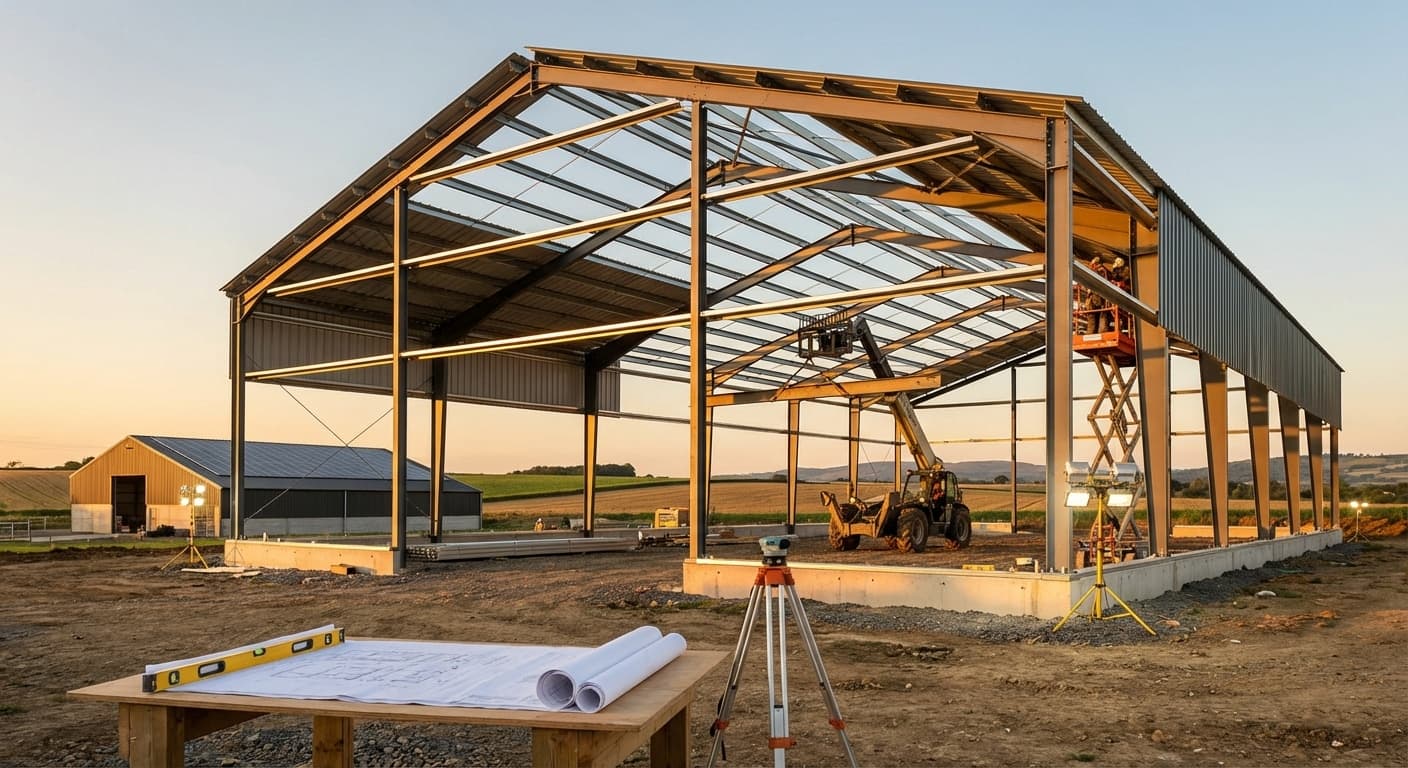

We help you plan, design, and build farm structures that maximize productivity and protect your investment through clear goals and smart material choices. Strategic planning with steel buildings delivers 50+ years of reliable performance while reducing long-term maintenance costs and operational expenses.
Getting Started with Your Farm Buildings Guide
Set SMART goals for your building projects before sketching plans, giving you clear benchmarks to track progress and guide every design decision.
Defining Farm Objectives and Building Goals
Your farm buildings start with clear objectives. Before sketching plans or calculating materials, identify exactly what your buildings need to do. These structures represent major investments that directly impact your daily operations, productivity, and long-term profits [1].
Set SMART goals for your building projects: Specific, Measurable, Achievable, Realistic, and Timebound [1]. Skip vague aims like "building a better barn." Instead, create precise targets: "construct a 2,400-square-foot livestock barn with automatic ventilation for 40 cattle by next spring." This clarity guides every design decision and budget allocation while giving you clear benchmarks to track progress [2].
Balance personal and business objectives. Your business goals likely include maximizing efficiency, increasing production, and reducing labor. Personal goals might focus on reducing physical strain, creating time away from the farm, or making space for family involvement [3]. When goals conflict, prioritize based on what matters most to your farm's success and sustainability [2].
Build a hierarchy of objectives:
- Essential for business success
- Important but not immediate
- Nice-to-have features
- Potentially unnecessary items
This framework optimizes your limited resources while addressing critical needs first [2]. Include at least one financial performance goal (like cutting operational costs) and one growth goal (such as flexible design for future expansion) [3]. Break major building goals into smaller tasks with clear timelines–this transforms your vision into actionable steps [1].
Assessing Site Conditions, Soil and Climate
Assess your site thoroughly before breaking ground. This step saves you from costly mistakes and ensures your buildings work perfectly with your farm's operations.
Start with professional soil testing. Your buildings need stable soil that supports substantial weight without settling [4]. Poor bearing soil? You'll remove it and bring in crushed rock for proper support [5]. Also check soil fertility, pH, and topsoil depth–these affect both your foundations and surrounding operations [4].
Study your topography. It determines building placement, drainage, and construction costs. Excessive slopes mean significant grading expenses [6]. South-facing slopes provide better sunlight for production areas. North-facing slopes offer cooler spots for livestock facilities [6]. Note low areas that collect water and high spots exposed to wind [6].
Water management can make or break your project:
- Check water table depth–high tables need specialized foundations [5]
- Map drainage patterns to avoid interfering with natural flow [4]
- Test well and surface water quality for construction and future use [4]
Climate shapes your building design. Track sun patterns throughout seasons. Note shaded areas from trees or existing structures [6]. Study wind exposure and prevailing directions–proper orientation maximizes ventilation while minimizing storm stress on your
Budget Planning, Financing Options and ROI Forecast for the farm buildings guide
Smart budget planning turns your farm building project into a strategic investment. Build your budget using tax returns and past projects as your baseline [9]. Include both immediate construction costs and long-term operational impacts. Create multiple scenarios–optimistic projections with high yields and conservative estimates based on potential insurance payouts [9].
Use free tools to streamline planning:
- Agricultural Budget Calculator (ABC) shows production costs and projected returns [9]
- Loan payment calculators estimate monthly obligations
- Equipment financing tools compare purchase versus lease options
- Cash flow calculators analyze rental property potential [9]
Watch these key financial metrics:
- Current ratio should exceed 1.0 (assets versus liabilities) [9]
- Debt-to-asset ratio below 30% signals strength; above 60% increases risk [9]
- Include capital costs, depreciation, and maintenance reserves [9]
Explore your financing options:
- Operating lines of credit for flexible, shorter-term needs [9]
- Equipment loans for specific building components [9]
- Land loans for larger projects that boost property value [9]
Compare more than monthly payments–look at interest rates, term lengths, and dividend opportunities [9].
Calculate your ROI using both numbers and operational benefits. Divide annual net income by total investment for your cap rate [9]. Then factor in indirect returns:
- Reduced labor requirements
- Better livestock health
- Increased production capacity
- Lower maintenance with durable materials [9]
Document how improvements support your farm goals. This justifies costs through immediate gains and long-term advantages–especially when you choose low-maintenance solutions that keep working for decades [9].
Choosing the Right Farm Building Types
Steel barns deliver the best return on investment with 50-year lifespans, zero termite risk, and column-free interiors that maximize your usable space.
Overview of Building Categories: Barns, Sheds, Multi‑Purpose Structures
You have three main building categories to consider–barns, sheds, and multi-purpose structures–and choosing the right type saves money while boosting productivity.
Barns remain your most versatile option. You can use them for livestock shelter, feed storage, equipment housing, and daily operations–all under one roof [10]. Modern barns go beyond traditional designs with specialized configurations: grain barns with ventilation systems, dairy barns with automated milking, and horse stables with individual stalls [10]. Steel barns deliver the best return on investment with 50+ year lifespans, zero termite risk, and minimal maintenance [11][12]. Plus, their column-free interiors maximize every square foot of usable space (more on clear-span benefits in our Design section).
Sheds solve specific problems with targeted designs. Loafing sheds–those three-sided, open-front structures–give your livestock weather protection while letting them move freely [11]. Cattle sheds adapt to your climate, from simple open-sided designs for mild weather to fully enclosed buildings with feeding systems for harsh winters [11]. Milking sheds streamline dairy operations with non-slip floors, automated equipment, and dedicated milk storage that meets hygiene standards [11]. Each design directly impacts your bottom line through healthier animals and efficient workflows.
Multi-purpose structures stretch your building budget by serving multiple functions. Equipment buildings protect your machinery investment while providing maintenance space that keeps you operational [10]. Workshop buildings combine repair bays with fabrication areas–some farmers even add living quarters for that popular barndominium setup [10]. Cold storage extends produce shelf life, while on-site feed mills cut processing costs [10]. These flexible designs let you handle more operations under your own roof instead of paying someone else.
Today's farmers increasingly choose
Material Selection: Steel vs. Wood vs. Hybrid Solutions
Material selection: steel vs. wood vs. hybrid solutions
Your material choice affects every aspect of your farm building–from initial cost to decades of maintenance. Here's what you need to know to make the right decision.
Steel buildings protect your investment better than any other option. They handle extreme temperatures, high winds, and even earthquakes without flinching [13]. You'll get 50+ years of service with just occasional rust checks and simple cleaning [13]. Yes, steel costs about 5% more upfront than wood, but you save up to 50% on installation labor, which more than makes up the difference [15]. Plus, steel won't burn–critical protection for hay storage and equipment.
Wood construction still has its place, especially if you want that traditional barn look [13]. The lower initial price tag attracts budget-conscious farmers, but factor in the true cost: regular inspections, termite treatments, rot prevention, and eventual replacement [13]. Once moisture hits 20%, decay sets in fast [15]. Wood works best for smaller structures or interior finishes where aesthetics matter more than longevity.
Hybrid solutions give you the best of both worlds. Pre-engineered building (PEB) systems use steel frames for strength, then add various cladding options for the look you want [14]. Smart farmers use steel where it counts–the frame, roof, and high-stress areas–then add wood touches for offices or break rooms [14]. This approach keeps lifecycle costs low while creating comfortable, functional spaces.
Your climate should drive material decisions. In humid regions, steel with proper insulation outperforms wood every time. In dry climates, you have more flexibility. Either way, insulated steel panels cut your heating and cooling costs while eliminating most maintenance headaches [14].
Sizing, Layout and Future Expansion Planning for a durable farm buildings guide
Start with your biggest equipment and add growth room–that's the golden rule for sizing farm buildings. Measure your largest machinery, then add 4-8 feet of workspace on all sides for safe maintenance access [16]. Your doors need 13-15 feet of clearance to handle modern equipment with cabs, exhaust stacks, and bin extensions [18].
Smart layout tips that save money long-term:
- Make building width at least double your door width for proper work flow [18]
- Create distinct zones: equipment storage, maintenance bay, wash station [16]
- For buildings over 50 feet wide, put repair bay doors on the sidewall, not the endwall [18]
Build for tomorrow, not just today. Your electrical system should handle 30% more load than current needs. Water lines need capacity for future expansion. Add 20-30% extra space in high-traffic areas–equipment keeps getting bigger, and tight spaces kill productivity [17].
Since enlarging steel buildings later costs more than building right the first time, plan expansion into your initial design [17][18]. Smart options include:
- Removable endwalls for easy lengthening
- Foundations prepped for future additions
- Extra electrical capacity roughed in
- Space allocated for emerging tech (drone stations, precision ag equipment, EV charging) [16]
This forward-thinking approach means your building adapts as your operation grows–no expensive rebuilds needed.
Design, Efficiency and Smart Technology
Smart sensors automatically monitor temperature, humidity, and equipment condition around the clock, alerting you to problems before they become costly failures.
Clear‑Span and Column‑Free Designs for Maximum Flexibility
You need every square foot of your farm building working for you. Clear-span designs deliver exactly that–wide-open interiors with zero columns getting in your way [19]. Steel framing carries all roof loads to the exterior walls, leaving you with unobstructed space from wall to wall [20].
Your modern equipment keeps getting bigger. That new combine won't squeeze around support posts. Clear-span buildings give you the room to maneuver, store, and work without obstacles [19]. You can set up bulk storage one season, then reconfigure for equipment maintenance the next–all in the same flexible space [19].
You've got options for your specific needs:
- Tapered I-beam construction: Cost-effective for 40-100 foot widths
- Single-span rigid frames: Perfect for equipment storage and warehouses
- Open web truss systems: Simplified HVAC installation for larger facilities [20]
These column-free designs streamline your workflow. Equipment moves straight through. Workers access tools without detours. Everything flows better when nothing's in the way [20].
Today's
Energy‑Efficient Envelopes, Insulation and Renewable Power Integration
IoT Sensors, Automation and Data‑Driven Management in the farm buildings guideSmart sensors turn your farm building into a system that thinks for itself. Temperature climbing in the grain bin? Ventilation kicks on automatically. Feed running low? You get an alert on your phone. No more checking everything manually–the building monitors itself [25].
The numbers tell the story: agricultural IoT grows from $13.73 billion in 2023 to $22.65 billion by 2028 [26]. Farmers see why. These systems catch problems before they cost you money.
What Smart Buildings Do for You:
- Environmental sensors track temperature, humidity, and air quality 24/7
- Ventilation adjusts automatically when conditions threaten livestock or crops [25]
- Feed bin sensors alert you before supplies run out [25]
- Equipment monitors predict maintenance needs before breakdowns [25]
- Livestock wearables detect health issues early, cutting mortality rates [26]
Everything connects through your smartphone or computer. One dashboard shows your entire operation–building conditions, equipment status, livestock health [26]. You manage the farm from anywhere with internet access.
The payoff comes fast. Smart irrigation alone cuts water use by 70% compared to timer-based systems [27]. Labor costs drop when you stop manual monitoring rounds. Equipment lasts longer with predictive maintenance.
Making It Work in Rural Areas Yes, connectivity can be spotty on farms. That's why modern systems use edge computing–critical functions keep running even when internet drops [25]. Data security concerns? Work with providers who understand agriculture and offer robust protection.
Smart farm buildings don't just house your operation–they actively improve it. Every sensor, every automated system, every data point works to cut costs, save time, and boost productivity through precision management [25].
Permitting, Construction and Long‑Term Maintenance
Securing permits early shapes your entire farm project by clarifying zoning requirements, protecting your investment, and ensuring structures meet safety standards that affect insurance and property value.
Navigating Zoning, Building Codes and Permit Process for the farm buildings guide
Building permits protect your investment and ensure your farm structures meet safety standards that affect insurance coverage, property value, and liability [28]. You'll need permits for most agricultural buildings–barns, storage facilities, greenhouses, livestock housing, and processing facilities–though requirements vary by location [28].
Start by identifying which authority governs your property. County planning departments can quickly tell you which zoning district applies and what's required for agricultural structures. Properties near city limits often face different rules than those in rural areas [29]. Get this information early–it shapes everything that follows.
Before applying, gather your essential documents:
- Property survey showing exact boundaries and existing structures
- Construction plans with engineering specs
- Environmental assessments if near water or protected areas
- Floodplain compliance documentation
- Detailed drawings of structural components, dimensions, and utility systems [28]
Permit fees typically range from $457 to $2,859 nationally, depending on your project's size and complexity [28].
You'll face common challenges that smart planning can overcome. Zoning restrictions might limit building height or footprint–some counties focus regulations near lakes or recreational areas, while others apply county-wide standards [29]. Environmental reviews add time when building near watersheds or wildlife habitats [28]. When you hit obstacles, request variances through your county's adjustment board. They can provide relief when strict code enforcement creates unnecessary hardship [29].
Many
Construction Management: Foundations, Quality Control and Safety Protocols
Your foundation determines whether your farm building stands strong for decades or develops problems within years. Site preparation starts with the right equipment–skid steers for versatility, excavators for larger earthwork, and proper compaction equipment matched to your soil type [30]. In regions with heavy clay or high water tables, drainage becomes critical. Spring thaw and heavy rains test every foundation, especially where frost penetration runs deep [30].
Professional crews bring specialized equipment that makes the difference between adequate and exceptional results. Telehandlers prove invaluable for agricultural construction, combining the lift height, reach, and carrying capacity needed for efficient assembly [30]. For structures with high clearances, scissor lifts handle interior work while boom lifts provide safe access to complex exterior areas [30]. Each building type demands specific approaches–equipment storage facilities need machinery capable of placing large door headers and trusses, while livestock buildings require precise installation of ventilation and specialized flooring [30].
Farm construction safety requires planning beyond typical job sites. Your active operations continue during construction, demanding:
- Temporary access routes that keep equipment away from livestock areas
- Equipment washing stations for biosecurity compliance
- Careful scheduling to minimize disruption to daily farm activities
- Height awareness for rural power lines often hung lower than urban standards [30]
Remote locations compound safety challenges. With emergency services potentially 30 minutes away or more, you need enhanced on-site safety protocols and reliable equipment with superior safety features [30]. Weather adds another layer–winter construction requires concrete heating and insulated blankets, while summer work demands equipment with excellent cooling systems to protect operators [30].
Working with experienced agricultural builders who understand these challenges saves time, money, and headaches. They know which equipment matches your project, how to maintain safety on active farms, and how local conditions affect construction timelines. Their expertise turns potential problems into managed details.
Maintenance, Upgrades and Future‑Proofing Strategies for lasting farm buildings
Smart maintenance keeps your farm buildings performing for decades. Schedule inspections every few years and always after severe storms–catching small problems prevents expensive failures [31][32]. Focus on connection points where posts, trusses, and purlins meet. These junctions carry the load during wind storms and heavy snow, making them your first priority [32].
During inspections, check for:
- Loose or corroded fasteners (tighten just right–over-tightening cracks paint and causes rust)
- Water stains indicating leaks
- Shifted materials or sagging sections
- Pest damage, especially in wood components
- Cracks in concrete or foundations [32][33]
Document everything. Keep maintenance records with dates and details–you'll need them for insurance claims or if regulatory authorities ever ask questions [33].
Strategic upgrades pay for themselves through improved efficiency and reduced operating costs. Before upgrading, map out your immediate needs versus long-term goals [31]. Think ahead–will you add automation? Solar panels? Larger equipment? Design modifications that accommodate future technology extend your building's useful life and protect your investment [31].
Focus upgrade dollars where they deliver maximum return:
- Weatherproofing protects equipment and livestock while cutting energy costs
- Improved ventilation reduces moisture damage and creates healthier environments
- Updated electrical systems support modern equipment and future additions [31][33]
While you can handle routine maintenance yourself, structural upgrades need professional expertise to ensure safety and code compliance [31].
Future-proof your buildings with adaptable designs. Modular components allow expansion without major reconstruction [31]. Every connection point matters–from foundation attachments to roof bracing. Each must meet or exceed your region's wind and snow load requirements [32].
Steel buildings excel here. Their minimal maintenance needs, resistance to pests and weather, and structural flexibility make them ideal for evolving farm operations. Combine quality construction with regular care, and your buildings serve your operation reliably for generations [31][32][33].
- Set SMART goals with specific measurements and timelines before construction to guide design decisions and budget allocation effectively.
- Conduct professional soil testing and thorough site assessment to avoid costly foundation mistakes and optimize building placement.
- Steel buildings provide 50+ year lifespans with minimal maintenance, costing only 5% more upfront while saving up to 50% on installation labor.
- Design buildings with clear-span interiors and 20-30% extra space to accommodate future equipment growth and operational expansion.
- Install IoT sensors and automation systems to monitor environmental conditions, predict equipment maintenance, and reduce labor costs by up to 70%.
- Obtain proper building permits early and gather required documents including property surveys, construction plans, and environmental assessments.
- Schedule regular inspections every few years focusing on connection points and fasteners to prevent costly structural failures and weather damage.
- https://farmplanning.ces.ncsu.edu/getting-started/defining-goals/
- https://www.lsuagcenter.com/articles/page1650920234273
- https://www.farmprogress.com/farm-business-planning/how-to-make-and-prioritize-goals
- https://njaes.rutgers.edu/fs1342/
- https://barnpros.com/resource-center/preparing-to-build-on-your-land/
- https://extension.psu.edu/farmland-assessment-checklist/
- https://www.fcsamerica.com/resources/calculators
- https://www.fbn.com/community/blog/building-budget-2022?srsltid=AfmBOooDVK_x8ujsHHdkC8Dhu1ANN0oQZqSsgdog81WQG3v_A45k5QIr
- https://cap.unl.edu/abc/
- https://peb.steelprogroup.com/steel-structure/agricultural/type-of-farm-buildings/
- https://peakpolebarns.com/articles/steel-agricultural-buildings-guide/
- https://www.buildingsguide.com/metal-building-kits/farm/?srsltid=AfmBOoqKOQRhwZUhZ5N7U0Q0HvKmZeWzm5ljteaehl9hjSJA9zd3fQHe
- https://ccr-mag.com/steel-vs-wood-whats-best-for-farm-buildings/
- https://peb.steelprogroup.com/peb-structure/agricultural/farm-structure-vs-building/
- https://bulldogsteelstructures.com/blog/wood-vs-steel-buildings/
- https://builtmorbuildings.com/blog/complete-guide-to-workshop-design-planning-your-agricultural-workspace/?utm_source=openai
- https://agrisysintl.com/key-considerations-when-planning-an-agricultural-construction-project/
- https://www.extension.purdue.edu/extmedia/ae/ae-104.html
- https://ecosteel.com/ecosteelprefab/clear-span-buildings-operational-efficiency/
- https://www.buildingsguide.com/build/clear-span-buildings/?srsltid=AfmBOoqGuHqNCI1TR3UAShfjqrO70UnSOMqiqCvjG3Dnihj1Coq5vxPy
- https://www.vikingbarns.com/blog/how-innovative-uses-of-metal-farm-buildings-shaping-modern-farming
- https://www.ny-engineers.com/blog/energy-efficient-farm-buildings-6-key-design-elements
- https://www.rmax.com/blog/energy-efficient-building-envelope
- https://www.iea.org/energy-system/buildings/building-envelopes
- https://www.digi.com/blog/post/iot-in-agriculture
- https://www.iot-now.com/2024/10/30/147619-how-iot-is-transforming-yields-and-optimising-resources-in-agriculture/
- https://www.planradar.com/au/advantages-iot-sensors-building-management/
- https://www.steelcobuildings.com/building-permit-for-agricultural-building/
- https://blog.eb3construction.com/construction/texas/zoning-land-use-texas/
- https://ivsrentals.ca/blog/agricultural-building-projects-equipment-guide
- https://www.kitbuildingsdirect.co.uk/blog/maintaining-and-upgrading-your-agricultural-buildings/
- https://www.extension.iastate.edu/news/ensuring-farm-building-strength-key-longevity
- https://www.agproud.com/articles/57460-preventative-maintenance-on-equipment-buildings-improves-farm-safety