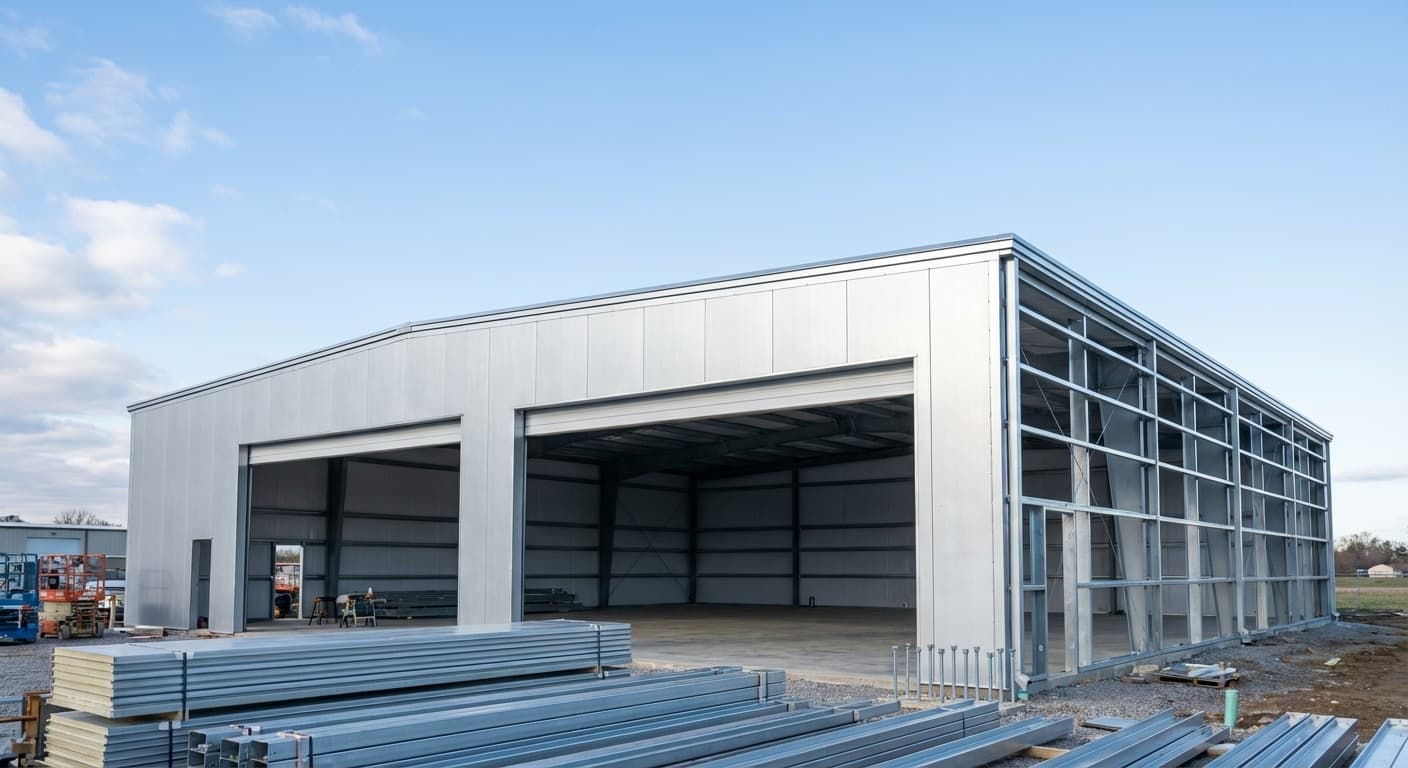

The Ultimate Guide to 60×80 Metal Buildings equips business owners, farmers, and warehouse operators to turn a 4,800-ft² steel shell into a fast, flexible, and future-proof facility in weeks, not months, for about $75k-$150k all-in. Readers learn to lock in base-kit prices ($20k-$35k), budget for hidden line items such as foundations ($6-$14/ft²) and site prep ($7k-$30k), compare financing from USDA farm loans to SBA 7(a), and slash lifetime costs with energy-smart insulation and 50-year, low-maintenance steel. Step-by-step guidance walks through wind-, snow-, and seismic-rated engineering options, PEMB vs. conventional construction, 2024 code changes, and 3-D design tools that prevent $20k layout mistakes before the first anchor bolt is set. The guide also covers foundation choices (slab, gravel, or piers), installation timelines (DIY to turnkey), door/window placement for zero-column workflow, color and cladding upgrades, inspection checkpoints that protect warranties, and green perks like 100% recyclable steel and cooler reflective roofs. By following these field-tested tactics, owners avoid budget overruns, open doors months sooner, and gain a clear-span space that adapts from factory to retail without costly renovations–delivering payback in 6-8 years and 60-80% resale value after two decades.
Why Choose a 60×80 Metal Building
A 60×80 metal building delivers 4,800 square feet of column-free space that assembles in weeks, locks in costs upfront, and adapts as your business evolves.
Market Drivers and Growing Demand
Metal buildings are having their moment–and for good reason. The market is doubling by 2033 [1], driven by businesses that need space fast and can't afford construction delays. You see it everywhere: e-commerce companies scrambling for warehouse space, manufacturers expanding operations, and farms modernizing their storage [1]. The 60×80 configuration hits the sweet spot for most operations–big enough to matter, small enough to manage.
Why now? Three simple reasons. First, traditional construction keeps getting slower and more expensive, while metal buildings go up in weeks instead of months [1]. Second, your building arrives ready to assemble, cutting labor costs and weather delays [2]. Third, with material prices jumping around, you lock in your costs upfront–no surprises, no change orders. Smart businesses are choosing metal because it solves real problems: you need space, you need it fast, and you need it within budget. The 60×80 size delivers exactly that.
Space Efficiency and Functional Benefits
Picture 4,800 square feet with zero columns in your way. That's what you get with a 60×80 metal building–pure, usable space from wall to wall [4][5]. No posts blocking your forklifts. No beams limiting your equipment placement. Just open floor that works exactly how you need it.
The 16-20 foot ceiling height means you can stack inventory high, park tall equipment, or add a mezzanine to double your workspace [5]. Need an office in the corner? Add partition walls. Want separate storage zones? Done. The structure handles whatever you throw at it–manufacturing floor today, warehouse tomorrow, retail space next year [5].
This flexibility saves money two ways. First, you build one structure instead of multiple buildings. Second, when your business changes, your building changes with it. No expensive renovations, no new construction–just reconfigure and keep working. That's the practical advantage of clear-span steel.
What This Guide Will Deliver
This guide cuts through the confusion and shows you exactly how to get your 60×80 metal building done right. You'll discover the real costs–not just the steel price, but everything from foundation to finish [7]. You'll understand which foundation works for your site and budget. You'll know what questions to ask and which corners never to cut.
More importantly, you'll see how to avoid the expensive mistakes that catch first-time builders. Like discovering your site needs $20,000 in unexpected prep work. Or realizing too late that your doors are on the wrong wall for your workflow [6]. We cover it all–from choosing the right steel gauge for your location to understanding why proper drainage matters more than you think [8]. This isn't theory. It's practical knowledge that saves you time, money, and headaches on your project.
Design and Engineering Essentials for 60×80 Metal Buildings
Proper engineering for wind, snow, and seismic loads upfront prevents costly problems while keeping your clear-span design intact and fully compliant.
Structural Framework and Load Calculations
Your 60×80 metal building starts with a proven structural system. The framework uses C-shaped members for walls and openings, plus Z-shaped members for roof support [9]. Together, they create a rock-solid structure that handles whatever nature throws at it.
Here's what determines your building's strength and cost:
Wind Loads – Your location's wind speed sets the steel requirements [10]. Suburban areas need standard protection. Coastal zones require beefier frames, closer spacing, and heavier panels. Each upgrade adds cost but ensures your building stands strong.
Snow Loads – Wet snow can weigh 21 pounds per square foot–seven times more than dry powder [11]. One inch of ice adds 5 pounds per square foot. On your building, that's 24,000 pounds of extra weight. We engineer for your worst-case scenario.
Seismic Requirements – Earthquake zones need special calculations based on soil type and shake intensity [11]. The right design keeps your building safe and your insurance happy.
The bottom line: Higher loads mean more steel and bigger foundations [10]. But proper engineering up front saves you from problems down the road. Your clear-span design stays intact while meeting every safety requirement.
Pre‑Engineered vs Conventional Construction
Two construction methods compete for your 60×80 project: pre-engineered and conventional steel. Here's what matters to your timeline and budget.
Pre-Engineered Metal Buildings (PEMBs)
- Arrive ready to bolt together–no on-site cutting or welding
- Go up 50% faster than conventional construction [12]
- Use less steel while maintaining full strength [13]
- Cost less due to factory efficiency
- Perfect for standard commercial and industrial uses up to two stories
Conventional Steel Construction
- Built piece by piece on-site [14]
- Handles complex custom designs
- Works for buildings over two stories
- Takes longer and costs more
- Requires specialized welding crews
For your 60×80 building,
Code Compliance and 2024/2025 Standards
Building codes change, but your project stays on track. The 2024 International Building Code brings updates that affect metal buildings–here's what you need to know.
New Classification: "Metal Building System" [16] The code now recognizes metal buildings as integrated systems. This means clearer rules for manufacturers and faster approvals for you. Your 60×80 building benefits from streamlined compliance paths.
What Your Building Must Meet:
- Structural steel requirements [16]
- Cold-formed steel standards
- Proper joist specifications
- Seismic design for earthquake zones [15]
Quality Assurance Built In The new code demands better inspection protocols [16]. Manufacturers must certify compliance with approved plans [15]. You get documentation proving your building meets every requirement.
Timeline Note: Adoption varies by location–some areas implement immediately, others take longer [17]. The 2025 code cycle may bring additional changes [15].
Don't worry about tracking every detail. We navigate current codes for your location, ensuring your building passes inspection the first time. You focus on your business; we handle the compliance.
Integrated 3D Design Tools and Customization Options
See your building before you build it. Today's 3D design tools put you in control of every detail.
Design Your 60×80 Building Online:
- Set exact dimensions, roof style, and pitch
- Choose colors for walls, trim, gutters, and roofing [7]
- Add doors and windows exactly where you need them
- Select insulation and interior finishes
- See changes instantly as you make them
Practical Planning Features:
- Drop in vehicles and equipment to check clearances [7]
- Use templates for shops, warehouses, or agricultural buildings [18]
- Test different layouts before committing
- Avoid expensive space-planning mistakes
From Design to Quote: Your finished design goes straight to us for pricing [19]. No lost-in-translation problems. No back-and-forth clarifications. We see exactly what you want and quote it accurately.
Many clients find they save thousands by catching issues in the design phase–like realizing they need a taller door for that new equipment or discovering they can fit more workspace by shifting the office location. The tool pays for itself in avoided change orders.
Ready to start? We'll guide you through the design process and ensure your plans meet both your needs and local codes.
Accurate Cost Planning and Financing Strategies
A 60×80 metal building kit costs $20,000 to $35,000, but budget an additional $36,200 to $96,900 for foundation, site prep, and regional adjustments.
Base Kit Pricing and Current Square‑Foot Benchmarks
Your 60×80 metal building base kit will run $20,000 to $35,000–that's about $4.17-$7.29 per square foot for 4,800 square feet of workspace [20]. This gets you the essentials: primary framing, secondary framing, roof and wall panels, fasteners, and sealants. Foundation, insulation, doors, windows, and finishing come separately [20][5].
Regional differences matter. You'll see 15-20% price swings between states based on local codes and shipping distance [20]. Steel prices shift with market conditions–when global supply chains hiccup, your quote changes too [21].
Your building type affects the bottom line:
- Clear-span (no interior columns): $15-25 per square foot [21]
- Modular frame (with columns): $11-$18 per square foot [21]
Location drives engineering requirements. High snow loads (70+ psf) or hurricane winds (120+ mph)? You need heavier materials and tighter spacing. That adds 15-40% to your base cost [20][21].
Most suppliers offer three pricing tiers:
- Economy ($9-$12/sq ft): Basic structure, minimal extras
- Standard ($13-$18/sq ft): Includes doors, windows, gutters
- Premium ($22-$43/sq ft): Full insulation, interior finishing, architectural features [21]
Hidden Expenses: Foundations, Site Prep, Permits
Your foundation will cost $28,800-$67,200 ($6-$14 per square foot) for a 60×80 building [22]. Most people forget this when they see the kit price. Your 4,800-square-foot footprint needs serious engineering to handle the loads properly.
Problem sites cost more–count on it:
- Expansive clay: Add $5,300-$12,000 for special engineering [22]
- Rocky terrain: Add $8,000-$20,000 for blasting [22]
- Flood zones: Add $37,700-$87,500 for elevated piers [22]
- Slopes: Add $6,600-$24,300 for stabilization [22]
Site preparation runs $7,400-$29,700 total. Here's what you're paying for:
- Land clearing: $5,400-$16,000 ($1-$4 per square foot) [22][23]
- Soil testing: $1,200-$3,200 [22]
- Excavation: $4,200-$12,800 [22]
- Drainage: $3,000-$10,000 [22]
- Utilities: $4,800-$16,000 [22]
- Access roads: $6,600-$24,300 [22]
- Grading: $0.40-$2 per square foot extra [23]
Permits add more:
- Building permit: $720-$4,740 [22]
- Electrical: $248-$1,140 [22]
- Plumbing: $203-$900 [22]
- HVAC: $128-$675 [22]
Processing takes 2-8 weeks. Delays mean carrying costs [22]. Budget for site work up front–it can match or exceed your building kit cost [24].
Lifecycle Savings, Energy Efficiency Payback, ROI
Your metal building pays for itself in 6-8 years. Traditional construction? You're waiting 10-15 years [25].
Here's why your 60×80 building delivers faster returns:
Speed to revenue: You're operational 30-40% faster. That's months of income while traditional builds still have crews on site [25].
Lower operating costs: Modern insulated panels cut heating and cooling by 15-30%. Your utility bills drop from day one [25][27].
Minimal maintenance: You'll spend 50-80% less on upkeep than traditional buildings. No rot, no warping, no termite treatments. These savings multiply as years pass [26].
Strong resale: Metal buildings hold 60-80% of their value after 20 years. Try getting that from stick-built [27].
Tax advantages:
- 39-year depreciation schedule
- Investment tax credits for energy features
- Section 179 deductions on qualifying components [25][26]
Your clear-span design pays dividends long-term. Need to reconfigure for new equipment? Move a few partitions. No structural headaches, no major renovation costs [25].
Just upgrading insulation delivers 15-25% annual energy savings with 3-5 year payback [25]. Over decades, these efficiency gains compound into serious money [27].
Financing Options, Tax Incentives, and Budgeting Tools
Your complete 60×80 project needs $75,000-$150,000 in financing. Here are your best options: Personal loans: Quick approval for projects under $150,000. Good credit gets you lump-sum funding fast [28].
Home equity loans: Fixed rates, predictable payments. Works when you know exact costs [29].
HELOCs: Draw funds as needed. Smart for phased construction or when material prices shift [29].
Agricultural financing: USDA Farm Service Agency loans offer longer terms and competitive rates for farm buildings. They understand metal structures [29].
Construction-to-permanent loans: No refinancing hassle. Converts to a fixed mortgage when you're done. Perfect for larger commercial projects with heavy site work [29].
Local credit unions: Often beat big banks on rates. They know metal buildings aren't "non-conforming"–they're smart business [28][29].
SBA loans: $5,000 to $5 million for commercial use. Terms based on your business history [28].
What lenders look for:
- Your credit score and debt-to-income ratio
- Building purpose (commercial vs. agricultural)
- Property location (rural programs differ)
- Quality blueprints and permits (better docs = better terms) [29]
Many suppliers partner with metal building lenders for faster pre-qualification. Rates might run higher than your bank, but approval comes easier [29][30]. Watch for promotional rates as low as 4.99% APR, though these change with market conditions [30].
Working with a single-source provider like National Steel Buildings simplifies the entire process–we handle design through construction, making financing clearer for lenders.
Site Preparation, Foundations, and Installation Best Practices
Choose between concrete slabs, gravel pads, or concrete piers based on your site conditions, soil type, and budget to ensure your building performs reliably for decades.
Choosing the Right Foundation System
Your 60×80 metal building needs the right foundation to perform for decades. You have three proven options, each fitting different needs and budgets.
Concrete slabs give you the complete package–a clean floor, easy door alignment, and maximum durability [31]. Your 4,800 square feet requires 3,000-4,000 PSI concrete with proper reinforcement. The key? Start with firm soil, add compacted stone, include a vapor barrier, and place control joints correctly [31].
Gravel pads save significant money while providing solid support (covered in detail in our cost section). Use angular crushed stone–never rounded river rock–compacted in lifts. Add geotextile fabric when your soil demands extra stability [31].
Concrete piers solve challenging sites beautifully. Got slopes? Poor soil? High water table? Piers transfer loads precisely where you need them [31][32]. We install 12"-24" diameter tubes below frost line, perfect for barns and equipment storage that don't need concrete floors [32].
Your site conditions drive the choice. Cold climates need perimeter walls to prevent frost heave on heated buildings. Non-heated structures often work fine with monolithic foundations [32]. Success starts with checking drainage after rain, understanding your soil, and grading water away from your building [31].
Site Grading, Drainage, and Soil Assessment Checklist
Smart site prep saves you money and prevents problems down the road. Here's your essential checklist:
Site Survey First Get a professional survey marking your exact building location, property lines, and setbacks [34]. This establishes proper orientation and spots drainage issues early.
Test Your Soil Run both perc tests (drainage rates) and geotechnical analysis (load capacity). You need to know if you're dealing with expansive clays or other problem soils before you build [34].
Grade for Drainage Create a 1% slope extending 10 feet beyond your building footprint [36]. Water flowing toward your building causes expensive problems. Add French drains or culverts where natural drainage falls short [36].
Prepare Your Pad
- Clear all vegetation, roots, and organic material
- Apply crushed angular stone in 4-6 inch lifts
- Compact each lift thoroughly
- Test moisture content before pouring concrete [35][36]
Mark Utilities Early Flag water, power, and sewer locations before any foundation work starts. Planning trenches now prevents costly surprises later [36].
Bottom line: Good drainage and solid soil prep protect your investment. Check water patterns after rain, understand your soil type, and keep water moving away from your building [34].
Step‑by‑Step Installation Timeline and Contractor Coordination
Your 60×80 steel building goes up in 3-8 weeks after foundation curing (7-28 days minimum) [37]. Here's what to expect and how to coordinate success.
Your Three Installation Options:
- DIY – Save $4-$8 per square foot if you have construction experience [38]
- Self-Contract – Manage subs yourself, save 10-20% over general contractors [38]
- Full Service – Let experienced pros handle everything, including permits and coordination (our
Quality Assurance, Inspections, Warranty and Safety Protocols
Quality inspections protect your investment and preserve your warranty. Here's what happens and what you need to track.
Critical Inspection Points: Professional inspectors check your building at key stages–when materials arrive, during foundation work, throughout frame assembly, and as the envelope goes up [40]. They verify:
- Fasteners and clips at correct spacing
- Proper lap installation
- Sealant application rates
- Anchor bolt placement
- All structural connections [40]
Many components become inaccessible once enclosed, making timely inspections essential.
Document Everything: Smart owners maintain inspection logs with [40][41]:
- Digital photos and videos
- Component checklists with dates
- Crew information
- Brand names and part numbers
- Before/after repair photos
This documentation protects your warranty. Manufacturers need proof of proper maintenance when evaluating claims. Skip the records or use wrong materials? You risk voiding coverage [41].
Safety Verification: Independent agencies verify welder certifications, test connections, and confirm proper bolt tension [40]. This third-party verification keeps everyone safe and your project on track.
Ongoing Maintenance Checks: You can handle monthly visual inspections yourself. But call professionals immediately for:
- Noticeable sagging
- Widespread corrosion
- Seam separation
- Persistent leaks [41]
Quick response prevents minor issues from becoming major problems–and major expenses.
Customization, Maintenance, and Sustainable Performance
Customize your 4,800 square feet with no interior columns, positioning doors and insulation to match your workflow and climate for daily efficiency gains.
Doors, Windows, Access and Interior Layout Flexibility
Your 60×80 metal building starts with standard access–a 10'x10' overhead door and 3'x7' personnel door–but you can customize everything to match how you actually work [42]. Need wider openings for equipment? Choose from overhead, roll-up, sectional, sliding, or bifold doors sized to your biggest machinery [42][20].
Windows go where you need them for natural light and energy savings, keeping that crucial 2-foot clearance from corners and eaves (add 8-10 inches for bypass sidewalls) [42]. The real advantage? Without interior columns in the way, you get all 4,800 square feet to configure however makes sense–partition off an office, create separate work zones, or keep it wide open [20].
Add a mezzanine and you've doubled your usable space without expanding your footprint [42]. Position doors and openings based on your daily workflow, whether you're moving tractors, manufacturing equipment, or customer vehicles–smart layout saves steps and time every single day [20].
Insulation, Roofing, Climate Control and Energy Codes
Getting your insulation right means lower energy bills and comfortable working conditions year-round. The 2024 energy code (IECC) sets specific requirements, but here's what matters: you've got options that work for your budget and climate [44]. Traditional single-layer fiberglass with vapor barrier fits between the structure's framework and does the job for moderate climates [46].
Need better performance? High-R systems use multiple insulation layers that meet stricter codes and slash heating/cooling costs [46]. Liner systems put continuous vapor barrier below the purlins with insulation on top–no gaps, no cold spots [45].
For maximum efficiency, continuous insulation boards eliminate thermal bridges completely [46]. Your location drives the specs–northern buildings need higher R-values, while humid environments (think indoor pools or wash bays) require special vapor barriers [46]. Our
Exterior Finishes, Color, Branding and Add‑Ons
Your building's exterior makes the first impression, and we give you complete control over that statement. Start with durable 26-gauge panels that stand up to weather and look sharp with just occasional washing [43][47]. Pick your colors for everything–walls, trim, corners, even the screws–from professional Ash Gray to eye-catching Rustic Red, or match your company colors exactly [48].
These aren't basic paints either; you get 25-40 year warranties against fading and peeling that outlast anything else you could build with [48]. Want to dress it up? Add wainscoting for a professional look, canopies for weather protection, or architectural details that set you apart [43].
Don't forget the practical touches–gutters and downspouts protect your foundation, light panels brighten the interior naturally, and proper ventilation keeps everything fresh [43]. In tough environments like coastal areas or industrial zones, upgrade to Galvalume Plus for extra corrosion resistance [48]. Every choice works together to create a building that performs as good as it looks, year after year [43].
Maintenance Schedule, Longevity, Sustainability Benefits and Next Steps with National Steel Buildings
Your metal building can last 50-60 years with simple, smart maintenance [49]. Here's the schedule that protects your investment: walk around quarterly to check roof and walls, clean gutters twice a year, and have a pro inspect fasteners and seals annually. That's it–no painting, no rot repair, no termite treatments like you'd face with wood or other materials [49]. Small issues caught early stay small and cheap to fix.
Beyond saving you money, steel buildings deliver real environmental benefits. The steel comes from recycled content and stays 100% recyclable when you're done with it–try that with conventional construction [51]. Metal roofs reflect heat to cut cooling costs, while proper insulation keeps temperatures steady all year [51]. Lower energy use means smaller bills and smaller carbon footprint–wins all around.
Ready to move forward? At National Steel Buildings, we've completed over 1,480 projects nationwide. We handle everything from initial design through final construction, keeping you informed at every step. Our in-house erection team means no finger-pointing between subs, just smooth execution within budget and on schedule.
- 60×80 metal building delivers 4,800 sq ft of clear-span space in 3-8 weeks for $75k-$150k all-in.
- Foundation, site prep and permits can equal or exceed the $20k-$35k steel kit price–budget them early.
- Wind, snow and seismic loads dictate steel gauge and spacing; coastal or heavy-snow zones add 15-40% cost.
- Pre-engineered systems cut build time 50%, use less steel and cost less than on-site welded conventional framing.
- Continuous insulation, 26-gauge panels and Galvalume options slash energy use and carry 25-40 yr fade warranties.
- Quarterly gutter cleaning plus annual fastener/seal inspection yields 50-60 yr lifespan with 50-80% lower upkeep than wood.
- Tax breaks, faster occupancy and 15-30% lower utility bills give metal buildings 6-8 yr payback vs 10-15 yr for conventional.
- https://www.grandviewresearch.com/industry-analysis/us-pre-engineered-metal-building-market-report
- https://finance.yahoo.com/news/u-pre-engineered-metal-building-153400050.html
- https://www.uspatriotsteel.com/sizing/60×80-metal-building/
- https://atlanticsteelstructures.com/steel-building/60×80/
- https://gensteel.com/steel-building-kits/base-building-packages/60×80/
- https://www.buildingsguide.com/standard-sizes/?srsltid=AfmBOoox8Yh47vxMJbPOmp3Fej-91yxEeBNRkl42RAFJft_AzVTffyj7
- https://titansteelstructures.com/steel-building-services/how-to-design-a-60×80-steel-building-using-our-3d-designer/
- https://trusteelbuildings.com/steel-buildings/warehouse/60×80/
- https://renegadesteelbuildings.com/everything-you-need-to-know-about-buying-a-steel-building/
- https://metalbuildingsguide.com/loads-codes
- https://www.rhinobldg.com/blog/metal-building-construction-loads-101
- https://www.alpha-labor-co.com/blog/pre-engineered-metal-buildings-vs-conventional-steel-construction
- https://www.butlermfg.com/blog/is-a-pre-engineered-metal-building-or-conventional-steel-building-right-for-you/
- https://veneklasenconstruction.com/choosing-between-pre-engineered-metal-and-conventional-steel-construction/
- https://codes.iccsafe.org/content/IBC2024V1.0/chapter-22-steel
- https://www.structuremag.org/article/2024-ibc-significant-structural-changes-part-4-steel/
- https://gundersonengineering.com/important-changes-in-the-ibc-irc-2024/
- https://www.buildingsguide.com/design/3d-metal-building-designer/?srsltid=AfmBOopyy–JrJ4PZltl00DRAFn80tUObuHGOfiQvtdDQ2g2eMPEcdiA
- https://sunwardsteel.com/
- https://www.uspatriotsteel.com/blog/how-much-does-a-60×80-metal-building-cost/
- https://americansteelinc.com/blog/steel-building-costs-prices-guide/
- https://www.metal-buildings.org/60-x-80-metal-building/
- https://www.cascadingfallsinc.com/what-do-prefab-metal-building-cost-to-construct
- https://ecosteel.com/ecosteelprefab/hidden-costs-in-steel-building-projects-how-to-avoid-them/
- https://metalprobuildings.com/steel-industrial-building-cost-roi/
- https://www.hswilliams.com/blog/commercial-metal-buildings-cost-vs-value-analysis
- https://www.vikingsteelstructures.com/carports-infographics/how-metal-buildings-save-costs-over-time?srsltid=AfmBOoqv78WaHHNMGbnc-XMs9b9Db6K95lVK9z9Aeu_1nf4YIzKHoWY3
- https://metalbuildingsnorthamerica.com/traditional-financing/
- https://bullbuildings.com/5-options-for-financing-your-metal-building/
- https://www.carportcentral.com/financing-carports-and-metal-buildings?srsltid=AfmBOoroBhfbYPMQCvD_pxj3BSf0zeeWLc9UO-WOInvWA2oQbSlMNHRN
- https://www.aametalbuildings.com/blog/metal-garage-foundation-guide-slab-vs-gravel-vs-piers-cost-best-use?srsltid=AfmBOopBEHV1VNAZh8NniwDK1C0TP29k5e2XBG7EStpVNW07EGXB3LjW
- https://sunwardsteel.com/foundation/
- https://idadevelops.com/what-kind-of-foundation-do-i-need-for-a-metal-building/
- https://www.buildingsguide.com/build/metal-building-site-prep/?srsltid=AfmBOopqgwwsHg5TDlcVcvaKrnLjZ8qsi9QL0_WZCH41VLEZeVs-qWWr
- https://www.aametalbuildings.com/blog/commercial-metal-building-pre-construction-checklist?srsltid=AfmBOoopxAKkJhCBEHbi38_Cq6lrK5unM7a9rg39lL2U2nzaIqRDghaX&srsltid=AfmBOopJ8XQglbbH5p1AgFZ9HPBmPIPv7Ys7uBc-B3S_2GEaxm9i-AvE
- https://lionbuildings.com/how-do-i-prepare-my-site-for-a-steel-building-install/2/
- https://www.buildingsguide.com/build/?srsltid=AfmBOor_68qB7WCVR9TvJk6OjO6cloc297zlCrC9J0M6ZvFGU77UY3Fo
- https://steelbuildingsguide.org/construction/
- https://midweststeelcarports.com/metal-building-installation-process/
- https://www.metalconstructionnews.com/articles/metal-building-system-inspections/
- https://www.metalbuildingcontractorsnearme.com/maintenance-checklist/
- https://www.buildingsguide.com/products/standard-size/60x80x12-metal-building/?srsltid=AfmBOoqu5JvzpXAKiquB-IlNsIXJcyJm49-y4CRtl2F7PMbSjibr2FZ0
- https://www.metalbuildingoutlet.com/60×80-metal-building-kit/
- https://thermaldesign.com/techinfo/codeanalysis/
- https://www.cecobuildings.com/blog/energy-code-insulation-solutions-metal-buildings/
- https://therm-all.com/a-guide-to-metal-building-insulation/
- https://titansteelstructures.com/60×80-metal-buildings/
- https://sunwardsteel.com/steel-building-colors/
- https://nationalmetalbuildings.com/blog/the-durability-and-longevity-of-metal-buildings
- https://nationalmetalbuildings.com/blog/maintaining-your-commercial-metal-building-tips-for-long-term-durability
- https://usnationalsteel.com/the-evolution-and-advantages-of-metal-buildings/