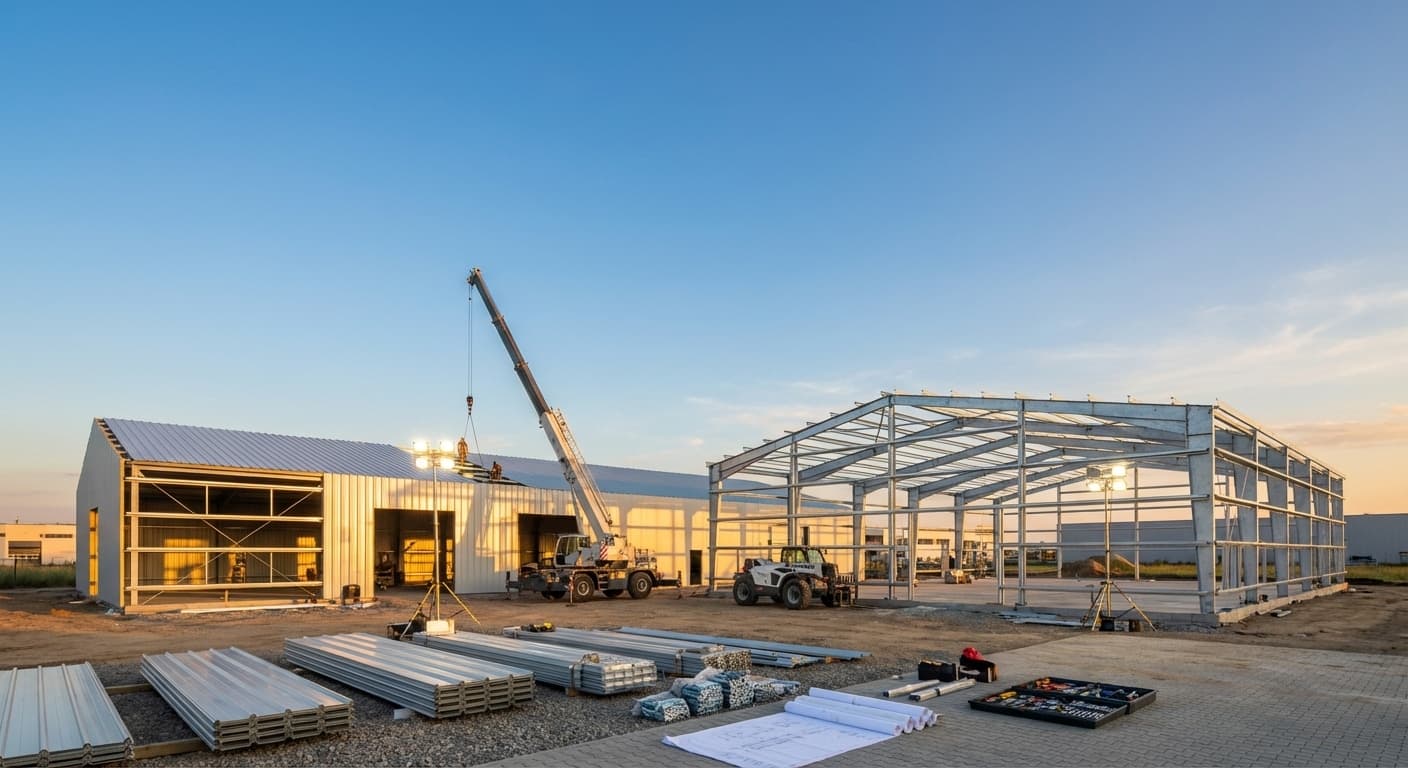

From budgeting to bolts, this guide walks you through every step of buying, customizing, and owning a metal-building kit so you end up with a structure that costs 30-50 % less than conventional construction, goes up in weeks instead of months, and lasts half a century with almost no upkeep. You'll learn how to size the frame and pick coatings, insulation, and certifications that handle your local snow, wind, and energy codes; compare financing, permits, and tax breaks that can drop real costs below $16 per square foot; and decide when DIY makes sense versus hiring certified crews who warranty their work. Real-world checklists show how to avoid anchor-bolt mis-alignment, rust, or permit rejections, while upgrade paths–cool roofs, solar-ready trusses, clear-span expansions–future-proof the building as your business or farm grows. By the end you'll know exactly how to turn a prefab steel shell into a durable, eco-friendly asset that cuts insurance and utility bills, qualifies for LEED points, and adds resale value whether you need a warehouse, workshop, or barn.
Why Choose Metal Building Kits
Choose metal building kits to slash construction costs by up to 50%, erect warehouses in weeks not months, and lock in durable, low-maintenance structures that thrive in a USD 49.4 billion market surging at 11.9% annually.
Growing popularity and market trends in 2025
The metal building system market is experiencing explosive growth, valued at USD 22. 5 billion in 2025 with projections to reach USD 49. 4 billion by 2032–representing an 11. 9% CAGR [1]. Asia Pacific currently dominates with 38. 8% market share, while North America shows the fastest growth at 30.
4% [1]. Industrial applications lead demand, accounting for 48. 7% of the market, driven by warehousing needs for e-commerce expansion [1]. Price points remain a key advantage, with prefabricated kits averaging $10-25 per square foot and fully installed systems ranging from $24-43 per square foot [1]. Regional patterns show distinct development trajectories: the US holds 26. 1% of the global market, China 16%, and India 7.
5%, with significant growth in Germany and Japan at 5. 1% each [1]. Rising steel prices are impacting the 2025 landscape, with hot-rolled coil prices increasing from $650 to $900 per ton, partly due to a 25% tariff on imports [3]. The Infrastructure Investment and Jobs Act is substantially boosting demand, particularly in the Southern US where nearly 695 million square feet of new industrial space is under development [3]. Industry forecasts predict 18-20% price increases for key steel products in 2025 compared to 2024 averages [3]. Sustainability remains a major driver, with metal buildings leading in eco-friendly construction through high recyclability and reduced waste [2].
Core advantages over traditional construction
Metal building kits offer significant advantages over traditional construction methods. The most immediate benefit is cost: metal structures cost 30-50% less than brick or wood buildings due to prefabricated components that reduce labor hours and material waste [4]. Construction speed provides another compelling advantage, with metal buildings erected in days or weeks rather than months for traditional structures [5].
Their durability sets them apart – resistant to rot, pests, fire, and extreme weather conditions, metal buildings require minimal maintenance throughout their lifespan [6]. This durability translates to lower insurance premiums and long-term savings [4]. Metal structures offer superior versatility with clear-span designs that eliminate the need for interior support columns, creating flexible open floor plans that adapt easily to changing needs [5].
Environmental benefits include high recyclability, with most metal buildings constructed from partially recycled steel, and construction processes that generate significantly less waste than traditional methods [6]. Metal buildings also deliver energy efficiency when properly insulated, helping to reduce utility costs [5]. This combination of economic, practical, and environmental advantages explains the growing shift toward metal construction across industrial, agricultural, and commercial applications.
Alignment with sustainability and energy goals
Metal buildings offer intrinsic sustainability advantages that align with modern environmental priorities. The steel used in these structures is among the most recycled materials globally, with components typically containing significant recycled content while maintaining full structural integrity through infinite recycling cycles [7]. This closed-loop material usage significantly reduces demand for virgin resources. Construction waste decreases by up to 30% compared to traditional building methods through precision factory manufacturing that pre-cuts and pre-drills components before they reach the construction site [7][8]. Energy efficiency features integrate seamlessly into metal building designs.
Cool roof coatings reflect solar radiation and can reduce cooling costs by 15% or more during summer months [7]. The framework accommodates advanced insulation systems that maintain comfortable interior temperatures while minimizing HVAC demands [8]. Clear-span designs enable strategic placement of windows and skylights for natural daylighting, reducing electricity usage [8]. Metal structures also provide ideal structural support for both solar panel installations and green roofs without requiring additional reinforcement [8]. The exceptional durability of metal buildings–resistant to fire, pests, moisture and structural degradation–extends their useful life to 50+ years with minimal maintenance [7].
This longevity dramatically reduces material consumption and embodied carbon costs compared to buildings requiring frequent repair or replacement. For projects seeking formal recognition, metal buildings contribute significantly toward LEED certification across multiple categories including Materials & Resources and Energy & Atmosphere [7][9]. The LEED process evaluates sustainable site development, water savings, energy efficiency, materials selection, and indoor environmental quality–all areas where metal buildings can excel [9]. These inherent sustainable characteristics position metal buildings as forward-looking choices for climate-conscious construction in 2025 and beyond [8].
Key considerations before starting your project
Before starting your metal building project, assess your current and future needs to determine appropriate size, design, and expansion potential [10]. Secure all necessary permits from local building departments to avoid costly fines or potential building removal orders [10]. For site preparation, select level ground above natural water runoff with clear access for delivery equipment–trucks and cranes need solid, wide pathways unaffected by seasonal ground conditions [11].
Plan utility integration (power, water, climate control) before pouring your foundation rather than cutting into finished concrete later [11]. Evaluate foundation options carefully, as concrete pads provide superior stability but require additional permits and 2-4 week curing periods before construction can begin [12]. Your budget should account for all expenses including site preparation, foundation work, permits, and the building kit itself [10].
Compare multiple manufacturers to find the best combination of quality, customization options, and warranty coverage [12]. For a smoother construction process, coordinate closely with your supplier on delivery timing and ensure your site is fully prepared according to specifications when materials arrive [12].
Understanding the Components and Engineering
Master the three-engineered-system anatomy–primary frame, secondary framing, and panel/fastener package–and you can slash both construction time and cost by up to 30% while choosing between a $15-25/sq ft standard kit or a custom build that expands with your business.
Core components: frames, panels, fasteners
Your metal building kit breaks down into three core systems–and understanding them saves you money and headaches down the road. The primary frame does the heavy lifting. These are your main columns and rafters that channel weight from roof to foundation [13][14]. You've got options: clearspan frames give you wide-open space with zero interior columns, modular frames use interior supports for larger buildings, and expandable endwall frames let you grow later without starting over [14].
Secondary framing ties everything together. Think of Z-shaped purlins across your roof, C or Z-shaped girts on your walls, and eave struts where roof meets wall [13][14]. These members create the skeleton your panels attach to. Your panels and fasteners complete the package.
Steel wall and roof panels come in different gauges and finishes to match your needs and budget [13]. Every bolt, nut, and screw is engineered for its specific spot–no guessing, no trips to the hardware store [13]. This systematic approach cuts your costs and keeps your project moving [14].
Standard versus fully customized kits
You've got two paths: standard kits that get the job done fast, or custom solutions that match your exact vision. Here's what matters for your bottom line. Standard kits deliver the basics–frame, panels, fasteners–all pre-engineered to meet your local codes [15][16]. At $15-$25 per square foot, they're your fastest route to a weathertight building [15]. Everything arrives pre-punched and ready to bolt together.
You can cut construction time by 30% compared to traditional methods [15]. Custom kits start with that same engineered foundation but adapt to your specific needs. Need a 14-foot overhead door instead of 10? Want windows on the south wall for natural light? Planning a mezzanine for office space?
Custom gets you there [15][16]. Yes, you'll pay more for those rollup doors, specialized roof profiles, and structural add-ons [15]. But you get exactly what your operation needs.
Material choices: gauge, coating, insulation
Your material choices directly impact your building's performance and operating costs. Let's cut through the options to what actually matters. Steel gauge determines strength and price. Heavier gauge costs more upfront but handles higher loads and lasts longer. Your location's wind and snow requirements (detailed in Section 6) dictate minimum gauges. Coating options protect your investment.
Standard galvalume gives you 20-year protection. Painted panels with siliconized polyester or PVDF coatings push that to 40 years while adding color options that reduce cooling costs. Insulation pays you back every month through lower energy bills. Your basic options: – Fiberglass batts (R-8 to R-30): Affordable but needs proper vapor barriers to prevent moisture problems [18][19] – Layered systems: Better performance by combining materials without compression at framing [18] – Insulated metal panels: One-step installation with superior R-values, worth it for conditioned spaces [20] Your building's purpose drives insulation decisions. Warehouse storing dry goods? Basic R-13 walls work fine.
Climate-controlled shop or office space? You'll want R-19 walls and R-30 roof minimum [18][19]. High-humidity environments need vapor barriers below 0. 1 perm–way better than standard vinyl at preventing condensation [18]. Smart material choices now mean lower operating costs forever. We'll match your materials to your actual needs and local energy codes, not oversell you on features that don't pay back.
Engineering certifications and code compliance
Here's the engineering reality: Your building must handle whatever nature throws at it, and you need the paperwork to prove it. Every metal building requires certified engineering for your specific location [21]. Engineers calculate everything–your building's weight, equipment loads, snow accumulation, wind forces–then combine them using ASCE 7 formulas to ensure your structure stays standing in worst-case scenarios [21]. Your location changes everything. Beach property? You're engineering for 150 mph winds. Mountain site?
Heavy snow loads drive the design. Earthquake zone? Special anchoring and bracing requirements kick in [21][23]. These aren't suggestions–they're legal requirements backed by the International Building Code [23]. What certification gets you: – Engineer-stamped drawings your building department requires [22] – Lower insurance premiums (insurers love engineered buildings) [23] – Higher resale value [23] – Peace of mind when storms hit [23] The permit process (covered in detail in Section 6) demands these stamped drawings proving code compliance [22]. Without them, you're dead in the water. Common mistake?
Trying to save money by under-engineering. Those "agricultural use only" buildings might be cheaper, but they won't pass commercial inspections and your insurance company will laugh at your claim after a storm [23]. We handle the engineering complexity. You get buildings certified for your exact location with all documentation ready for permits. No surprises, no delays, no wondering if it'll stand up to that once-in-50-years storm.
Customization Options for Every Need
From 10' to 60' heights, 22 standard colors to over 100 finishes, and clear-span frames up to 300' with no interior posts, your metal building is engineered to fit your exact dimensions, style, and future business needs–today and tomorrow.
Structural customization: dimensions, roof styles, clear‑span options
Your metal building starts with dimensions that work for you–not the other way around. You get standard widths from 40' to 100' that keep costs down, or custom spans up to 300' when your project demands it [25]. Need vertical clearance? Choose heights from 10' to 60' to fit everything from farm equipment to aircraft [24][25].
Pick the roof that matches your needs: – Gable roofs: Classic symmetrical design for maximum interior space – Single-slope: Smart drainage for retail and commercial applications – Gambrel: Extra headroom without extra cost As covered in our engineering section, clear-span construction gives you completely open floor space–no posts, no columns, no wasted square footage [25]. Your 100-foot warehouse stays 100 feet of usable space. When your business changes, your building adapts. Manufacturing today, retail tomorrow–the space works either way [25].
We use the right frame system for your project [25][26]: – I-beam frames for economical 40'-100' spans – Rigid frames when you need industrial-grade strength – Open web trusses that make running HVAC and electrical simple For specialized needs, consider Quonset designs for quick assembly or fabric structures for temporary solutions [25]. Whatever you choose, you're getting a building that fits your operation–not forcing your operation to fit the building.
Aesthetic choices: colors, finishes, architectural trims
Your building's color does more than look good–it saves you money. Start with 22 standard colors or choose from over 100 specialty finishes including woodgrain and weathered steel looks [27]. Want your building to stand out? Go high-contrast with dark roofs and light walls.
Need it to blend in? Match the local landscape [27]. Your paint choice matters: – SMP coatings: Budget-friendly option that handles most climates – PVDF/Kynar finishes: Premium protection when you need colors to stay vibrant for decades Both come with 40-year warranties on painted panels–20 years on galvalume [27][29]. Cut your cooling bills by 15% with "cool" roof coatings that reflect heat instead of absorbing it [27].
These energy-smart finishes can qualify you for LEED points and tax breaks too. Simple color rules that work: – Black trim on white buildings–classic and professional – Earth tones for rural settings – Match existing structures for a unified look Use online color visualizers to see exactly what you're getting before you commit [28]. No surprises, no repainting–just the look you want from day one.
Functional add‑ons: doors, windows, mezzanines, solar integration
The right add-ons turn your steel shell into a working building that earns its keep. Start with doors that match your workflow: – Roll-up doors for drive-through equipment access – Walk doors for people–insulated options available – Overhead sectional doors when you need both [30][32] Windows pay for themselves. Natural light cuts your electric bill. Cross-ventilation keeps air fresh without running fans.
Place them right, and they're emergency exits too [31][32]. Need more space without more building? Add a mezzanine. You double your square footage by going up instead of out–perfect for offices above the shop floor or extra storage that doesn't eat into work space [32].
Keep your building working efficiently: – Ventilation systems: Stop moisture before it starts rust – Insulation packages: Cut heating and cooling costs year-round – Partition walls: Create separate work zones without permanent construction Every add-on serves a purpose. Pick what makes your operation run better, skip what doesn't. You're building a tool, not a showpiece [31].
Industry‑specific configurations for agriculture, commercial, and residential use
Every industry needs something different. Your metal building delivers exactly that.
Agricultural Buildings Farm operations demand clear spans–up to 200 feet of open space for moving equipment, storing harvests, and housing livestock [34]. Choose from traditional barn styles, vertical designs, or modern A-frames [33].
Planning and Budgeting Your Project
Plan your building for the next decade–listing every door, window, and climate need now–because a 40×60 kit at $18/sq ft can balloon past $29/sq ft once foundation, site prep, permits, and hidden utility costs are counted.
Defining project goals and functional requirements
Start with a clear vision. What's this building for? Storage? Workshop? Agricultural operations? Commercial use? Your answer shapes everything else [12].
Think beyond today. Your business will grow. Your needs will change. Plan for 5-10 years out, not just next month [12]. A building that's too small today becomes a bigger problem tomorrow. Get specific about features. Need overhead doors for equipment access?
Windows for natural light? Climate control for sensitive materials? List these requirements now [12]. It's far cheaper to plan for electrical runs and plumbing before you pour concrete. Your layout matters. Open floor plans give you flexibility–you can reconfigure space as needs change without tearing down walls [12]. That adaptability protects your investment long-term [35].
Accurate cost estimating: kit price, foundation, site prep, permits
Your real budget goes beyond the sticker price. Here's what you're actually looking at: Building kit costs: Materials-only packages run $11-$20 per square foot in 2025 [38]. A 40×60 building kit? About $43,200, or $18 per square foot [37]. Fully installed with foundation and labor?
Budget $16-$29 per square foot [38]. These ranges reflect the broader market pricing discussed earlier. Foundation expenses: Concrete slabs cost $4-$8 per square foot [38]. That same 40×60 building needs $9,600-$19,200 just for the foundation. Skip the shortcuts here–a proper foundation prevents costly problems later.
Site prep: Add $1-$2 per square foot for clearing, grading, and drainage [38]. Good drainage now saves you from water damage headaches down the road. Permits: Several hundred to several thousand dollars, depending on your location [38]. Every municipality has its own rules and fees. Hidden costs that bite first-time builders: – Utility connections (electrical, water, sewer) – Interior finishing (insulation, HVAC, walls) – Regional requirements for snow loads and wind resistance [36] Smart move: Get itemized quotes from suppliers.
Financing solutions and tax incentives for steel buildings
You don't need all cash upfront. Here are your financing options: Bank loans: Traditional financing with competitive rates and tax-deductible interest. Yes, there's paperwork. Yes, they check your credit. But the terms often beat other options [39]. SBA loans: Two flavors here: – 7(a) loans for general business needs – 504 loans specifically for buildings and equipment Lower down payments than banks, but expect more documentation [39]. Seller financing: Work directly with your building supplier.
Faster approval, custom terms, but usually higher interest rates [39]. Rent-to-own: Some suppliers offer this with no credit checks. Own your building in 36 months or less through manageable monthly payments [39]. Tax benefits that lower your real cost: Metal buildings come with serious tax advantages. The IRS lets you depreciate commercial structures over 39 years, but metal buildings often qualify for faster schedules [40]. Section 179 is your friend–deduct the entire building cost in year one, up to $1,160,000 for 2024 [40]. That's immediate tax relief, not spread over decades.
Bonus depreciation adds another layer, though it's phasing down. Energy-efficient designs? That's a $2,000 tax credit per unit under Section 45L [40]. Some states sweeten the deal with property tax breaks for green buildings [39]. Stack these incentives with smart financing, and your effective cost drops significantly. Talk to your accountant–they'll show you exactly how much you'll save [39].
Site evaluation: soil, drainage, wind and snow loads (2025 standards)
Your site determines your building's future. Get this wrong, and you'll fight problems for decades. Check your soil first. Clay behaves differently than sand. Rock requires different foundation approaches than loam. Match your foundation to your soil type, or watch your building shift and crack. Drainage matters more than you think. Water pooling around your foundation leads to erosion, frost heaving, and structural damage.
Grade your site to move water away from the building. 2025 brings new snow load standards. The updated ASCE/SEI 7-22 code uses 40 additional years of weather data [41]. What's changed: – Buildings now categorized by risk level, not just location – Snow loads calculated as ultimate loads, matching wind and seismic standards – Better insulation = slower snow melt = heavier roof loads – New sliding scale for thermal factors based on actual R-values [41] Wind loads vary wildly. Coastal areas face 150 mph design requirements. Inland sites might need half that [42]. Your exact location–not just your state–determines your requirements. **Local codes trump national standards.
** Many municipalities exceed IBC minimums. That's why certified engineering drawings aren't optional–they're essential for permits [42]. These requirements directly impact your costs. Higher loads mean beefier framing, stronger anchors, and steeper roofs for snow shedding [42]. But certified buildings come with the documentation to prove compliance. No guessing, no delays at inspection.
Permits, Regulations, and Sustainable Practices
Before you buy a single steel panel, secure the right permits–because skipping weeks of zoning checks, engineer-stamped plans, and up to $2,000 in fees can trigger fines, delays, or a demolition order.
Navigating local building codes and zoning for metal building kits
Metal building projects almost always require permits to ensure safety standards, code compliance, and legal construction. Local building departments enforce specific requirements based on your structure's size, purpose, and location. Residential projects typically require simpler permitting than commercial buildings, with the latter facing stricter regulations for safety, accessibility, and environmental impact [43].
The permit application process includes contacting your local building authority, submitting detailed site plans, providing engineer-stamped structural drawings, and paying application fees that typically range from $500-$2,000 depending on project complexity [43][44]. Building codes originated to standardize construction practices–like Oregon's 1973 Senate Bill 73 that created uniform statewide requirements–and are continuously updated by organizations like the National Institute of Standards and Technologies and the American National Standards Institute [45]. These codes vary regionally to address location-specific hazards such as earthquakes, hurricanes, or flooding [45].
As the property owner, you bear full responsibility for securing permits and facing consequences for non-compliance, which can include fines, construction delays, or even demolition orders [43][44]. Common permitting mistakes include underestimating timelines (permit processing typically takes several weeks to months), submitting incomplete applications, and failing to check setback requirements that dictate how far structures must be from property lines [44]. When planning your metal building project, verify local zoning ordinances that regulate building height, appearance, and intended use before purchasing materials–these restrictions often vary even between neighboring communities [44].
Environmental certifications (LEED, ENERGY STAR) and green roofing
LEED certification evaluates buildings on environmental performance across water efficiency, energy usage, indoor quality, and carbon reduction [47]. This USGBC standard offers four levels–Certified (40-49 points), Silver (50-59 points), Gold (60-79 points), and Platinum (80-110 points) [46][47]. Metal buildings excel through high recyclability, minimal site waste from pre-engineered components, and exceptional durability [8].
They contribute significant points in Materials & Resources (up to 30% recycled content), Energy & Atmosphere (cool roofs reduce cooling costs by 15%), and Sustainable Sites [8][46]. Their framework supports solar panels and green roofs without additional reinforcement [8]. Green roofs reduce urban heat islands, improve insulation, manage stormwater, and create biodiversity [8].
Metal roofs with cool surface treatments reflect solar heat while potentially qualifying for tax incentives [46]. LEED-certified buildings offer reduced operating costs, improved occupant health, higher property values, and enhanced sustainability reputation [47].
Storm‑proofing and climate‑responsive design updates
Modern metal buildings incorporate advanced design features to withstand extreme weather conditions. Wind uplift–the upward force created when wind creates pressure differences over roofs–represents a major threat that requires specific engineering solutions [48]. Buildings now receive ratings through multiple testing standards including UL-580, FM Global Standard 4471, ASCE 7-16, ASTM E 1592, and UL 1897 to verify wind resistance [48].
Key structural improvements include cable bracing that transfers lateral loads to the foundation and prevents twisting during high winds, and purlin strapping that provides crucial support to roof purlins and wall girts, maintaining structural integrity during storms [49]. Climate-responsive elements now address regional weather patterns–buildings in hurricane zones use reinforced steel frameworks designed to withstand winds exceeding 150 mph, reducing storm damage by up to 80% [50]. Heat management has evolved through reflective roofing materials and advanced ventilation systems that decrease cooling costs by approximately 15% while improving indoor air quality [50].
Building orientation also significantly impacts wind resistance, with structures positioned perpendicular to prevailing winds experiencing reduced wind loads [48]. For enhanced stability, designers now consider site surroundings–clearing potential airborne hazards while strategically using tree cover to reduce wind impact [48]. This comprehensive approach to weather resilience ensures metal buildings can adapt to increasingly unpredictable climate conditions.
Documentation checklist for a smooth approval process
Successfully navigating the permit approval process for metal buildings requires thorough documentation preparation. Before submitting your application, gather property documentation including your deed with legal property description to establish ownership and boundaries [51][52]. Prepare a detailed site plan showing property lines, existing structures, utility locations, setbacks (distances from property lines), easements, proposed building location with dimensions, and north arrow orientation [51]. Building plans must include engineer-stamped structural drawings, which reputable metal building suppliers typically provide with your purchase [52].
These drawings should detail dimensions, materials, structural connections, and foundation specifications [51]. Engineering documentation must demonstrate compliance with local load requirements–specifically wind ratings, snow loads, and seismic criteria for your area [51]. Many jurisdictions now require foundation plans certified by an engineer familiar with local soil conditions, as requirements vary based on frost depth and soil composition [51][52]. For structures with specialized uses, include electrical, plumbing, and HVAC plans as required by your local building department [51].
To avoid common approval delays, verify zoning requirements before applying, accurately describe the building's intended use, provide clear anchoring details, and submit complete documentation showing all setbacks [51][45]. In areas with complex permitting processes, consider a "permit hold" approach where you secure approval on drawings before finalizing your building order [52]. Remember that permit requirements vary significantly between jurisdictions–what's acceptable in one county may be insufficient in another, making pre-application consultation with local officials invaluable [51][45].
Selecting a Supplier and Installation Path
Choose a certified installer whose rust-through and weathertightness warranties are backed by a long-standing company, because DIY-ing anything larger than a small shed risks costly mistakes that pros avoid by following a strict, phase-by-phase build sequence.
Vetting manufacturers: certifications, warranty, after‑sales support
Start by asking the right questions. Does the manufacturer back their product with real warranties–not just paper promises? Look for coverage that actually protects you: rust-through protection for coastal builds, paint warranties that don't fade after year one, and workmanship guarantees when they handle installation [53]. Watch for the fine print. Most warranties won't cover storm damage or DIY modifications, and some shrink their coverage year by year [53].
The best indicator? Certified installers. Programs like CICP mean the crews passed rigorous testing and can offer premium weathertightness warranties–the kind without dollar limits [54]. That certification translates to better builds and fewer callbacks. Ask about after-sales support before you buy.
You want a manufacturer who answers the phone when you need help, not one who disappears after delivery [55]. Check how long they've been in business–a 40-year warranty from a 5-year-old company won't help you much [53]. For comprehensive warranty details specific to your project, see our discussion in the Long-Term Ownership section.
DIY assembly vs professional erection: pros, cons, safety tips
DIY sounds great until you're standing in front of 10,000 pounds of steel with three friends and a toolbox. Yes, you'll save on labor–but only if everything goes perfectly [56]. Small sheds?
Sure, grab some helpers and a weekend. But anything over 30×40 feet needs serious equipment and know-how [57]. Here's what DIY really means: You'll prep the foundation, set anchor bolts exactly right, raise heavy frames without dropping them, align every panel perfectly, then seal it all weathertight [57].
Miss any step and you're looking at leaks, wobbles, or worse. Professional installation costs more upfront but saves headaches.
Step‑by‑step installation timeline and quality‑control checkpoints
Good installation follows a proven sequence. No shortcuts, no surprises. Phase 1: Frame Up (Days 1-2) Set your columns and trusses. Check every piece for level and plumb before bolting–fixing it later means starting over [59]. Phase 2: Main Structure (Days 3-4) Complete the frame and test stability.
This checkpoint matters–your building needs to handle the snow and wind loads your permit specified [59]. Phase 3: Panels and Weatherproofing (Days 5-7+) Here's the surprise: sheeting takes nearly half your total time [59]. Every panel needs proper overlap, correct fasteners, and weathertight seals. Rush this and you'll chase leaks for years. Professional crews finish in 1-2 weeks.
DIY? Plan on a month of weekends minimum [60]. Quality checks that matter: – Pre-drilled holes line up (they should if you bought quality) – Every fastener torqued to spec – Panels align perfectly (check often–fixing later is brutal) – Doors and windows operate smoothly before trim goes on [59] The best part about pre-engineered buildings? Components arrive pre-cut, pre-drilled, and numbered. Follow the guide, check your work, and the building goes together like it should [59].
Common installation challenges and modern solutions such as pre‑drilled anchor plates
The mistakes that cost you thousands: Anchor bolts in the wrong spot. Miss by an inch and nothing fits. Your choices: jackhammer the concrete or modify the building (both expensive) [61]. Smart fix? Pre-drilled anchor templates that guarantee perfect placement. Make sure bolts go 12 inches deep minimum [63]. Poor alignment. Looks fine until you're 20 feet up and nothing squares.
Even small errors compound into big problems–gaps in panels, doors that won't close, structural weakness [62]. Solution: laser levels and constant checking. Measure twice, bolt once. Bad site prep. Soft spots, poor drainage, or slopes mean your building starts crooked and gets worse [61]. Fix the site first or pay for it forever. Weather delays. Wet metal is slippery metal.
Hot metal burns through gloves. Cold metal contracts and throws off measurements [62]. Plan around weather or plan on problems. The universal fix: Follow the engineered plans exactly. They're not suggestions–they're what keeps your building standing in that 70 mph wind. Pre-drilled components and modern anchor systems eliminate most guesswork [61]. When you start with precision-engineered parts, you end with a building that works.
Long‑Term Ownership, Maintenance, and Future Expansion
Protect your metal building for decades by choosing a warranty that covers rust-through, paint, and workmanship–then back it with monthly fastener checks, gentle twice-yearly washes, and immediate action on any orange rust spots.
Warranty coverage and service plans for metal building kits
Your metal building warranty protects your investment for decades. Here's what you need to know. Standard warranties cover five key areas: – Rust-through protection: 20 years for steel framing, 30-40 years for panels [64] – Paint/coating coverage: Guards against fading and peeling, with improved UV resistance in 2025-2026 models [53] – Panel integrity: Ensures walls and roofs stay structurally sound – Workmanship guarantees: Covers installation errors when professionally erected – Accessory protection: Separate coverage for doors, windows, and components [53] Watch for these common exclusions that void coverage: natural disasters, poor maintenance, unauthorized modifications, and DIY repairs [53].
When comparing warranties, dig deeper than just years. Ask these questions: – Full coverage or prorated over time? – Structural protection or just cosmetic?
– Does the manufacturer honor claims promptly? A solid warranty saves you thousands in unexpected repairs [53]. Choose manufacturers who stand behind their work with comprehensive coverage–it's the difference between a building that costs you money and one that protects it [64].
Preventive maintenance schedule and corrosion prevention
Smart maintenance keeps your building performing like new for decades. Here's your action plan.
Monthly inspection checklist: – Check all fasteners for looseness – Examine roof penetrations and flashing – Look for rust warning signs: orange spots, peeling paint, rough surfaces, or rust streaks [65] – Inspect foundation connections and trim [67] Basic cleaning (twice yearly): – Use mild detergent and water–skip harsh chemicals that damage coatings [67] – Pressure wash below 1,500 PSI, working top to bottom – Pay extra attention to areas where moisture collects Corrosion prevention strategies: Choose the right coating for your needs: – Acrylic latex: Easy DIY application, good basic protection – Epoxy coatings: Best chemical resistance for industrial use – Polyurethane: Superior UV protection in sunny climates – Zinc-rich primers: Active rust prevention for high-risk areas [65] Environmental controls that work: – Install dehumidifiers in humid regions – Maintain proper ventilation to prevent moisture buildup – Apply extra protection in coastal areas where salt accelerates corrosion [65][66] – Clean vehicles and equipment before storing–dirt and moisture transfer to walls [66] Seasonal maintenance schedule: – Spring: Clean gutters, check for winter damage – Summer: Apply protective coatings before storm season – Fall: Inspect and seal doors/windows before winter – Winter: Clear snow from roof, check for ice dam formation [67] Catch rust early and you'll stop it cold. Remove affected areas with wire brushing, apply rust converter, then recoat with appropriate finish [65][66].
This proactive approach saves thousands compared to major repairs down the road.
Upgrading components: insulation, solar panels, smart building systems
Modern upgrades transform your metal building into an energy-saving powerhouse. Here's how to maximize your return. Insulation retrofits that pay for themselves: Cut HVAC costs by up to 40% with these options [68]: – Spray foam: Best R-value and air sealing for maximum efficiency – Reflective systems: Perfect for tight spaces where traditional insulation won't fit – Aerogel blankets: Superior performance in ultra-thin profiles Most insulation upgrades pay back in just 2-4 years through energy savings [68].
Solar panel installation made simple: Your metal roof is solar-ready. Two mounting options work best [69]: – Crystalline panels: Mount with clips–no roof penetration needed – Laminate panels: Peel-and-stick installation with ultra-low profile Before installing: – Verify your structure can handle the extra weight – Check warranty implications with your manufacturer – Position panels south or southwest for maximum output (west-facing works too for peak-hour production) [69] Smart integration options: – Grid-connected systems: Offset utility costs, sell excess power back in some states – Battery storage: Go off-grid or maintain power during outages – UL 3741 certified components: New safety standards prioritize non-conductive materials [70] Pro tip: Combine insulation upgrades with solar installation. Better insulation creates ideal conditions for solar performance while the combined project often qualifies for additional incentives [68].
These improvements work together to slash operating costs and boost property value.
Designing for future expansion and modular add‑ons
Plan for growth from day one–your metal building expands as easily as your business does. Four ways to expand without starting over: 1. Length extensions: Connect new frames directly to existing endwalls (requires vertical roof style) [71] 2.
Width additions: Add lean-tos on one or both sides–open or enclosed–without disrupting operations [72] 3. Multi-directional growth: Install expandable endwall frames initially for seamless future expansion [71] 4. Vertical expansion: While not standard, proper initial engineering supports future second stories [72] Smart expansion planning checklist: – Choose clear-span design–no interior columns means unlimited reconfiguration options [71] – Verify your property has room to grow – Check zoning laws (addition permits differ from new construction) [72] – Specify connection points during initial design – Build foundations to handle future loads This forward thinking saves thousands when expansion time comes [71].
The clear-span advantage: Metal buildings use 95% of floor space versus 80% for traditional construction. No wasted space on support columns means more room for your operations and easier expansion when you need it [71].
- Metal building kits cost 30-50% less than wood/brick and erect in days, not months.
- Engineered for local wind/snow/seismic loads; stamped drawings are mandatory for permits.
- Standard kits run $11-20/ft²; full install $16-29/ft²–budget slab, prep, utilities, permits.
- Cool-roof coatings and high-recycled steel cut energy use 15% and earn LEED points.
- Plan expansion upfront: clear-span frames and expandable endwalls add length/width later.
- 2025 steel prices up 18-20%; tariffs and demand from U.S. industrial boom drive costs.
- Warranties: 20-40 yr rust/paint coverage void if you DIY modify or skip maintenance.
- https://www.coherentmarketinsights.com/market-insight/metal-building-system-market-5459
- https://www.bossbuildings.com/blog/steel-buildings-industry-statistics/?srsltid=AfmBOoo3kEqT_r8VNcN1RSnarqKhFT-hWCMNtFBKtQE_jnSRqkVLvVoW
- https://www.tylerbuilding.com/post/steel-market-trends-why-now-is-the-time-to-buy-a-metal-building
- https://waldropmetalbuildings.com/the-benefits-of-metal-buildings-over-traditional-construction/
- https://bulldogsteelstructures.com/blog/exploring-the-cost-efficiency-of-metal-buildings-vs-traditional-construction/
- https://lionbuildings.com/metal-buildings-vs-traditional-construction-which-one-is-better/4/
- https://www.alliedbuildings.com/sustainability-of-preengineered-metal-buildings/
- https://bulldogsteelstructures.com/blog/green-building-in-2025-sustainable-solutions-with-steel-structures/
- https://www.worldwidesteelbuildings.com/blog/how-to-get-a-metal-building-leed-certified/
- https://directmetalstructures.com/blog/planning-your-metal-building-project-a-comprehensive-checklist/?srsltid=AfmBOoqgZ_y8sFPtNGYNAikgnMzG7FOyZnbmkY6oSVfPMu0Ej_PHfzfh
- https://buildway.com/metal-building-site-preparation-guide/
- https://www.worldwidesteelbuildings.com/blog/pre-construction-checklist-for-metal-buildings/
- https://www.uspatriotsteel.com/blog/whats-included-in-a-steel-building-kit/
- https://rapidsetbuildings.com/below-is-an-expanded-explanation-of-the-metal-building-parts/
- https://www.buildingsguide.com/metal-building-kits/?srsltid=AfmBOoo3nxURlXKCRpRze3OZTlSM59cRIWh8BtwtCInrZ7EHeC3lzeUv
- https://gensteel.com/steel-building-kits/
- https://www.probuiltsteel.com/blog/a-complete-buyers-guide-to-metal-building-kits/?srsltid=AfmBOoqFoJaGtvUEgD7yzNamFfdE1f7V5voOEJWbhHipsZaTPi2gdWgu
- https://therm-all.com/a-guide-to-metal-building-insulation/
- https://sinoinsulation.com/fiberglass-metal-building-insulation-is-it-the-best-choice-for-modern-facilities/
- https://www.buildingsguide.com/build/metal-building-insulation/?srsltid=AfmBOoo2Y6QxdeES4TnCdpvacq3E1leY69TGjK0FAOZrabGfvA1LfyqO
- https://norsteelbuildings.com/building-codes-permits/steel-building-codes-loads/
- https://www.americanmetalbuildings.com/certification-requirements/?srsltid=AfmBOoqnC4nhztpkA_MP3H8jN-fDnvWUV0rZDZ7-WLgJFhRk7nzXTtJN
- https://globalsteelconstruction.com/building-codes-for-steel-buildings/
- https://garagebuildings.com/clear-span-buildings
- https://www.buildingsguide.com/build/clear-span-buildings/?srsltid=AfmBOopN1_RVop4i_TJ1Zv2l522pyZf3foZZ3a2Az8eyC498svQmBKlf
- https://americansteelinc.com/blog/custom-metal-building-trends/
- https://www.buildingsguide.com/design/metal-building-colors/?srsltid=AfmBOopjseLMlhwq0kRS8W-hiIyGRcL68POyYg9-SJZH6x0DPdHd-byn
- https://alansfactoryoutlet.com/metal-building-colors/?srsltid=AfmBOopoRCgL7Ez_SyR-7JAAXDsA7N8OyT6o9UFs0bzLs4r8PzFqiKGd
- https://sunwardsteel.com/steel-building-colors/
- https://hintonbuildings.com/prefabricated-metal-buildings/?srsltid=AfmBOoogoANBbqQbPIrlWocwwYroq3gNYdrsyFZV3y2ilipWknuVOuns
- https://www.universalsteel.com/transform-your-space-metal-building-add-on-kits-for-maximum-efficiency/
- https://wolfsteelbuildings.com/custom-accessories/?srsltid=AfmBOoqHh9ul6sPtL7BQpHAmtFuujqxYAYkr1P8P9ifa9KbA36AxLpan
- https://goldtierstructures.com/blogs/news/the-ultimate-guide-to-metal-buildings-for-sale-in-2025?srsltid=AfmBOoqB4m7V3G2oVySQHiQkwO7iz1kLDNsUm-pKebHVtbvZI1IqfnJX
- https://iconsteelbuildings.com/metal-building-design-ideas/
- https://sspro.ca/pre-construction-checklist-for-metal-buildings/
- https://americansteelinc.com/blog/steel-building-costs-prices-guide/
- https://www.buildingsguide.com/metal-building-prices/?srsltid=AfmBOorvRywfPAGTt6t4nR-A7o-nxyjwvc6xL0gsTQ5LsgooxK41gY_l
- https://harrisconstructorsinc.com/how-much-does-a-metal-building-cost/
- https://www.vikingsteelstructures.com/blog/tips-for-financing-your-commercial-metal-building-project?srsltid=AfmBOooFEI_D9-5BdCku9VwaPOQpuT0P9y42U6M7zOaOcBu02sBFIrdY
- https://www.paramountmetalsystems.com/tax-advantages-of-metal-building-systems-save-money-while-adding-value
- https://ryanbiggs.com/news/8-blog/917-snow-loads-what-s-changed-in-the-new-code
- https://www.aametalbuildings.com/blog/snow-load-wind-speed-requirements-for-metal-buildings-with-codes-pricing-impact?srsltid=AfmBOop9qOdx7XZRnMRuUpK6dR07bg7c-jjPrG3jwJ5TmH_G7kX4NWLn
- https://www.longstarsteel.com/permits-you-need-before-installating-a-metal-building/?srsltid=AfmBOoqyRltqDFL888N9xaxee4cWIKrywE4PSztrI6UkbziIVkeO4u5C
- https://qebuildings.com/2025/10/do-i-need-a-permit-for-a-metal-building/?srsltid=AfmBOoobQoAuE7Ieunf6tPJcqgxtY56_0mRhey_-43x5KlOnR4hIOowM
- https://pbsbuildings.com/metal-building-codes-and-permits/
- https://www.decra.com/pro/leed-program-and-decra-metal-roofing
- https://www.primaverse.com/post/your-guide-to-leed-certification-navigating-sustainable-building-standards-2025
- https://garagebuildings.com/designing-your-metal-building-for-wind-resistance
- https://mbmisteelbuildings.com/blog/steel-buildings-extreme-weather/
- https://www.buyabp.com/the-future-of-metal-buildings-in-florida-s-unique-climate
- https://www.getcarports.com/metal-building-permit-checklists?srsltid=AfmBOopnhQPTkIZgY5Q2GRtuQYRU2VicvGKnWkpt9uOV7Mb1ks2Y07Il
- https://www.rhinobldg.com/blog/construction-permits-for-metal-buildings
- https://garagebuildings.com/steel-building-warranties-explained-whats-really-covered-in-2025-2026
- https://www.americanbuildings.com/resources/warranty/
- https://www.steelbuildingsandstructures.com/warranty/
- https://trinitysteelstructures.com/blog/metal-building-kits-diy-vs-professional-installation?srsltid=AfmBOooBmiQHrqVmQgxw9PbDfV-pi4AfsHH9ubsTOuByPCxQxw9nN-Ix
- https://www.nationwidesteelstructures.com/post/metal-garage-kits-guide
- https://www.buyabp.com/diy-vs-contractor-built-metal-kits-which-is-right-for-you
- https://norsteelbuildings.com/us/steel-building-planning-design-us/timeline-of-most-diy-metal-building-kits/
- https://prometalbuildings.com/steel-building-kits-vs-fully-installed-metal-buildings/?srsltid=AfmBOoqSZu3O-I_yf4ULsohVKS8KyX6izVZsNw0qlpvJXz5kHg7nnpys
- https://www.alpha-labor-co.com/blog/metal-building-erection-mistakes
- https://avmgroup.com/metal-framing-challenges/
- https://marbuildingsolutions.com/avoiding-costly-building-foundation-mistakes/
- https://metalgaragecentral.com/what-included-in-metal-building-warranty
- https://www.worldwidesteelbuildings.com/blog/how-to-prevent-rust-on-metal-buildings/
- https://futurebuildings.com/blog/tips-to-stop-rust-on-metal-garage.html
- https://mbmisteelbuildings.com/blog/maintenance-and-care-tips-for-metal-buildings/
- https://www.moserbaersolar.com/uncategorized/metal-building-insulation-the-key-to-maximizing-your-solar-pv-retrofit-success/
- https://www.worldwidesteelbuildings.com/blog/solar-panels-on-a-steel-building/
- https://solarbuildermag.com/news/rooftop-solar-bos-buyers-guide/
- https://roimetalbuildings.com/how-to-expand-your-facility-with-metal-building-kits-a-comprehensive-guide/
- https://metalgaragecentral.com/need-additional-space-metal-building-add-on-provides-an-easy-affordable-way