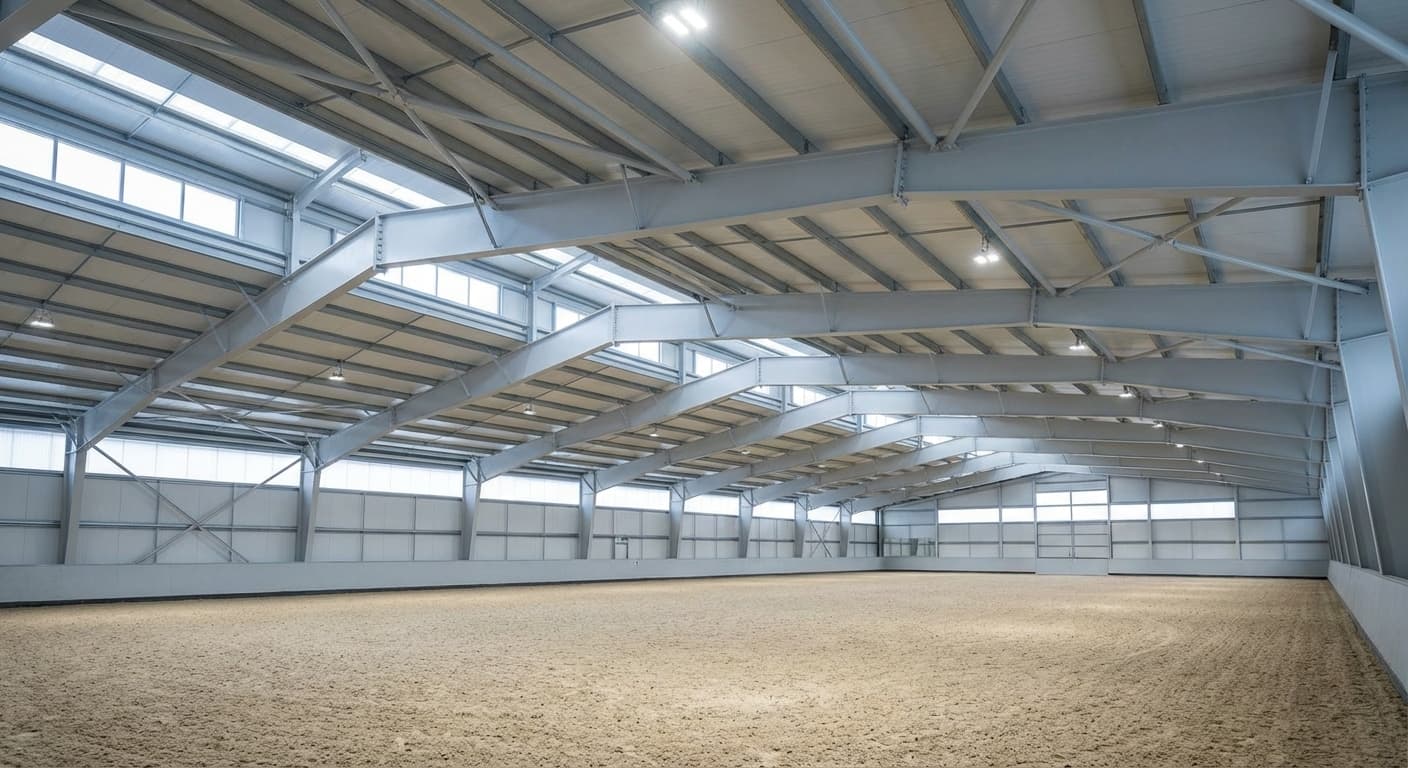

Prefabricated steel riding arena kits deliver a turnkey, column-free arena that snaps together in weeks, not months, slashing construction headaches and letting horses generate revenue faster; the article walks you through every stage–from soil testing, code-proof engineered plans and financing tricks that tap equity or supplier loans, to customizable roof styles, ventilation and smart lighting that keep horses healthy and energy bills low–while showing how 89 % recycled steel beats wood on fire, rot and maintenance costs, carries 25-50-year warranties, and expands easily so your 60 x 100 ft starter can grow into a 150 x 250 ft competition venue. Readers learn to budget $50-70/ft², recoup costs with premium boarding and year-round lessons, and pick a single-source partner with equestrian experience to turn dirt into cash-flowing, climate-controlled, virtually maintenance-free riding space that outlasts its owner.
Understanding Prefabricated Steel Riding Arena Kits
Every component arrives pre-cut and pre-drilled to exact specifications, so parts fit perfectly the first time without on-site guesswork or delays.
Definition, core components, and the prefabricated steel riding arena kits concept
You get everything you need in one complete package–steel frames, roof panels, walls, hardware, and clear assembly instructions [1][3]. No hunting for missing parts. No surprise trips to the hardware store. Just open the delivery, follow the plans, and start building.
Your arena arrives pre-cut and pre-drilled to exact specifications [3]. Every beam fits where it should. Every connection lines up perfectly. That's the difference between prefabricated precision and on-site guesswork.
You choose between two main styles: fully enclosed for year-round riding regardless of weather, or covered designs that keep rain off while letting fresh air flow [2]. Both give you column-free space–no posts blocking your riding patterns or creating safety hazards [1].
Standard sizes start at 60×100 feet for personal use and scale up to 150×250 feet for competition venues [1]. But standard doesn't mean cookie-cutter. You pick the door placement, ceiling height, ventilation system, and lighting setup that works for your program. Need to expand later? The steel framework accepts additional bays on the end walls without major reconstruction [3].
How prefabrication accelerates construction timelines
Your arena goes up fast because the hard work happens before it reaches your property. Components arrive ready to assemble–no on-site cutting, drilling, or fabricating [4].
While traditional builders stop for rain, your steel components keep going up. The modular design means your crew spends time assembling, not measuring and remeasuring [5]. Parts fit right the first time because they're engineered that way [4].
You save weeks–sometimes months–compared to stick-built construction. Less time building means horses start training sooner and revenue starts flowing faster [5].
Engineering standards, material grades, and quality certifications
Your building meets every local code–wind loads, snow loads, seismic requirements [6]. We provide engineer-stamped plans that sail through permitting and keep your insurance company happy [7]. No guesswork, no delays, no surprises at inspection time.
Third-party inspectors verify every steel component before it leaves the factory [6]. You get two coating options: standard paint for most climates or hot-dip galvanization when you need maximum rust protection [6].
Clear-span steel gives you riding widths over 90 feet–try that with wood framing [7]. Your horses get uninterrupted space to work. Your riders get clear sightlines. Your spectators get unobstructed views.
The multi-stage quality checks mean your arena handles whatever nature throws at it–decade after decade [6]. When you build with properly engineered steel, you build once.
Key advantages compared to traditional wood or masonry arenas
Steel doesn't rot. Termites don't eat it. Wind doesn't warp it. While wood arena owners schedule repairs, you're scheduling rides [5].
Your maintenance checklist stays short–inspect the roof seals, check the door tracks, maybe touch up paint every few years. Compare that to replacing rotted boards, treating for pests, and reinforcing sagging beams in wooden structures [5][8].
Yes, steel costs more upfront. But run the numbers over 20 years–minimal repairs, no replacements, lower insurance premiums. Steel pays you back through what you don't spend [5]. Plus, you're operational in weeks while traditional builders are still framing [8].
Fire can't feed on steel–crucial when you're storing hay [5]. Your structure performs the same in a blizzard as it does in a heat wave. That consistency protects your investment and your peace of mind [9].
The column-free interior gives you design freedom wood can't match. Configure stalls, viewing areas, and storage however your program needs. When growth happens, adding space is as simple as extending the end wall [8][9]. That's the advantage of building with
Site Planning and Regulatory Considerations
Invest $500-1,500 in professional soil testing now to avoid thousands in foundation repairs later.
Assessing site conditions, soil types, and space requirements
Your arena investment starts with smart site planning. Professional soil testing runs $500-1,500–skip it and you'll likely spend thousands fixing settlement issues later [10]. A geotechnical engineer evaluates your soil's bearing capacity, moisture content, and expansion potential to specify the right foundation [10]. Sandy and gravelly soils typically support 2,000-3,000 pounds per square foot. Clay soils vary dramatically–some support heavy loads while expansive clays can crack slabs when they swell and shrink [10]. High water tables need special attention through deeper foundations or drainage systems [10].
Beyond soil, your site needs proper drainage to channel water away from the building [11]. Check how neighboring structures or land features affect water flow. You may need trenching for gutters and downspouts [11]. Position your arena considering prevailing winds, sun exposure, and typical weather patterns [11].
Your construction team needs 10-12 feet of clearance around the foundation plus clear access for delivery trucks [11]. Contact local utilities to mark existing lines–your building officials know exactly who to call [11]. Factor in sidewalks, driveways, and parking areas, ensuring everything slopes away from your arena [11].
Choosing arena dimensions, clear‑span layouts, and footing systems
As covered in our overview section, arena dimensions depend on your intended use–from 60'x100' for leisure riding to 150'x250' for competition venues. The key decision here is matching size to your actual needs and budget, not just your dreams.
What matters most for your riding space is the clear-span design that eliminates interior columns [12]. Steel enables column-free spans up to 300' wide–impossible with wood's 90' maximum [12]. This unobstructed space keeps riders safe and maximizes your usable area [1].
Your footing system starts with proper base preparation. Install 4 inches of limestone screening over your prepared subgrade [7]. For the riding surface, medium-coarse washed sand delivers the best combination of traction, cushioning, and stability [7]. Skip the round-particle sand–it gets slippery. Avoid fine sands that turn to dust [7].
Budget reality check: larger arenas mean proportionally higher footing costs that catch many owners off guard [7]. Match your footing depth to your discipline–deeper, softer surfaces for jumping; firmer footing for dressage precision [7].
Navigating zoning codes, permits, and environmental regulations
Navigating local regulations doesn't have to derail your project. Start with your county planning office–they'll outline building codes, zoning rules, and any equestrian-specific requirements [13]. Even rural properties face restrictions, so verify what's allowed on your land [13].
Check three often-overlooked items: deed restrictions that limit building options, easements affecting placement, and HOA covenants dictating materials or sizes [13]. County officials don't always know about HOA rules, so dig deeper [13].
Environmental rules matter especially near water sources. You might need separate composting structures or enhanced drainage systems [13]. Areas with streams or wetlands enforce stricter manure management protocols [13].
Here's where a qualified steel building partner saves you time and money–we provide the engineer-stamped plans your county requires for permits [14]. Get these regulatory details sorted early. It's much cheaper than fixing compliance issues mid-construction.
Coordinating ancillary structures such as stables, tack rooms, and utilities
Your arena works best when support structures flow together seamlessly. Map traffic patterns that keep feed deliveries separate from manure removal.
Add vestibules at tack and feed rooms to control dust and maintain biosecurity [15]. Steel construction lets you integrate stables, viewing areas, and tack rooms without compromising your clear-span riding space [16]–exactly what our
Custom Design Options and Modern Innovations
Choose from gable, single-slope, or monitor roof designs to maximize headroom, manage snow, or flood your arena with natural light.
Roof styles, insulation options, and energy‑efficient upgrades
Custom Design Options and Modern Innovations### Roof styles, insulation options, and energy‑efficient upgradesYour arena's roof does more than keep rain out–it shapes your entire riding environment.
Choose from three proven designs: gable roofs that maximize center height for jumping, single-slope styles that shed snow efficiently, or monitor roofs with raised center sections that flood your arena with natural light [18].
Each design works with our
Advanced doors, windows, ventilation, and climate‑control solutions
Prefabricated steel arenas offer specialized door systems designed specifically for equestrian applications. Large-scale doors with minimum dimensions of 16' width and 13-15' height accommodate mounted riders safely [20]. Roll-up doors provide weather protection while slide doors offer maximum clearance without overhead tracks. Beyond standard entry points, frame-out options allow custom door placements to optimize traffic flow between stabling areas and the main arena [20].Natural lighting transforms indoor riding experiences through strategically placed translucent wall panels that minimize electricity costs while creating even, shadow-free illumination [20]. Skylights installed along roof sections eliminate harsh light contrasts on arena floors that could spook horses [20].
These lighting solutions work alongside windows that can be positioned at human or horse-height depending on ventilation and visibility needs [20].Ventilation systems are critical for equine respiratory health and facility longevity. Ridge vents and cupolas promote continuous passive airflow by allowing hot air to escape at roof peaks [20]. For completely enclosed arenas, mechanical ventilation through high-volume, low-speed (HVLS) fans creates gentle, consistent air movement without disruptive drafts [20]. These systems reduce dust accumulation and prevent the condensation issues common in poorly ventilated indoor arenas [20].Climate control solutions vary based on regional requirements and arena usage. Fully enclosed and climate-controlled designs enable year-round training regardless of external weather conditions [20].
These systems maintain comfortable environments for both horses and riders while protecting revenue streams that would otherwise be lost during extreme weather [20]. Insulation plays a key role in temperature management with several options available: fiberglass, mineral wool, foam board, or spray foam–each reducing energy costs while minimizing condensation [19]. For milder climates, covered arenas with open sides provide natural ventilation and sun protection without complete enclosure [20]. These partially-open designs balance climate control with the airflow benefits of outdoor riding [20].
Interior finishes: arena flooring, LED lighting, and smart‑control technology
Modern riding arenas combine performance flooring, efficient lighting, and integrated technology systems for optimal functionality. Quality footing begins with engineered concrete foundations supporting specialized riding surfaces that combine sand with rubber particles or synthetic fibers for improved traction and joint protection [18][8].
Lighting systems merge natural illumination from translucent panels with energy-efficient LEDs featuring zoning capabilities that allow riders to illuminate only needed areas [18]. These systems typically include different presets for training, competitions, and maintenance [8].
Smart-control technology integrates lighting, ventilation, and climate management through centralized applications that automatically maintain optimal conditions [18][8]. Commercial facilities benefit from additional integration of Wi-Fi networks, security cameras, and access control systems that enhance operations while collecting usage data to optimize energy consumption [18].
Optional add‑ons: bleachers, storage, offices, solar power, and fire‑safety features
Prefabricated steel riding arenas accommodate numerous add-ons that enhance functionality and value. For spectator facilities, the 120×200 riding arena size provides enough room to install bleachers along the building length, creating designated viewing areas for events [1]. Storage integration offers practical benefits–many owners attach stables directly to the arena structure, creating connected spaces that improve workflow while protecting equipment [21].
Office spaces can be incorporated into the main structure, particularly beneficial for commercial operations requiring client meeting areas and staff workspaces [21]. Natural lighting transforms the riding experience through strategically placed skylights and translucent wall panels that provide even, shadow-free illumination while reducing electricity costs [21]. Solar panels represent a valuable energy-saving option, with prefab steel structures serving as ideal installation platforms for renewable energy systems [21].
Fire safety features provide critical protection–unlike wood structures, steel won't fuel fires, offering essential safety in facilities storing hay and other flammable materials [21]. The expandable nature of these structures allows owners to add framing bays to existing end walls as needs grow, making future expansion straightforward and cost-effective [21].
Financial Planning, ROI, and Sustainable Ownership
Build larger now to lower your per-square-foot costs, and plan for future growth rather than paying significantly more to expand later.
Transparent pricing for prefabricated steel riding arena kits
You'll invest $50-70 per square foot for a complete steel arena project. For an 80'x200' arena (16,000 square feet), your material costs run $400,000-$560,000, with construction adding $68,000-$130,000 [22]. The bigger you build, the lower your cost per square foot–simple economics that work in your favor [8].
Your location drives the final price through transportation costs, labor rates, and local building codes [8]. Steel prices fluctuate, so get current quotes–don't rely on last year's numbers [22][23].
Every choice affects your budget: roof style, insulation type, door configuration, ventilation, and lighting [8]. But here's what saves money long-term: planning for growth now. Adding space later costs far more than building it right the first time [8].
Your investment breakdown includes:
- Steel structure and materials: 50-60% of total cost
- Professional erection: 15-20%
- Foundation work: 15-20% (varies by soil conditions)
- Customization and features: 10-15%
Smart planning means honest budgeting. Factor in everything–structure, site work, permits, and the riding surface you'll need. Get it all on paper before you start.
Financing pathways, tax incentives, and grant opportunities
You have more financing options than you might think. Start with unsecured personal loans–up to $100,000 with 12-year terms, no collateral required, rates from 6.99% [24]. Cash in hand gives you negotiating power and keeps liens off your property. Your home equity opens another door. Use existing equity or secure a home improvement loan specifically for your arena project [24]. Many steel building suppliers offer direct financing too–up to $50,000 with flexible payment plans from 24-72 months, sometimes with same-as-cash options for 3, 6, or 12 months [25].
The application stays simple:
- Choose your building specifications
- Submit basic documents (license, income proof, homeownership verification)
- Make a small down payment after approval [25]
Your equestrian property investment brings tax advantages that offset construction costs. These properties appreciate steadily while generating income through boarding, training, or events [26].
Specialized loans work better than standard mortgages for equestrian facilities:
- Hobby Farm Loans: For properties where farming isn't your primary income
- Portfolio Loans: For significant equestrian improvements
- Commercial Agricultural Loans: Flexible payment schedules matching seasonal cash flow [26]
Connect with lenders who understand equestrian properties. They know how arenas add value and can structure financing that makes sense for your operation [26]. The right financing turns your arena from a dream into a revenue-generating asset.
Lifecycle cost analysis, maintenance plans, warranties, and sustainability
Your steel arena lasts 50-100+ years. Annual maintenance runs $5,000-$20,000–mostly for the riding surface, not the structure itself [27][28]. Compare that to wood buildings that need constant repairs, treatments, and eventual replacement.
Your maintenance checklist stays short:
- Quarterly inspections of roof seals
- Door track adjustments
- Fastener checks
- Riding surface care
That's it. No rot repairs. No pest treatments. No water damage remediation [28].
Quality manufacturers back their structures with 25-40 year warranties–they know steel performs. Your building contains 89.5% recycled content and stays 100% recyclable when you're done with it [28].
Energy costs drop 10-20% annually thanks to superior insulation and tight building envelopes [28]. Insurance companies reward you too–expect premium reductions up to 30% because steel resists fire, wind, and earthquakes better than any other building material [28].
The numbers work: minimal maintenance, lower energy bills, reduced insurance costs, and a structure that outlasts you. That's sustainable ownership.
Calculating return on investment for training centers, competitions, and boarding farms
Equestrian businesses run on tight margins. Training centers need 30+ months to break even, with monthly overhead topping $56,000 [29]. But smart revenue planning changes everything. Your money comes from three sources–prioritize accordingly:
- Premium boarding ($1,200/month): Highest profit per customer
- Training packages ($600/month): Steady foundation revenue
- Lessons: Volume business with thinner margins [29]
Track these metrics to measure success:
- Revenue Per Available Hour (arena and instructor time)
- Stall utilization rates
- Service contribution margins after all costs [29]
Competition venues need patience–a $435,000 arena investment typically takes 58 months to recoup [29]. But year-round steel structures accelerate payback by maximizing billable hours in any weather [30].
Build your revenue beyond hourly rentals. Bundle services. Create packages. Raise your Average Revenue Per User instead of constantly chasing new customers [29].
Realistic planning transforms negative $536,000 (Year 1) into positive $70,000 EBITDA by Year 3 [29]. The key? Know which services actually make money after you factor in all costs. Some popular offerings operate at a loss–cut them loose.
Your steel arena enables 365-day operation. More operating days mean more revenue opportunities. More revenue opportunities mean faster ROI. That's the math that matters.
Selecting a Partner and Ensuring Project Success
Choose a steel building partner with 40+ years of equestrian experience, third-party certifications, and a 25-50 year warranty backing their structures.
Evaluating experience, certifications, and equestrian project portfolio
You need a steel building partner with proven equestrian experience–not just general construction knowledge. Start by verifying industry tenure of 40+ years, which demonstrates both financial stability and technical evolution alongside modern equestrian needs [31]. Your partner should have in-house engineers who grasp the specific demands of riding facilities, from ventilation requirements to traffic flow patterns [31].
Request third-party inspection certifications that verify steel quality and manufacturing standards–these aren't bureaucratic checkmarks but your assurance the structure will handle your region's wind, snow, and seismic loads [31]. A meaningful warranty tells you everything about a manufacturer's confidence. Industry leaders back their structures with 25-50 year guarantees, protecting your investment long after the ribbon-cutting [32].
Beyond paperwork, examine their equestrian portfolio. You want to see completed arenas similar to your vision–whether that's a fully enclosed competition facility or a covered training arena. Request specific project details: How did they handle stall integration? What door systems did they recommend? How did they solve unique site challenges? [31]
Most importantly, talk to their past clients. These conversations reveal what matters: Did they stick to timelines? How did they handle inevitable changes? What's their support like after the keys are handed over? The right partner provides references readily–they know satisfied clients are their best advocates [31].
Service excellence: design assistance, project management, and after‑sale support
Why National Steel Buildings Corp. offers single‑source, problem‑solving solutionsNational Steel Buildings Corp. simplifies arena construction through single-source accountability. You work with one team from concept to completion–no finger-pointing between suppliers, fabricators, and contractors when issues arise.
The process starts with understanding your vision and budget constraints. NSB develops conceptual designs and detailed quotes that lock in pricing before fabrication begins [18]. Their in-house engineers produce stamped drawings that meet local codes, eliminating permit delays that plague many projects [18]. With 1,480+ buildings completed nationwide, they've seen every code variation and site challenge.
What sets NSB apart is vertical integration. Their ProTrades erection division handles on-site construction, maintaining quality control from factory to finished arena.
Case studies, client testimonials, and ongoing maintenance programs
Real results speak louder than promises. Professional trainers report their steel arenas pay for themselves through year-round lesson schedules–no more canceled sessions due to weather. One facility owner noted: "We explained what we wanted and they delivered beyond our expectations. The planning support and practical suggestions saved us thousands."
Design flexibility proves crucial during planning. "I made countless changes to accommodate our specific training needs. The team never made me feel like a burden–they understood this was a 30-year investment that needed to be right" [18]. This patience during design prevents expensive field modifications later.
Timelines tell the efficiency story. Most arenas move from signed contract to first ride in 4-6 months [18]:
- Design and permitting: 4-6 weeks
- Fabrication and delivery: 6-10 weeks
- Structure erection: 6-8 weeks
Compare that to traditional construction stretching 8-12 months with weather delays.
Long-term performance validates the steel choice. Basic quarterly maintenance–checking roof seals, lubricating door tracks, tightening fasteners–prevents small issues from becoming budget-busters [34]. As discussed in the Financial Planning section, this minimal maintenance translates to annual costs of just $5,000-$20,000, mostly for footing care rather than structural repairs.
Smart owners leverage manufacturer support programs that include foundation assessments and mechanical system checks. These proactive inspections maintain warranty coverage while catching potential issues early [18]. For climate-controlled facilities, regular ventilation cleaning ensures optimal air quality–critical for equine respiratory health and rider comfort [34].
- Steel arenas arrive pre-cut/pre-drilled, slashing build time vs stick-built by weeks or months.
- Column-free clear-span up to 300 ft eliminates posts, boosting rider safety and sightlines.
- Up-front cost $50-70/ft², but 50-100 yr life, minimal upkeep and 30% insurance cut drive ROI.
- Soil testing ($500-1,500) and county permits for drainage, setbacks, manure rules are critical.
- Add bays on end walls later without major rebuild; plan size for growth to avoid costly retrofits.
- Year-round steel arenas raise billable hours, accelerating payback for training/boarding revenue.
- Quarterly roof/door checks plus footing care keep annual maintenance at $5k-20k for decades.
- https://titansteelstructures.com/metal-building-types/prefabricated-steel-riding-arenas/
- https://mavericksteelbuildings.com/steel-buildings/horse-arena/
- https://www.rhinobldg.com/indoor-horse-arenas
- https://smartbuildsystems.com/6-benefits-of-an-all-metal-riding-arena/
- https://www.uspatriotsteel.com/blog/steel-vs-wood-riding-arenas/
- https://qdsteelbuilding.en.made-in-china.com/product/BFdfkYlAXxWI/China-Prefabricated-Steel-Structure-Equestrian-Horse-Riding-Arena-Steel-Horse-Stable-Building.html
- https://www.alliedbuildings.com/what-is-a-good-size-for-an-indoor-riding-arena/
- https://reichconstructionllc.com/cost-of-pre-engineered-steel-indoor-horse-riding-arena/
- https://www.technology.org/2025/07/17/why-steel-riding-arenas-are-the-top-choice-for-equestrian-facilities/
- https://mbmisteelbuildings.com/blog/steel-building-foundation/
- https://www.rhinobldg.com/blog/how-to-prepare-a-metal-building-site
- https://gensteel.com/steel-building-kits/riding-arenas/
- https://mortonbuildings.com/blog/top-planning-tips-for-building-a-riding-arena
- https://precisebuildings.com/1183-2/
- https://unisteel400.com/equestrian-steel-building-design/
- https://www.universalsteel.com/steel-metal-riding-arena-buildings/
- https://atlanticsteelstructures.com/steel-buildings/prefabricated-steel-riding-arenas/
- https://www.steelcobuildings.com/steel-buildings/horse-arenas/
- https://www.metalbuildingoutlet.com/equestrian-buildings/
- https://www.vikingsteelstructures.com/metal-riding-arenas?srsltid=AfmBOoprtv2U9GfGRmP_9sccGxRDjUPbDZm-UaPtkpQYrwZdZCXsPtza
- https://www.vikingsteelstructures.com/metal-riding-arenas?srsltid=AfmBOorkYWBIJPYa57sWdz4v4wZs2O0HljuW3vAG4t6wcP3x9b61zJms
- https://titansteelstructures.com/ag-and-farm-buildings/steel-riding-arena-prices-cost-estimates-and-considerations/
- https://gensteel.com/steel-building-kits/riding-arenas/100×200-riding-arena/
- https://www.acornfinance.com/outdoor/horse-barn-financing/
- https://www.vikingbarns.com/metal-barn-financing
- https://www.horseproperties.net/blog/financing-equestrian-properties/
- https://www.uspatriotsteel.com/blog/how-much-does-it-cost-to-build-an-indoor-riding-arena/
- https://masonsteelcorp.com/benefits-of-pre-engineered-steel-buildings/
- https://financialmodelslab.com/blogs/profitability/equestrian-center?srsltid=AfmBOorH0Vc2OGwNSdCt55LAN66icO6gqR_2hk-m6Y_jKIIsP52qFAB9
- https://blog.legacybuildingsolutions.com/equestrian-arena-guidelines-for-riding-disciplines
- https://sunwardsteel.com/building-type/equestrian/
- https://gensteel.com/recommended-use/riding-arena/
- https://batimentsmetbec.com/en/steel-riding-school-construction-and-prices/
- https://coastalsteelstructures.com/benefits-of-training-your-horses-in-an-indoor-arena/