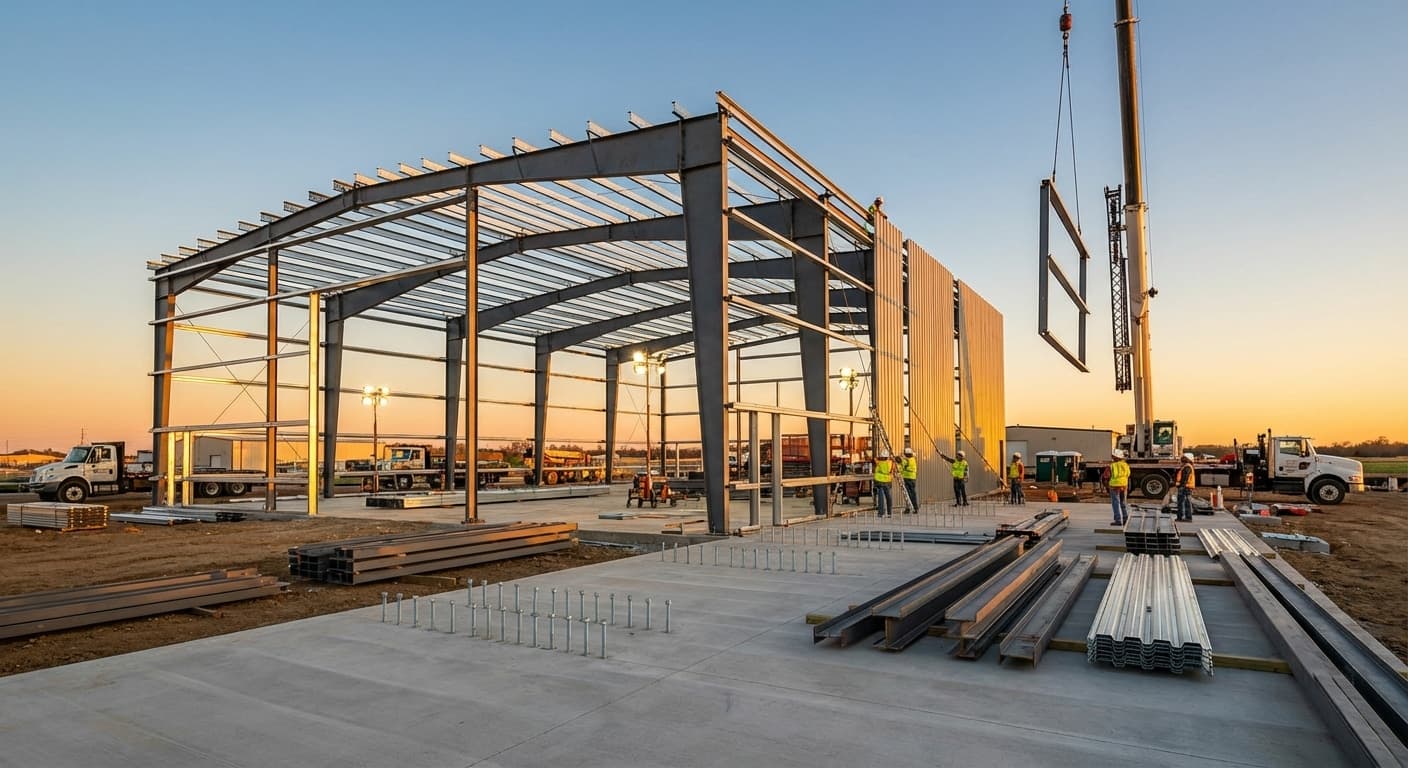

Steel building kits deliver faster construction and significant cost savings compared to traditional building methods. We help you navigate design, permits, financing, and maintenance to ensure your project succeeds from foundation through decades of reliable performance.
Introduction to Steel Building Kits
Steel building kits arrive pre-engineered and ready to bolt together, going up in 2-3 days while costing 30-40% less than wood construction.
What Are Steel Building Kits?
You need a building that goes up fast and stays within budget. Steel building kits deliver both–pre-engineered packages with every component ready to bolt together on your foundation [1]. No cutting, no waste, no delays. Your kit arrives with frames, panels, roofing, and pre-punched openings for doors and windows [3].
These systems handle any job. Small garage? Check.
Key Benefits Over Traditional Construction
Your steel building costs 30-40% less than wood construction. Period. You're looking at $20-35 per square foot all-in, while wood framing alone runs $22-39 per square foot–before adding anything else [4]. After construction? You'll spend just 0.5-1% annually on maintenance versus 2-3% for wood buildings [4].
Time is money, and steel saves both. Your building goes up in 2-3 days instead of 3-6 weeks [4]. Everything arrives ready to assemble. No weather delays. No on-site cutting. No surprises [5].
Steel doesn't burn, rot, or attract termites [6]. That safety translates directly to your insurance bill–expect premiums 15-30% lower than wood construction [4]. You'll never pay for termite treatments, rot repairs, or fire damage that plague wood buildings [5].
Need wide-open workspace? Steel spans up to 60 feet without interior columns. Wood structures need posts every 12-16 feet, eating up your floor space and blocking equipment movement [4]. You get every square foot you pay for–unobstructed and ready to work [6].
When you're done with the building decades from now, 100% of the steel gets recycled. No landfill fees. No disposal headaches. Just value recovery from materials that keep their strength forever [4]. About 25% of your building's steel already comes from recycled sources–good for your budget and the environment [4].
Essential Terminology and Components
You don't need an engineering degree to understand your building. Here's what matters:
The Main Structure Your building stands on four corner columns–the vertical posts at each corner [7]. Horizontal beams called eave struts connect these columns and support your walls and roof [7]. Additional columns and rafters fill in the frame as needed [7]. Every column sits on a base plate with anchor bolts. Get these wrong, and you're looking at expensive fixes [8].
The Support System Purlins–horizontal roof supports running the length of your building [9]. Girts–the same thing but for walls [9]. Cross bracing–X-shaped supports that keep everything square and stable in high winds [7]. Simple as that.
The Roof Pitch determines water runoff–from nearly flat (½":12) to steeper slopes (4:12) [9]. Ridge caps seal where roof panels meet. Ridge vents let hot air escape. Trim pieces weatherproof the edges. Gutters move water away from your foundation [7][9].
The Details That Matter Framed openings hold your doors, windows, and equipment penetrations [7]. Small fasteners make or break your building's weather-tightness [8]. Quality connections mean a tight, trouble-free building for decades. Cheap fasteners mean leaks and headaches [8].
Know these terms, and you'll speak the same language as your supplier and crew. More importantly, you'll spot quality–or the lack of it–before it becomes your problem.
How Kits Accelerate Project Timelines
Your building goes up in days, not months. Steel building kits arrive ready to assemble–no measuring, no cutting, no delays. Professional crews erect most structures in 1-3 days [10]. Here's why you finish faster: Every component is pre-engineered and pre-cut at the factory [11]. Your crew spends time building, not fabricating. Fewer workers needed. Less equipment rental. No weather delays stretching your timeline [11][12].
For your business, speed means everything. You occupy your building sooner. You start operations faster. You stop paying for temporary facilities [11]. While traditional construction drags on with subcontractor scheduling conflicts and material delays, your steel building is already generating revenue [10].
(For detailed timelines and installation processes, see "Installation and Project Management" section.)
Planning Your Project
Conduct a geotechnical soil analysis and assess drainage patterns before purchasing your steel building kit to ensure proper foundation design and long-term structural integrity.
Assessing Site Conditions and Space Requirements
Planning Your Project### Assessing site conditions and space requirementsProper site assessment fundamentally impacts steel building performance and longevity. Before purchasing a kit, conduct a geotechnical soil analysis to determine bearing capacity, moisture content, and subsurface issues that affect foundation design [13]. Different soil compositions–clay, sand, loam, or rocky–behave uniquely under structural loads and require specific foundation approaches [13]. In areas with unstable or expansive soil, you may need perimeter foundations or pier systems rather than standard slabs [14].Drainage patterns critically influence foundation integrity. Poor drainage leads to erosion, settling, and potential structural damage [13].
The site must be properly graded with appropriate slopes to direct water away from the building, potentially requiring French drains or other water management systems [13]. In colder climates, foundations must extend below the frost line–the depth to which ground freezes in winter–to prevent frost heave damage to the structure [13].Space requirements should account for both current operations and future expansion. Analyze workflow patterns, equipment dimensions, storage needs, and required clearances when determining building size [15]. The intended use directly impacts spatial configurations, door placements, and column spacing [15]. For optimal functionality, consider how interior activities will flow and where utilities need to access the structure [14].Site preparation begins with professional surveys to stake the building layout before clearing vegetation and debris [14].
The land must be graded and leveled, often requiring removal of topsoil down to the first layer of natural soils [14]. Establish erosion control measures like silt fences and sediment basins to protect the construction area and surrounding environment [15]. Site access for heavy equipment and material deliveries requires planning temporary roads with compacted gravel bases if existing access is inadequate [15].
Choosing Size, Shape, and Layout
Steel building kits offer remarkable flexibility in sizing, with dimensions customizable to match virtually any requirement. Though no rigid "standard" sizes exist, common dimensions range from 30'x30' (900 sq ft) for small workshops to 60'x100' (6,000 sq ft) for warehouses or manufacturing spaces [16]. Size selection should directly reflect your intended use–a 40'x60' building (2,400 sq ft) provides ample space for commercial workshops or residential applications, while a 30'x40' (1,200 sq ft) suits multi-car garages or small warehouses [16].Square-shaped buildings deliver maximum interior space with minimal exterior wall material, making them the most economical option per square foot [16]. For budget efficiency, consider increasing length rather than width and maintaining minimum necessary height, as both width and height significantly impact cost [16].
Clear-span framing–which eliminates interior columns–works efficiently up to 80' widths, while modular framing with limited interior supports becomes more economical for widths from 80' to 100' and beyond [17].Layout planning should account for current operations and future growth. Steel buildings offer complete interior design freedom since their self-supporting structure eliminates the need for load-bearing interior walls [17]. When anticipating expansion, specify load-bearing endwalls in your original design to facilitate simple horizontal additions [17]. For vertical dimensions, consider both immediate clearance needs and long-term functionality–eave heights typically range from 10' to 30' in 2' increments [16].
Roof design affects both aesthetics and cost–gable roofs represent the most common choice, while single-slope designs work well for additions or when managing water runoff is critical [17]. Lower roof pitches (1:12 to 4:12) generally reduce costs, though local snow loads may require steeper pitches [17].
Material Grades, Coatings, and Energy‑Efficiency Options
Steel buildings deliver exceptional durability through their material composition. Modern steel framing withstands winds, heavy snow loads, and even fires up to 1,200 degrees Fahrenheit without compromising structural integrity [18]. While the sources don't specify exact steel grades, your choice significantly impacts both building performance and cost. Material quality directly affects a structure's ability to resist corrosion, maintain appearance, and provide long-term protection for contents.Coating options enhance steel's inherent durability.
For buildings in warm climates, cool-coated steel roofing reflects ultraviolet rays away from the structure, reducing cooling costs by 7-15% during hot weather [19]. These specialized finishes provide both aesthetic benefits and practical protection against weathering.Energy efficiency represents one of steel buildings' most significant long-term advantages. With energy typically accounting for 30% of a building's operating costs, proper insulation becomes essential [19]. The deeper wall cavities in steel structures accommodate thicker insulation than conventional construction.
High-performance systems like RHINO's Pro-Value Insulation package can decrease heating and cooling expenses by 50% or more compared to minimally insulated buildings [19]. This efficiency stems from steel's ability to create an airtight building envelope when properly insulated, maintaining consistent interior temperatures regardless of external conditions [18].
Customization Possibilities and Accessories
Steel building kits transform from basic shells into specialized spaces through strategic customization. Manufacturers offer hundreds of ways to personalize both appearance and functionality–from color schemes and decorative siding to practical components that enhance usability [21]. Exterior options include multiple door types (walk doors, roll-up doors with power lifters), windows for natural lighting, and skylights for additional illumination [21].
Climate control accessories improve comfort and efficiency with insulation packages reducing energy costs by up to 50%, while ventilation systems (ridge vents, powered fans, wall louvers) prevent moisture buildup and improve air circulation [20][21]. For better space utilization, interior add-ons like partitions create dedicated areas for specific functions without sacrificing the open design advantages [20]. Architectural elements such as cupolas, canopies, and panel breaks that allow integration of brick or rock wainscot enhance aesthetics while maintaining structural integrity [21].
These modifications transform standard structures into workshops, offices, storage facilities, or virtually any other application while preserving the durability and cost advantages of steel construction [21].
Design, Engineering, and Compliance
Steel buildings span up to 100 feet unobstructed, letting you position equipment where it works best instead of where support posts require it.
Pre‑Engineered Design Principles for Metal Building Kits
You get maximum strength with minimum material when you choose pre-engineered steel buildings. Our engineering team places steel exactly where your building needs it most–more material at high-stress points, less where it's not required [22]. This smart design cuts your foundation costs while maintaining rock-solid structural integrity.
Your building starts with our proven component library, customized to match your exact specifications. We use advanced 3D modeling to test your structure digitally before fabrication begins [24]. Every piece arrives with pre-punched holes in the right sequence–no guesswork, no on-site cutting, no delays [24].
Planning to expand later? We build that flexibility in from day one. Your end bays come ready for future additions–just unbolt the end wall panels and add new frames when you're ready to grow [22]. No structural compromises, no expensive retrofitting.
The clear-span advantage changes everything. While wood buildings need support posts every 12-16 feet, your steel structure spans up to 100 feet completely unobstructed [22]. That means you place equipment where it works best, not where posts allow. From the 40-foot spans of the 1940s to today's 100+ foot capabilities, pre-engineered design keeps improving–and you get all those advances built into your project [23].
Navigating Local Building Codes, Permits, and Inspections
Navigating local building codes, permits, and inspections
We handle the complex world of building codes so you don't have to. Every steel structure must meet your local requirements for wind, snow, and seismic loads–the standards that keep your building standing through any storm [25]. While most areas use the International Building Code (IBC) as their foundation, local modifications can catch you off guard. That's why we verify current requirements for every project location [25].
Your permit package needs everything right the first time: site layouts, structural drawings, foundation specs, and certified engineering calculations [25]. Permit costs vary widely–from $150 in small towns to $7,500 in major cities, with most projects falling between $550-$2,000 [25]. Skip this step and you risk fines, removal orders, insurance problems, and financing roadblocks [25].
We prepare your documentation package to include:
- Site plans with property boundaries and setbacks
- Detailed building plans with dimensions and materials
- Engineer-certified structural calculations
- Foundation designs matched to your soil conditions [25]
Remember–permits expire. Most jurisdictions give you six months to start and one year to complete construction [25].
Inspections keep your project moving smoothly. Inspectors typically check your foundation before concrete pouring, your framing before walls go up, and everything again before you occupy the building [25]. Our experience with local officials helps address their questions quickly and keeps your project on schedule. We know what they're looking for and make sure you're ready [26].
Load Considerations: Wind, Snow, and Seismic Factors
Load considerations: wind, snow, and seismic factors
Your building faces three main environmental challenges: wind, snow, and seismic forces. We engineer for all three, calculating loads in pounds per square foot (PSF) to ensure your structure handles whatever nature delivers [27].
Wind loads vary dramatically by location. Florida coastal buildings need to withstand 150 mph winds, while inland structures face lighter requirements [29]. We calculate your specific needs based on:
- Wind speed at your location
- Surrounding terrain (open fields vs. urban areas)
- Building openings (doors, windows, vents) [27]
Snow loads range from 10 PSF in southern states to 70+ PSF in snow country [29]. Don't underestimate this–just 6 inches of wet snow weighs as much as an inch of standing water, about 5 PSF [27]. In heavy snow regions, we design steeper roofs with vertical panels that shed snow naturally [29].
Seismic requirements apply in more places than you'd think. Beyond California, underwater fault lines and shifting plates create risk zones across the country [27]. U.S. codes rate seismic risk from A (lowest) to F (highest), while Canada uses site-specific acceleration values [27].
These environmental loads combine with:
- Dead loads (your building's weight)
- Live loads (people, equipment, storage)
- Collateral loads (HVAC, lighting, sprinklers)
- Point loads (heavy equipment mounts) [27]
Load calculations aren't suggestions–they're law. The IBC sets minimums, but your local jurisdiction often requires more based on regional conditions [28]. Get this wrong and you face structural failure, permit rejection, insurance denial, and plummeting property values [28]. That's why we engineer every building to exceed your local requirements from day one.
Sustainability and Insulation Strategies
Your steel building beats traditional construction on energy efficiency–when you design it right. Steel conducts heat, creating "thermal bridges" where energy escapes through the framing [30]. But modern insulation systems turn this challenge into an advantage.
As detailed in our Material Grades and Energy-Efficiency Options section, you have multiple insulation choices that deliver real savings. Beyond those basics, consider these advanced strategies:
Cool roof finishes reflect up to 70% of solar heat, cutting cooling costs by 10-15% [30][32]. In hot climates, this single upgrade pays for itself quickly.
Airtight construction maximizes any insulation system. We seal every gap and crack–because even the best insulation fails when air leaks through [30].
Smart building technologies put you in control:
- Programmable thermostats adjust to your schedule
- Occupancy sensors eliminate wasted heating/cooling
- Automated systems respond to real-time conditions [32]
Solar-ready design turns your metal roof into a power plant. The durable surface handles panel mounting perfectly, and many areas offer incentives that improve your ROI [32].
These strategies work together. Combine quality insulation with cool roofs, tight construction, and smart controls–you'll see utility costs drop by up to 50% while maintaining superior comfort [30]. Your
Cost Estimation and Financing
Basic steel building kits cost $15-$20 per square foot, while turnkey construction ranges from $24-$43 per square foot depending on included services and materials.
Breaking Down Kit Costs vs Turnkey Construction
Understanding the cost difference between basic steel building kits and turnkey construction helps with accurate budgeting. Basic steel building kits typically cost $15-$20 per square foot, with common sizes priced at $24,000 for a 30×40 building, $43,200 for a 40×60 structure, and $75,000 for a 50×100 facility [33]. In contrast, turnkey construction–which includes the kit, concrete foundation, delivery, and professional installation–ranges from $24-$43 per square foot [33].
This substantial price gap reflects the additional labor, materials, and expertise involved in complete construction. Kit prices vary significantly based on frame quality, with commercial-grade steel I-beam frames costing more than tubular-framed alternatives [33]. The turnkey approach eliminates the technical challenges of self-installation but adds 40-115% to your overall project cost.
Kit-only purchases make sense for those with construction experience, access to equipment, or tight budgets, while turnkey packages provide convenience and professional precision. Many homeowners choose DIY kits for smaller projects like garages but opt for turnkey solutions for larger structures such as barndominiums or warehouses to ensure structural compliance [34]. When evaluating quotes, confirm whether they include foundation work, delivery fees, and tax–these often overlooked costs can add thousands to your final investment.
Hidden Expenses to Budget for
Basic kit prices exclude critical costs that often surprise buyers. Site preparation and foundation work typically add $5-10 per square foot beyond your kit price [35]. This includes soil testing, grading, concrete work, and proper drainage systems–all essential for structural integrity. Permits and engineering requirements vary by location but can significantly impact timelines and budgets. Local building departments may require specific wind loads, snow loads, and seismic calculations that necessitate design modifications after your initial quote [36].Delivery logistics create unexpected expenses when site access is limited.
Restricted driveways, tight turns, or soft ground may require specialized equipment for unloading, adding $1,000-3,000 in crane fees or special handling charges [35]. Doors and windows demand proper framing beyond basic openings. Each framed opening adds $300-1,200 to your cost depending on size and complexity [35].Utility integration requires advance planning. Running electrical conduit, plumbing lines, and HVAC systems can add $10,000+ if not coordinated before foundation pouring [35]. Many quotes exclude finishing elements like insulation, interior walls, and sealing systems.
Insulation alone typically costs $1-3 per square foot but provides essential energy efficiency [37]. Local taxes, cleanup costs, and HOA approvals present final hurdles that can add 2-10% to your total project cost [35]. Request itemized quotes specifying exactly what's included and excluded to avoid these budget surprises [36].
Financing Options, Tax Incentives, and ROI
Steel buildings offer multiple financing pathways based on your business situation and credit profile. Traditional bank loans provide competitive interest rates and flexible terms with tax-deductible interest, though they require thorough applications and strong credit [40]. SBA loans present alternatives through 7(a) programs (for general business expenses) and 504 loans (specifically for fixed assets like buildings), with government backing that reduces down payment requirements [40]. Many manufacturers offer direct seller financing with negotiated terms and payment periods ranging from 24-72 months for buildings up to $50,000 [40]. For businesses with cash flow concerns, rent-to-own options eliminate credit checks while building ownership through monthly payments over 36 months or less [40].Tax incentives significantly improve steel building economics.
Section 179 deductions allow you to subtract the full cost of qualifying property in the first year rather than depreciating it over decades [40]. The recent tax legislation restored 100% first-year depreciation that would have otherwise phased down to 40% in 2025 and disappeared by 2027 [39]. While most commercial buildings normally depreciate over 39 years, manufacturers can now deduct entire facilities through an extended window until 2033 [39]. Additional incentives include renewable energy credits, Property Assessed Clean Energy (PACE) financing for energy-efficient improvements, and bonus depreciation for inflation adjustment [39][40].Calculating ROI helps determine if your investment will truly pay off. The basic formula–(Annual Net Benefit / Total Project Cost) x 100–factors in energy savings, maintenance reduction, and additional revenue minus operating costs [38].
Steel buildings typically deliver 5-10% annual returns with payback periods of 5-10 years, substantially outperforming traditional construction [38]. This superior performance stems from accelerated construction timelines that generate revenue sooner (30-40% faster builds), lower maintenance costs (predictable lifecycle expenses), and energy efficiency that compounds savings annually through high-performance envelope systems [38]. The combination of faster depreciation schedules and reduced operational expenses makes steel buildings particularly attractive for long-term investment, with proper planning often showing clear ROI advantages over 10-20 year horizons [38].
Using Online Configurators for Accurate Quotes
Online configurators transform steel building procurement by delivering instant, accurate pricing without traditional delays. These digital tools eliminate the need for lengthy phone calls and paper forms by capturing your exact specifications and location data to generate precise quotes in seconds [41]. Location information is crucial–your zip code determines essential engineering factors like snow loads, wind speeds, and seismic conditions that significantly impact structural requirements and pricing [42].
Advanced configurators integrate mapping features that let you place your building on your actual property, visualize its footprint, and immediately price different dimensions [42]. The most sophisticated tools offer 3D modeling capabilities where you can virtually test different roof styles, door placements, and color combinations while seeing real-time price adjustments [43]. This technology factors in critical cost variables like material thickness requirements for hurricane-prone regions (26-gauge instead of standard 29-gauge sheeting) or enhanced framing for areas with heavy snowfall (up to 50 psf load capacity) [43].
The result is dramatically improved quote accuracy that accounts for regional building code compliance and local weather conditions [42]. Beyond speed, these systems provide transparency by showing exactly how each customization affects your final price–from roof pitch modifications to wall enclosures, which typically double the cost of open-sided structures [43]. The best configurators break down prices by square footage (ranging from $8.20-$12.50 for open-sided structures) and clearly separate optional add-ons from base building costs [43].
Installation and Project Management
Precise anchor bolt placement within 1/16" of specifications prevents costly foundation rework and ensures your steel building's structural integrity from day one.
Preparing the Foundation and Anchor System
Your foundation does the heavy lifting–literally. It's the critical connection between your steel building and the ground, and getting it right the first time saves you money and headaches down the road.
Start by clearing your site properly. Remove all vegetation and debris at least five feet beyond your building footprint [45]. Have professional surveyors stake your exact building layout before you grade and level the ground [14]. This upfront precision prevents expensive fixes later.
Your foundation type depends on three factors: building size, soil conditions, and budget. Here's what works:
- Slab-on-grade foundations (most common): Concrete slabs with footings below the frost line that distribute loads evenly [14]
- Pier foundations: Best for uneven terrain or poor soil–vertical concrete supports connected by reinforced grade beams [14]
- Screw pile foundations: Quick installation without excavation using helical metal piles–perfect for remote or environmentally sensitive sites [14]
Here's where precision pays off: anchor bolt placement. These bolts get embedded in concrete before pouring and must match your manufacturer's plans exactly. Quality suppliers provide detailed specifications with every order [44]. You'll need at least four anchor bolts per column, placed within 1/16" of specified locations and perfectly perpendicular to the foundation [44].
Use templates to guarantee exact bolt positioning–you can't fix this after concrete sets. Triple-check everything before pouring. Foundation mistakes mean costly rework or worse, structural problems that compromise your entire building [44].
Step‑by‑Step Frame Erection and Safety Practices
Frame erection moves fast when you follow the right sequence. Start with your manufacturer's drawings–they're your roadmap for every connection [46].
Raise your first structural frame with both temporary and permanent bracing. This prevents twisting or collapse during installation [47]. For I-beam structures, work from the middle outward. Keep your bolts clean, maintain proper spacing, and level each column before moving on [48].
Once your center frame stands solid, erect the remaining frames in sequence. Connect them with sidewall girts for stability [48]. Here's what separates a professional installation from amateur hour: precise alignment. Measure your diagonals to confirm they're equal. Check that all columns have consistent eave heights [47]. This accuracy now saves you from panel installation nightmares later.
Safety isn't optional–it's profitable. Your crew needs:
- Hard hats, steel-toed boots, and safety harnesses for elevated work
- Clear zones under suspended loads
- All temporary bracing left in place until permanent structures are secured [47]
For maximum efficiency, organize all components before starting. Follow your specified sequence for secondary elements–purlins, eave struts, and wall girts. They're not just accessories; they provide crucial structural support [48]. When you work with an experienced erection team like our
Installing Panels, Doors, Windows, and Utilities
Panels transform your frame into a weathertight building. Start with roof panels–they protect your work area during the rest of construction [49]. Position panels with proper overlap per manufacturer specs (this prevents leaks), then secure with self-tapping screws [49].
For walls, begin at one corner and work systematically around your building. Every panel must align perfectly with your structural frame [49]. Here's the pro tip: apply weatherstripping or sealant around panel edges before installation. This creates watertight barriers that keep moisture and air where they belong–outside [50].
Doors and Windows Location matters. Place doors for convenient access and windows where you need natural light [50]. Frame openings require exact measurements–follow your manufacturer's specifications to the letter [49]. After securing frames, seal all edges thoroughly. This prevents water infiltration and cuts energy costs [49].
Planning for Utilities Map out your electrical conduit, plumbing, and HVAC paths before installing panels. Retrofitting utilities after panels are up doubles your labor costs [50]. If you need climate control, install insulation between frame members now. Your options:
- Fiberglass (most economical)
- Spray foam (best seal)
- Rigid board (highest R-value)
Choose based on your budget and local climate requirements [50].
Quality Checks, Final Inspection, and Handover
Quality checks, final inspection, and handover
Quality checks before inspection save you from expensive do-overs. Build your checklist around these critical elements:
- Structural connections properly torqued
- All fasteners installed with correct hardware
- Panel alignment verified for weathertightness [51]
Your final inspection with local authorities confirms code compliance and safety before you can occupy the building. Schedule it after completing all work but before requesting occupancy certificates. Have your documentation ready–previous inspection approvals for electrical, plumbing, and structural work [52].
Common inspection points to nail before the inspector arrives:
- Exit signage properly placed
- Accessible routes compliant
- Emergency systems functioning
- Exterior drainage complete [51]
The handover process officially transfers your building from contractor to owner. This includes exchanging:
- Warranties and compliance certificates
- As-built drawings showing actual construction
- Operation manuals for all systems [53]
During handover, you'll also handle utility account transfers, clear the site of construction materials, and settle final payments [53].
Smart owners establish a defects liability period (typically 12-24 months). Your contractor remains responsible for fixing any issues that emerge during this time. Document initial conditions thoroughly–photos and written records protect both parties [53]. When you work with a single-source provider, this entire process stays streamlined under one point of contact.
Maintenance, Warranty, and Long‑Term Performance
Just 30 minutes twice yearly on basic inspections keeps repair costs down and your building performing for decades.
Routine Inspection and Upkeep Checklist
Smart maintenance keeps repair costs down and your building working hard for decades. You'll spend about 30 minutes twice a year on basic inspections–that's it.
Your first year matters most. Buildings settle slightly, and catching minor shifts early saves money. Check seals, fasteners, and panels for movement [56]. After that, inspect every spring and fall. Look for storm damage, foundation shifts, and loose panels [55].
Your maintenance checklist stays simple:
- Pressure wash exterior surfaces annually
- Tighten any loose screws (thermal expansion loosens them naturally)
- Check insulation for moisture or pests
- Clean gutters before winter
- Test drainage around your foundation
- Oil door hinges and tracks [54][55]
Water causes most problems. Keep gutters clear. Fix pooling immediately. Good drainage protects your investment [55].
By year five, check structural connections more carefully. At ten years, consider a professional inspection [56]. Between scheduled checks, watch for these red flags: rust stains, water leaks, loose fasteners, bent panels, or peeling coatings. See any? Time for maintenance [56].
Corrosion Protection, Coating Care, and Repairs
Your building's location determines its coating needs. Dry warehouse? Basic water-based acrylics work fine. Near the coast or in high humidity? You need epoxy systems. Saltwater exposure demands zinc-epoxy-urethane–the zinc protects your steel by corroding first [57][58].
Surface prep makes or breaks coating performance. Professional-grade cleaning (near-white metal blast) gives coatings the grip they need [58].
Keep corrosion away with simple steps:
- Clean your building annually
- Tighten loose fasteners regularly
- Spot-check coatings for damage
- Fix scratches before rust starts [59]
Found rust? Clean it completely, then apply matching primer and topcoat. Deep rust needs barrier coatings like epoxy or polyurethane [58][57].
Two premium options cost more upfront but last longer:
- Hot-dip galvanization (factory-applied)
- Alloyed steel for specialized uses [57]
Focus inspections where water hides–panel overlaps and foundation contact points rust first [59].
Understanding Warranty Coverage and Service Plans
Your warranty package covers three main areas: structural frames, panel integrity, and finish quality [60]. Rust-through warranties protect against holes in the steel. Paint warranties cover fading, chalking, and peeling [61].
Components carry different coverage periods:
- Frames: typically 20 years
- Paint systems: 30-40 years
- Doors and windows: separate terms apply [61]
Here's what voids warranties fast:
- Skipping maintenance
- Blocked drainage
- Unauthorized modifications [60]
Document everything. Take photos. Keep receipts. This paperwork determines whether claims get approved or denied [60].
When comparing warranties, dig deeper:
- Full coverage or prorated?
- Simple claims process or bureaucracy?
- Stable company or startup? [61]
Most manufacturers give you 30-60 days to report missing or damaged parts. Know what's excluded–natural disasters need insurance, not warranties. Installation errors and unauthorized changes void coverage too [61].
Remember: proper installation prevents most warranty issues. Get it right the first time.
Extending Lifespan and Planning Future Expansions
Your steel building will last 50+ years with basic care [65]. Choose vertical roof styles–they shed snow and rain better, protecting your investment longer [63].
Simple habits extend building life:
- Inspect twice yearly (covered in detail above)
- Keep air moving–open windows regularly
- Fix problems while they're small [65][63]
Good ventilation prevents expensive problems. Stagnant air creates condensation. Condensation ruins insulation and damages inventory. Keep air flowing [63].
Planning Smart Expansions
Your business grows. Your building grows with it. Steel's modular design makes expansion straightforward and cost-effective [64].
Three expansion options:
- Lean-to additions (extend from the side)
- End-wall extensions (make it longer)
- Side-wall extensions (make it wider) [64]
Need more office space? Manufacturing area? Storage? Expanding beats building new every time. You save money and minimize downtime [64].
Plan ahead: specify load-bearing endwalls in your original design. This small decision makes future horizontal expansions simple and affordable [64]. As discussed in Planning Your Project, thinking about future needs during initial design pays off.
Never modify your building without professional guidance. Unauthorized changes compromise structural integrity and void warranties. Consult your
Choosing the Right Supplier and Resources
Verify your supplier's AC472 and AISC certifications through official IAS and AISC directories before committing to any quote.
Evaluating Manufacturer Reputation and Certifications
Your steel building is only as good as the company behind it. Look for manufacturers with IAS Metal Building Systems Inspection Accreditation (AC472)–the gold standard that evaluates sales, engineering, and manufacturing operations. This certification means twice-yearly inspections verify the company meets International Building Code requirements [66].
Why does this matter to you? AC472-accredited manufacturers maintain documented quality control at every step. The Metal Building Manufacturers Association (MBMA) requires all members to hold this accreditation, ensuring consistent standards across the industry [66].
You'll also want to check for American Institute of Steel Construction (AISC) certification. AISC-certified companies have proven they have the right people, equipment, and processes to deliver quality steel buildings [67]. They focus on preventing problems, not just fixing them after the fact.
Here's your action plan: Ask potential suppliers for their certification numbers. Then verify them directly through IAS and AISC online directories [67][66]. Companies that invest in these certifications invest in your project's success.
Comparing Quotes, Support, and Delivery Options
Comparing quotes, support, and delivery options
That low quote might cost you thousands more. Most steel building quotes exclude foundations, permits, site prep, and unloading–costs that can double your final price [36].
Build Your Comparison Checklist:
- Steel gauge (26-gauge beats 29-gauge every time)
- Roof type and pitch
- Framing specifications
- Insulation package
- Doors and windows
- Delivery costs
- Foundation requirements
- Engineering stamps for your area
Demand itemized quotes. If a supplier gives you one line that says "40×60 building – $30,000," walk away. You need every component spelled out.
Evaluate Support Quality:
- Do they provide stamped engineering drawings for permits?
- Can you reach a real person when problems arise?
- Will they help navigate local building codes?
- What's their track record for on-time delivery?
Watch for hidden delivery costs. Limited site access might add $1,000-3,000 in crane fees [36]. Ask about lead times–they vary wildly based on steel availability and manufacturing schedules.
Buy direct from manufacturers, not brokers. You'll get better prices, clearer communication, and simpler warranty claims. For complex projects like our
Leveraging National Steel Buildings' Communication Approach
Transparent communication separates professional suppliers from order-takers. You want a company that puts everything in writing–from sales tax to delivery schedules–with no surprise charges at the end [71].
Signs of Quality Communication:
- Upfront pricing with all costs detailed
- Educational resources, not high-pressure sales
- Clear documentation throughout your project
- Regular updates without you having to chase them
- Plain English explanations of technical requirements
The best suppliers guide you through each phase. They explain the difference between kit-only and turnkey packages. They provide detailed timelines. They answer your 2 a.m. questions about snow loads.
Look for companies that maintain contact from first call through final inspection. They should proactively update you on:
- Design approval status
- Manufacturing progress
- Shipping schedules
- Site preparation requirements
- Installation milestones
Quality suppliers document everything–material specifications, warranty terms, maintenance schedules. They build relationships, not just buildings. When evaluating potential partners, ask how they'll keep you informed. Their answer tells you everything about how smooth your project will run.
Helpful Tools: 3D Estimator, Case Studies, FAQs
Helpful tools: 3D estimator, case studies, FAQs
3D Design Tools Stop guessing what your building will look like. Modern 3D configurators let you design in real-time–adjust dimensions, swap roof styles, change colors, add doors and windows. Watch your building take shape from every angle.
Start with your zip code. The system calculates your local requirements for wind, snow, and seismic loads, then shows accurate pricing as you build. No more surprises when you see how that extra bay door affects your budget.
The best tools show cost breakdowns per square foot and itemize every add-on. You'll know exactly what drives your price before committing.
Real-World Case Studies Nothing beats seeing actual projects. Look for case studies matching your needs:
- Similar building sizes and uses
- Your climate conditions
- Comparable site challenges
- Actual cost data (not just pretty pictures)
These examples reveal what works and what doesn't. You'll spot potential issues before they become your problems.
Smart FAQ Sections Quality FAQ resources answer the questions keeping you up at night:
- How long will my building really last? (50+ years with basic maintenance)
- Can I install it myself? (Depends on size and your skills)
- What maintenance is actually required? (Mostly checking sealants and cleaning gutters)
- How fast can I get my building? (Varies by season and customization)
Together, these tools eliminate guesswork. You'll make informed decisions based on facts, not sales pitches. Use them all–they're free insurance against expensive mistakes.
- Steel building kits cost 30-40% less than wood construction at $20-35 per square foot versus $22-39 for wood framing alone.
- Steel buildings erect in 2-3 days compared to 3-6 weeks for traditional construction, reducing labor costs and project delays.
- Steel structures span up to 100 feet without interior columns, providing unobstructed floor space compared to wood buildings requiring posts every 12-16 feet.
- Annual maintenance costs for steel buildings are 0.5-1% versus 2-3% for wood, and insurance premiums run 15-30% lower due to fire and pest resistance.
- Proper site assessment including geotechnical soil analysis and drainage planning is critical before purchasing kits to prevent costly foundation failures.
- Hidden costs like site preparation ($5-10 per square foot), permits ($550-$2,000), and utility integration ($10,000+) can double initial kit pricing.
- Steel buildings offer 5-10% annual ROI with 5-10 year payback periods through energy savings, reduced maintenance, and faster revenue generation.
- https://www.buildingsguide.com/metal-building-kits/?srsltid=AfmBOop9lciSohgjKO3zF3uBAPsOJj2vl0LtRVF7l4KDypuhH6GZX7qh
- https://www.universalsteel.com/what-is-a-metal-building-kit/
- https://gensteel.com/steel-building-kits/
- https://metalbuildingsnorthamerica.com/steel-commercial-buildings-beat-wood-every-time/
- https://norsteelbuildings.com/us/steel-building-basics/steel-vs-wood/
- https://goldtierstructures.com/blogs/news/metal-buildings-vs-traditional-construction-which-is-better?srsltid=AfmBOop80tM7JJrmta0NBRK2Yr6Mua9e4TBLwTAy8P66z80NlfOSdQsq
- https://tripleasteelstructures.com/blog/what-are-the-basic-components-of-a-metal-building-kit
- https://www.ibeehivesteelstructures.com/blog/steel-structure-building-parts-explained/
- https://cdmg.com/building-faqs/components-of-metal-buildings
- https://waldropmetalbuildings.com/the-benefits-of-metal-buildings-over-traditional-construction/
- https://goldtierstructures.com/blogs/news/metal-buildings-vs-traditional-construction-which-is-better?srsltid=AfmBOoqXsChofymJ7Dma6_VqWZRiOMQ3pIo5hHwGe0Q1qCLIbR5Ivthb
- https://armstrongsteel.com/blog/metal-buildings-vs-traditional-construction-a-comparative-analysis
- https://lionbuildings.com/the-complete-guide-to-metal-building-foundation-design/
- https://norsteelbuildings.com/steel-building-foundations/an-introduction-to-building-foundations/
- https://roimetalbuildings.com/how-to-build-a-metal-building/
- https://www.buildingsguide.com/standard-sizes/?srsltid=AfmBOoro8AcXxAZai6hPXqEVTFGQw0FSRBtxnse5l7EW4WORd3wUiAlK
- https://www.rhinobldg.com/blog/guidelines-for-metal-building-sizing
- https://www.probuiltsteel.com/blog/a-complete-buyers-guide-to-metal-building-kits/?srsltid=AfmBOooZQ8oblTKeqnLug1SHwodKTeYJvxQ3VV8OBeACgUZxDsLH7VeM
- https://www.rhinobldg.com/blog/metal-buildings-efficiency-and-the-bottom-line
- https://www.universalsteel.com/transform-your-space-metal-building-add-on-kits-for-maximum-efficiency/
- https://renegadesteelbuildings.com/products/accessories/
- https://pinnacleinfotech.com/pre-engineered-metal-building-structure-features/
- https://norsteelbuildings.com/steel-building-basics/what-is-a-pre-engineered-metal-building/
- https://ddcon.co/designing-for-efficiency-the-core-principle-of-pre-engineered-metal-building-design/
- https://www.buildingsguide.com/build/metal-building-codes-permits/?srsltid=AfmBOoricLp1hF4kQ33i5KCWD_7dPkKfhH-qsHhjsV08htscbRtarXEZ
- https://www.eaglecarports.com/blog/metal-building-foundation
- https://norsteelbuildings.com/us/building-codes-permits-us/steel-building-codes-loads/
- https://www.buildingsguide.com/build/metal-building-codes-permits/?srsltid=AfmBOook3Lq1cOgszdvf7XoIeQxEWXxNjsEu-kr3gOKOIMBcbVshcSFx
- https://www.aametalbuildings.com/blog/snow-load-wind-speed-requirements-for-metal-buildings-with-codes-pricing-impact?srsltid=AfmBOop7K0lPbkK55Gw8B1g47Sz46z5BjjgbuTvpHeMuwwtSa4Mi6aXS
- https://jcibuildings.com/blog/sustainability/energy-efficient-steel-buildings-design-tips/
- https://therm-all.com/a-guide-to-metal-building-insulation/
- https://smartbuildsystems.com/10-strategies-for-creating-an-energy-efficient-metal-building/
- https://www.buildingsguide.com/metal-building-prices/?srsltid=AfmBOoqpN8hpOq1sgG3rykopzh_gQheDWpkVpyWyA6KyQwUGFD3GIRW9
- https://steelbuildingkit.com/steel-building-kits-the-complete-guide-to-cost-companies-and-best-options-in-2025/
- https://www.americanmetalbuildings.com/blog/hidden-costs-that-blow-up-metal-building-budgets-and-how-to-catch-them-early/?srsltid=AfmBOoqiu3k1k0p7e8QueX1NY3vR8IZ5hUyrLLGVSWwHMnNjNjgMI8Br
- https://metalprobuildings.com/steel-metal-buildings-what-you-need-to-know-before-signing-a-contract/
- https://reichconstructionllc.com/cost-of-a-100000-square-foot-prefab-steel-building/
- https://metalprobuildings.com/steel-industrial-building-cost-roi/
- https://gensteel.com/resources/infographics/steel-building-tax-advantages-2026/
- https://www.vikingsteelstructures.com/blog/tips-for-financing-your-commercial-metal-building-project?srsltid=AfmBOoo7aXIMT3HmTny6Ns-LvAxWWGuTNah-A7w2Jvpb7QaGJpQMM-O-
- https://www.buildingsguide.com/metal-building-prices/?srsltid=AfmBOor2HXvHdClWHpWU1NdyCMOrwiCMVFaiTBRZ3QcKb5aG0WGvqWib
- https://gensteel.com/price-your-building-online/
- https://alansfactoryoutlet.com/metal-building-prices/?srsltid=AfmBOooXrCQGhwl9Ay_XP-VMjkrF-U1R8kgOhAIWppwG2aKWh5eoMCY5
- https://www.rhinobldg.com/blog/how-to-anchor-a-metal-building
- https://www.arcosteel.com/a-step-by-step-guide-to-installing-a-bolt-up-steel-building/
- https://www.simpsonsteel.com/building-standards/building-erection-manual/
- https://norsteelbuildings.com/steel-building-design-construction/steel-building-step-by-step-assembly-guide/
- https://titansteelstructures.com/metal-structure-tutorials/metal-building-installation-step-by-step-process/
- https://qebuildings.com/2025/10/step-by-step-guide-installing-your-metal-building-kit/?srsltid=AfmBOooFo6YyYaFQOfwbyOVHsGv3PNIbsKXODyexktZPhBsF9-M7TQke
- https://bullbuildings.com/the-ultimate-guide-to-installing-a-metal-building/
- https://www.procore.com/library/final-inspection
- https://iconsteelbuildings.com/construction-quality-control-checklist/
- https://goaudits.com/blog/construction-handover/
- https://www.mscsteel.com/blog/maintenance-tips-for-your-steel-building-with-checklist.html
- https://bungersteel.com/blog/news/annual-routine-maintenance-on-your-steel-buildings/
- https://metalprobuildings.com/steel-building-maintenance-checklist/
- https://eoncoat.com/corrosion-prevention-methods/
- https://ampp.org/resources/what-is-corrosion/coatings-first-line-of-defense-in-protecting-structural-steel
- https://steelconstruction.info/Standard_corrosion_protection_systems_for_buildings
- https://steelcommandercorp.com/warranty-maintenance-upkeep-how-ongoing-care-impacts-lifetime-cost/
- https://garagebuildings.com/steel-building-warranties-explained-whats-really-covered-in-2025-2026
- https://futurebuildings.com/blog/steel-building-maintenance.html
- https://www.vikingsteelstructures.com/blog/best-tips-extend-commercial-metal-buildings-lifespan?srsltid=AfmBOopypgwvrDSCEkGR8LxJoF_I9ZIubAW8g6BBp6PJdiz5FVVUwakT
- https://lionbuildings.com/are-metal-buildings-easy-to-extend-even-after-years-of-use/
- https://norsteelbuildings.com/steel-building-basics/how-long-do-steel-buildings-last/
- https://mbma.com/accreditation
- https://www.aisc.org/certification/
- https://packagesteelsystem.com/the-gold-standard-for-metal-buildings-the-ias-accreditation-package-steel/
- https://roimetalbuildings.com/how-to-vet-a-metal-building-quote/
- https://armstrongsteel.com/blog/how-to-compare-pricing-on-pre-engineered-metal-buildings
- https://www.nationalsteelbuildingsinc.com/
- https://www.nationalbuildinggroup.com/steelabout.html
- https://nationalsteelbuildings.co.uk/steel-building-kits-a-comprehensive-buyers-guide-for-your-next-project/
- https://hintonbuildings.com/prefabricated-metal-buildings/?srsltid=AfmBOoo4wt0gtx0lX29xiPn0ZAylNU6Yoy_yxY4aMPesxXTA_wR0rxnh
- https://www.vikingsteelstructures.com/metal-building-3d-estimator?srsltid=AfmBOopqYTKN1Pp4-DXa-3pHWsy0uyuQc_bE01ivRVALqaTWcspTDQCG