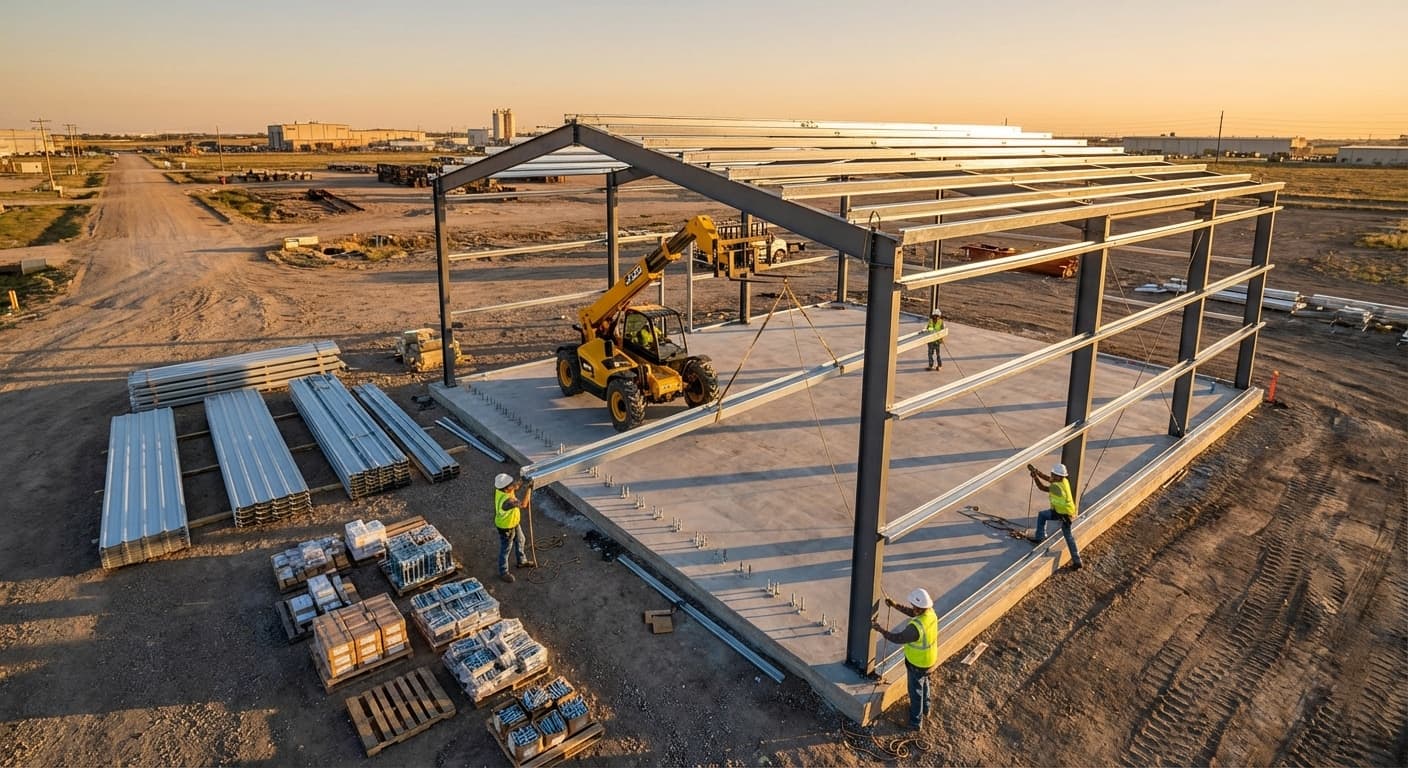

We walk you through each phase of a 30×40 steel building project so you can plan design, permitting, fabrication, site preparation, erection, and final buildout with confidence. By following our timeline and best practice tips you can keep the schedule tight, avoid common delays, and occupy your building in as little as ten weeks.
Understanding the 30×40 Steel Building Timeline
A complete, code-compliant drawing package submitted upfront prevents permitting delays and keeps your 30×40 steel building on schedule.
Key Phases in the 30×40 steel building timeline
A 30×40 steel building project moves through six distinct phases, each with its own dependencies.
It starts with design and planning–defining the building's use, number of openings, roof pitch, and layout–which typically takes 2-4 weeks. [1] Permitting and engineering follow, running 3-6 weeks depending on your jurisdiction; rural zones often clear faster than commercial or urban areas where review backlogs are common. [2] Fabrication is usually the longest stretch: once your order is approved, the kit goes into production and ships in 4-8 weeks, with lead times extending further during peak construction seasons or when specialty coatings and insulation types are specified. [2] Site prep and foundation work–grading, pouring a concrete slab, and allowing for cure time–takes 1-3 weeks and can run in parallel with fabrication so you're not waiting on both. [2] Actual erection is the fastest phase; a basic 30×40 shell can be framed and enclosed in as little as 3-4 days with an experienced crew, though buildings with insulation and accessory work may take a couple of weeks. [1] Final buildout–electrical, HVAC, interior framing, plumbing–varies entirely by how the building will be used, and determines whether your total timeline lands closer to 10 weeks or stretches past 20. [2]
Typical timeframes for each phase
Design and permitting together consume roughly the first third of your total schedule. Design lands at 2-4 weeks when decisions are made quickly–use, openings, roof pitch, eave height–while permitting runs 3-6 weeks depending on jurisdiction, with rural zones clearing in as little as 2-3 weeks and urban or commercial areas often hitting the 4-6 week ceiling. [4] Submitting a complete, code-compliant drawing package on the first attempt is the single most effective way to prevent permitting from eating into your build window. [4]Fabrication is where the schedule either holds or slips.
Most standard 30×40 kits ship within 6-8 weeks after order approval, though simpler clear-span configurations can come in closer to 3-4 weeks. [4] Peak construction seasons and any specification changes–special coatings, non-standard insulation, custom panel profiles–push lead times toward the longer end of that range. [4] Running site prep and foundation work in parallel with fabrication is one of the most reliable ways to compress the overall timeline, since a concrete slab for a 30×40 footprint involves less than a week of active work once conditions are right, plus cure time and inspections. [4]Erection is the phase most people overestimate in duration. A basic 30×40 shell can be framed and enclosed in 1-3 weeks with a professional crew, and straightforward ag or workshop builds regularly go up in just a few days. [4] Add insulation, interior partitions, or finish accessories and that window stretches, but it's still the fastest phase relative to what it delivers.
Final buildout–electrical, HVAC, plumbing, interior framing–has no fixed timeframe because it's entirely driven by intended use. A shell-only build can reach occupancy in as little as 10 weeks total; a fully finished commercial space with mezzanines and mechanical systems can push past 20 weeks. [4]
Factors that can speed up or slow down the timeline
Permitting is the most unpredictable variable in the entire schedule. Approval timelines depend on your jurisdiction, the completeness of your submission, and whether you're subject to HOA review on top of municipal permits–each layer adds waiting time that no amount of planning can fully eliminate. [5] Submitting an incomplete package is the most common self-inflicted delay; a single revision request can add weeks to what should have been a straightforward approval. [6]Once permits are in hand, crew size and equipment availability become the dominant controls on pace. More workers on-site compress erection time directly, while a short-staffed crew–especially one stretched across multiple active projects–extends it. [7] Equipment breakdowns and rental shortages during peak construction season create the same bottleneck, since site prep and foundation work require machinery that isn't always readily available on short notice. [6]Weather stops work that equipment and crew size can't compensate for.
Rain delays slab pours, extreme heat or cold slows curing, and high winds or lightning shut down steel erection entirely–a responsible crew will halt rather than work unsafely. [6] Scheduling your build during historically stable weather windows reduces exposure to these delays, though it doesn't eliminate them. Running site prep in parallel with fabrication also provides a buffer: if weather interrupts foundation work, fabrication continues unaffected, and you lose days rather than weeks. [7]Customization is the quietest schedule killer. Standard catalog configurations move through design and fabrication faster because the engineering work is already done.
Every modification–non-standard panel profiles, specialty coatings, altered bay spacing–requires additional engineering review and often extends fabrication lead times before a single component is cut. [7] Marking utilities before breaking ground is a similar time investment that pays back multiples: accidentally rupturing a line doesn't just cause a repair delay, it triggers a permit revision cycle for any rerouting required. [6]
Preparing Your Site for a Smooth Build
Skip even one of six required site assessments, and permit delays will push your entire timeline back before breaking ground.
Site assessment and permitting checklist
You need six site assessments before breaking ground–skip one, and you're looking at permit delays that push your whole timeline back. Start with your site survey. Most jurisdictions require it, showing exact building placement and setback distances from property lines. [8] Next comes soil testing. You need two types: a perc test for drainage and a geotechnical report for load-bearing capacity. That geotech report flags expansive clays and other problem soils before they crack your slab six months later. [8] With soil data in hand, get your site plan drawn–building orientation, setbacks, access roads, utility runs–this becomes the backbone of your permit application. [8]
Your local building department checks four things: zoning compliance, setback requirements, foundation specs, and load calculations. Wind and snow loads need stamped engineering drawings in most jurisdictions. [9] Submit without stamped drawings when they're required? That's the fastest way to reset your permit clock to day one. [9] Last step before excavation: locate all utilities. Extending power, gas, or water to your building needs separate permits, and only licensed contractors can pull them. Mark everything–even lines you think you won't touch. [8]
Foundation options and preparation timeline
Your 30×40 build needs one of three foundation types. The concrete slab wins for most applications–foundation and floor in one pour. Standard agricultural or workshop use needs 4-6 inches; heavy equipment or vehicle traffic bumps that to 6-8 inches. The edges thicken to 12-18 inches at column points because steel buildings concentrate loads there instead of spreading them like wood frames. [10]
Got a sloped site, expansive clay, or flood risk? Consider pier and beam. Piers drill below the frost line to stable soil, avoiding the seasonal movement that cracks slabs. [10] Stem walls work for moderate slopes and frost exposure–a perimeter wall on footers, compacted gravel fill, then a slab inside. You'll pay 25-40% more than a monolithic slab, but you get better grade adaptation. [10]
Here's what catches first-timers off guard: foundation work takes less than a week of actual labor for a 30×40 slab. You're waiting on inspections and cure time, not work hours. [11] Concrete hits 70% strength at seven days–safe for steel erection. Full 28-day cure gets you to 90%, but you don't need to wait that long to start building. [10]
The number one foundation mistake? Anchor bolt placement. Your cold-formed steel building kit specifies exact bolt positions down to the inch. Miss by even one inch, and columns won't align. Use a template or jig during the pour–it's the difference between smooth assembly and expensive field fixes. [10]
Utility coordination and site access planning
Plan your utilities before the concrete truck shows up, not after. That's the difference between a $500 conduit run and a $5,000 concrete cutting job. [12] Walk your floor plan with your electrician and plumber before forming starts. Map every conduit path, drain location, and panel position. Get it right now–every penetration needs to land exactly where your finished building needs it. [13]
For electrical, calculate real loads. Welders pull 50 amps. EV chargers need dedicated circuits. Your HVAC draws what it draws. Size your panel for what you'll actually use, then coordinate those conduit runs so they don't clash with anchor bolts or grade beams. [14] No power on site yet? Budget $10,000 to $30,000 for utility extensions, depending on distance from existing lines. Only licensed contractors can pull these permits–don't let anyone tell you different. [13]
Your delivery access needs the same attention. That 30×40 kit arrives on a 53-foot truck. Add crane width and turning radius–you need firm, graded access that handles the weight. [12] Soft ground after rain stops everything. One stuck delivery truck pushes your whole erection schedule back while you wait for the ground to firm up. Grade your access to drain away from the staging area. Schedule delivery during dry periods. [12]
Time your crew and kit delivery like they're meeting for lunch. Kit arrives without crew? You get a disorganized pile that slows assembly. Crew arrives without kit? You're paying hourly for people to stand around. Lock both schedules before the truck leaves the fabrication plant–that's how you keep momentum from delivery through erection. [12]
Optimizing Delivery and Erection
Smart staging–placing columns near anchor bolts and keeping hardware central–cuts days off your build timeline.
Coordinating kit delivery and unloading efficiently
Your delivery day runs smoothest when you settle two things upfront: who unloads the truck and what equipment they'll use. Kit suppliers deliver materials–that's it. You need a forklift or skid steer ready, plus a crew who knows what to do. With our ProTrades erection team, this handoff is seamless. We handle the equipment, the unloading, and the staging so you're not scrambling on delivery day. [15] [16]
Two inspections protect your investment. First, check everything against the packing list while the driver waits. Any damage or missing pieces get documented before that truck leaves. Second inspection happens after–unpack, recount, photograph anything suspicious. You've got 14 days to report issues, but faster claims mean faster replacement parts. One missing component can shut down your whole project. [15]
Smart staging cuts days off your build. Place columns near their anchor bolts. Keep hardware packages central. Stage panels away from traffic, elevated on blocks for drainage. When components sit where they'll be installed, your crew moves faster and your timeline stays tight. This is where experienced teams like ours make a difference–we've staged 1,480+ buildings and know exactly how to set up for speed. [15]
Professional crew vs DIY: time comparison for the 30×40 steel building timeline
Here's what separates professional erection from DIY: experience turns days into hours. Our crews frame a 30×40 shell in 3-5 days because they've done it hundreds of times. They know the sequence cold–columns, rafters, purlins, panels–no head-scratching, no rework, no wasted motion. [18] [17]
DIY stretches that timeline unpredictably. You're learning as you go, renting equipment you've never used, solving problems pros prevent. Miss one connection detail? That's a day lost. Fail an inspection? Another delay. Equipment breaks down while you're figuring out the manual? More time gone. [19]
The real difference shows in momentum. Professional crews maintain steady progress because they have the right equipment ready, know local codes by heart, and catch mistakes before they compound. When you're juggling site prep, framing, roofing, and code compliance for the first time, every phase takes longer than planned. That's why we handle erection in-house–your timeline stays predictable, your budget stays intact. [19] [17]
Best practices for rapid on‑site assembly
Speed lives in the sequence. Start center bay, work outward–this keeps your frame square and stable. Columns first, then rafters, then your secondary steel. Never pull temporary bracing early. It's holding everything true until panels lock the geometry in place. Rush this step and you'll spend days fixing alignment problems. [20] [21]
Check your hardware before lifting anything. Anchor bolts, nuts, washers–verify it all matches the plan. If something looks wrong, stop and call. Pre-engineered parts don't need field modifications. What looks like a manufacturing error is usually a placement mistake, and cutting or drilling holes will void your warranty faster than you can say "rework." [20] [21]
Four people minimum for a 30×40 build. Less than that and you're compromising safety and speed. Your forklift handles the heavy lifting, your scissor lift keeps workers positioned right. With proper crew and equipment,
Ensuring Quality and Staying on Schedule
Schedule inspections at four critical points during your steel building construction to document progress and prevent costly disputes at closeout.
Integrating quality inspections into the timelineQuality control catches problems. Quality assurance prevents them. You need both, scheduled right. [25] For your 30×40 steel building, schedule inspection holds at four critical points:
- After anchor bolts, before concrete pour
- After foundation cure, before steel goes up
- After framing, before panels attach
- At enclosure, before interior work
Each inspection becomes a documented green light for the next phase. [26] No informal approvals. No disputes later. No crews showing up to find their phase isn't ready. When you use experienced The last 10% of your build is where profits disappear. One unsealed ridge vent. One gap in the trim. One storm before occupancy. [27] Suddenly you're dealing with water damage, rust, delays, and warranty claims that eat your entire margin.
Stop it with checklists. Not just at closeout–at every walkthrough. Same checklist. Same standards. Every time. [27]
Your closeout conversation changes too. Instead of arguing over memories, you're reviewing documented proof. Jobs close faster. Final payments clear sooner. Everyone wins when the paper trail is clean.
Post‑construction support and warranty activation
Your warranty clock starts the day your building closes in. Most owners miss this critical window. [28]
Here's what you're actually getting:
- Structural frame: typically 20 years
- Panels and paint: now 30-40 years
- Rust-through protection: covers perforation
- Paint coverage: fading and chalking
- Installation warranty: assembly errors
But they only work if activated correctly. [28] Register with the manufacturer. Keep your inspection documents. Verify your installer's credentials–unapproved crews void workmanship coverage completely. With 1,480+ buildings under our belt, we know exactly what manufacturers require and make sure you're protected.Post-construction support saves money. Period. Problems caught in the first months cost pennies compared to what they'll cost next year. [29]
Your immediate checklist:
- Schedule a 30-day walkthrough–catch what closeout missed
- Train your staff on required maintenance–keep warranties valid
- Document vulnerable spots–roof penetrations, trim gaps, sealant joints
That last point matters most. Skipped maintenance kills more warranty claims than anything else. [28] Know what your manufacturer requires. Do it. Document it. Your future self will thank you when that coverage actually works. [29]
- Submit a complete, code‑compliant drawing package on the first attempt to avoid permitting delays.
- Run site‑prep and foundation work in parallel with kit fabrication to compress the overall schedule.
- A basic 30 x 40 steel shell can be erected in 3-4 days; adding insulation or interior work extends it to 1-3 weeks.
- Permitting is the biggest schedule risk; rural zones may clear in 2-3 weeks, urban/commercial often 4-6 weeks.
- Accurate anchor‑bolt placement is critical; use a template or jig during the concrete pour to avoid costly rework.
- Coordinate kit delivery with crew arrival and stage components near installation points to eliminate idle time.
- Schedule inspections after anchor bolts, foundation cure, framing, and enclosure to keep the project on track and protect warranty.
- https://www.buildingsguide.com/build/30×40-building-construction/?srsltid=AfmBOophqGapI996Ymh6prtac0VAITpPzBKjtuW9Pzx9J4_HUdv7x-VC
- https://www.builtbyad.com/learning/how-long-does-it-take-to-build-a-metal-building
- https://www.buildingsguide.com/build/30×40-building-construction/?srsltid=AfmBOooW8FQNrnU7qEghgI1awnWM5UWHJULZ0PhzwpBgDBXHr5aNeCc8
- https://metalprobuildings.com/pre-engineered-steel-building-timeline/
- https://www.wasatchsteel.com/steel-building-construction-timeline-factors/
- https://www.peaksteelbuildings.com/5-things-can-delay-steel-building-project/
- https://benchmarksteel.com/2020/02/what-determines-the-timeline-for-steel-building-construction/
- https://www.buildingsguide.com/build/metal-building-site-prep/?srsltid=AfmBOoqmlTppdKEF1femcd46Z_z9dxLwYB9D4YellUXZvACjsP3388qt
- https://www.eaglecarports.com/blog/how-long-does-metal-building-installation-take
- https://mbmisteelbuildings.com/blog/steel-building-foundation/
- https://lionbuildings.com/what-is-the-building-timeline-for-diy-metal-building-kits/
- https://buildway.com/metal-building-site-preparation-guide/
- https://www.buildingsguide.com/build/metal-building-site-prep/?srsltid=AfmBOoq2PpFtNMFxBOETuWXYMpKbh3caJl82PhfwWZgFB1dupsbseut6
- https://roimetalbuildings.com/how-to-plan-for-utilities-in-your-metal-building-project/
- https://www.buildingsguide.com/build/metal-building-delivery/?srsltid=AfmBOoqVYepj8jN5u4U8MhON46yRE6sz77dZuhtDo5KgMtwZJ6wxCvHb
- https://norsteelbuildings.com/us/steel-building-planning-design/easybuild-kit-delivery-preparation-unloading-guide/
- https://www.rhinobldg.com/blog/how-long-does-it-take-to-erect-a-metal-building
- https://www.mtnssb.com/how-quickly-can-a-metal-building-be-erected-when-done-correctly/
- https://barnsandbarndos.com/cold-formed-steel-building-erection-diy-vs-hiring-a-professional-erector/
- https://mavericksteelbuildings.com/resources/metal-building-installation/
- https://www.buildingsguide.com/build/metal-building-construction/?srsltid=AfmBOoqJNPeA-dXa6Q-WMMyAYxr4ue_Tyj-vMownkF4otUp-5M_tasBh
- https://www.projectmanager.com/blog/construction-milestones-milestone-schedule-example
- https://www.outbuild.com/blog/construction-milestone-schedule
- https://www.procore.com/library/construction-scheduling
- https://www.outbuild.com/blog/construction-quality-assurance
- https://stonebldg.com/setting-and-achieving-milestone-inspection-deadlines-in-construction/
- https://www.tylerbuilding.com/post/the-metal-building-checklist-that-protects-your-margins
- https://garagebuildings.com/steel-building-warranties-explained-whats-really-covered-in-2025-2026
- https://darbyconstructionservices.com/post-construction-support-ensuring-building-performance-and-client-satisfaction/