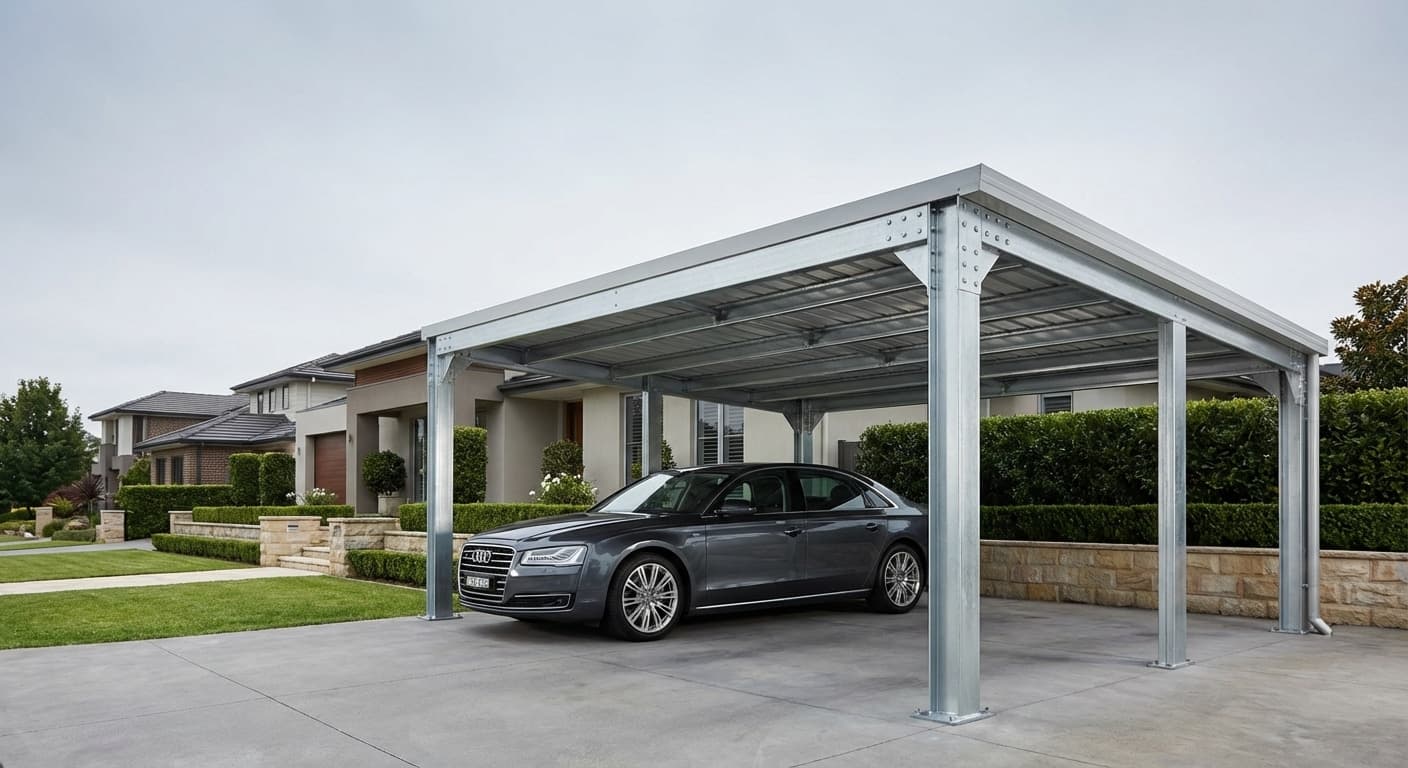

Metal carport kits have become the smart, fast, and affordable alternative to five-figure garages, shielding cars, boats, and RVs from hail, UV, and sap for thousands less and in a weekend's work. This guide walks buyers through every decision that turns a simple canopy into a decades-long asset: choosing galvanized-steel or marine-grade aluminum, matching 24- to 29-gauge panels and vertical roofs to local snow and wind loads, sizing frames 2 ft larger than vehicles, and anchoring to level concrete, gravel, or pier foundations. It demystifies permits, setbacks, and drainage, compares DIY assembly with professional installs, and shows how a modular tubular-steel frame can grow from open carport to enclosed workshop or EV-charging pavilion. Regional ratings, coastal corrosion protection, and extreme-weather certifications are spelled out so readers buy once and pass inspection, while a five-minute rinse-and-tighten routine is all the upkeep steel needs to outlast wood. By weighing upfront cost against lifetime savings–lower insurance, zero paint or pest bills, added home value, even rental income–homeowners learn to spec a structure that protects vehicles today and adapts to tomorrow's needs.
Why Metal Carport Kits Are Essential for Driveway Protection
Metal carports shield your vehicles from UV damage, hail, and debris while costing a fraction of a traditional garage and installing in days.
Rising demand for vehicle protection in 2026
More homeowners are protecting their vehicles with metal carports than ever before. The reasons are simple: extreme weather is getting worse, vehicles are getting more expensive, and garages cost a fortune to build. [1] [2]
You've probably noticed it yourself–hailstorms that dent hoods, UV rays that fade paint, and tree sap that ruins finishes. Your vehicles take a beating sitting in the driveway. Meanwhile, building a traditional garage can run $20,000 to $40,000 or more.
Metal carports solve this problem. They deliver real protection at a fraction of the cost, and you can have one installed in days instead of months. With electric vehicles needing dedicated charging spaces and more families owning multiple vehicles, the two-car carport has become the go-to solution for residential properties. [1] [3]
Core benefits of metal carport kits for homeowners
Metal carport kits deliver substantial value for homeowners beyond basic vehicle protection. These structures shield vehicles from damaging UV rays, precipitation, and debris while requiring minimal maintenance compared to wooden alternatives [4]. Their flexibility stands out as homeowners can use them for gatherings, workspaces, or equipment storage–not just vehicle coverage [4].
Most kits feature modular designs that can be disassembled and relocated if you move, making them practical investments for both homeowners and renters [5]. Cost remains a major advantage, as metal carports typically cost significantly less than building a traditional garage while still providing essential protection [4]. The durability of steel and aluminum construction resists pests, rot, and weather damage, often lasting decades with proper maintenance [5].
Modern kits accommodate various vehicle types–from compact cars to RVs–through customizable dimensions, roof styles, and support structures [6]. Many manufacturers offer wind and snow load ratings suitable for regional weather conditions, ensuring structural integrity during extreme weather events [4]. For budget-conscious homeowners, the DIY-friendly assembly of many kits eliminates contractor costs, with most installations completable in just a few days [5].
How metal carport kits integrate with metal building solutions
Metal carport kits serve as versatile foundations for expanded metal building systems rather than isolated structures. Homeowners can transform basic carports into comprehensive solutions by adding lean-to extensions that create multipurpose spaces for storage, work areas, or social gatherings [7].
These additions typically cost less than constructing separate standalone buildings while providing seamless aesthetic integration [7]. The modular nature of metal carports allows strategic placement within your property landscape–position them where they serve both functional and visual purposes rather than treating them as afterthoughts [8].
For optimal integration, incorporate simple landscaping elements to blend the structure with your property design [8]. Like our This integration flexibility makes metal carports particularly valuable for property owners who anticipate changing needs, as these structures can evolve from simple vehicle protection to comprehensive building solutions over time.
Assessing driveway conditions before installation
Your carport needs a solid foundation to last. Start by checking that your site has less than 3 inches of slope–anything more requires leveling [9]. Measure your space carefully and verify local setback requirements before you order [10].
The foundation type matters. Concrete provides the best stability, while properly compacted gravel works for lighter structures. For challenging terrain, you might need a ledger wall to create level ground [11]. As covered in the installation section, each foundation type requires specific anchoring systems to ensure your carport stays put during storms.
Document your site conditions–dimensions, slope, surface type–when requesting quotes. This information helps manufacturers recommend the right anchoring system for your specific situation.
Selecting the Ideal Metal Carport Kit
Galvanized steel carports deliver the strength and longevity you need at 30-40% less cost than aluminum for most installations.
Steel versus aluminum – strength, weight, and cost
Here's the bottom line: steel gets the job done for less money. You'll pay 30-40% less upfront for steel, and it handles whatever nature throws at it–250% denser than aluminum means your carport won't budge in a storm [12]. Steel structures resist denting and support heavier snow loads without breaking your budget [13]. Aluminum has its place. Weighing one-third of steel, you can install it without heavy equipment–saving labor costs if you're DIY-minded [14]. Living near the coast? Aluminum's natural corrosion resistance beats steel hands-down, no special coatings required [13]. Steel needs galvanized or powder-coated finishes to match that protection [12].
Your location decides the winner. For 90% of installations, galvanized steel delivers the strength you need at a price that makes sense [13]. Choose aluminum only when salt air threatens daily or when you absolutely need lightweight materials for transport [14]. Remember: proper coatings make steel last just as long, and you'll pocket the savings.
Gauge, roof style, and protective coating options
Forget the technical specs–here's what gauge means for your wallet and peace of mind. Standard 29-gauge (0.0142 inches) works fine for basic protection in mild climates. Step up to 26-gauge (0.0188 inches) for real durability without breaking the bank. Need bulletproof protection? 24-gauge (0.0250 inches) shrugs off hail and falling branches [15]. Only extreme snow country needs 22-gauge–save that money unless you're facing 60+ PSF snow loads [15]. Roof style makes or breaks long-term performance. Skip regular roofs entirely–those horizontal panels trap everything and leak within five years [16]. Boxed eave designs look better and perform decently, but here's the truth: vertical roofs pay for themselves. Panels run from peak to ground with hat channel support underneath. Water, snow, leaves–everything slides right off [17]. Yes, you'll pay 15% more upfront. No, you won't regret it when your neighbor's horizontal roof starts sagging [17].
For structures over 35 feet, vertical becomes mandatory–horizontal panels simply can't span that distance without problems [17]. As for coatings, galvanized steel handles 95% of locations perfectly. Only coastal properties within two miles of saltwater need special consideration [16]. Your
Load ratings, wind and snow zone compliance
You need two numbers before buying: snow load (PSF) and wind rating (MPH). Standard carports handle 20-40 PSF snow loads–fine for most of the country. Heavy snow regions need certified structures rated 60-90 PSF [18][19]. Wind ratings start at 90 MPH for basic models. Coastal areas demand 140+ MPH ratings, hurricane zones need 150+ MPH [19].
Your zip code determines everything. Florida? You're buying for wind–140-180 MPH minimum [19]. Minnesota? Snow capacity matters most–aim for 40-70 PSF [19]. Don't guess–local building codes spell out exact requirements, and inspectors will check your certification papers [20].
Here's what actually fails in storms: bad anchoring and horizontal roofs. Proper anchors matter more than panel thickness–they keep your investment grounded when winds hit [18]. Vertical roofs shed snow naturally while horizontal designs collect it until they buckle (covered in detail above) [18].
Bottom line: buy certified structures that exceed local requirements by 20%. The extra cost beats explaining to your insurance company why your non-compliant carport landed in the neighbor's yard [19][20].
Custom sizing and modular designs for single, dual, and multi‑vehicle setups
Stop measuring your vehicles–measure how you'll use them. Single-car carports start at 12×20 feet, but that's tight. Add 2 feet each side for comfortable door clearance [21]. Two-car structures need 18×21 feet minimum, though 20×24 or 24×24 feet lets you actually open doors without dinging them [21][22]. Planning for growth? Jump straight to 24×30 or 30×36 feet–you'll use every inch for storage, workspace, or that boat you're thinking about [21][23].
Height kills more carport plans than width. Standard 8-foot clearance handles sedans. Got a truck? You need 10 feet. RV owners, don't even consider less than 12-14 feet–measure your rig's AC unit, not just the roofline [23].
Frame choice determines what you can add later. Tubular steel (square tubes with gusseted corners) delivers serious strength in compact packages like 12×24 feet–perfect for residential lots with hurricane concerns [21]. Need maximum flexibility? I-beam construction starts at 16×20 feet but handles anything you throw at it, including future lean-to additions [21].
The modular advantage: start with an open canopy today, add side panels next year, enclose it completely when budget allows [21]. Every addition integrates seamlessly–no cobbled-together look. Choose your initial frame wisely and you're building a system, not just buying a carport [23]. Match your gauge to your worst weather day: 29-gauge for mild climates, 26 or 24-gauge where Mother Nature means business [21].
Smart Installation Planning for Modern Driveways
Proper site selection and foundation choice–whether concrete, gravel, or pier–directly determine your carport's long-term stability and performance.
Site assessment, grading, and drainage best practices
You've selected your metal carport–now let's get it installed right. Start by picking a spot that's easy to access and away from flood zones and tree branches [24]. Your ground needs to be level within 3 inches, and if you're adding doors, you'll need even tighter tolerances [9].
Clear out all vegetation and debris first. Any plant material left behind weakens your anchors and compromises stability [25]. For dirt foundations, compact the soil thoroughly with a steel tamper, working from edges to center [9]. Mark your layout with stakes and string–it's worth the extra five minutes to ensure accurate dimensions [9].
Here's where drainage gets tricky: concrete foundations need a slight 1/8-inch per foot slope to prevent puddles, but carport base rails require dead-level ground [9]. The solution? Create drainage around the perimeter with French drains, swales, or rain gardens that direct water away from your structure [24]. On soil foundations, add gravel or crushed stone after installation to minimize erosion [25].
Smart positioning saves you money long-term. Place your carport where it gets less direct sun–your vehicles stay cooler and the structure lasts longer [24]. Consider wind direction too. A sheltered spot reduces stress on anchors during storms [24]. For certified structures, you'll need concrete with specific PSI ratings–your manufacturer will tell you exactly what's required for your carport size [25].
Foundation options: concrete slab, compacted gravel, or piers
Your foundation choice makes or breaks your carport investment. Concrete slabs give you rock-solid stability and a clean, professional look–doors stay aligned, and you get permanent protection for daily use [26].
Gravel pads save money while providing excellent drainage. When properly compacted and graded, they work great for lighter structures or if you might relocate later [26]. Got a slope? Pier foundations raise your carport on concrete blocks, keeping everything level while water runs underneath [26].
Many homeowners choose hybrid solutions–like gravel with concrete runners under support points. You get stability where you need it without the cost of a full slab [26]. Match your foundation to your site conditions, soil type, and future plans. The right choice now prevents headaches later.
DIY tool kit, safety gear, and step‑by‑step assembly guide
Ready to tackle this yourself? Here's what you need: tape measure, level, hammer drill with masonry bits, socket set, ladder, string line, rubber mallet, and power drill with driver bits [27]. Safety first–wear heavy-duty gloves, safety glasses, steel-toed boots, and a hard hat throughout the job [28].
Start smart by sorting all components–base rails here, vertical legs there, roof trusses over there. Put hardware in labeled containers. Trust us, this saves hours of frustration [28].
Position base rails around your foundation perimeter. Check they're square by measuring corner to corner–both diagonals should match [28]. Attach vertical legs at corners using a magnetic level, but keep bolts finger-tight for now [28].
Roof trusses need two people minimum. Connect opposing corners first, then work down the length [28]. Once your entire frame is up, check alignment and tighten every bolt from bottom to top [28].
For panels, start at one end (ideally away from prevailing winds). Leave a slight eave overhang and overlap panel ribs properly–that's what keeps rain out [28].
Your final step is critical: anchoring. Use expansion anchors for concrete, rebar for asphalt, or auger anchors for soil and gravel. Proper anchoring is what keeps your carport standing through storms [28].
When to hire professionals and latest permitting requirements
Know when to call the pros. If your carport exceeds 20×20 feet, needs electrical work, or requires specific load-rated concrete anchoring, professional installation makes sense [29].
Expert teams finish in hours what takes DIYers weeks [29]. When you work with a single-source provider like National Steel Buildings, our
Top‑Rated Metal Carport Kits for 2026
Galvanized steel frames with sloped roofs handle most regional weather patterns while costing half as much as all-metal alternatives, with weekend DIY assembly saving you thousands on installation.
Best overall metal carport kit – performance, warranty, and value
You need a carport that performs year after year without constant worry or maintenance headaches. The best overall kits deliver three essentials: structural integrity that handles your local weather, warranties that actually protect your investment, and pricing that makes sense for your budget [31][6].
Start with tubular steel frames featuring square extrusions with gusseted corners–this design delivers hurricane-force wind resistance without the hurricane-force price tag [6]. When integrated with quality
Budget‑friendly metal carport kit without compromising durability
Budget doesn't mean compromising on protection. Smart shoppers find value in hybrid designs that combine metal frames with weather-resistant fabric panels–you get essential coverage at prices that won't strain your finances [33].
Metal-frame carports with polyethylene roofs deliver real-world performance: they resist rust, shed rain efficiently, and stand up to daily UV exposure [33]. In mild to moderate climates, these structures protect your vehicles just as effectively as all-metal alternatives at half the cost [33].
The key to budget value? Focus on what matters. Galvanized steel frames prevent corrosion for decades. Sloped roof designs naturally shed water without requiring expensive heavy-gauge panels. Structures rated for 35 pounds per square foot of snow and 100 mph winds handle most regional weather patterns without the premium price [33].
You can assemble these kits yourself in a weekend with basic tools–no specialized equipment or contractor fees required [34]. That's thousands saved on installation alone, money better spent on other home improvements.
Heavy‑duty metal carport kit for extreme weather and wind loads
When standard carports won't cut it, you need structures engineered for punishment. Heavy-duty kits feature longitudinal reinforcing crossbeams and top reinforcement systems that handle snow loads up to 100 pounds per square foot and winds approaching 100 mph [35].
These aren't marketing claims–they're engineered specifications. Look for exact ratings: vertical load capacity (snow) in PSF and horizontal force resistance (wind) in MPH [35]. As discussed in our gauge and load ratings section, 12-gauge steel frames provide the backbone for extreme conditions [36].
The 15-25% premium over standard carports pays for itself through extended lifespan–these structures last beyond 10 years even in harsh environments [35]. Your anchoring system matters just as much as the frame. Reinforced base rails with deeper ground penetration keep everything secure when 90+ mph winds hit [35].
Yes, installation takes more effort–plan on 3-5 people and a full day for proper assembly [35]. But that extra time upfront prevents catastrophic failure when extreme weather strikes. In high-risk zones, this investment protects both your vehicles and your peace of mind.
Regional recommendations: climate, shipping, and local dealer support
Your zip code determines your carport requirements. Florida residents need 120-140 mph wind ratings with hurricane-grade anchors. Northern homeowners require 40-70 PSF snow ratings. Coastal buyers must prioritize corrosion resistance [37].
Local expertise saves money and headaches. Regional dealers stock climate-appropriate models, cutting shipping costs on heavy-gauge structures. They know your building codes, provide engineer-stamped plans for permits, and connect you with installers who understand local challenges [6][37].
Smart regional shopping checklist:
- Verify wind/snow ratings match local requirements–not national averages
- Confirm anchoring systems work with your soil type
- Choose dealers with regional inventory to avoid freight damage
- Get written confirmation of code compliance for your specific municipality [37]
National buying power combined with local knowledge delivers the best value. You get competitive pricing plus expertise that prevents costly mistakes. Before signing anything, ensure your chosen kit meets both current codes and likely future weather extremes [6].
Maintaining Your Metal Carport Kit and Next Steps
Five minutes of weekly maintenance prevents thousands in repairs and keeps your metal carport's coating protected for decades.
Routine maintenance, coating care, and corrosion prevention
Five minutes a week saves thousands in repairs. That's the maintenance math for metal carports.
Start with a simple weekly rinse using your garden hose. Dust, pollen, and salt deposits cause corrosion when they sit–wash them off before they become problems [38]. Live near the coast or in high-pollution areas? Rinse twice weekly [39].
Monthly inspections take five minutes but catch issues early. Check seams, edges, and fasteners. Tighten loose bolts immediately. After storms, verify all anchors remain secure–wind loosens connections gradually [39].
Coating protection basics:
- Use mild detergent and soft brushes only
- Keep pressure washers under 1,500 PSI
- Fix scratches fast with zinc-rich paint (ASTM A780 standard)
- Never use harsh chemicals or abrasive pads [39]
Seasonal maintenance schedule:
- Fall: Clear leaves and debris weekly
- Winter: Remove snow evenly from both roof sides (non-metal rake only)
- Spring: Deep clean accumulated grime
- Summer: Inspect for UV damage [38]
Rust appears? Act immediately. Remove it completely with rust remover and scouring pads, then apply metal polishing paste. Small holes need alternating layers of urethane roof cement and steel roofing mesh [38].
Watch these corrosion hot spots during every inspection:
- Panel overlaps
- Fastener points
- Where different metals touch
- Gutter connections [39]
Keep drainage clear–standing water accelerates deterioration. Direct runoff away from your foundation [40]. In snow country, remember wet snow weighs up to 21 pounds per cubic foot. Remove it before stress damages panels [40].
Most carport failures stem from skipped maintenance, not material defects. Your coating lasts decades with proper care–or fails in years without it [39].
ROI analysis: property value impact and long‑term savings
Your metal carport pays for itself through property value gains and eliminated maintenance costs. Immediate property value boost: Quality metal carports increase home value by adding covered space buyers want. Choose designs that match your home's style–the right carport enhances curb appeal while providing function [41].
Long-term savings breakdown:
- Maintenance: Wash it occasionally. That's it. No painting, sealing, or refinishing bills every few years
- Durability: Decades of service without major repairs (wooden structures need expensive fixes every 5-10 years)
- Vehicle protection: Cars and equipment last longer when shielded from UV damage, hail, and debris
- Insurance: Some carriers reduce premiums for protected vehicles [41]
Revenue opportunities: Turn extra carport space into income. Rent storage bays. Create workshop space for local artisans. Add EV charging stations for the growing electric vehicle market [41].
Energy efficiency options:
- Insulated panels cut heating/cooling costs for enclosed spaces
- Solar panel integration offsets electricity expenses
- Strategic placement provides passive cooling for adjacent structures [41]
The math is simple: higher upfront cost, lower lifetime expense. Wood looks cheaper initially but demands constant maintenance. Metal costs more day one, then saves money for decades [41].
For the specific savings potential based on your property and location, consider the factors outlined in our earlier sections on material selection and regional requirements.
How to request a personalized quote from nationalsteelbuildingscorp.com
Getting your exact price takes minutes. National Steel Buildings makes quoting straightforward–no games, no surprises.
Before you request your quote:
- Measure your site accurately (tape measure, measuring wheel, or GPS)
- Know your intended use (vehicles, equipment, workspace)
- List desired features (doors, windows, partial walls, specific gauge) [43]
The quote process: Fill out the Simple Quote Request form at nationalsteelbuildingscorp.com. Include all customization details–ends, sides, gables, J-trim, anchors. Every detail helps create accurate pricing [42].
A Building Specialist contacts you directly to refine specifications. They translate your needs into the right carport solution, considering local codes and weather requirements. No pushy sales tactics–just clear information to help you decide [42].
Direct contact options:
- Phone: (866) 453-3904
- Email: nsbarkansas@gmail.com
- Spanish language support available [42]
The more details you provide upfront–site conditions, local weather patterns, specific uses–the more precise your quote. National Steel Buildings'
Quick pre‑purchase checklist and FAQ for confident decision‑making
Quick pre-purchase checklist and FAQ for confident decision-makingPre-purchase checklist:
☐ Measure realistically: Add 3 feet to vehicle length, 2 feet to width. Include door swing, mirrors, walking space [44]
☐ Check clearance height: The truss or header determines clearance–not the peak [44]
☐ Verify site conditions: Maximum 3-inch slope allowed (see Section 3 for detailed prep requirements) [45]
☐ Choose vertical roofs: For areas with rain or snow–horizontal panels trap moisture [44]
☐ Confirm permits: Check local requirements before ordering (Section 3 covers permit details) [46]
☐ Focus on framing: Heavy-duty frames matter more than panel thickness [44]
☐ Plan for growth: Adding features later costs double. Think ahead [44]
☐ Match anchors to foundation:
- Dirt/gravel: Mobile home anchors
- Asphalt: Rebar anchors
- Concrete: Concrete bolts [46]
Common questions answered:
How long will it last? Decades with proper maintenance and anchoring. The maintenance routine above ensures maximum lifespan [44].
Do I need a permit? Usually yes, especially for enclosed units. Requirements vary by location [44].
Can I move it later? Possible but complicated. Plan for permanent placement [44].
Will it handle my weather? Only if rated for your specific wind and snow loads. Don't guess–verify ratings match local requirements [44].
What causes failures? Poor planning–not materials. Wrong height, tight clearance, bad anchoring. Measure twice, order once [44].
Ready to move forward?
- Steel carports cost 30-40% less than aluminum and resist wind better.
- Vertical-roof designs shed snow/leaves; skip cheaper horizontal panels.
- 29-gauge steel suits mild zones; 26/24-gauge needed for hail or heavy snow.
- Anchor type and roof style matter more than panel thickness for storm survival.
- Concrete slab best for daily use; gravel saves money and aids drainage.
- Weekly rinse prevents rust; inspect/tighten bolts monthly after storms.
- Measure vehicles plus 2-3 ft clearance each side; height must fit AC/truck roofs.
- https://www.verifiedmarketresearch.com/product/us-metal-carports-market/
- https://finance.yahoo.com/news/carports-market-reach-usd-3-114200332.html
- https://www.accio.com/business/carport-metal-trends
- https://www.shelterlogic.ca/knowledge/is-a-metal-carport-a-good-investment
- https://futurebuildings.com/blog/the-advantages-of-metal-carport-kits.html
- https://www.metalcarports.com/blog/metal-carport-kit/
- https://www.carportcentral.com/blog/adding-on-to-your-metal-carport-garage-or-storage-building?srsltid=AfmBOopm4b0kQ-IuSllLX8hfpUO_gz72RD6bz_RZCxofS_7O4MI5_5gf
- https://carport-proz.com/garage-integration-guide-elevate-your-property-with-metal-buildings-steel-structures-and-prefab-metal-garages/
- https://www.legacycarports.com/post/how-to-prepare-your-site-for-a-carport-installation
- https://www.carportcentral.com/blog/bloginstallation-checklist-preparing-your-site-for-installation?srsltid=AfmBOoon-R1uRrVKUn8tgRzLh2BtsMIiwmF_4ls1lLDONrghA7RES3Dp
- https://conestogasteel.com/metal-building-site-preparation/
- https://carportsolution.com/news/steel-vs-aluminum-carports-comparing-strength-durability-and-cost/
- https://metalcarport.com/aluminum-carports-vs-steel-carports-pros-and-cons/
- https://www.carportcentral.com/blog/which-to-choose-an-aluminum-or-steel-carport?srsltid=AfmBOoq7Hz6-Tub4Z9du51U91oPNN0mbCTTzjxMb3d2SDR9KNGFKdVOB
- https://prairieexteriors.com/metal-roofing-gauge/
- https://www.metalcarports.com/blog/a-guide-to-metal-garage-roofing-options/
- https://metalbuildingsnorthamerica.com/types-of-carports-roof-styles-and-structural-options/
- https://californiaallsteel.com/metal-carport-snow-load/
- https://valuemetalbuildings.com/blog/snow-load-and-wind-speed-ratings
- https://dreamscarports.com/wind-snow
- https://gensteel.com/recommended-use/two-car-carport/
- https://garagebuildings.com/metal-carports/2-car-carports
- https://www.americanmetalbuildings.com/metal-carport-kits/?srsltid=AfmBOoq1US8fPrW2B_94ar2CDkMjHd2gWFhJwIa1NVoiupDETNeXCHMi
- https://www.metalbuildingoutfitters.com/essential-guide-to-installing-metal-carports/
- https://www.carportcentral.com/blog/bloginstallation-checklist-preparing-your-site-for-installation?srsltid=AfmBOoqpNll1tKDihiaN_d86As2E5LwRAgPFAY9S5xM82VMckplz8g4Y
- https://ravenelbuildings.com/foundations-for-metal-garages-what-options-work-why/
- https://americansteelinc.com/blog/how-to-install-a-metal-carport-professional-guide/
- https://iconsteelbuildings.com/metal-carport-installation/
- https://www.eaglecarports.com/blog/metal-building-installation-checklist
- https://bullbuildings.com/do-metal-carports-require-a-permit-what-you-need-to-know/
- https://futurebuildings.com/blog/carports-metal-carport-kits.html
- https://www.americanmetalbuildings.com/metal-carport-buying-guide/?srsltid=AfmBOoq-h4dTvURPpsvaoM9U20L4AXYxrNK0sofKOHXX-4ZywjJTaImN
- https://www.popularmechanics.com/cars/g60278607/best-carports/
- https://www.metalbuildingoutfitters.com/top-affordable-metal-carports-for-homeowners/
- https://www.amazon.com/Carport-Heavy-Duty-Military-Grade-Reinforced-Hurricane/dp/B0F3X736S3
- https://www.buildingsandmore.com/steel-buildings/metal-carports
- https://carportsolution.com/news/climate%E2%80%91proof-carports-choosing-the-right-structure-for-hurricanes-snow-and-harsh-weather/
- https://prometalbuildings.com/the-ultimate-guide-to-metal-carport-maintenance/?srsltid=AfmBOoq0Dptk435HpyxUST1K4OpC4YcQy9XRw-2nyweWhl7O_pvGAy0O
- https://metalprobuildings.com/metal-carport-maintenance-tips/
- https://sunjoyshop.com/blogs/news/how-to-keep-your-metal-carport-roof-looking-new-for-20-years?srsltid=AfmBOoqhehB5uanCvb9IAjhn60p2T27j2DrprMMaRpl_LsfXx0_mqG0W
- https://hometriangle.com/blogs/how-a-metal-carport-adds-value-to-your-home/
- https://www.nationalsteelbuildingsinc.com/quote-request
- https://www.steelcarports.com/blog/the-ultimate-steel-carport-installation-site-measurement-guide?srsltid=AfmBOooQtv3EW18gewJFdf1KN9Aich8bkCUICG0i8vFXtCwWTpWG7i42
- https://www.aametalbuildings.com/blog/metal-carports-the-complete-2025-buyers-guide?srsltid=AfmBOor2Zc0pT5UCmfiypH8ZgIpzdHFf9L_Rm0y7wTzDuF8MWZzeJ8xh
- https://carport1.com/metal-carports-buying-and-installation-guide/
- https://www.vikingmetalgarages.com/blog/checklist-before-buying-a-perfect-metal-carport-structure