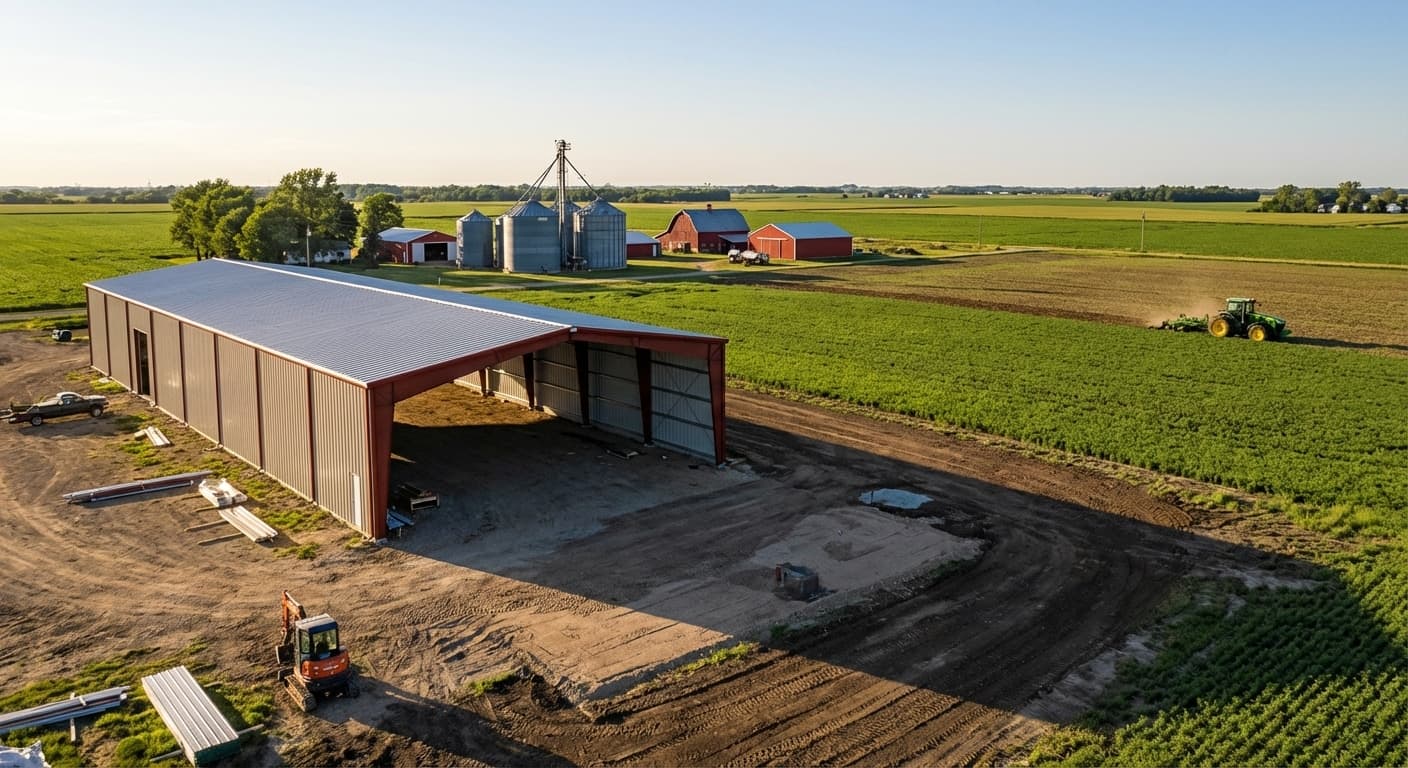

Turnkey farm building construction delivers a single-source solution that keeps producers farming instead of refereeing contractors, as one integrated team handles design, engineering, permitting, steel fabrication, and erection under one schedule and one budget. The article shows how pre-engineered steel buildings slash weeks off build times through factory-cut components that bolt together in days, eliminate decades of wood's rot, pest, and fire costs, and scale from 30×40 equipment sheds to mega-dairies with clear-span interiors that adapt as operations grow. Readers learn to size buildings by matching dimensions to machinery or livestock needs, lock in all-in costs (kit, site prep, freight, add-ons) before committing, and time site work around planting and harvest so construction traffic never disrupts daily workflows. It details a seamless process–run site prep and fabrication in parallel, coordinate just-in-time delivery, and lock design decisions before steel is cut–while explaining post-build value: 50-year structural warranties, simple connection inspections, and easy future expansion. Ultimately, the piece arms busy farmers with a roadmap to gain faster occupancy, cost certainty, lower lifetime maintenance, and a structure that evolves with their business–without pulling them out of the field.
Defining Turnkey Farm Building Construction for Modern Agriculture
One team handling design through completion means you skip contractor disputes and get cost certainty, freeing you to focus on farming instead of construction coordination.
What makes a farm building truly turnkey in today's market
A truly turnkey farm building means one team handles everything from your first sketch to handing you the keys — no juggling separate contractors for design, engineering, foundation, steel erection, and finishing work. You get one phone number, one project manager, and one schedule that actually holds. [1] The difference between genuine turnkey and a handful of loosely connected subcontractors?
Accountability. When something needs fixing or a decision needs making, you know exactly who to call.
For producers running dawn-to-dark operations, that single point of contact saves hours every week that would otherwise disappear into contractor coordination.
Key advantages for busy producers: speed, cost certainty, and reduced risk
You're already managing input costs, technology decisions, labor shortages, and market swings — all while keeping daily operations running. University of Illinois research confirms what you already know: farm managers are stretched thin, and that complexity is forcing consolidation across the industry. [2] The last thing you need is a construction project that pulls you away from the field to referee contractor disputes or chase down why the electrician can't start until the concrete crew finishes arguing with the steel erector.
A turnkey approach cuts through that chaos. Speed comes first — when one team owns design through completion, you skip the dead time between trades and the finger-pointing when schedules slip. Cost certainty follows naturally. Those surprise charges that pop up when contractors play hot potato with scope gaps? They disappear when one partner owns the entire budget. [2] Risk drops for the same reason. Research shows that disconnected project management exposes you to cascading failures across multiple fronts. [2] An integrated build — where your
Why steel is the preferred material for quality, durability, and rapid delivery
Steel beats wood and concrete on three counts that matter to your bottom line: it's stronger, it lasts longer, and it goes up faster. Take structural performance — red iron steel shrugs off snow loads and high winds that would stress a pole barn, and the clear-span design means no posts cluttering your work space. [5] Every square foot stays usable for equipment maneuvering, livestock movement, or reconfiguring as your operation grows.
Then there's the biological immunity. While traditional barns fight a losing battle against termites, carpenter ants, rot, and rodents, steel simply doesn't play that game. [5] No pest control contracts. No rot repairs. Lower insurance premiums because steel doesn't fuel fires. Those maintenance headaches that nickel-and-dime wood structures for decades? Gone.
Speed seals the deal. Pre-engineered components show up numbered, pre-drilled, and ready to bolt together — turning months of traditional construction into weeks or even days. [5] When you need grain storage before harvest or shelter before the first freeze, that timeline difference isn't academic. And because every piece is factory-cut to exact specs instead of field-fitted with a tape measure and hope, you get consistent quality at every connection point and a structure that needs minimal attention for decades. [4]
Strategic Planning and Precise Costing from 30×40 Barns to Mega Dairies
Right-sizing your barn during design costs pennies compared to expanding later, so account for equipment dimensions, livestock needs, and growth before breaking ground.
Assessing operational needs and sizing the structure correctly
Your building size starts with one question: what work needs to happen inside? Equipment storage demands different dimensions than livestock housing or shop operations — and each use scales differently as your operation grows. [6] For equipment storage, you need your largest machine dimensions plus working clearance. A 16-foot eave height handles most implement combinations without jumping to heavier columns that push costs up. [6] Livestock buildings run larger — cattle operations typically start at 40×60 ft. for shelter, feed, and basic equipment, while machinery storage often needs 60×80 ft. minimum. Add square footage for worker movement, feed storage, and ventilation systems. [8]
Your actual buildable area shapes every decision. After accounting for setbacks, existing structures, and local codes, your usable site often differs from what you first envision. [8] Here's what matters: under-building costs more than over-building. Adding space during design costs pennies compared to expansion later. For growing operations, clear-span
Transparent pricing models and budgeting tools for steel ag projects
Your steel building budget breaks into four clear pieces — know each one to avoid surprises that kill projects. The building kit (framing, panels, fasteners) takes 40 to 50 percent of your total spend, running $7 to $14 per square foot for materials. [11] Turnkey installed pricing — including slab, delivery, and erection — lands at $24 to $43 per square foot based on your site and design. [9]
Real numbers help: A 30×40 kit costs $21,600 to $30,000. A 40×60 runs $43,200 to $60,000. A 50×100 — smart starting size for serious operations — sits at $90,000 to $125,000, before site work and installation. [10]
Site prep adds 10 to 20 percent to your budget. Flat, accessible land stays low. Sloped or remote sites push high. [11] Freight takes 3 to 7 percent, depending on distance and fuel costs at delivery. [11]
The mistake that blows budgets? Treating the kit price as your total cost. Lock down all four estimates — kit, site prep, freight, and add-ons like insulation — before you commit. That's how you keep your project on budget from start to finish.
Single‑source design, engineering, and permitting workflow
Your permit process shows why single-source delivery matters. Agricultural permits take 6 to 12 weeks and cost $457 to $2,859 — if your application arrives complete. [12] Missing documents, zoning conflicts, or non-compliant drawings restart your clock from zero. Pre-engineered steel buildings dodge these delays. The three-step process — design, fabrication, assembly — creates stamped engineering drawings and component specs before you file for permits. [13] That's the exact package building departments need for fast approval.
When one team handles design through permitting, translation errors vanish. What the engineer draws matches what the permit shows. No gaps, no confusion, no delays. [14]
Zoning compliance happens upfront, not after submission. Setbacks, height limits, land use rules, flood zones — we catch these during design, not after you've paid for drawings that won't work. [14] You stay focused on your operation. We handle the complexity of making sure what gets designed can actually get built on your specific site. That's the difference between hoping for approval and knowing you'll get it.
Seamless Construction Process That Keeps You in the Field
Thorough site mapping keeps construction traffic away from your livestock corridors and active areas, preventing operational disruption before equipment ever arrives.
Coordinated site preparation with minimal disruption to farm activities
Site prep is where most construction bleeds into your daily operations. Heavy equipment crossing fields. Access roads blocked. Drainage disrupted near livestock. You can prevent that mess with thorough site evaluation before any machinery shows up.
We map everything first: natural slope, soil type, drainage patterns, equipment routes. This keeps construction traffic away from your livestock corridors and active storage areas. [16] Soil conditions tell us exactly what prep work you'll need — and identifying them early keeps the project on schedule instead of expanding into your operational zones mid-build. [15]
Your building's purpose drives every site decision. Equipment storage needs firm, well-graded ground with clear machinery access. Livestock buildings require strategic airflow orientation and sun exposure for animal health and building performance. [16]
Drainage matters most. Proper grading and gravel placement under the pad prevents moisture buildup, post shifting, and floor damage for the building's entire life. Get it right during prep, and you won't face remediation work that forces construction back into your active areas later. [16]
The smartest move? Schedule site work around planting and harvest seasons. When one team owns your entire timeline — like our approach with Agricultural Steel Buildings — they plan proactively around your operations instead of handing you a schedule to work around. [15]
Modular steel erection, rapid assembly, and on‑time delivery tactics
Steel goes up fast because of what happens before it reaches your site. Every component is cut, welded, and pre-drilled in the factory to exact specs — down to 2mm tolerances. They arrive ready to bolt together, cutting fitting time by 40% compared to on-site fabrication. [19]
Once your foundation's ready and materials are staged, erection runs fast. A few days for smaller structures. Up to three weeks for larger multi-bay designs with wide clear-spans, ridge vents, and specialized doors. [17] The sequence matters: primary frames go up first — columns and main beams squared and set. Then secondary members complete the skeleton. This lets crews work multiple sections at once instead of waiting for each phase to finish. [17] Bolted connections beat welding every time, achieving 35-50% faster installation. [19]
Here's how we keep you on schedule: run site prep and fabrication in parallel, not back-to-back. While steel fabricates (typically 3-6 weeks), crews clear, grade, and set anchor bolts. Your pad's ready the moment components arrive. No idle foundations. No steel sitting in storage. [18]
Just-in-time delivery keeps everything moving. Coordinate cranes with material arrival. Pre-arrange access routes. Experienced crane operators can place 500 square meters of framing per day — but only when logistics run smooth. [19]
Weather's the wildcard. High winds stop crane lifts. Wet ground stalls foundation work. Extreme heat slows crews. Build realistic buffers into your schedule to absorb these without pushing your handover date. [17]
One critical rule: lock in every design decision before fabrication starts. Door locations, clear-span requirements, interior features — changing any of these after steel production begins resets the clock and adds weeks to delivery. [18]
Clear communication checkpoints and service‑excellence protocols
One miscommunication can cost you thousands in rework and weeks of delay. That's why structured communication isn't a courtesy — it's a project management tool. [21]
Start with clear command at contract signing. Your project manager owns client relations and overall schedule. The superintendent handles field decisions. Subcontract coordinators manage trade conflicts. Everyone knows who handles what. No ambiguity. [21]
Communication runs like clockwork:
- Daily logs track field conditions, weather, and progress
- Weekly meetings align subcontractor sequencing and resolve conflicts
- Monthly reviews examine budget and schedule performance with you present [21]
Change orders follow the same discipline. Every modification gets documented — who requested it, technical specs, materials, labor adjustments, and full impact on budget and timeline. No informal requests piling up. No scope creep. [21]
You don't need to be on-site daily. Weekly reports arrive in consistent format. Progress photos tie to specific milestones. Escalation paths are defined before problems arise. You always know project status without chasing it down. [20]
That's our service standard. You know when you'll hear from us, how, and through which channel. No chasing information. Faster decisions because you have context in hand. That predictability — clients tell us — is what sets single-source delivery apart. [21]
Post‑Build Support, Maintenance, and Future‑Proofing
Your steel building's three-tier warranty system–50 years structural, 40 years paint, 20-25 years roof–protects your investment when backed directly by your supplier.
Comprehensive warranty, inspection, and problem‑solving services
Your steel farm building comes with three separate warranties, and knowing what each covers saves headaches down the road. The structural warranty covers your primary frame for 50 years — the backbone of your investment. Paint warranties protect all coated surfaces for 40 years.
Roof warranties run 20 years for standing seam systems or 25 years for Galvalume. [22] Here's what matters: Is the warranty backed by your building supplier or just passed through from the fabricator? A company-backed warranty stays valid as long as your supplier stays in business. A fabricator-backed warranty?
That protection ends if the fabricator closes shop. [22] During construction, special inspections verify you're getting what those warranties promise — independent quality checks on fabrication, installation, and key structural components. Done right, these inspections keep your project moving while catching issues early. [23] After you take possession, support shifts to practical resources: a 24/7 hotline for urgent questions and a detailed owner's manual that shows exactly what maintenance keeps your building performing for decades. [24] That's real post-build support — not just paperwork, but ongoing partnership.
Ongoing quality monitoring and performance optimization
Keep your steel building performing like new with simple inspections every few years — and always after severe storms. Iowa State University Extension pinpoints exactly where to look: post embedment, foundation attachments, truss-to-wall connections, roof purlin fasteners, and diagonal wind bracing. These connection points show wear first and cost least to fix early. [25] Check your metal sheeting fasteners closely. Too tight? They crack the protective coating and invite rust.
Too loose? Wind gets underneath. Both problems are cheap fixes when caught early, expensive disasters when ignored. [25] Here's what makes steel inspection simple: no rot to probe for, no termites to track, no weathered wood cycling toward failure. You're checking connections and coatings, period. [26] Know which fixes you can handle yourself and which need a pro. Tightening a loose panel fastener?
That's yours. Repairing a compromised structural connection? Call in qualified help — improper fixes create bigger problems than the original issue. [25]
Scalable upgrades and expansion pathways for growing operations
Your operation will grow — and your building should grow with it.
That's where
- One team handles design to keys, ending finger-pointing and surprise charges.
- Steel clear-span buildings go up faster, last longer, and need zero pest or rot repairs.
- Budget for kit (40-50%), site prep (10-20%), freight (3-7%), and add-ons before committing.
- Lock every design choice before fabrication; late changes reset the clock and add weeks.
- Pre-engineered parts arrive numbered and pre-drilled, cutting erection to days, not months.
- Schedule site work around planting/harvest; map soil and drainage early to protect operations.
- Inspect connections and fasteners after storms; catch loose or overtightened panels early.
- https://www.peaksteelbuildings.com/facts-about-turnkey-steel-buildings/
- https://farmdocdaily.illinois.edu/2024/06/maintaining-key-resources-amid-strategic-uncertainty.html
- https://www.universalsteel.com/farm-steel-buildings-the-durable-solution-for-agricultural-needs/
- https://armstrongsteel.com/blog/the-future-of-farming-steel-buildings-and-modern-agriculture
- https://renegadesteelbuildings.com/why-steel-is-the-best-material-for-your-agricultural-building/
- https://info.fbibuildings.com/blog/farm-building-size
- https://shermanpolebuildings.com/the-guide-to-choosing-the-right-pole-barn-size/
- https://www.vikingbarns.com/blog/choose-the-right-dimensions-for-your-custom-steel-barn
- https://www.buildingsguide.com/metal-building-prices/?srsltid=AfmBOoreds2mdajsLVcx_ACwnlPbl2YjKHj7oWf4oqF6KLwIVtz2ZcDx
- https://www.metalbuildingoutlet.com/metal-building-cost/
- https://www.starbuildings.com/blog/case-studies/2025-steel-building-cost-estimator-a-contractors-guide-to-pemb-pricing/
- https://www.steelcobuildings.com/building-permit-for-agricultural-building/
- https://pebsteel.com/en/pre-engineered-steel-building-applications-in-agricultural-construction/
- https://mbmisteelbuildings.com/blog/multi-purpose-agricultural-steel-building/
- https://agrisysintl.com/key-considerations-when-planning-an-agricultural-construction-project/
- https://mqsbarn.com/2026/01/14/tips-on-prepping-your-land-for-farm-building-construction-in-victor/
- https://www.eaglecarports.com/blog/how-long-does-metal-building-installation-take
- https://metalprobuildings.com/pre-engineered-steel-building-timeline/
- https://www.jysteelstructure.com/blog/speedy-erection-of-steel-frame-construction-saving-time
- https://pro-commercial.com/construction-project-updates-best-practices/
- https://blog.eb3construction.com/construction/project-management/client-contractor-communication-process/
- https://csisteelbuildings.com/about-capital-steel/capital-steel-warranties
- https://www.terracon.com/service/materials/special-inspections/
- https://greatwesternbuildings.com/steel-buildings-by-location/agricultural/
- https://www.extension.iastate.edu/news/ensuring-farm-building-strength-key-longevity
- https://www.worldwidesteelbuildings.com/blog/uses-of-metal-buildings-in-agriculture/
- https://roimetalbuildings.com/role-of-metal-buildings-in-modern-farming/