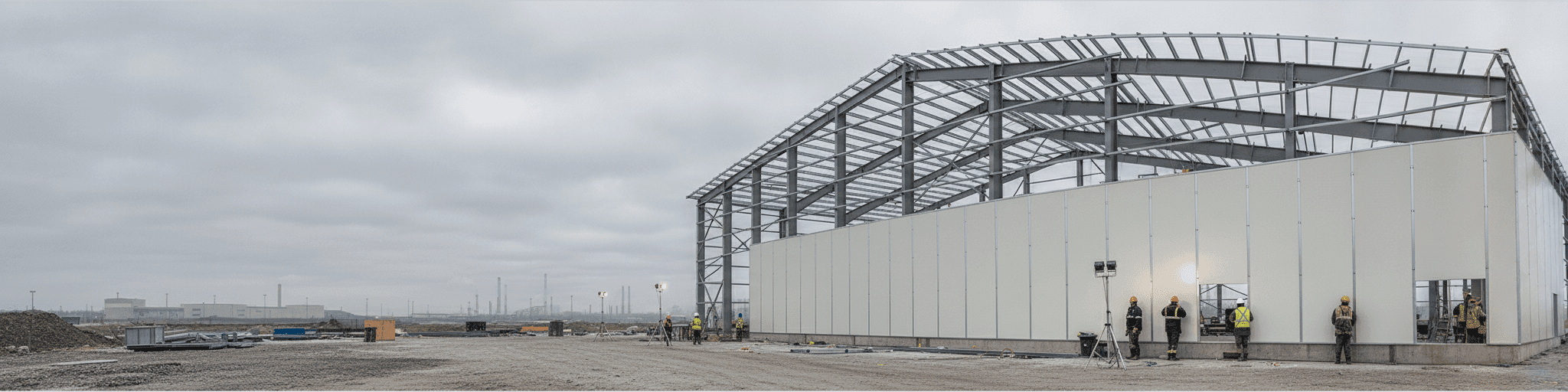

Selecting the right steel contractor for frozen warehouses requires vetting expertise in thermal envelopes, structural loads, and cold storage codes–areas where general contractors commonly fail. We recommend choosing a design-build partner with in-house erection capability and single-source accountability to keep your project on budget and schedule.
Why Choosing the Right Steel Contractor for Frozen Warehouses Matters More Than General Construction
Frozen warehouses demand specialized contractors because refrigeration systems, thermal envelopes, and subfreezing ground conditions require expertise that standard commercial builders simply don't possess.
Frozen facilities demand specialized structural and thermal engineering that standard contractors often miss
A frozen warehouse behaves nothing like a standard steel building, and that gap catches general contractors off guard fast. Standard commercial contractors size a frame for wind, snow, and live loads, but frozen facilities add refrigeration equipment weight, condensation control, and thermal envelope continuity that a generalist rarely models correctly.[3] Below 32 degreesF, ground beneath the slab will freeze and heave without an active sub-slab heating system, a structural risk that many contractors overlook until cracking appears months after occupancy.
The refrigeration mechanical system itself typically drives 25 to 35% of total construction cost at frozen temperature ranges, meaning a contractor who treats it as someone else's scope is missing the single largest line item in the project.[1] Vapor barriers must wrap continuously from wall to roof juncture, since any gap invites condensation that compromises both insulation performance and structural steel over time.[3] These aren't optional refinements. They're the load-bearing, code-driving specifications that separate a contractor qualified for frozen storage from one who has only built dry warehouses.[2]
How poor contractor selection leads to insulation failures, code violations, and operational shutdowns
A contractor unfamiliar with cold storage fire protection will often default to wet pipe sprinklers, the standard for ordinary warehouses, without recognizing that standing water in subfreezing piping guarantees failure.
Frozen facilities require dry pipe or antifreeze systems instead, and NFPA 13 sets strict water delivery time limits precisely because those systems introduce a lag between activation and water reaching the fire.[4] Insulated metal panels compound the risk: many use combustible foam cores, so a fire that breaches the metal facing can travel inside the wall and ceiling assembly where sprinklers never reach it, leaving inspectors and owners with a building that looked protected on paper.[4] Contractors who skip proper drainage or heat tracing on dry-pipe runs invite condensate freeze-ups that block water delivery mid-emergency, a documented cause of sprinkler impairment in cold environments.[6] Refrigeration equipment adds another compliance layer entirely, since jurisdictions like New York regulate field-charged and packaged refrigeration systems under their own code sections, and a contractor who hasn't tracked those requirements can leave a facility non-compliant before it opens.[5]
Why single-source design-build contractors outperform fragmented general contractor models for cold storage
Fragmented delivery splits a frozen warehouse across an architect, a general contractor, and a refrigeration subcontractor. Each one protects its own scope instead of your building's outcome.
A single-source design-build approach collapses that into one contract and one point of accountability, so structural, thermal, and refrigeration decisions get made together instead of surfacing as conflicts mid-construction.[7] That integration shows up in results: purpose-built redesigns routinely add storage height and pallet capacity while finishing faster than a design-bid-build schedule can. When one team self-performs insulated metal panel installation, you control the envelope timeline every other trade depends on, rather than waiting on a subcontractor's calendar.[8] Concurrent design and construction lets foundations and sitework begin while thermal envelope details are still being finalized, a sequencing advantage plan-and-bid delivery can't match.
For a facility where refrigeration equipment, fire protection, and structural loads all interact, one team owning every decision beats three teams defending three separate contracts. That single-source model is exactly how National Steel Buildings works with you, every step of the way.
Five Critical Vetting Criteria for Steel Contractors in Frozen Food Warehouse Construction
Verify your contractor understands the specific USDA, FDA, or FSA requirements for your facility type, not just generic "USDA approval" claims.
Local code compliance and frozen facility permits: Do they understand USDA cold storage requirements and regional building codes? Ask a prospective contractor what "USDA approved" actually means for your build, and a generalist will likely give you a vague answer. It isn't one certification: it can mean a federal license under the United States Warehouse Act, a Commodity Credit Corporation storage agreement, or neither at all [12].
A distributor of frozen or processed foods typically needs facilities built to satisfy FDA/FSMA standards, HACCP plans, and third-party audits like SQF or BRC rather than a USWA license, which covers raw commodities like grain and cotton, not refrigerated goods [12]. If your project involves on-farm cold storage financed through USDA's Farm Storage Facility Loan Program, the contractor needs to know that eligible facility types and minimum life-span requirements are spelled out in program rules the FSA administers [13]. For on-farm builds, an agricultural steel building sized for cold storage can meet those durability and life-span requirements without blowing your budget.
A contractor building toward CCC-approved warehouse listings also needs familiarity with AMS's warehouse dashboard and approval process, since producers must store on approved facilities to access marketing loans [14].
How Steel Contractors Structure Frozen Warehouse Projects: Design, Fabrication, and Erection Phases
Structural engineers must design refrigeration equipment supports and thermal breaks into your frame before fabrication to prevent condensation leaks and panel failures months after erection.
Custom engineering for frozen loads: Why steel frame design must account for refrigeration equipment weight and condensation controlRefrigeration equipment doesn't just sit inside a frozen warehouse, it hangs from and bolts to the frame itself, so structural engineers must design support platforms, maintenance access systems, and reinforced connection points for evaporators, condensers, and rooftop units before steel ever ships to the field.[15] That same frame has to survive thermal movement as the building cycles between ambient and subfreezing air, since contraction at columns and girts left unaddressed can crack panel seams and open condensation paths.[15] Every girt, purlin, and column that penetrates the insulated envelope becomes a potential thermal bridge, and crews now use thermal imaging after panel installation specifically to catch the leaks that framing connections create.[16] Tight erection tolerances matter here too: panel joints depend on straight, true framing to stay sealed, and a frame that sways or drifts during erection compromises the vapor barrier before the building ever reaches operating temperature.[16] Getting this coordination wrong doesn't show up on day one, it shows up as ice, sag, or a failed inspection months later.[15]
Insulated metal wall and roof assembly specifications: Understanding U-factor ratings and thermal break requirements
In-house erection capability: Why contractors with dedicated installation crews deliver faster timelines and fewer defects A frozen facility's envelope only performs once it's sealed correctly, and that seal depends on who's swinging steel in the field.
An in-house erection crew handles rigging, structural alignment, insulation, and sheeting under one unified, OSHA-compliant safety program instead of handing pieces to third-party erectors, which removes a major source of schedule uncertainty.[19] National Steel Buildings runs its own erection division, ProTrades, so self-performing site work, concrete, fabrication, and erection under one contract can shave weeks off your timeline compared to waiting on subcontractor availability.[20] Owner-supervised crews also protect quality on frozen builds: certified erectors under daily oversight produce tighter panel fit-up and fewer field corrections than rotating subcontractor labor.[21] That direct control shortens the window between steel delivery and a weatherproof, insulated envelope, the single milestone every refrigeration and fire-protection trade downstream is waiting on.
Fewer handoffs also mean fewer parties to blame when a seam leaks or a connection sits out of tolerance, since one crew answers for the whole erection scope.
Contractor Evaluation Planner Notes and Cost Comparison Framework for Frozen Facility Builds
Ask contractors in writing about past cold storage projects, insurance, subcontractors, and change-order pricing before any contract arrives on your desk.
Vetting Essentials: 12 questions to ask steel contractors before signing a frozen warehouse contract
Put your questions in writing before any contract lands on your desk, since a contractor who dodges specifics on paper is telling you something a glossy proposal won't. [22] Work through these before you sign:
- What comparable cold storage projects have you built, and who ran them? [23]
- Can you produce your license and a certificate of insurance naming our entity? [23]
- Who performs concrete flatwork, steel erection, and refrigeration mechanical work? [24]
- Do you offer formal pre-construction services with budget accountability? [24]
- How do you price change orders, and what triggers a holdback release? [23]
- What does your payment schedule look like, and when is final payment due? [22]
- Which references can confirm your on-time, on-budget track record? [22]
If a bid comes in far below the others, ask why before you celebrate the savings, since an underbid contractor is often financially underwater before the slab is even poured. [24]
How to compare bids from multiple contractors without sacrificing quality or thermal performance
Comparing bids fairly starts with forcing identical scope: require every contractor to quote against the same drawings, insulation R-values, and refrigeration specs, since bids built on different assumptions can't be ranked by price alone [25]. An RFP structure borrowed from mechanical procurement works just as well for envelope and structural scope: ask for at least three proposals against identical performance targets, plus a line-item breakdown separating equipment, labor, materials, and contingency so hidden costs don't surface mid-project [27].
Weigh each number against market benchmarks rather than against each other, since a bid that undercuts every competitor by a wide margin usually signals a scope gap, not savings [26]. Ask which contractors hold direct manufacturer relationships for insulated metal panels, since that leverage can swing material pricing 15 to 35 percent and compress lead times that otherwise run 6 to 14 weeks [25].
Specification decisions made early drive the majority of lifetime operating cost, so the cheapest bid on paper can still be the most expensive building over 20 years [25].
Red flags in contractor proposals: What to watch for in pricing, timeline, and warranty language
Pricing red flags start with bids that separate equipment from installation but leave heavy logistics as "time and materials" or "TBD," since that variable language is exactly where crane, rigging, and disposal costs resurface as change orders. A contractor who quotes without a physical site inspection, assuming an existing slab or curb will simply work, is gambling with your structural budget [29]. Timeline red flags look similar across trades: vague windows like "8-12 weeks" without milestones for foundation, envelope closure, and refrigeration startup signal a contractor who hasn't sequenced the build at all [28]. On warranty language, insist labor coverage stays separate from manufacturer panel and refrigeration warranties, in writing, with stated duration and exclusions [28].
Watch specifically for:
- Deposits exceeding 30% of contract value [28]
- No written estimate, only verbal pricing [28]
- Bids skipping a physical site inspection [29]
- Vague scope language like "complete electrical work"
Any of these should stop you before you sign.
Vetting a frozen-facility contractor comes down to one question: who owns the outcome? National Steel Buildings answers that with a single-source design-build model, national buying power that keeps your budget in check, and an in-house erection team that keeps your schedule tight. You get one point of accountability from design to delivery, cold storage engineered to your exact temperature category, and clear communication every step of the way. Ready to build it right the first time? Get a Free Quote.
Frequently Asked Questions
-
How much of a frozen warehouse’s construction cost typically goes to refrigeration equipment?
The article states the refrigeration mechanical system typically drives 25 to 35% of total construction cost at frozen temperature ranges. A contractor who treats refrigeration as someone else’s scope is missing the largest line item in the project, so ask upfront how they account for it in their bid.
-
How many contractor bids should I collect, and how do I compare them fairly?
The article recommends requesting at least three proposals against identical drawings, insulation R-values, and refrigeration specs, with a line-item breakdown separating equipment, labor, materials, and contingency. Comparing bids built on different assumptions isn’t a fair price comparison, so weigh each number against market benchmarks rather than just against each other.
-
Does a USDA-approved contractor mean the same thing for every frozen storage project?
No – the article notes ‘USDA approved’ isn’t one certification; it can mean a federal license under the United States Warehouse Act, a Commodity Credit Corporation storage agreement, or neither. For on-farm cold storage financed through USDA’s Farm Storage Facility Loan Program, the contractor needs to know the FSA’s eligible facility types and minimum life-span rules, while a distributor of frozen or processed foods typically needs FDA/FSMA compliance, HACCP plans, and audits like SQF or BRC instead.
-
How many questions should I put in writing before signing a contract, and what should they cover?
The article lists a set of vetting questions to work through in writing before signing, covering comparable past projects, license and insurance certificates, who performs concrete, erection, and refrigeration work, whether pre-construction budget services are offered, change-order pricing, payment schedule, and references. Putting these in writing matters because a contractor who dodges specifics on paper is signaling a problem a glossy proposal won’t reveal.
-
What pricing or timeline red flags in a proposal should make me stop before signing?
Per the article, watch for deposits exceeding 30% of contract value, verbal-only pricing with no written estimate, bids that skip a physical site inspection, and vague scope language like ‘complete electrical work.’ Timeline red flags include windows like ‘8-12 weeks’ with no milestones for foundation, envelope closure, and refrigeration startup – any of these should stop you before you sign.
- Improper thermal barrier detailing causes thermal bridging at panel joints, leading to condensation, ice formation, and structural damage that can force operational shutdowns.
- Frost heave displacement of 1 to 3 inches is common when sub-slab heating systems are missing or undersized, violating floor flatness tolerances and destabilizing racking systems.
- Frozen warehouse erection requires dual skill sets combining ironworker precision with sheet metal technique; crews trained in only one discipline produce longer timelines and lower-quality work.
- Bid comparisons must include calculated assembly U-factors, itemized material and labor costs, and warranty language covering both product and installation workmanship, not just bottom-line pricing.
- https://terrapincg.com/news/average-cost-to-build-cold-storage-facility-usa
- https://www.storagebuildingcompany.com/resources/2025/5/27/best-practices-in-the-construction-of-cold-storage-facilities
- https://www.clarionconst.com/news/what-is-cold-storage-construction
- https://firemaxfirepro.com/cold-storage-freezer-warehouse-fire-suppression/
- https://www.law.cornell.edu/regulations/new-york/6-NYCRR-494-1.3
- https://www.chesapeakesprinkler.com/how-to-prevent-frozen-fire-sprinkler-pipes-in-cold-weather/
- https://www.arconational.com/design-build-difference/
- https://terrapincg.com/news/what-does-a-design-build-contractor-do
- https://projul.com/blog/construction-cold-storage-refrigerated-warehouse-guide/
- https://terrapincg.com/news/best-insulated-metal-panel-manufacturers-usa
- https://metalprobuildings.com/insulated-metal-building-for-cold-storage/
- https://augecoldstorage.com/blog/what-is-a-usda-approved-warehouse
- https://www.fsa.usda.gov/resources/loans/farm-storage-facility-loan-fsfl-program
- https://www.ams.usda.gov/services/warehouse/approved-storage-warehouses
- https://www.bennett-pless.com/cold-storage/
- https://sqpanel.com/blog/cold-storage-installation-process-explained/
- https://therm-all.com/a-guide-to-metal-building-insulation/
- https://metlspan.com/market-segments/cold-storage/
- https://m2steel.com/service/erecting-steel-building/
- https://www.jbsteelconstruction.com/services/self-performance
- https://midmass.com/
- https://www.myaglender.com/news/contractor
- https://syngltd.com/insights/what-to-ask-a-contractor-before-an-industrial-build-out
- https://kcsconstructioncompany.com/news/how-to-choose-warehouse-construction-contractor-houston/
- https://terrapincg.com/commercial-building-systems-specialty-trade-2026
- https://www.maxxbuilders.com/texas-commercial-construction-cost-2025-2026/
- https://www.budgetheating.com/blog/commercial-hvac-upgrade-costs-strategic-guide-for-2026/
- https://deltawye.com/questions-to-ask-electrical-contractor/
- https://midlandhtg.com/blog/evaluating-commercial-hvac-bids-apples-to-apples
- https://therm-all.com/not-all-metal-building-insulation-is-created-edu/