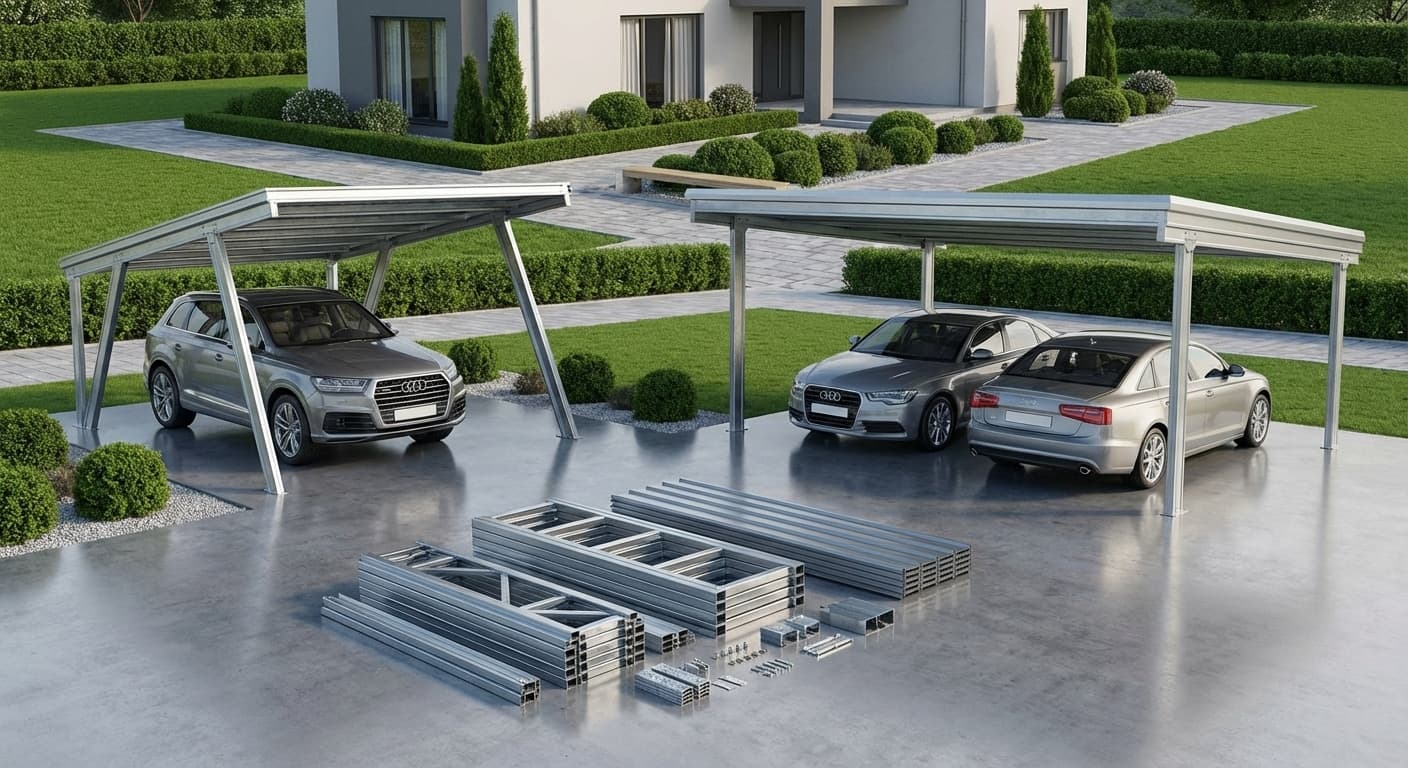

Carport kits give you garage-level protection for a fraction of the cost–prefabricated, DIY-friendly steel systems that assemble in a weekend and last 50-75 years with almost zero maintenance. This guide steers you past the hype and hidden fees by mapping the best places to buy (direct from VersaTube or Mueller for wholesale pricing, vetted online marketplaces for customization, big-box stores for speed, or bulk suppliers for multi-unit savings), explains why 2025 pricing swings from $3,000 to $10,000 based on roof style, certifications, and ZIP-code-specific wind and snow loads, and shows how to time fall and winter purchases for 25-40% savings while locking in engineer-stamped drawings, warranties, and financing as low as $30/month. You'll learn to compare frame gauge, anchoring, and coatings instead of chasing the lowest sticker price, budget an extra 20-40% for permits, site prep, and delivery access, and decide when DIY truly saves money versus hiring pros who warranty their work. Follow the seasonal buying calendar, insist on certified plans up front, and you'll land a carport that survives local codes, extreme weather, and decades of use–without costly do-overs or surprise charges.
Understanding Carport Kits and Current Market Trends
Steel carport kits ship complete with all hardware and fasteners, assemble quickly, and require only occasional washing versus the constant maintenance wood demands.
Defining carport kits for sale and their core components
You need vehicle protection without garage construction costs. That's what carport kits deliver–prefabricated structures that ship complete and assemble fast [1]. Every kit includes the essentials: posts, beams, roof framing, panels, plus all hardware and fasteners [1][2]. No scrambling for missing parts, no guesswork on what fits where.
Your standard kit gives you a sturdy framework supporting the roof while keeping sides open for easy access [1]. Want more protection? Add endwalls or commercial ridge vents [2]. Steel dominates the market for good reason–it resists pests, fire, and mold while lasting decades [1]. Premium options like Galvalume Plus(TM) Steel push corrosion resistance even further [1].
These aren't just parking spots. You get workshops, equipment storage, covered work areas–whatever your operation needs [1]. The flexibility pays for itself when you realize one structure handles multiple jobs.
Advantages of metal building kits for modern carports
Your vehicles face constant assault–UV rays fading paint, rain causing rust, hail leaving dents. Metal carports stop that damage cold [5]. Wood rots, attracts termites, needs constant maintenance. Steel? Just occasional washing. That's it [5].
You're looking at real savings here. Initial cost runs a fraction of garage construction. No annual painting bills. No pest control contracts. The math is simple–steel pays for itself [5]. DIY-friendly kits mean you skip installation labor costs too. Everything ships with clear instructions and proper hardware [5].
Don't limit your thinking to vehicle storage. You need flexible space that adapts–today's equipment shelter becomes tomorrow's workshop [5]. Add side panels when you need wind protection. Install doors for security. Build it your way with
Latest material innovations and protective coatings in 2025
Today's protective coatings change the game. Galvanized and galvalume steel now come standard–your structure shrugs off corrosion no matter what weather throws at it [6].
Here's what's interesting: red oxide primer is back. That rust-inhibiting coating you see on steel framing? It's become a design feature. Industrial-chic builds leave it exposed on purpose–protection meets aesthetics [6].
Beyond basics, you get powder-coated finishes that won't fade, chip, or surrender to environmental damage [6]. These aren't minor improvements. You're looking at 50-75 years of service life with basic maintenance. Wood structures? Lucky to hit 20-35 years [6].
The Steel Construction Institute backs this up–properly coated structural steel can last 100+ years in optimal conditions [6]. That's not marketing talk. That's engineering fact.
Popular styles, sizes, and customization options today
Your location determines your roof choice. A-frame designs shed water fast–perfect for rainy regions [7]. Vertical roofs go further, with panels running top to bottom for maximum drainage. Heavy snow areas? Vertical is your answer [7]. Want residential appeal? Boxed eave designs deliver horizontal panels with clean lines [7].
Size flexibility keeps you covered. Width options run 10' to 40'. Heights range 7.5' to 15.5'. Single car to multi-vehicle storage–we build what fits [8]. Standard frames use 2" x 3" galvanized steel tubing. Tough weather demands 2" x 4" frames [8]. Snow loads over 45 psf? You need reinforced vertical panel designs [8].
Start basic, add what you need. Side panels block wind. End panels and doors secure equipment. Frame spacing (4' or 5' on center) adapts to snow load requirements [8]. Your carport becomes whatever you need–workshop today, storage tomorrow, covered gathering space next weekend [8].
Need to relocate? Portable designs move with you. Want maximum protection? Fully enclosed models with insulated panels control your climate [7][8]. The right configuration solves your specific challenge.
Where to Find Reliable Carport Kits for Sale
Buy directly from manufacturers like VersaTube and Mueller to eliminate middleman markups while choosing between DIY kits starting at $1,680 or full professional installation.
Direct manufacturer portals such as VersaTube, Mueller, and Eagle CarportsPurchasing carport kits directly from manufacturers cuts your costs by eliminating middleman markups. You'll find two distinct approaches in the market: DIY-focused suppliers offering pre-drilled kits with assembly instructions, and full-service manufacturers providing turnkey installation. DIY kits typically start around $1,680 for single-car units and $2,166 for two-car models, with standard shipping in 5 business days [9]. Professional installation services handle everything from delivery through final assembly–ideal when you want the job done right without lifting a hammer [10].
The smartest choice? Work with a single-source manufacturer that offers both options. You get the flexibility to choose DIY savings or professional installation based on your project needs. Multiple manufacturing facilities across the country mean faster delivery to your site [10]. Direct manufacturer relationships deliver personalized support, customization options, and quality assurance that third-party brokers simply can't match [11]. Your manufacturer becomes your partner, accommodating specific design requirements and providing expert guidance on materials and specifications [11]. That's the difference between buying a kit and building a solution.
Specialized online marketplaces and DIY retailers
Specialized online marketplaces promise convenience, with DIY kits starting as low as $1,295 including delivery [12]. You'll find 3D builder tools for customizing size, roof style, and color–helpful for visualizing your project before purchase [12]. These platforms emphasize pre-cut parts and hardware engineered to meet state building codes [13]. Heavy-gauge steel components deliver the durability you need, far exceeding aluminum alternatives or temporary structures [13].
Most online retailers ship throughout the contiguous United States, with some offering local pickup from distribution hubs for faster delivery [13]. Watch for hybrid approaches–modular systems that promise professional installation in about an hour while maintaining DIY pricing [14]. Here's the catch: assembly instructions vary wildly in quality, and critical items often hide behind extra fees. Some vendors exclude structural plans from base pricing, charging $250 or more for preliminary drawings that still won't satisfy your permit office [13].
When comparing online options, dig deeper than the advertised price. What's actually included? Installation services, delivery costs, engineering plans, permit-ready documentation–these "extras" transform a bargain into a budget-buster [14]. The lowest price rarely delivers the best value when you factor in everything needed to complete your project.
Big‑box home improvement stores and regional distributors
Big-box retailers provide convenient access to carport kits through manufacturer partnerships. These mass merchants source framing systems from manufacturers while often supplying their own sheet metal and trim components–a hybrid approach that can complicate quality control [15]. The retail channel has grown particularly popular as DIY projects surged in recent years [15]. Strategic manufacturing facilities positioned near major distribution centers improve delivery times for these retail partnerships [15].
You'll find DIY-friendly designs at these stores, typically ranging from 10' to 30' wide. Anything larger becomes too heavy for manual installation without specialized equipment–a limitation that matters when planning bigger projects [15]. The advantage? You can physically inspect products before purchase and tap into existing contractor networks these stores maintain. The downside? Product selection remains limited compared to specialized suppliers, focusing primarily on single and double carports that represent the highest consumer demand [15]. For anything beyond basic needs, you'll quickly outgrow what's on the shelf.
Wholesale, bulk, and custom order options for large projects
For contractors, developers, or property managers handling multiple sites, bulk purchasing delivers substantial savings. National suppliers leverage purchasing volume to secure wholesale pricing that benefits large-scale buyers [16]. These economies of scale typically slash 10-30% off individual unit costs. You'll see tiered pricing structures where costs drop as quantities increase–the more you buy, the more you save.
Most manufacturers accommodate custom dimensions for commercial applications, producing structures up to 70 feet wide for industrial-scale needs [17]. Complex projects demand more than just materials–you need a supplier with nationwide contractor networks who can coordinate synchronized installation across multiple locations [16]. The right partner offers both turnkey and DIY options, giving you flexibility to manage assembly internally or outsource based on each project's requirements [16].
Smart financing programs designed for commercial quantities help manage cash flow. Some suppliers provide rent-to-own arrangements that make large orders feasible without straining budgets [17]. When evaluating wholesale options, look beyond unit pricing. Delivery logistics become critical when coordinating materials for simultaneous installations across different sites. Your supplier should handle the complexity while you focus on project completion. Consider
Evaluating Price, Value, and Financing in 2025
Your metal carport will cost $3,000 to $10,000 depending on size, roof style, location, and local building codes that may require certified engineering.
Current price ranges by size, style, and steel gauge
Your metal carport investment in 2025 will range from $3,000 to $10,000, depending on what you need [4]. Single-car structures start around $3,000. Double and triple carports cost more–you're paying for additional materials and stronger framing [5].
Roof style drives your price point. Standard horizontal panels give you basic protection at the lowest cost. A-frame and boxed eave styles cost slightly more but look sharper. Vertical roofs command premium pricing because they shed water and snow better–worth every penny if you live where weather hits hard [5].
Your location affects pricing too. City installations run 5-15% higher than rural ones due to tougher codes and higher labor costs [5]. RV-height carports need beefier supports, adding 15-30% to standard pricing [4].
Want to customize? Side panels, gable ends, or heavy-duty anchors each add $300-$1,500. Smart buyers focus on what actually protects their investment–proper drainage, certified ratings for their area, and materials that match local weather patterns [4].
Cost drivers: coating, wind/snow ratings, and geographic factors
Your ZIP code controls more of your carport cost than you might think. Three factors drive pricing beyond size: protective coatings, wind/snow ratings, and where you live.
Building codes vary wildly–even within the same state. Coastal areas need hurricane-rated structures. Mountain regions require heavy snow loads. Open farmland faces different wind exposure than downtown lots [18]. When your county mandates certified ratings, you'll pay 15-30% more for upgraded bracing and heavier frames [18].
Here's what those certifications mean for your budget: Engineers calculate wind resistance using ASCE 7 standards–factoring your site's exposure, building height, and local wind maps [19]. Snow load math converts ground accumulation into roof strength requirements. You need both calculations right, or you won't get a permit [19].
The certified versus non-certified choice matters. Certified buildings cost more upfront but come with engineer-stamped drawings your building department requires. Skip certification in areas that need it, and you can't legally install your carport [19]. Urban installations typically cost 5-15% more than rural ones–stricter codes plus higher labor rates [18].
Even delivery affects your bottom line. Hard-to-reach properties or long hauls from manufacturing facilities add transportation costs.
Hidden expenses including shipping, foundation, permits, and taxes
That advertised price? It's just the beginning. Most quotes cover steel and basic installation–nothing else. Budget an extra 20-40% for the real cost of getting your carport up and running [20]. Permits: $75-$500, depending on your location and structure size. Areas requiring certified ratings push permit costs higher [20][21]. Skip the permit to save money? Bad idea. Fines and forced removal cost far more than doing it right [22].
Site prep: Your biggest variable expense. Level ground saves money. Slopes need grading. Existing structures need removal. Concrete pads aren't included in standard quotes. Even a minor slope turns simple installation into an expensive project [20].
Delivery surprises: Distance matters, but access kills budgets faster. Narrow gates, steep driveways, or soft ground mean special equipment and extra labor charges. Tell your supplier about access challenges upfront [20].
Ongoing costs you'll face:
- Property tax increases when municipalities reassess
- Higher insurance premiums to cover your new structure
- Sales tax (where applicable)
- Debris removal and site cleanup [21]
Smart buyers get complete project quotes that include everything–not just the steel. National buying power helps control these costs when you work with the right partner.
Financing options, rebates, seasonal promotions, and price‑match tools
You don't need $10,000 cash to protect your vehicles today. Smart financing turns large purchases into manageable monthly payments.
Rent-to-own programs start as low as $30 monthly for smaller structures–no credit check required [23]. Payment processors like PayPal, Klarna, Acima, and Viabill offer flexible terms that match your budget [23]. You get immediate protection while paying at your pace.
Price matching saves money when you shop smart. Many dealers match identical quotes–same specs, same certification, same materials [24]. Use this leverage, but compare apples to apples. That cheaper quote might exclude critical features you need.
Pre-qualification takes 30 seconds. No hard credit pulls. No commitment. You'll know your options before making decisions [24]. Focus on total cost, not just monthly payments–low payments over long terms cost more.
Seasonal opportunities pop up during slow construction months. While the industry rarely offers permanent sales, watch for flash deals and limited-time promotions [23]. The best deals combine fair base pricing with transparent total costs.
Remember: the lowest monthly payment isn't always the best deal. Calculate total interest. Check early payoff options. Understand what happens if you miss payments. Smart financing protects your investment without straining your budget.
Ensuring Quality, Compliance, and Service Excellence
Get your local building department's requirements before purchasing, since you cannot upgrade certification after installation and code violations cost far more than proper planning upfront.
Key material specs, wind and snow load ratings, and building code compliance
Your carport must meet local building codes–period. No shortcuts, no surprises. Construction documents need the right numbers: roof snow loads, wind design data, exposure categories [25]. You'll find standard snow ratings from 30-60 PSF work for most areas. Need more? Certified options handle up to 90 PSF for heavy snow regions [26].
Here's what matters: get your anchoring right the first time. You can't upgrade certification after installation [26]. Your steel gauge determines whether you pass or fail code requirements. Skip the guesswork–call your local building department before buying. They'll tell you exactly what you need [26].
Yes, certified structures with engineer-stamped drawings cost more. But that extra investment beats code violations, fines, or tearing down your carport [26]. When you choose
Warranty coverage, after‑sales support, and service guarantees
Warranties tell you who stands behind their work–and for how long. Most suppliers cover painted sheet metal for 20 years against peeling, cracking, and blistering. The catch? You need to clear debris and clean twice yearly [27][28].
Watch the fine print on workmanship guarantees. Many last just 90 days–barely enough time to spot problems [28][29]. Frame coverage varies: standard frames get basic protection, while 12-gauge tubing often includes 20-year rust-through warranties [27].
Know what voids your coverage:
- Making unauthorized changes
- Weather damage (even severe storms)
- Wrong roof style for your building length [28][29]
Some manufacturers exclude regular roofs over 31 feet from full warranty protection. You'll need vertical roofs for longer structures [29].
After-sales support ranges from phone help to full modification services. Good vendors let you add panels later for a reasonable trip charge [28]. Always confirm if engineering documents come standard or cost extra–you'll need them for warranty claims and permits [27].
Verifying vendor reputation through reviews, certifications, and references
Smart buyers verify before they buy. Start with your state's contractor board–legitimate vendors have active licenses and liability insurance [30]. That insurance protects you when things go wrong.
Read reviews for the real story. Skip the stars–look for specifics about durability, weather performance, and problem resolution [31]. Pay attention to how vendors handle complaints. That tells you more than any five-star rating [31].
Get local references. You want projects in your area, not three states away. Ask direct questions:
Red flags that scream "run away":
- Wire transfer or crypto payment demands
- Prices way below market
- "Today only" pressure tactics [30]
For metal carports, confirm they provide engineer-stamped drawings. Discount suppliers often skip these to cut costs–leaving you stuck at permit time [30]. Check for industry associations and steel certifications. These memberships mean quality standards [31].
One final check: physical address and working phone number. Scammers use temporary contacts before vanishing with deposits [30].
Problem‑solving common issues and proactive maintenance strategies
Problems creep up slowly–catch them early and save thousands. Each season brings its own challenges. Spring means birds and wasps. Stop them with bird netting or methyl anthranilate spray. Winter? Clear that snow before it overloads your structure [32].
Your maintenance checklist:
- Inspect for leaks twice yearly and after storms
- Fix weak spots immediately–water causes rot [34]
- Clean with mild detergent only (harsh chemicals wreck coatings)
- Touch up scratches with zinc-rich paint before rust starts [33]
- Check anchors monthly–especially after wind events
- Fill foundation cracks fast–they grow quickly [33][34]
Set a simple rhythm: rinse weekly (more near salt water), check hardware monthly, deep clean each season [33].
The five mistakes that cost you big:
- Using harsh cleaners that strip finishes
- Ignoring gutters and drainage
- Mixing different metals (causes corrosion)
- Letting anchors loosen
- Pressure washing too hard–forces water under seams [33]
Small fixes today prevent major repairs tomorrow. Stay ahead of problems, and your carport stays strong for decades.
Smart Purchasing Strategies and Next Steps
Buy your carport in fall or winter to capture 25-40% savings as suppliers clear inventory rather than store bulky structures.
Timing purchases with seasonal sales and clearance events
You can save 25-40% on your carport investment by understanding seasonal pricing cycles. Fall delivers the best deals–prices drop 25-30% by October as suppliers clear inventory [35]. Winter pushes savings even deeper, with 30-40% off as demand bottoms out [35]. Spring? That's when prices climb with project season demand [35]. Summer holds steady with occasional delivery promotions [35].
Smart buyers also target holiday sales. Memorial Day and Independence Day knock 15-20% off outdoor structures [35]. Labor Day kicks off serious fall clearance [35]. Black Friday and year-end events bring the steepest cuts–suppliers need space for new models [35].
Here's what most buyers miss: summer's higher prices come with advantages. Construction-friendly weather means faster installation. Peak production creates better inventory selection. You'll pay more upfront but finish before fall storms arrive [36]. Plus, when manufacturers overproduce, you might catch unexpected discounts [36].
Why such dramatic price swings? Simple warehouse economics. Carports eat space. When inventory transitions hit, suppliers slash prices up to 70% rather than store bulky structures [37]. You're not buying damaged goods–you're capitalizing on logistics reality [37].
Using comparison tools and negotiating bulk discounts
Skip the surface comparisons. Google search data shows everyone shops spring and summer–that's when suppliers compete hardest for your business [38]. Use that knowledge. But here's what matters more than timing: comparing the right specs.
Stop obsessing over panel gauge. Your frame does the real work. Posts, trusses, spacing–that's where strength lives [39]. Height clearance trips up more buyers than any other spec. The number on paper isn't your usable space–check the lowest point at trusses or headers [39].
Buying multiple units? You hold the cards. North America drives 40% of global demand, creating fierce supplier competition [38]. December through February? That's your sweet spot. Manufacturers need to move inventory [38].
Location matters too. Washington, Montana, Idaho, California–extreme weather states see highest demand and tightest inventory [38]. If you're elsewhere, use that leverage.
Think beyond parking when comparing options. That 12×20 carport serves as workshop, storage, gathering space. The right configuration multiplies your investment value [40]. HOAs, property managers, multi-site businesses–standardized sizing creates bulk pricing power [40].
DIY assembly vs professional installation cost‑benefit analysis
DIY saves 10-20% upfront. That's the hook. Here's the reality: first-timers take 3-5 times longer than pros [41]. At $38.75/hour (median household income), your "savings" vanish [41]. The real DIY cost breakdown:
- 35-50 hours over 5-7 days
- 2-3 helpers ($300-$600)
- Tools ($300-$800)
- 15-25% material waste
- Permit fees ($100-$500)
- Potential rework [42]
Professional installation runs $1,500-$5,000 extra but delivers what matters: warranty protection, code compliance, and completion in hours–not weeks [42][21]. Complex sites, strict building codes, severe weather zones? Professional expertise prevents expensive mistakes [21].
Our
Checklist for selecting, quoting, ordering, and safe installation
Your carport success starts with preparation. Here's your action list: Pre-Purchase
- Measure every vehicle–add clearance for doors and movement
- Check tallest vehicle height for leg selection [43]
- Verify local codes and HOA rules (non-compliance means teardown) [43]
- Choose 12-gauge steel for extreme weather zones [43]
Quote Comparison
- Base price plus delivery (10 days to 8 weeks typical)
- Shipping, tax, installation fees
- Vendor certification and reviews [43][2]
Site Preparation
- Level ground completely
- Complete foundation before delivery
- Clear truck access and staging area [43]
Anchoring (match to your base)
Installation Day
- Tools ready, 2-3 helpers on standby (DIY only)
- High-wind concrete anchors for permanent installation [44]
- Post-install inspection–every connection, every anchor [44]
Skip one step, pay for it later. Weather doesn't forgive loose anchors or code violations. Get it right the first time.
- Steel carport kits last 50-75 years vs. 20-35 for wood and cost far less than garage builds.
- Certified engineered drawings add 15-30% but are mandatory for permits in snow or wind zones.
- Fall-winter pricing drops 25-40%, while spring demand pushes costs back up.
- DIY saves 10-20% upfront yet can take 35-50 hrs vs. pro install in one day.
- Total project cost adds 20-40% for permits, site prep, delivery and anchoring.
- 12-gauge steel and vertical roofs are required for snow loads over 45 psf or spans 31 ft+.
- Warranty coverage (20 yr panels, 90 day labor) is void if modifications or wrong roof style are used.
- https://futurebuildings.com/blog/a-complete-guide-to-diy-steel-carport-kits.html
- https://www.muellerinc.com/b/the-step-by-step-guide-to-carport-kits
- https://futurebuildings.com/blog/carports-metal-carport-kits.html
- https://www.abettercarport.com/blog/metal-carport-prices-factors-2025
- https://www.eaglecarports.com/blog/metal-carport-prices
- https://www.carportcentral.com/blog/why-steel-buildings-outlast-everything-a-deep-dive-into-strength-spans-and-smart-construction?srsltid=AfmBOoqsyjWGR7thIDmbHf1M_SjhAWBzIHCZMyBzuWEurwvYxjcw08Sr
- https://www.metalbuildingoutfitters.com/top-5-durable-metal-carport-designs-to-consider/
- https://www.absoluterv.com/carport-kits/styles/
- https://thecarportco.com/buyers-guide/versatube/?srsltid=AfmBOop_XTqx0WiqRcqKs1Jb09AGb03e2u9Su3n3qawpbFvk3lw2ySS9
- https://www.eaglecarports.com/blog/eagle-carports-vs-versatube
- https://www.tylerbuilding.com/post/why-buy-direct-from-a-metal-building-manufacturer
- https://alansfactoryoutlet.com/carport-plans/?srsltid=AfmBOorRmtF4o8F58bo0ZR3zjXw0XHhss7KKWsqx6oF34-6Nf14R1YKm
- https://metalcarport.com/home/
- https://admin.metalcarportsdirect.com/metal-carport-kits
- https://garageshedcarportbuilder.com/shed-builders-may-see-steel-carport-kits-as-an-opportunity/
- https://www.carportsrus.com/
- https://www.americanmetalbuildings.com/metal-carport-kits/?srsltid=AfmBOor-zJVlzxLToNbshXozs71oaE9K1h7gnFfirmv71Dj2ZF-B5Tfl
- https://www.aametalbuildings.com/blog/how-much-does-a-metal-carport-cost-in-2025-prices-by-size-what-really-changes-the-quote?srsltid=AfmBOoo-g9TLFIgTvbXMsMjfgJMLXuJD_uNOXuqT7h6dPVUpLf7iQ_nd
- https://www.getcarports.com/wind-and-snow-load-ratings-for-metal-buildings?srsltid=AfmBOooj_0Z1uuBD1eWNnG39yqcntgwtUODs0jolSGtByCuObl_xZsxV
- https://www.aametalbuildings.com/blog/how-much-does-a-metal-carport-cost-in-2025-prices-by-size-what-really-changes-the-quote?srsltid=AfmBOoqaLYmuq9IvM06I8ex5502vRZN1RQZWGMH81n_5_HpBp6mfLJGU
- https://www.angi.com/articles/metal-carport-installation-cost.htm
- https://alansfactoryoutlet.com/blog/cost-to-build-a-carport/?srsltid=AfmBOoofssc2I1po0q8xopgpq7-AxSRrR2YS8QmPhHRRYlVkumwovd0l
- https://www.shopabunda.com/collections/carport-financing?page=2
- https://www.carportcentral.com/washington-carports-wa?srsltid=AfmBOoplXoVXWILqUCfk8Wt7qKmymVQOx_UthRUIYun34AiYtqiiIDbd
- https://up.codes/viewer/new_york/ibc-2024/chapter/16/structural-design
- https://dreamscarports.com/wind-snow
- https://alansfactoryoutlet.com/product/12×25-regular-style-carport-florida/?srsltid=AfmBOopyXynmnhlCYJFM7-H-2URC2JF7-uuZBopCNk5eurY6gBXss79P
- https://www.gaport.com/carports.htm
- https://www.eaglecarports.com/about/warranties
- https://oregoncarports.com/carport-buying-mistakes/
- https://www.eaglecarports.com/blog/top-qualities-to-look-for-in-metal-building-suppliers
- https://prometalbuildings.com/the-ultimate-guide-to-metal-carport-maintenance/?srsltid=AfmBOopM4PHuA8yrYPW4cxu5gVCi2NoVMzn68ah9gFcMvsONPwgxjco7
- https://metalprobuildings.com/metal-carport-maintenance-tips/
- https://abccarport.com/2023/11/common-carport-repairs-extending-the-life-of-your-structure/
- https://aecojoy.store/blogs/helpful-tips/best-time-to-buy-a-storage-shed?srsltid=AfmBOopOkmjPfpY1muMA-9Okst08r0ojLiCskbgm9GG2EQvU51W-zYeH
- https://futurebuildings.com/blog/summer-deals-on-steel-buildings-cloned.html
- https://sunjoyshop.com/blogs/news/outdoor-coverage-made-affordable-carports-gazebos-up-to-70-off?srsltid=AfmBOorBD6DvCoxUHtVQc2AEYS5m3ooxll1ikMlqiZ_bgv1-z-8tx1Ie
- https://www.accio.com/business/metal-carport-trends
- https://www.aametalbuildings.com/blog/metal-carports-the-complete-2025-buyers-guide?srsltid=AfmBOoqzcxqOPEFcyazQiaokEC1h9rKoDAABVyWdsVj44MJOJs8O62Kr
- https://sunjoyshop.com/blogs/news/ultimate-guide-to-choosing-the-best-carports-for-2025?srsltid=AfmBOop8tqS8dDlkS32nkaYK-5NCdutWQFbLNLgGK9P1pQZz5RXpTM6d
- https://keensbuildings.com/diy-vs-professional-carport-installation-cost-comparison/?srsltid=AfmBOorH55emZMEbKcBBpk7kwi0NLWZm-ePfAJNUmoWU4EPT7cpX0eN_
- https://oregoncarports.com/build-vs-buy-carport-oregon-guide/
- https://www.vikingmetalgarages.com/blog/checklist-before-buying-a-perfect-metal-carport-structure
- https://futurebuildings.com/blog/guide-to-installing-a-metal-carport-kits-2.html