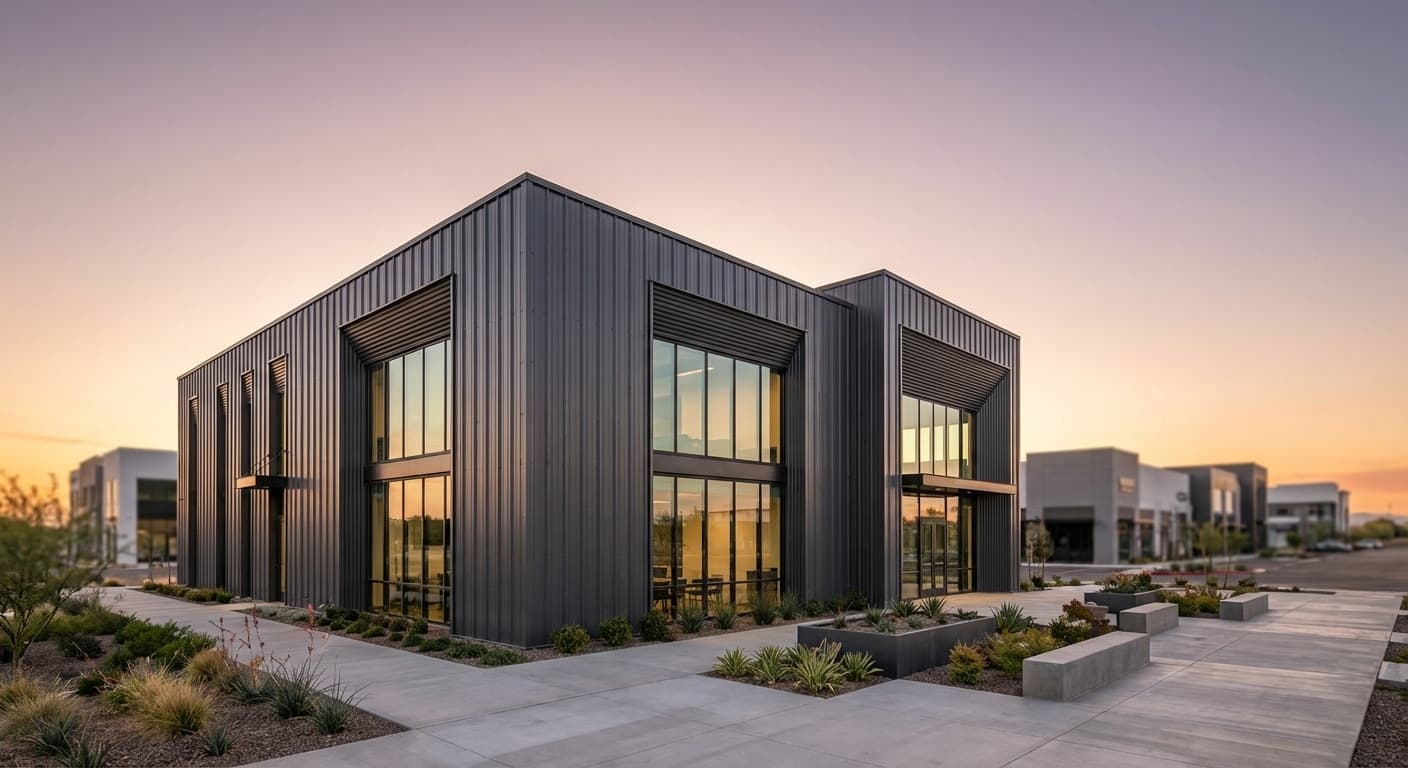

Charcoal gray has become the go-to finish for metal buildings because it delivers a timeless, professional look that flatters any setting–warehouses, barns, offices, even barndominiums–while hiding dirt, cutting maintenance by half, and slashing cooling costs 7-15% with modern reflective coatings. Readers will learn how this single neutral shade pairs with glass, wood, or concrete to create high-contrast or monochromatic façades that still look current decades later, how factory-applied 40-year warrantied finishes eliminate repainting, and how the color's subtle heat reflection and 90% recyclable steel help earn LEED points and meet net-zero goals. The article walks through real-world cost data–$24-$43 per square foot installed, 30% faster erection saving up to $75k in interest on a $5M job–and shows how charcoal gray's universal market appeal (11.9% annual growth) protects resale value better than trendy hues. From selecting the right gauge, texture, and cool-paint formulation to integrating smart-building tech and solar-ready insulation, readers discover why choosing charcoal gray is the smartest, lowest-risk way to balance curb appeal, energy performance, and long-term ROI.
The Growing Appeal of Charcoal Gray in Modern Metal Architecture
Charcoal gray metal buildings blend seamlessly with their surroundings while keeping your architectural details sharp and professional for decades without trendy color regret.
Historical shift from traditional colors to charcoal gray
Your metal building doesn't have to look like it came from 1960. Back then, you got what you got–basic colors, zero flexibility. Pre-engineered metal buildings were purely functional, with finishes that screamed "warehouse" [1].
Everything changed when computer-aided design hit the industry in the mid-1970s. Suddenly, manufacturers could deliver custom solutions instead of generic boxes [2]. The color revolution followed. Those harsh black-and-white contrasts? Gone.
"Color schemes now have less contrast, looking more natural with hues less stark against the landscape," notes Brynn Wildenauer of Sherwin-Williams [3].
You're seeing this shift everywhere–commercial properties, agricultural facilities, even residential projects. Charcoal gray leads the pack because it works. It blends with your surroundings while still looking sharp and professional [3]. No wonder it's become the go-to choice for owners who want contemporary style without the maintenance headaches of trendy colors.
Current design trends that favor neutral tones
Why are charcoal gray metal buildings popular? Design motivationsWhy do so many owners choose charcoal gray? It works harder than any other color.
This neutral shade doesn't shout–it enhances. Your architectural features pop against the sophisticated backdrop. Your trim, doors, and windows become design elements instead of afterthoughts [7].
The versatility pays off in every setting:
- Contemporary commercial buildings? Check.
- Traditional agricultural structures? Perfect fit.
- Mixed residential-commercial projects? Seamless blend [8].
While trendy colors date your building in five years, charcoal gray stays relevant decade after decade [7]. You can go rustic with traditional elements or ultra-modern with clean lines–same color, completely different look [7].
The real magic happens when you mix materials. Charcoal gray metal plays well with everything–wood accents, stone facades, glass entrances. As discussed in the Design Versatility section, these combinations create architectural statements that command attention.
Today's metal buildings deliver the aesthetic flexibility you need. No more choosing between good looks and practical performance [9]. With charcoal gray, you get both–a color that enhances your design vision while standing up to real-world demands [8].
Branding advantages of a sleek gray façade
Your building is your brand's first impression. Make it count with charcoal gray.
This sophisticated neutral transforms your signage and logos into focal points. Against the muted backdrop, your company colors pop–no visual competition, just clean brand presentation [10]. When you choose charcoal gray for your
Performance Benefits that Make Charcoal Gray the Smart Choice
Charcoal gray roofing delivers 7-15% cooling cost savings while maintaining a professional appearance that resists visible aging better than lighter or darker alternatives.
Heat reflection properties and energy savings
Let's be honest–charcoal gray isn't the coolest color under the sun. Lighter shades like ash gray or dove gray reflect more heat and can cut your cooling costs more dramatically [12]. But here's what matters: charcoal gray still delivers solid energy performance when you factor in the whole picture. You're looking at 7-15% savings on cooling costs with properly coated metal roofing, regardless of the specific gray you choose [12].
Your location drives the real decision. In Phoenix or Houston, lighter colors make more sense for maximum efficiency [13]. But in moderate climates, the difference shrinks considerably. Want the charcoal look without compromising efficiency? You've got options. Specialized cool paint formulations give you that sophisticated charcoal appearance while reflecting more heat than standard dark colors [13]. These advanced coatings can qualify your building for LEED points and potential tax breaks–money back in your pocket while keeping energy bills down [14].
The bottom line: charcoal gray balances professional aesthetics with reasonable energy performance. You're not getting maximum efficiency, but you're getting a building that looks sharp year-round while still cutting operational costs compared to traditional construction.
UV resistance and long‑lasting color integrity
Your charcoal gray building will look just as professional in year 20 as it does on day one. That's the power of modern coating technology working for you. Today's premium finishes–whether SMP WeatherXL(TM) or Fluropon 70% PVDF–lock in that sophisticated charcoal appearance through decades of sun, rain, and weather [15].
Here's why charcoal gray beats other colors for long-term value: it ages gracefully. Light colors show dirt and discoloration. Dark blacks fade to uneven patches. But charcoal gray? It maintains its appearance with minimal visible change, keeping your building looking sharp without constant attention [16].
The numbers back this up. Most quality manufacturers warranty their charcoal gray finishes for up to 40 years–they're that confident in the color's staying power [17]. That warranty translates directly to your bottom line: fewer repaints, consistent curb appeal, and a building that represents your business professionally for decades. (For more on long-term durability benefits, see our sustainability discussion below.)
Ease of maintenance and dirt concealment
Here's a maintenance secret that saves you thousands: charcoal gray hides dirt better than any other color. While your neighbor's white building needs pressure washing every season, your charcoal gray structure looks professional month after month [7]. That means fewer service calls, lower maintenance budgets, and more time focusing on your business instead of building upkeep.
The smooth metal surface gives you another advantage–no moss, no algae, no mildew taking hold like they do on wood or stucco [18]. When you do need to clean (maybe once a year), it's simple: mild soap, warm water, and a soft brush or gentle pressure wash. That's it [19]. No special chemicals, no expensive treatments, no weekend warrior maintenance marathons.
Quick tip: Walk your building quarterly to spot any issues early–scratches, loose fasteners, or dings. These five-minute checks prevent small problems from becoming big expenses [7]. But compared to traditional buildings that need constant painting, sealing, and repairs? You're saving serious time and money every year.
Compatibility with advanced insulation systems
Your charcoal gray building works perfectly with any insulation system you choose–and that flexibility saves you money. Start with basic fiberglass batts for budget-friendly R-values, or upgrade to Banded Liner Systems that eliminate thermal bridging and slash energy costs even further [20]. The beauty of charcoal gray? It doesn't fight your insulation choices or create special challenges like extreme colors do.
Metal buildings need smart insulation to control condensation and maintain comfortable temperatures [21].
Design Versatility: How Charcoal Gray Enhances Aesthetics
Charcoal gray delivers professional aesthetics across warehouses, agricultural buildings, and mixed-use developments while maintaining energy efficiency and requiring no costly repaints as you expand.
Modern, industrial aesthetic for commercial and agricultural projects
As discussed in the design motivations above, charcoal gray creates the perfect industrial look for your commercial or agricultural project. You get professional aesthetics without the premium price tag. In warehouses and factories, this color means business–clean, modern, and built to last [7].
For 2025, high-contrast designs lead the way. Picture charcoal walls with white trim–sharp, professional, impossible to ignore [4]. Agricultural projects benefit too. Take that 40 x 60 pole barn with charcoal siding and ash gray roof–you save on cooling costs while your building looks like it means business [7].
Monochromatic steel gray schemes work across the board. Corporate clients want it. Residential developers love it. You get one color palette that satisfies everyone without endless design meetings [4]. Add white trim for contrast or keep it simple with textured finishes. Either way, you maintain clean lines that won't look dated in five years [7].
Mixed-use developments? Charcoal gray ties everything together. One consistent look across all your buildings–no costly repaints when you expand.
Seamless pairing with glass, wood, and concrete elements
Your charcoal gray building looks even better when you pair it with glass, wood, or concrete. These combinations work–and they work within budget.
Glass against charcoal metal creates instant impact. Floor-to-ceiling windows pop against the dark background while flooding your space with natural light [23]. You maintain energy efficiency while getting that modern, open feel clients expect. The metal framework handles those large glass expanses without structural compromises [23].
Wood warms up charcoal's industrial edge. Vertical wood cladding breaks up metal panels, adding texture without breaking the bank [25]. The combination stays attractive even as wood weathers naturally–no constant maintenance required [25].
Concrete foundations and accent walls complement charcoal perfectly. You get durability plus sophisticated contrast [23]. Each material does what it does best–metal for structure, concrete for mass, working together to cut overall costs.
Look at successful projects like the Burke Museum in Seattle–glass, wood, and metal working together [25]. That's not accident. It's smart design that maximizes your investment.
Custom finishes, textures, and accent options
You control exactly how your charcoal gray building looks. Pick your metal profile–different rib heights and spacing change the whole appearance without changing your budget [17].
Skip smooth paint. Textured finishes that look like wood grain or brushed metal cost slightly more but deliver major visual impact [4]. Choose between standard 26-gauge and premium 29-gauge panels. The thicker option adds durability and creates subtle visual differences your customers will notice [17].
Smart color combinations multiply your options:
- White trim on charcoal = instant definition
- Bronze accents = sophisticated earth tones
- Light gray walls with charcoal trim = balanced, timeless look [4]
Add gabled porches or vary your panel orientation. Small changes, big impact [26]. For 2025, monochromatic schemes using deep blacks and steel grays dominate both residential and commercial projects. One color family, multiple tones–simple to specify, impressive to see [4].
Your
Boosting curb appeal and property value
Your property value starts climbing the moment your charcoal gray building goes up. This isn't about trends–it's about lasting appeal that buyers recognize [7].
Charcoal gray makes buildings look taller, more substantial. Dark roofs draw eyes upward. Your trim, windows, and entrance pop against the neutral background [28]. Choose white trim for maximum contrast or light gray siding for subtle sophistication. Both combinations boost curb appeal without boosting costs [7].
Modern buyers see charcoal metal with glass accents and think "premium property." You invested in quality, and it shows [28]. But here's the real value: charcoal gray looks good longer. The color hides dirt and weather marks between cleanings. Less maintenance means lower operating costs–buyers calculate that into their offers [27].
Unlike trendy colors that scream "2020s building," charcoal gray stays timeless. Your building looks current today and will still look professional in 2045 [27]. That's the kind of long-term thinking that protects property values.
Sustainability and Environmental Impact of Charcoal Gray Buildings
Charcoal gray steel buildings recycle at rates up to 90% without losing strength, stay 22 degrees cooler than traditional dark roofs, and earn LEED points through resource conservation.
Recyclable steel and low‑VOC coating benefits
Your charcoal gray metal building starts green and stays green. Steel recycles at rates up to 90% in developed countries–and it never loses strength, no matter how many times it's recycled [31].
That's a major advantage over materials that degrade with each recycling cycle [29]. Today's
Reduced urban heat island effect compared with darker hues
Your charcoal gray building helps keep neighborhoods cooler. While not as reflective as white, charcoal gray strikes a smart balance–you get the professional look you want without the extreme heat absorption of black or deep brown [32].
The numbers tell the story: A properly finished charcoal gray roof stays about 22 degreesF cooler than traditional dark roofs on a summer afternoon [33]. That temperature difference matters. Your building releases less heat into the surrounding area, and when multiple buildings choose charcoal gray over darker colors, entire neighborhoods stay cooler [32].
Here's what makes it work: Advanced charcoal gray finishes reflect invisible near-infrared light while maintaining their attractive dark appearance [33]. You get better thermal performance than the color suggests–ideal when you need a building that looks sharp but doesn't add to urban heat problems [32].
Alignment with LEED, Net Zero, and other green certifications
Need LEED certification? Your charcoal gray metal building makes it easier. Steel structures earn points through recyclability, waste reduction, and resource conservation [34]. Projects come with Environmental Product Declarations (EPDs) and Health Product Declarations (HPDs)–the documentation you need to verify sustainability credentials [34].
Pursuing net zero? Steel buildings support the LEED Zero Carbon standard by working seamlessly with high-performance insulation and solar installations [35]. You can meet energy efficiency standards and integrate renewable energy without design compromises [36].
The long lifespan of steel also counts toward certification. When your building lasts decades without major renovations, you're reducing environmental impact and supporting circular economy principles [36]. Bottom line: You get the sophisticated charcoal gray appearance you want while meeting the strictest green building standards.
Extended lifespan and minimal upkeep
Your charcoal gray metal building lasts decades with minimal upkeep–and that's good for your budget and the environment. Unlike wood or other materials that deteriorate quickly, steel resists pests, weather, and corrosion without constant repairs [37]. This durability means less waste, fewer resources consumed, and more money in your pocket over time.
These buildings handle whatever nature throws at them–heavy snow, high winds, even earthquakes–while other structures would need major repairs [38]. The advanced protective finishes on charcoal gray panels prevent rust and degradation, eliminating those maintenance cycles that eat up time and money [39].
Think about the environmental impact: fewer chemical cleaners, less energy spent on repairs, minimal materials heading to landfills [38]. The building won't warp, rot, or crack like traditional materials [39]. Your charcoal gray finish stays looking professional year after year, thanks to modern anticorrosive coatings that protect both appearance and structure [39]. You're not just building for today–you're investing in a structure that conserves resources throughout its entire life.
Cost Efficiency and Market Demand Insights
Cut three months from your construction timeline and save $75,000 in interest alone with pre-finished charcoal gray panels that arrive ready to assemble.
Competitive pricing of standard charcoal gray panels
You won't pay premium prices for charcoal gray–it's a standard color option that keeps your budget intact. Your metal building kit runs $15 to $20 per square foot for materials. Add delivery and construction, and you're looking at $24 to $43 per square foot total [40]. Since charcoal gray counts as a standard finish, you dodge the markup that comes with custom colors [41].
For commercial projects,
Accelerated construction timelines with pre‑finished steel
You'll cut construction time by 30% with pre-finished charcoal gray panels [43]. Here's how it works:
- Your foundation goes in while panels get built off-site
- Factory production means no weather delays
- Components arrive pre-cut, pre-drilled, ready to bolt together [43]
The math speaks volumes. Cut three months from a $5M project with a 6% construction loan–you save $75,000 in interest alone. Start operations sooner, and each month adds tens of thousands in revenue [43]. No on-site painting needed either–your charcoal gray finish comes ready from the factory.
Your 50,000 sq ft warehouse goes up in 6-8 weeks, not the 12-16 weeks traditional construction takes [43]. MEP trades start interior work while steel's still going up. Everything stays on schedule because factory precision eliminates field adjustments [43].
Broad market adoption across residential, agricultural, and industrial sectors
Charcoal gray metal buildings work everywhere–and the numbers prove it. The global market hits $49.4 billion by 2032, growing 11.9% annually [44]. You're joining a proven trend.
Industrial leads the way with 48.7% market share [44]. Manufacturing facilities choose metal for:
- Custom layouts for heavy machinery
- High ceilings and wide spans
- Fast deployment for production lines [45]
Agriculture grows at 8.8% annually through 2033 [45]. Farmers use charcoal gray buildings for:
- Livestock housing
- Equipment storage
- Cold storage that extends product life
Residential buyers embrace barndominiums too, though expect higher costs–$30-$50 per square foot for shells, $65-$160 finished [45]. North America claims 30.4% market share, with western and southern states driving growth [44][46]. E-commerce expansion means more warehouses, more distribution centers, more demand for structures that go up fast and stay within budget [46].
Lifecycle cost analysis and ROI considerations
Look beyond the sticker price. Your charcoal gray metal building's true cost includes construction, energy, maintenance, and eventual disposal value [47]. Run those numbers, and metal wins every time. Expect payback in 5-10 years with annual returns of 5-10% [48]. Over 20 years, your 10,000-square-foot metal building costs about $350,000 total. Traditional construction? $670,000 to $1.1 million [48].
Charcoal gray's durable coating stretches maintenance intervals even further. Calculate your specific ROI:
- ROI = (Annual Net Benefit / Total Project Cost) x 100
- Simple Payback = Total Project Cost / Annual Net Benefit [48]
Your annual net benefit includes energy savings, reduced maintenance, and added revenue minus operating costs. Charcoal gray never looks dated either–that preserves resale value down the road [47].
Skip the lifecycle analysis, and you risk higher costs, system failures, and missed savings that compound year after year [49]. Make the smart choice upfront.
Selecting a Trusted Provider and Future Outlook
Choose a manufacturer offering 40-year warranties, engineered coatings like Fluropon 70% PVDF, and gauge options matched to your site's specific weather demands.
Key certifications, warranties, and quality guarantees
You want warranty protection that matches your investment. Look for manufacturers backing their charcoal gray panels with 40-year warranties–that's four decades of confidence in a single document [15]. You'll choose between 26-gauge standard and 29-gauge deluxe panels, with thicker options delivering extra muscle against weather and wear [17].
The right provider applies specialized finishes–like SMP WeatherXL(TM) or Fluropon 70% PVDF–that keep your charcoal gray looking sharp through decades of sun, rain, and temperature swings [15]. These aren't just paint jobs; they're engineered shields that protect your investment while maintaining that sophisticated charcoal appearance.
Here's what matters: Your manufacturer should engineer your building for your specific site and use. Check warranty fine print for corrosion protection, paint adhesion guarantees, and structural coverage–these vary widely between suppliers [26]. Remember that unauthorized modifications typically void coverage, so work with providers who get your design right the first time [26].
Expertise in custom charcoal gray finishes and project support
You need a provider who knows charcoal gray inside and out–not just the color, but the coatings, profiles, and performance specs that make it work for your project. The best suppliers give you options: different metal profiles, varied rib heights and spacing, plus your choice of gauge thickness to match your needs and budget [17].
Look for comprehensive support that goes beyond order-taking. You want design tools that show exactly how charcoal gray pairs with different trim colors and accent materials before you commit [15]. You need direct jobsite delivery that puts materials where your crew needs them, when they need them [26]. Whether you're a
Real‑world case studies showcasing successful installations
Real projects tell the story. In Bainbridge Township, Ohio, the Holbrook Hollows park facility chose Slate Gray for sophisticated community appeal. Beachwood condominiums went with Charcoal Gray to achieve that upscale residential look without sacrificing durability [12].
Residential applications prove the versatility–a Milton, Georgia homeowner selected Dark Gray 26-gauge panels for curb appeal that whispers rather than shouts [12]. Down in Florida, Ash Gray handles the intense sun while keeping cooling costs manageable, proving you can have both style and performance [12].
Want to see what's possible? The Phase Family Center in Alpharetta pushed boundaries with 3,000 square feet of tapered Dark Bronze panels forming a circular entrance tower–part lighthouse, part architectural statement [50]. This 60,000-square-foot mixed-use facility houses everything from preschool to coworking spaces, showing how charcoal tones adapt to complex programs [50]. The installation demanded precision craftsmanship to handle the tapered design, but the result speaks for itself [50].
These aren't outliers. Charcoal gray consistently ranks in the top five color requests because it works everywhere–from agricultural buildings to corporate headquarters [12]. The key? Matching the right shade and finish to your specific needs.
Emerging technologies and future trends for charcoal gray structures
Your next charcoal gray building will do more than look good–it'll work smarter. Digital printing now creates wood-grain textures on metal surfaces, giving you that rustic appeal with zero maintenance headaches [23]. Smart building systems let you control lighting, HVAC, and security from your phone, turning your charcoal gray structure into a responsive, efficient workspace [51].
Coating technology keeps advancing. New formulations boost UV resistance and thermal performance while maintaining that sophisticated charcoal appearance for decades [52]. You get better solar reflectivity without compromising the color you want.
The mixed-material trend opens design possibilities. Pair charcoal gray metal with expansive glass walls and warm wood accents–you'll create visual interest while maintaining structural integrity and energy efficiency [23]. This isn't just aesthetics; it's smart building that performs.
Climate resilience drives innovation too. Today's charcoal gray buildings handle extreme weather–high winds, heavy snow, even wildfire exposure–through enhanced structural systems and specialized finishes [51]. Modular construction speeds everything up, with prefabricated components arriving ready to assemble, cutting weeks off your timeline [52].
Looking ahead? Net-zero buildings become standard, not special. Solar-ready designs, advanced insulation, and reflective coatings work together to slash energy costs while maintaining the charcoal gray aesthetic you want [51]. The future of charcoal gray buildings isn't just about color–it's about buildings that save you money every month they stand.
- Charcoal gray hides dirt, cutting pressure-washing cycles and maintenance budgets.
- 40-year finish warranties outlast trendy colors, protecting resale value.
- Cool-charcoal coatings reflect infrared light, trimming cooling costs 7-15%.
- Pre-finished panels shave 30% off build time, saving $75k interest on $5M projects.
- Global metal-building market grows 11.9% yearly; charcoal gray is top-five color.
- Steel's 90% recyclability plus LEED-ready coatings meet strict green standards.
- Mixed-material pairings–glass, wood, concrete–work with charcoal gray without budget jump.
- https://www.buildingsguide.com/design/metal-building-colors/?srsltid=AfmBOoo_WcjpRO-y5UWJRYBK9A8p8-E1efbOFwi_dvkCPJ9RZHXmO7DU
- https://pbsbuildings.com/evolution-of-metal-building-design/
- https://blog.mcelroymetal.com/metal-roofing-contractors/the-evolution-of-color-in-metal-roofs-insights-from-sherwin-williams
- https://bulldogsteelstructures.com/blog/what-are-the-most-popular-metal-building-colors-for-2025/
- https://www.americanmetalbuildings.com/blog/color-trends-for-metal-building-exteriors-2025/?srsltid=AfmBOor1BioaumxBa5MnVwEou-hv3kjcqPE4zwwI8p08AdrwlP8VnH2K
- https://www.wickbuildings.com/blog/most-popular-pole-barn-colors/
- https://www.metal-buildings.org/charcoal-gray-metal-building/
- https://www.coohom.com/article/exploring-the-benefits-of-charcoal-gray-metal-roofs
- https://norsteelbuildings.com/advantages-of-steel-series/advantages-aesthetically-pleasing/
- https://www.steelcobuildings.com/choosing-the-right-colors-for-your-metal-building/
- https://www.buildingsguide.com/design/metal-building-colors/?srsltid=AfmBOopetIrnOe-IIcTjF9Bo8n3uNF56wjZFNVaJjOEszJ1P3YCUnYty
- https://sheffieldmetals.com/learning-center/gray-metal-roofing/
- https://www.buildingsguide.com/design/metal-building-colors/?srsltid=AfmBOorfGe2o8oLLTXiltLkTEx7q63CAz9b0Oe260j0Xc-BuUz7qrKrQ
- https://www.berridge.com/resources/chart-of-sri-values/
- https://www.legacymetalcenter.com/colors/charcoal-gray/
- https://buncebuildings.com/featured-metal-buildings/12-popular-metal-roof-colors-that-stand-the-test-of-time/?srsltid=AfmBOorvRyC9SMC5Q90XDVNLyGe-RmdcSSNFklDZ6HtVryuFBuoPvirH
- https://cmtcomponents.com/colors/charcoal-gray/
- https://www.hfmetalroof.com/knowledge/gray-metal-roofing-pros-cons
- https://stevensec.com/blog/maintenance-for-a-metal-building
- https://therm-all.com/a-guide-to-metal-building-insulation/
- https://www.buildingsguide.com/build/metal-building-insulation/?srsltid=AfmBOoqV1-7pnnz-xTk4_g3JoymG6CRpgsWSv8fBkzWKrBq7tSq0hHsY
- https://www.generalplastics.com/blog/5-metal-building-insulation-options-to-consider
- https://iconsteelbuildings.com/metal-building-design-ideas/
- https://settdesign.wordpress.com/tag/glass/
- https://us.kebony.com/blog/building-architecture-17-examples-of-modern-wooden-building-architecture/
- https://www.muellerinc.com/building-products/-/products/steel-buildings/charcoal-workshop
- https://buncebuildings.com/featured-metal-buildings/12-popular-metal-roof-colors-that-stand-the-test-of-time/?srsltid=AfmBOooQ0XIJrbVds_Z0NJNWgDMyir7oj4PPprnzA6LXVgqbSEqZV1_0
- https://www.metalmastershop.com/metal-roof-and-siding-color-combinations-to-boost-curb-appeal/
- https://www.americanaerialservices.com/the-impact-of-structural-steel-on-green-building
- https://ecosteel.com/ecosteelprefab/exploring-the-environmental-impact-steel-vs-traditional-building-materials/
- https://marbuildingsolutions.com/recycled-steel-metal-building-construction/
- https://iroofalberta.ca/blog/how-colour-choices-for-metal-roofing-affect-energy-efficiency-and-curb-appeal/
- https://heatisland.lbl.gov/coolscience/cool-roofs
- https://www.metallic.com/solutions/sustainable-metal-buildings/
- https://www.usgbc.org/programs/leed-zero
- https://bulldogsteelstructures.com/blog/green-building-in-2025-sustainable-solutions-with-steel-structures/
- https://singlesourcesystems.com/blog/eco-friendly-benefits-of-metal-buildings/
- https://www.fswest.com/energy-efficiency-of-metal-buildings/
- https://www.kypolebuildings.com/the-advantages-of-metal-buildings-vs-wood
- https://www.buildingsguide.com/metal-building-prices/?srsltid=AfmBOorU-ImYh7M5N6WnSUVgikmFWvrGrKIpuUbMh9ZlxCdkP7ElHrr2
- https://www.westernstatesmetalroofing.com/r-panel-charcoal-gray-metal-roofing-siding-fencing
- https://www.summitsteelbuildings.com/20-year-cost-comparison
- https://www.tylerbuilding.com/post/speed-to-market-how-pre-engineered-metal-buildings-cut-construction-time-by-30
- https://www.coherentmarketinsights.com/market-insight/metal-building-system-market-5459
- https://www.grandviewresearch.com/industry-analysis/us-pre-engineered-metal-building-market-report
- https://www.businesswire.com/news/home/20251121488773/en/U.S.-Pre-engineered-Metal-Building-Market-Forecast-to-2033-A-%2427-Billion-Opportunity—FMCG-and-E-commerce-Boom-Spurs-Increased-Demand-for-Warehousing-Space—ResearchAndMarkets.com
- https://www.wbdg.org/resources/life-cycle-cost-analysis-lcca
- https://metalprobuildings.com/steel-industrial-building-cost-roi/
- https://eeace.com/maximizing-value-the-impact-of-life-cycle-cost-analysis-for-long-term-success/
- https://www.pac-clad.com/signature-tapered-metal-roof-tops-unique-mixed-use-project-in-georgia/
- https://metalcon.com/blog/metal-construction-industry-101-dive-into-the-basics-emerging-trends-of-2025/
- https://ludwigbuildings.com/blog/the-future-of-metal-buildings-trends-and-innovations