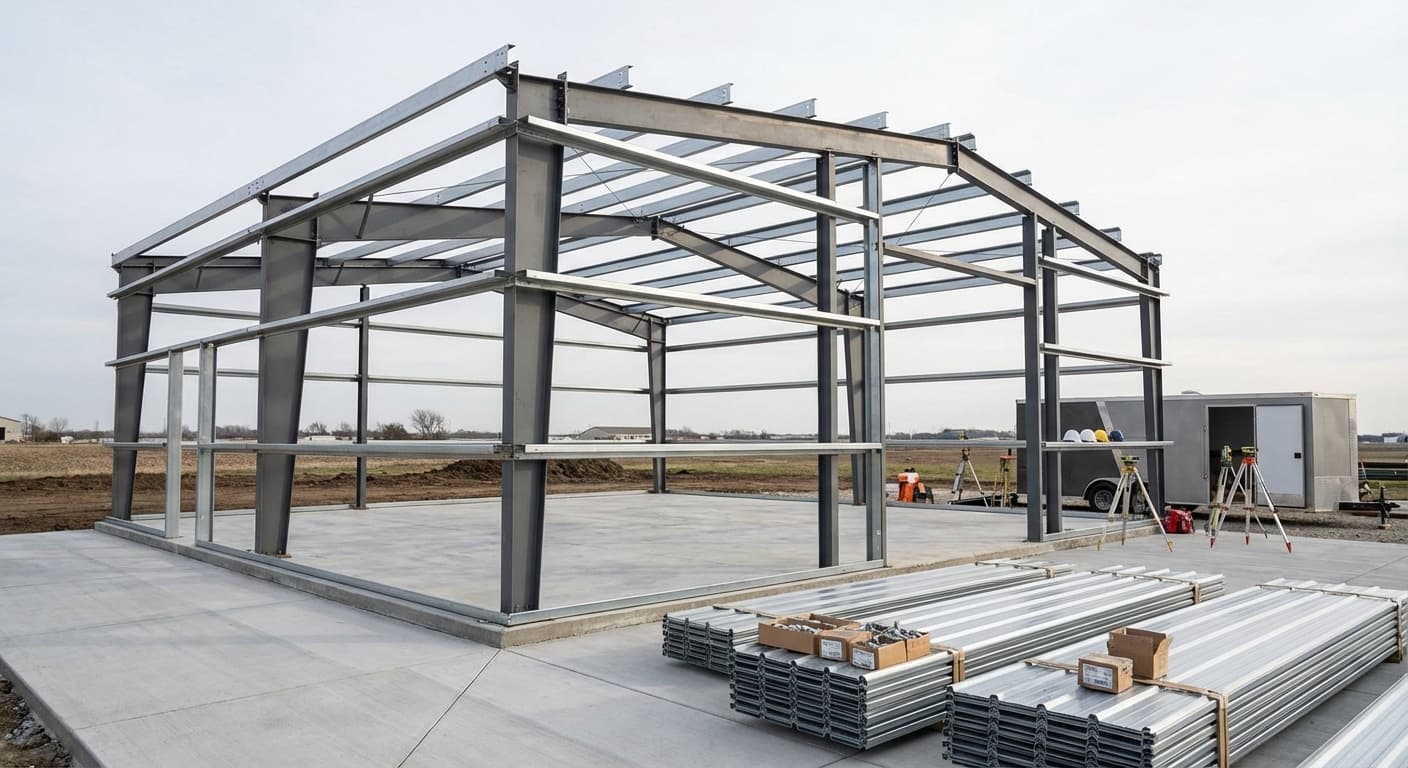

A 30×40 metal building delivers 1,200 sq ft of column-free space for roughly $28,000-$46,000 all-in, and this article walks you through every line-item–raw steel kit ($15k-$25k), foundation that can equal the kit price, labor, insulation, doors, permits, and region-specific code upgrades–so you see exactly where every dollar goes and why smaller footprints feel fixed-cost pressure. You'll learn how choices like 12-gauge vs. 14-gauge steel, 9-ft vs. 12-ft walls, and vertical roofs swing pricing, how winter ordering and turnkey single-source contractors lock in lower steel pricing and faster schedules, and why insulation, proper door counts, and locked specs before production are the smartest levers to control scope creep and energy payback. Hidden budget killers–utility-run lengths, lender unfamiliarity with metal, identical permit fees whether 1,200 or 6,000 sq ft–are exposed alongside financing work-arounds and warranty fine print, giving you the foresight to keep contingency for weather and price spikes, not surprise change orders. Ultimately, the piece equips you to time purchases with steel-market cycles, compare real quotes instead of base shells, and avoid the 15-20% overruns that plague DIY or piecemeal builds, ensuring your workshop, garage, or small commercial bay hits the sweet spot between size, speed, and budget without sacrificing code compliance or long-term value.
Breaking Down the Core Cost Elements
Base Kit Price: Calculating the 30×40 metal building cost per square foot
Your 30×40 metal building kit delivers 1,200 sq ft of clear-span space–no interior columns blocking your layout. The kit includes four essentials: primary steel frame, secondary framing (purlins and girts), roof and wall panels, and all fasteners. Budget $15,000-$25,000 for the kit alone, depending on steel thickness and manufacturer. [1] Here's the square-foot breakdown: materials run $17. 22-$19.
44 per sq ft, totaling $20,664-$23,328 for raw steel. [3] But that's just the start. Add foundation, labor, insulation, doors, and permits, and you're looking at $25-$30 per sq ft all-in. Total project: $28,000-$46,000+. [1][2] Why the wide range?
Fixed costs hit smaller buildings harder. Engineering fees and permits cost nearly the same whether you build 1,200 or 6,000 square feet. That's why a 60×100 runs less per foot–but for most shops, three-car garages, and small commercial spaces, the 30×40 hits the sweet spot between size and budget.
Foundation Fundamentals: Concrete slab and site work costs
The foundation often matches or exceeds your kit cost–budget $18,000-$24,000 for the concrete work alone. [4] That breaks down to $15-$20 per sq ft for a 30×40 slab, with labor eating half the total. [4] A standard 4-inch residential pour sits at the lower end.
Need to park heavy equipment or meet commercial codes? Reinforced footers with extra rebar push you toward the higher figure. [5] Concrete crews charge $3-$7 per sq ft plus delivery fees starting at $60.
A three-person team typically finishes your pour in eight hours–if the site's ready. [6] Site preparation and utility connections are covered in detail in our Hidden Expenses section, but remember: those costs hit before concrete trucks roll.
Labor and Erection: Installation fees and contractor considerations
Labor runs $5-$10 per sq ft–that's $6,000-$12,000 for erection alone on your 1,200 sq ft building. [7] Add project management at $50-$150 hourly for permit pulls, subcontractor scheduling, and code compliance. [7] Here's what that buys you: A professional crew of three to four erects your shell in three to five days. Metal buildings go up 30-50% faster than stick-built alternatives–one reason we complete projects on schedule.
[8] DIY temptation is real when you see that $6,000-$12,000 line item. But consider: You need the same crew size, specialized equipment, and code knowledge. One failed inspection costs more than you saved. [8] Smart compromise: Let professionals handle foundation and steel erection–the structural elements inspectors scrutinize.
Take on interior finishing yourself. You stay code-compliant while controlling costs.
How Custom Choices Impact Your 30×40 Metal Building Cost
Steel gauge, wall height, and roof style are the three levers that can swing your 30×40 metal building price by thousands–so lock in the right specs now, because retrofitting later costs triple and smart insulation alone can save you $24,000 over twenty years.
Steel gauge, roof pitch, and height options
Three decisions control your final price more than any others: steel gauge, wall height, and roof style. Start with gauge–the lower the number, the stronger your building. A 12-gauge frame beats 14-gauge every time for durability. [9] Ask for frame gauge and panel gauge separately on every quote, because some suppliers mix thicknesses to shave costs. [9] Wall height directly hits your wallet.
Your basic 30×40 with vertical roof and 9-foot walls runs $11,005. Jump to 12-foot walls? Add $2,300–plus the cost of bigger doors to match. [10] Your roof choice multiplies that impact. Vertical roofs cost more upfront but pay you back in regions with heavy rain or snow–they shed both better than regular or boxed-eave styles.
[10] Match your specs to your actual needs. A weekend workshop doesn't need the same clearance as a commercial bay with tall equipment. Get it right the first time–retrofitting height later costs triple.
Insulation, doors, windows, and interior finishes
Insulation pays for itself–the math proves it. Fiberglass with polypropylene facing costs $0. 50-$1. 50 per sq ft for materials. Add labor at $0. 50-$1.
25 per sq ft, and you're looking at $1,200-$3,300 total for your 30×40 building. [11] Here's why you do it anyway: Cut $100 from your monthly energy bill, and insulation pays back in three years. Over 20 years? That's $24,000 in your pocket. Plus, you eliminate condensation that ruins tools and equipment, cut outside noise, and work comfortably year-round instead of just in spring and fall. [11] Every opening adds cost.
Walk-in doors, roll-up doors, windows, skylights–each carries its own price tag. [12] A basic workshop needs one roll-up and one walk-in door. A commercial operation might add three windows, a second roll-up, and skylights for natural light. List every opening before you request quotes–it's the only way to compare real numbers instead of base shells.
Regional price variations and market drivers
Your zip code changes your price. Florida, Gulf Coast, and snow country add $3-$6 per sq ft because local codes demand certified ratings that standard kits don't provide. [13] Steel prices move while you wait. Hot-rolled coil runs $950-$1,050 per ton–double the 2018 price.
That same 30x40x12 building with 12-gauge frame and vertical roof that cost $17,000-$20,000 in 2023? Now it's $26,000-$32,000 installed. [13] Here's what waiting costs: An Arizona buyer delayed 90 days hoping prices would drop. His quote jumped from $27,400 to $31,200 while freight costs climbed and crews booked solid.
[13] With prices up 4-8% since January and no correction coming, your best move is simple–lock your quote when your site and financing are ready. The market won't wait for you. (For detailed timing strategies to capture the best pricing windows, see "Timing purchases with steel market trends" in the Cost-Saving section below.
Hidden Expenses and Optional Add‑Ons
Permits, engineering, and design service fees
Permit and engineering fees can add thousands to your budget if you're not prepared. The good news: metal buildings come with stamped structural drawings from factory engineers, bundled right into your kit price. [14] You won't pay a separate architect $3,000-$5,000 like you would for stick-built construction.
Those stamped drawings are exactly what your building department needs to issue permits. No back-and-forth. No consultant fees.
Just submit and go. [14] Permit costs vary by location and use type, but here's the catch: whether you build 30×40 or 60×100, the permit fee stays about the same. That's why your cost per square foot looks better on larger buildings.
Utility connections, site preparation, and grading
As covered in the foundation section, site prep and utilities can match or exceed your building kit cost. The wildcard? Distance to existing connections.
[5] Before you finalize any budget, call your utility providers. Get exact measurements from their connection points to your build site. That single distance number can swing your utility budget by $5,000-$10,000.
Pro tip: If you're running utilities through areas that need grading, dig trenches first. Otherwise you'll pay to grade twice.
Financing, warranties, and long‑term service costs
Most lenders don't understand metal buildings. Some, like FHA, won't touch them. [17] Your realistic options: * Home improvement loan: $1,000-$50,000, unsecured, 4-20% APR, 660+ credit score * HELOC: Lower rate but puts your property at risk * Construction-to-permanent loan: Best for larger commercial projects New Century Bank specializes in metal building mortgages with fixed rates and no second loan needed. Start there before wasting time with conventional lenders. [18] Critical timing issue: Steel prices can jump while you're doing paperwork.
Lock your kit price before starting the loan process or risk coming up short. [17] On warranties, read the fine print. Most cover structure and coatings but require specific maintenance. [16] Skip an inspection or use the wrong sealant? Coverage voided.
The good news: metal buildings need far less maintenance than wood structures. No rot, no warping, no repainting every five years. Just periodic fastener checks, panel resealing, and gutter cleaning to keep your warranty valid for 20-30 years.
Cost‑Saving Strategies for a Smart Build
Single‑source turnkey solution with ProTrades You've got enough on your plate without juggling six different contractors. That's where single-source responsibility saves both money and sanity. Instead of managing handoffs between the kit supplier, foundation crew, electrician, and general contractor–each a potential delay or dispute–you work with one team that owns the entire project. [20] Here's what that means for your bottom line: A turnkey contractor leverages buying power across all materials, not just the steel kit.
They negotiate volume pricing you can't touch as a one-time buyer. And since delays cost them money too, they keep your project moving. [19] Our ProTrades division handles everything from kit sourcing through final inspection on 30×40 builds. One contract.
One phone number. One team accountable for staying on budget and on schedule. No finger-pointing between subs when something goes sideways–we own the solution and keep building.
Timing purchases with steel market trends
Steel prices climb steadily with no seasonal reversal, but demand patterns create opportunity. November through February is your window–construction slows, order books thin out, and manufacturers discount to keep lines running. [21] For your 30×40 project, that translates to: * Lower material pricing from eager suppliers * 2-3 week faster delivery (vs.
8-12 weeks in summer) * Contractors available now, not booked three months out [22] The smart move isn't building in winter–it's ordering in winter for spring delivery. Lock your price while demand is soft, finalize permits while others wait, then break ground when conditions improve. [23] Savvy buyers work this cycle every year.
They place orders in December for April starts, securing both price and schedule before the spring rush hits. [23] As covered earlier, waiting for "better" pricing is costly–every month you delay is another month steel climbs. The question isn't whether to wait, but whether you can align financing and permits with the November-February sweet spot.
Clear communication and planning to avoid surprise costs
Budget blowouts happen, but they're preventable. Nearly every 15-20% overrun traces back to one mistake: changing plans after steel hits production. [24] Here's how scope creep kills budgets: You add a window here, upgrade a door there–each change seems minor until the invoice lands. Manufacturing change orders are profit centers for suppliers, not you. Lock every detail before releasing to production.
No exceptions. [24] Start with reality: Your kit represents 40-50% of total project cost. Build your budget from that truth, not the kit price alone. List every line item–foundation, labor, permits, utilities, insulation–before approving specs. [24] Keep a 5-10% contingency fund.
Not for upgrades–for the weather delays and material price shifts that happen on every project. Plan for them or pay for them later. [25] Communication prevents surprises: * Text your concrete contractor weekly * Call the building department before they call you * Meet on-site when questions arise * Check every delivery against the shipping list immediately [24] Missing components found during assembly shut down your entire schedule. One missing beam means your erection crew sits idle, your electrician reschedules, and your timeline shifts by weeks. Inspect shipments the day they arrive.
- https://www.probuiltsteel.com/blog/30×40-metal-building-cost/?srsltid=AfmBOop6WwM0M8abrUjdBUYaU65ZKchyQwtG0TI8lvfMJbNSL8jg8mFL
- https://titansteelstructures.com/facts/how-much-does-a-30×40-metal-building-cost/
- https://lionbuildings.com/how-much-does-it-cost-to-build-a-30×40-metal-workshop/
- https://www.metalbuildingoutlet.com/how-much-does-a-30×40-steel-building-cost/
- https://www.cascadingfallsinc.com/what-do-prefab-metal-building-cost-to-construct
- https://estimators.us/foundation-cost-per-square-foot/
- https://swfunk.com/news/metal-buildings-costs/
- https://www.steelcobuildings.com/how-much-does-a-30×40-steel-building-cost-in-2026/
- https://www.probuiltsteel.com/blog/30×40-metal-building-cost/?srsltid=AfmBOop_wdFmYIe_s5jLHNEzDc2kOQdkuH7XQ00kRMLV7hjhLlnUIfbH
- https://alansfactoryoutlet.com/30×40-metal-building/?srsltid=AfmBOorUWfOFn2hlVhrFqWQ9FtgusVNl98SJQAPAvvwu0WhTTX4nn9La
- https://steelbuildinginsulation.com/insulate-30×40-metal-building/
- https://www.probuiltsteel.com/blog/30×40-metal-building-cost/?srsltid=AfmBOor-Z5Om-VKjHZPIqy0tMF25kIgObkg-c2c9IgKKGRHlnZvBfzwZ
- https://www.aametalbuildings.com/blog/2025-metal-building-price-trends-are-steel-building-costs-going-up-or-down-this-year?srsltid=AfmBOopNd2r_BCTgCjQ4jjucRvG7YakeGCjPiuFXZAFMvLTnPJ1FcwjL
- https://pricebuildings.com/steel-buildings/cost/30×40-metal-building-cost/
- https://www.probuiltsteel.com/blog/30×40-metal-building-cost/?srsltid=AfmBOor8sScu7PaZQXwurE0jRAmBe2T9ldOhPEsnrNGgwVohOf4DgMGL
- https://www.empirebuilt.com/30×40-metal-building/
- https://www.buildingsguide.com/build/metal-building-financing/?srsltid=AfmBOorYqhHhNwR0LVCiS3kcgjL03uVRJG_1tW_GhSKn_YvHaMkoSCGE
- https://bullbuildings.com/5-options-for-financing-your-metal-building/
- https://allensconstructllc.com/everything-you-need-to-know-about-turnkey-construction-benefits-costs/
- https://www.wolgast.com/blog/top-benefits-of-ssr-construction
- https://carportkingdom.com/blog/best-time-buy-metal-building/
- https://futurebuildings.com/blog/winter-deals-on-steel-buildings.html
- https://armstrongsteel.com/blog/experts-discuss-why-buying-a-steel-building-in-the-winter-is-a-smart-move
- https://www.rhinobldg.com/blog/how-to-keep-a-metal-building-project-on-budget
- https://www.metalbuildingoutfitters.com/5-best-tips-for-estimating-metal-building-costs/