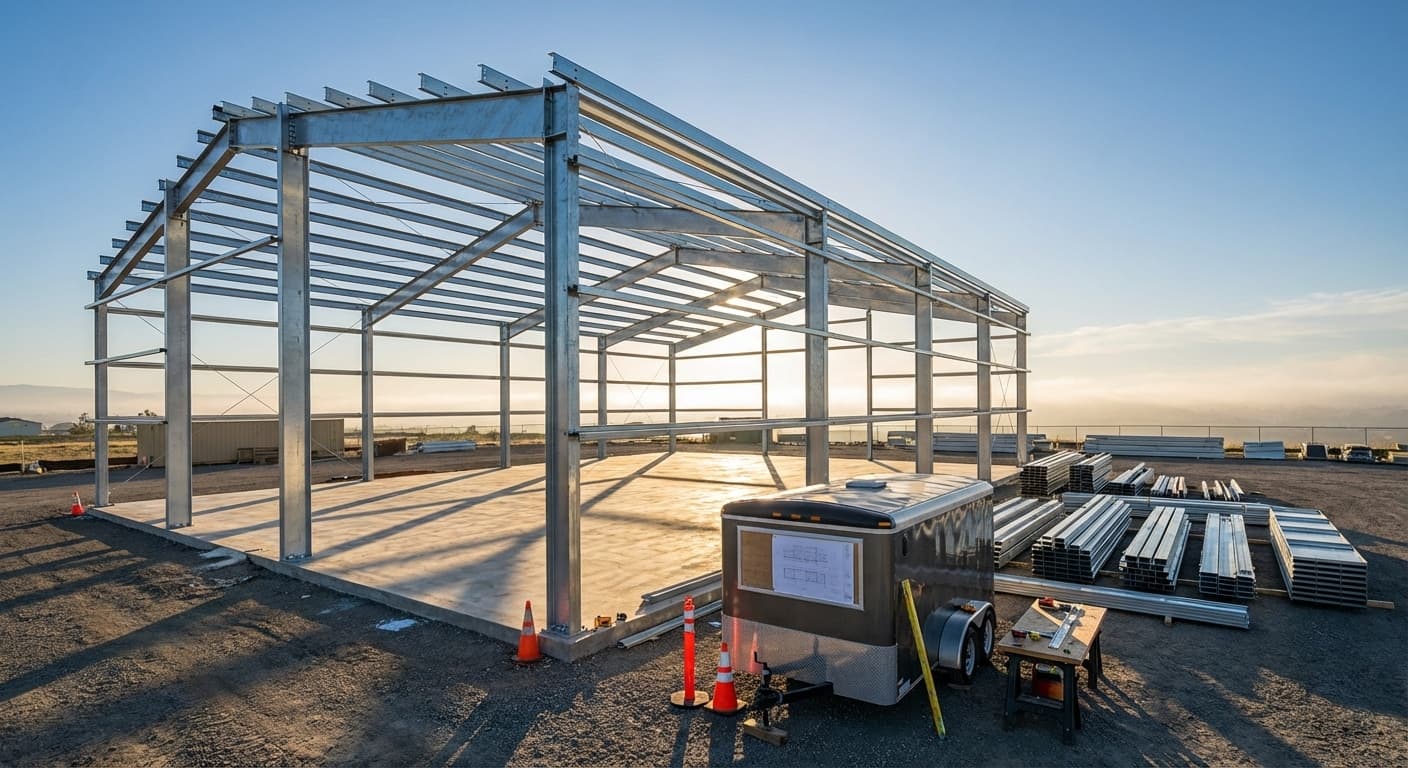

The 30×40 Building Cost Estimator article equips readers with a realistic, dollar-by-dollar roadmap for turning a $15,000 steel kit into a finished, code-compliant structure that actually costs $52,000-$106,000 once site work, 6-inch commercial slab, utilities, insulation, freight, regional surcharges, and certified erection are tallied. It shows how to avoid sticker shock by modeling upgrades–12-gauge vs. 14-gauge steel, spray foam vs. fiberglass, wind/snow ratings, door packages–so owners can see upfront how each decision ripples through the 20-year cost of ownership and warranty protection. Readers learn to compare turnkey, hybrid, and DIY paths, leverage single-source purchasing to cut waste, and choose construction loans, HELOCs, or SBA financing so the building pays for itself through tax deductions and energy savings while preserving working capital. By using the estimator's itemized data to vet contractors, lock quotes before freight and labor rates climb, and craft iron-clad scopes and timelines, owners secure NDL weathertightness warranties and decades of leak-free performance. In short, the guide transforms a daunting stack of variables into a clear, step-by-step budgeting and project-management tool that saves thousands, eliminates surprises, and delivers a durable 30×40 tailored to climate, code, and cash-flow realities.
Understanding the 30×40 Building Cost Estimator
Before you celebrate a $20,000 kit price, remember that steel gauge, snow-load codes, site prep, a commercial-grade slab, utilities, permits, and pro erection can more than double the total to $46,000–so run the full 30×40 estimator early and avoid a mid-project cash crunch.
How the Estimator Calculates Base Kit Prices
Your base kit includes the bones: primary framing (columns and rafters), secondary framing (purlins and girts), plus roof and wall panels with all fasteners and sealants. [1] Simple math drives the estimator–multiply your 1,200 sq ft by the going rate of $18-$22/sq ft, and you're looking at $18,000-$26,000 for the kit. [2] Watch the fine print on budget kits.
Those $10,000-$20,000 quotes? They often skip end walls, doors, and windows. [3] Add those back, and the savings shrink fast.
Two factors bump your base price before you pick a single upgrade: steel gauge and local codes. High snow loads or seismic zones demand heavier framing–that's 10-15% more right there. [2] The estimator catches these requirements early so you budget right from day one.
Factoring Foundation and Site Preparation Costs
Here's what catches buyers off guard: your kit quote won't include a penny for site work. Yet clearing runs $1-$4 per sq ft. Grading adds $0. 40-$2 per sq ft.
On your 1,200 sq ft footprint, that's $1,700-$7,200 before concrete trucks even show up. [4] Your 30×40 needs commercial-grade concrete–6 inches reinforced, not the 4-inch residential pour. Heavy equipment and vehicles demand it. Budget $8,500-$13,500 for the slab alone.
[4] Then utilities pile on: – Plumbing rough-in: $2-$6 per sq ft – Electrical rough-in: $2-$6 per sq ft – Permits: $550-$2,000 Bad soil? Add more. Unstable or expansive dirt requires engineered footers beyond the standard slab. The estimator flags this once you input your site data, but only a soil test tells the full story.
Adding Labor, Installation, and Optional Upgrades
Your $15,000-$25,000 kit becomes a $28,000-$46,000+ project fast. That gap? It's professional erection–and it's worth every dollar. [5] A qualified crew frames your 30×40 shell in three to five days.
They bring sequencing knowledge, structural expertise, and crane access you can't match. DIY erection might save $6,000-$12,000, but botch the job and your warranty vanishes. [7] That mistake becomes your expense, not the manufacturer's. Upgrades stack up quick.
Insulation alone offers three paths–fiberglass batts, rigid panels, or spray foam–each affecting your energy bills for decades (see "Choosing Interior Finishes and Insulation Packages" for the full breakdown). [7] Every opening costs extra: – Walk-in doors – Roll-up doors – Windows and skylights – Electrical rough-ins Smart move? Bundle these through your kit supplier.
Customizing Your 30×40 Project for Accurate Estimates
Selecting Steel Gauge and Material Options
Selecting steel gauge and material optionsSteel gauge works backwards: 12-gauge beats 14-gauge despite the smaller number. [8] The actual difference–0. 1046 inches versus 0. 0747 inches thick–determines what loads your building handles and how long it lasts. [8] Your 30×40 footprint sits right at a structural decision point.
Buildings wider than 30 feet or taller than 10 feet need 12-gauge framing to maintain proper support. [8] That thicker steel delivers real benefits. You get true clear-span interiors with wider spacing between framing members–essential for parking equipment or running operations without dodging columns. [8] Yes, 12-gauge costs 15-25% more upfront and takes longer to fabricate and erect. [8] But in hurricane zones, heavy-snow regions, or high-wind areas, that premium becomes mandatory–local codes often require it, and some manufacturers only warranty 12-gauge components against rust.
[9] For mild climates and light storage, 14-gauge works fine and keeps your investment lower. [8] But if you're housing valuable equipment, dealing with weather extremes, or planning heavy use, 12-gauge pays you back in durability and peace of mind. [9] The estimator helps you see exactly how that choice affects your total project cost–not just the kit price.
Choosing Interior Finishes and Insulation Packages
Choosing interior finishes and insulation packagesThe estimator shows you exactly what each insulation choice means for your budget and your building's performance. Three options dominate: fiberglass batts, spray foam, and rigid foam board–each with different costs and capabilities. Fiberglass batts start cheapest at $0. 40-$1. 50 per sq ft. [10] A basic 3-inch layer runs about $0. 40/sq ft, while 6-inch R-19 costs around $0. 70/sq ft.
[10] Go thicker and you need double-layer systems between girts and purlins. Why? Because any air gap lets warm interior air hit cold steel panels, creating condensation that drips on everything below. [10] Spray foam attacks that condensation problem head-on. It expands to seal every gap–at the base, corners, and eaves where fiberglass can't reach. [11] Open-cell delivers R-3. 0 per inch; closed-cell hits R-7. [11] The price reflects that performance: reaching R-25 with spray foam costs roughly $3.
50 per sq ft installed, while fiberglass double-layers achieve R-38 for about $1. 50 per sq ft. [10] Here's where the math gets interesting. Save $100 monthly on energy costs and you pocket $24,000 over 20 years. [10] That gap between fiberglass and spray foam suddenly looks different. For climate-controlled spaces–whether you're protecting equipment, housing animals, or creating workspace–model both options in the estimator.
Adjusting for Regional Price Variations
Location drives cost as much as design. Climate certifications hit first–Florida, Gulf Coast, and snow-belt builds need wind or snow ratings that add $3-$6 per sq ft. [13] On your 30×40 project, that's $3,600-$7,200 extra before you pick a single upgrade. Freight adds the second hit. Steel components typically cost 10% of the kit price to ship, rising with distance from the manufacturing facility.
[15] National buying power and strategic manufacturer partnerships help control these costs, but geography still matters. Labor compounds everything. High cost-of-living areas and union jurisdictions push erection costs well above national averages. [14] That competitive kit price can become an expensive installed price once local crews quote their rates. Time matters too.
One buyer watched their quote jump from $27,400 to $31,200 in just three months as freight rates and crew availability tightened. [13] When the estimator shows regional surcharges, don't wait for a better deal–lock your quote while it's valid. Regional factors only trend one direction: up.
Financing and Budget Management for Your 30×40 Build
Slash your 30×40 build costs by up to 20% with a hybrid DIY-pro strategy: let the pros handle foundation and structural erection to protect your warranty, then finish the interior yourself while leveraging single-source suppliers to eliminate costly material mismatches and waste.
Comparing Turnkey vs. DIY Cost Scenarios
Comparing turnkey vs. DIY cost scenariosYou've got two clear paths: DIY or turnkey. Here's what each really costs you. With turnkey delivery, you're looking at $52,000-$106,000 total–that includes everything from kit to finished building.
[2] Going DIY? You'll save $6,000-$12,000 on erection labor, plus another 10-20% if you skip the general contractor. [2] But here's what catches DIY builders: you need a crew of three to four people, specialized equipment, and the right sequencing knowledge. Make one mistake during erection and you could void your manufacturer warranty.
[2] Smart money takes the hybrid route. Hire pros for your foundation and structural erection–the work that absolutely must pass inspection. Then tackle interior finishing yourself. You keep warranty protection intact while still saving thousands on the work you can actually handle.
Leveraging Single-Source Solutions to Reduce Expenses
Leveraging single-source solutions to reduce expensesSingle-source buying cuts your costs in ways you might not expect. When every component–frame, panels, trim, fasteners–comes from one supplier, parts arrive pre-cut and pre-drilled to fit perfectly. No guesswork.
No waste. No extra labor hours fixing mismatched pieces. [17] Your jobsite stays cleaner too.
Factory fabrication means minimal scrap compared to field-cutting materials from multiple vendors.
Exploring Financing Options and Long‑Term ROI
Exploring financing options and long-term ROIYou've got three financing options that actually work for steel buildings: construction loans, HELOCs, or personal loans. Here's how to pick the right one. Construction loans release money as you build–not all at once. You draw funds at each milestone: foundation, framing, completion. This staged approach makes lenders more comfortable, which means easier approval for you. [19] Building a workshop or garage? Personal loans and HELOCs get approved fastest.
They look at your credit score and home equity–that's it. Running a business? You'll need more paperwork, but you unlock better options. SBA loans and agricultural financing offer terms designed for commercial projects. The extra documentation pays off in lower rates and longer repayment periods. [19] Some lenders specialize in metal buildings exclusively. They understand the project, offer competitive rates, and send funds directly to you–no home equity required.
Perfect if you want to manage your own contractors and suppliers. [20] Here's why smart businesses finance instead of paying cash: loan interest and depreciation become tax deductions. Your after-tax cost drops significantly compared to a cash purchase. [19] Meanwhile, your steel building starts saving you money immediately through lower insurance and energy costs. You preserve working capital while the building pays for itself over time.
Working with Contractors and Ensuring a Smooth Build
Use your detailed cost estimate to turn contractor quotes into transparent, line-by-line negotiations that expose hidden fees and protect your timeline.
Vetting Contractors with the Cost Estimator Data
Vetting contractors with the cost estimator dataYour detailed cost estimate turns contractor quotes from guesswork into checkable facts. You'll know exactly what's reasonable because you've already itemized labor rates, materials, equipment rentals, permits, and contingency funds. When skilled construction labor runs $40-$75 per hour, you spot red flags instantly–like bids that hide labor costs in one big number instead of showing crew hours.
[21] Professional contractors quote within +/-5% accuracy. If their price swings way higher or lower than your estimate, something's off–either they're adding work you didn't request or cutting corners you'll pay for later. [22] Every complete bid breaks down these components: * Labor hours and rates * Material quantities * Subcontractor fees * Equipment rentals * Permits * Overhead and profit (5-20% is standard) [22] Any contractor worth hiring walks you through their numbers line by line.
They'll match their material counts to your specs and their labor hours to your timeline. If they can't–or won't–explain their math, they're either guessing or padding. Your estimator data lets you catch both.
Communicating Scope and Timeline Clearly
Communicating scope and timeline clearlyYour cost estimate only works when everyone reads from the same page. That's why you need a scope of work document–it turns your numbers into clear marching orders. This becomes the single document everyone checks when questions arise. [23] Your scope document needs these elements in order: * Project overview * Deliverables * Technical specifications * Timeline with milestones * Who does what * How changes get handled * Cost breakdown by deliverable [24] Skip any piece, and you'll pay for the confusion later.
When changes come up (they always do), spell out the impact immediately and specifically. Don't say "this will delay things and cost more. " Say "adding a second roll-up door extends the timeline by four days and adds $2,200. " [25] Write everything in plain English.
Your crew might know what "girts" are, but your banker and permit officer might not. Define technical terms right where you use them. [24] Add visual aids that show the story: * Updated floor plans * Timeline charts showing each phase * Before-and-after schedule comparisons [25] Your timeline isn't just a schedule–it's budget protection. When everyone sees how a foundation delay pushes kit delivery and extends equipment rental, they all have skin in the game to keep things moving.
Ensuring Quality and Warranty Through Professional Installation
Ensuring quality and warranty through professional installationWho installs your building determines what warranty you get. Period. Manufacturer warranties cover three basics–structure (framing, beams, columns), rust perforation, and paint finish.
But the crucial fourth protection–weathertightness–only kicks in with certified installers. [26] Here's what you're protecting: * Structural warranties: 20-50 years * Workmanship warranties: 1-5 years (up to 10 with top-tier contractors) * Manufacturer warranty: covers material defects * Installer warranty: covers assembly mistakes like leaky roof seams or crooked doors [27][28] These warranties depend on each other. If an uncertified crew damages panels during installation, the manufacturer can deny your claim completely.
That "bargain" installation just cost you decades of coverage. [27] The gold standard? No-Dollar-Limit (NDL) weathertightness warranties that cover all leak repairs without a cap.
- Kit-only quotes skip doors/windows/site work; true 30×40 build runs $28k-$46k+
- 12-gauge steel is code-mandated for >30 ft spans and carries rust/wind warranties 14-gauge lacks
- Spray foam seals steel gaps at $3.50/sq ft; saving $100/month energy repays the premium in 20 years
- DIY erection risks voiding warranty; certified pro install secures 20-50 yr structural & weathertight coverage
- Finance via construction/SBA loans–interest plus depreciation are tax-deductible while cash stays liquid
- Itemized cost data exposes contractor padding; legit bids stay within +/-5% of estimator line items
- Single-source packages cut waste and labor by delivering pre-cut parts that fit, avoiding field surprises