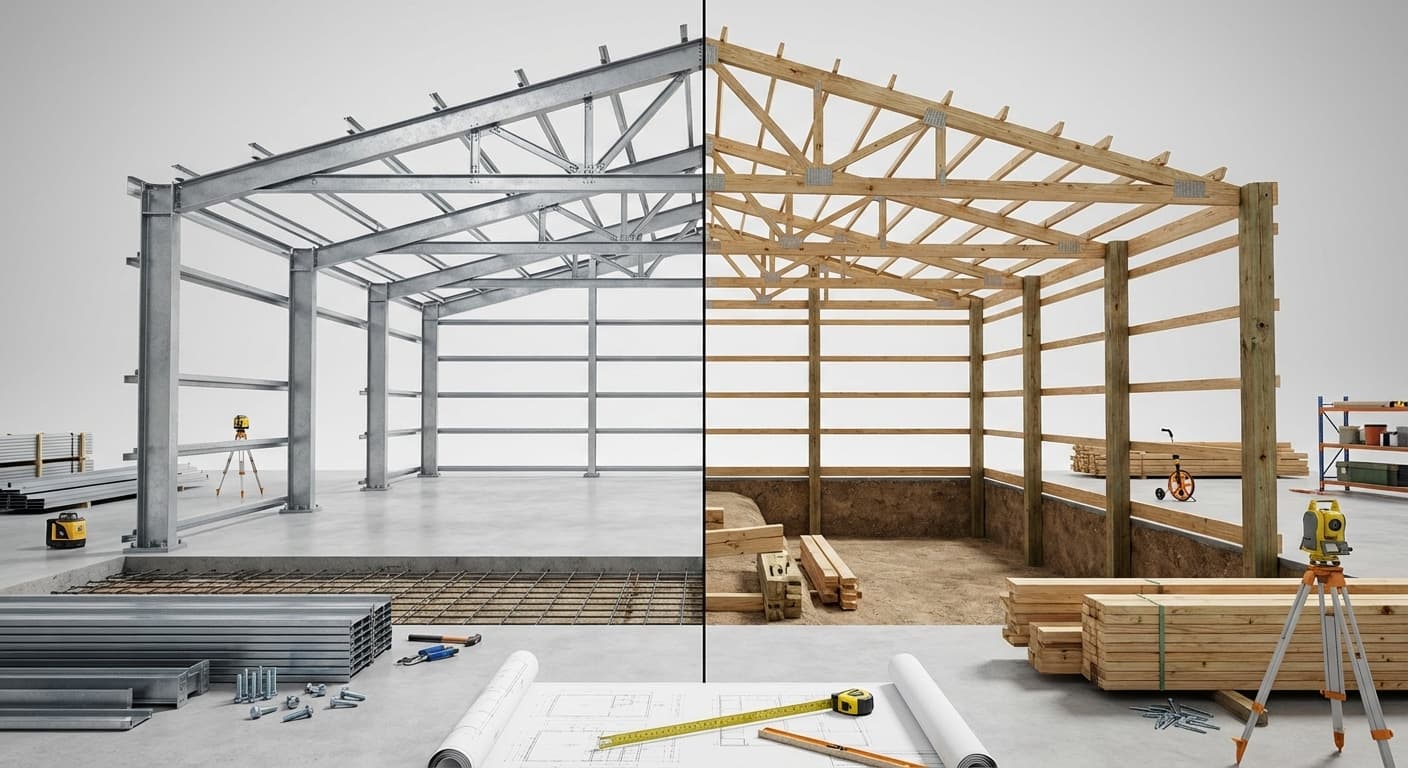

Over a ten-year span, a 30×40 steel building quietly reverses its higher sticker price into thousands of dollars of net savings while a pole barn slides into the expensive "fix-it" phase, because steel's straight, fire-proof frames slash insurance bills 30-40 % and demand only $200-400 a year for basic inspections, whereas wood posts warp, rot and loosen until yearly upkeep jumps to $800-1,500 and cumulatively costs $5-8 k more. The article walks readers through every hidden line item–laminated post quality, I-beam wind ratings, frost-footing slabs, regional labor swings, commodity price spikes and permit pitfalls–showing how a steel building's engineered stamp sails through inspections and appraisals as a permanent, value-adding asset, while pole barns are treated as depreciating storage that can trigger surprise redesign costs and resale deductions. You'll learn why financing programs favor steel, how volatile steel and wage markets make same-week quote comparisons critical, and why expansive soils, termite zones and hurricane codes can torpedo post-frame approvals. In short, if your horizon is longer than five years, the math says invest once in steel and let the insurance savings, near-zero maintenance and higher resale value pay you back every year after; if you truly need only quick, short-term shelter, then accept the pole barn's lower entry fee and its looming repair bills.
Understanding the True Cost Gap
A steel building's slightly higher upfront cost is erased within five to six years as you pocket $5,000-$8,000 in avoided repairs and 30-40% lower insurance bills while the wood pole barn next door starts its expensive downhill slide.
Initial Purchase Price Comparison
You'll pay $12,000 to $25,000 for a 30×40 pole barn kit–basic storage at the low end, insulated upgrades at the top.
Long‑Term Maintenance and Insurance Savings
Long-term maintenance and insurance savingsSteel buildings save you money year after year. Here's why: wood warps. Those warped boards open gaps that let in rain, pests, and rot–problems that compound into steady repair bills.
[3] Steel stays straight. No warping, no rot, virtually zero maintenance beyond basic inspections. [4] Pole barns need painting, pole realignment, and weatherproofing work that steel buildings simply don't.
Your insurance company knows this too. Steel doesn't burn, so you'll pay 30-40% less for coverage than wood-frame structures. [3] On a 30×40 building, those insurance savings alone can pay back your higher upfront investment within a few years–before counting the repair bills you'll never see.
Lifecycle Cost Analysis Over Ten Years
Let's run the ten-year numbers. Your pole barn starts cheap on maintenance–$300 to $600 yearly for the first five years. But watch years six through ten: costs jump to $800 to $1,500 annually as fasteners loosen, wood warps, and posts start showing wear.
[5] Steel buildings? You'll spend $200 to $400 per year, mostly on inspections, not repairs. [5] That gap–$5,000 to $8,000 over ten years on a 30×40 building–is money in your pocket.
Add your insurance savings (remember that 30-40% discount) compounding year after year. [6] Your steel building's 15% upfront premium–about $2,000 to $4,000 on a 30×40 kit–pays itself back in five to six years. [6] After that, you're saving money every year while your neighbor's pole barn enters its expensive phase: the years when major repairs can't wait any longer.
Breakdown of Component Costs
Before you celebrate a low square-foot price, ask whether the quote omits the I-beam frame, engineering stamps, insulation, doors, slab, or frost-footings that can triple the real cost of your 30×40 building.
Kit Pricing, Materials, and Custom Options
Kit pricing, materials, and custom optionsBoth kit types look identical from the outside–steel panels for siding and roofing. The difference? What holds them up. [7] Pole barn kits include wood columns, trusses, and fasteners. Steel building kits ship with commercial-grade I-beam frames that bolt to your concrete slab. [8] Quality varies widely in both camps. Big-box pole barn kits often use solid 6×6 posts that can't be fully pressure-treated–the core stays vulnerable to rot.
Engineered kits use laminated columns treated individually. [7] Steel kits have their own tiers. Tubular frames cost less but won't handle the loads that I-beam frames will. Those I-beams meet your local wind, snow, and seismic codes right out of the box. [8] Customization pushes prices fast. Your basic 30×40 pole barn shell starts cheap, but add insulation, windows, walk doors with thermal barriers, or steel liners? You're looking at $35-$50 per square foot.
[7] Steel buildings follow the same pattern–$15-$20 per square foot for the kit, then door upgrades, skylights, and insulation packages add up. [9] When you compare quotes, check what's actually included. Overhead doors? Usually extra on pole barn kits. Engineering stamps? You need those for permits, and uncertified trusses mean costly redesigns mid-project.
Foundation, Site Preparation, and Permits
Foundation, site preparation, and permitsFoundation costs hit your budget differently for each building type. Pole barns sink posts directly into the ground or concrete footings–no full slab needed. Steel buildings need a concrete slab or pier foundation, adding $8,000 to $12,000 for a standard 4-inch pour on your 30×40 footprint. [10] Building up north? Frost footings push that to $27,000 when you factor in deeper excavation and extra rebar.
[11] Site prep runs $5,000 to $6,500 for grading and dozer work–same for both building types. Rural properties cost more when utility lines run farther from your build site. [7] Permits reveal another cost difference. Steel buildings come engineered to meet local codes for wind, snow, and seismic loads. Your permit submission includes certified stamps that inspectors approve on the first pass.
[10] Pole barns? No universal building code covers post-frame construction. You might face plan revisions or surprise engineering costs mid-project. [10] Electrical work–trenching, permits, 200-amp panel–runs $1,200 to $1,500 bundled. Rural builds with longer runs cost more.
Labor, Installation, and Contractor Fees
Labor, installation, and contractor feesBoth building types ship as kits–DIY possible, but professional crews make sense for anything over 3,000 square feet. Prior construction experience?
Strongly recommended either way. [12] Steel buildings require precise anchor bolt alignment before framing starts.
But here's the payoff: steel bays span 20 to 30 feet versus 8 to 12-foot pole spacing. Fewer columns mean fewer connections, fewer potential failure points, and a cleaner interior space for your operations.
Regional and Market Influences
Lock in all quotes within the same week–because a $5,000+ cost swing between 30×40 steel and pole barn hinges on volatile steel prices and local wage gaps that can erase pole barn's speed savings overnight.
How Local Labor Rates Affect 30×40 steel building vs pole barn cost
How local labor rates affect 30×40 steel building vs pole barn costLabor rates don't hit both building types equally. Where you build changes the cost gap dramatically. As covered in our labor analysis above, pole barn crews work faster–but in high-wage markets, that speed advantage gets expensive.
Steel buildings take more precision during assembly, yet that extra time stays constant whether you're paying $25 or $75 per hour. The math shifts fast: a $20/hour wage difference across a five-day build adds $3,200 to your pole barn's "savings. " Get three quotes minimum–the spread will surprise you.
Regional wage differences can swing your total cost by $5,000 or more. [7] Urban lots save money on utilities (shorter runs to power), while rural builds eat budget on trenching and electrical. That rural premium hits both building types equally, but steel buildings face a double whammy: you're already paying for concrete work that pole barns skip.
Market Pricing Trends and Weekly Monitoring
Steel prices move too fast for leisurely shopping. Cold rolled steel–the sheets and decking in both building types–dropped 10% in one quarter during 2024. [15] Why? Ukraine conflicts, Middle East tensions, Panama Canal droughts cutting cargo capacity, oil market chaos.
Your supplier can't control these forces, but they land on your quote. [15] Labor costs compound the volatility. Construction wages jumped 20% from 2021 to 2023, with more increases coming through federal project mandates that ripple into private pricing. [15] That six-week-old quote?
Already stale. The cost gap between pole barn and steel shifts based on when you buy, not just where. [16] Smart move: gather all quotes within the same week. Staggered shopping makes clean comparisons impossible–you'll miss how fast that price gap actually moves.
State‑Specific Code and Permit Impacts
Geography changes which building type sails through permits. Pole barns lack that engineering package. In Texas, Oklahoma, Louisiana, and Gulf Coast states–where hurricanes and tornadoes shape building codes–inspectors routinely reject post-frame plans missing certified analysis.
[18] Soil creates another permit hurdle. Pole barns sink posts directly into ground that moves–a real problem across the South and Southwest where expansive soils shift seasonally. Inspectors know this.
They flag it. [17] Southeast and Northwest add pest problems: termites and rodents damage wood frames enough to fail reinspection. Counties with agricultural review cycles catch deteriorating posts years later, triggering permit delays and surprise costs on your "cheaper" building.
Financing, ROI, and Decision Guidance
After five years, the numbers make the choice for you: a steel building's lower maintenance, cheaper insurance, and stronger resale value turn the upfront cost into profit while the pole barn keeps costing you money.
Financing Options and Payback Period
– Farm Credit associations: Term loans for both building types – USDA Rural Development: 0. 5-2% below commercial rates, 6-10 week approval, favors permanent steel structures over temporary pole barns [5] – Equipment dealer financing: 7.
5-10. 5% rates, 3-5 day approval when you need to move fast [5] Here's what matters to your wallet: Over 30 years, a 40×60 pole barn costs you $73,000 total (build, maintenance, replacement).
Return on Investment and Resale Value
Return on investment and resale valueYour steel building adds property value. Your pole barn doesn't–at least not the same way. Appraisers see that 40-year warranty and 50- to 100-year lifespan on steel and mark it as a permanent improvement. [20] Pole barns? They're depreciating assets with 20- to 40-year lifespans that future buyers will calculate into their offers.
[20] Think ten years out: A buyer looking at your property sees a pole barn that might need replacing before their mortgage ends. They see your steel building and know it'll outlast their grandkids. [21] No shifted posts. No rot damage. No fire risk.
No repair backlog for their inspector to flag. [22] When you sell, your well-maintained steel building strengthens your position. That weathered pole barn with sagging doors and pest damage? It hands buyers a price-reduction checklist.
Choosing the Right Solution for Your Business
Choosing the right solution for your businessHere's your decision in plain terms: Choose a pole barn if you: – Need covered space fast – Have a tight upfront budget – Plan basic storage or equipment housing – Accept ongoing maintenance as a business cost [23] Choose a steel building if you: – Want minimal maintenance for the next decade – Need a structure that holds property value – Prefer lower insurance costs year after year – See your building as a long-term business asset [24] The math favors steel on any timeline past five years–lower maintenance, cheaper insurance, better resale value. [24] Businesses choose steel because the numbers work, not because they like the look of it. [25] Your mistake isn't picking one over the other.
It's picking the wrong one for how you'll actually use it. Don't over-invest in steel for temporary storage. Don't under-invest in wood for a building you'll rely on for decades.
[23] Match your building to your business plan, and the ten-year cost picture becomes clear.
- Steel buildings cost 30-40% less to insure than wood-frame pole barns.
- Over ten years, steel maintenance runs $2,000-4,000 versus $5,000-8,000 for pole barns.
- A 30×40 steel kit's 15% upfront premium pays back in 5-6 years through lower upkeep and insurance.
- Pole barns often fail permits in hurricane zones; steel kits arrive pre-engineered for code approval.
- Steel adds appraised property value; pole barns depreciate and can become buyer negotiation points.
- https://themetalshopllc.com/how-much-is-a-30×40-pole-barn-kit/
- https://www.buildingsguide.com/build/pole-barn-vs-metal-building/?srsltid=AfmBOorx7S9b2I3ThgFqlpGEAEUpCefnDi7kqy_3LuNCIAAWq5DGNfCa
- https://californiaallsteel.com/pole-barn-vs-steel-building-which-is-best-for-your-needs/
- https://www.buildingsguide.com/build/pole-barn-vs-metal-building/?srsltid=AfmBOoqLlPtzMQ09PgKtV8pMKrzmQpmTkN3N4xggzWWoRXrIus0AfOe-
- https://www.metal-buildings.org/pole-barn-vs-metal-building-for-farms/
- https://www.buildingsguide.com/build/pole-barn-vs-metal-building/?srsltid=AfmBOooUAml9PHVyvT2gY0hS3gPOZCuEqD3XBuR_hNQdzg_EB8vojxOF
- https://info.fbibuildings.com/blog/30-x-40-pole-barn-costs-diy-kits-vs.-construction
- https://www.buildingsguide.com/build/pole-barn-vs-metal-building/?srsltid=AfmBOooC2aqcejBg-J4Yk6PWjuVrvUvTOgz9BiYHDTh2sIVXlmzMahMp
- https://www.buildingsguide.com/metal-building-prices/?srsltid=AfmBOopalZfJ7OKOc9GZFy_VnJg4EXnkPeCX2dQnOlLlB8W7dNwRjS2i
- https://www.buildingsguide.com/build/pole-barn-vs-metal-building/?srsltid=AfmBOopwDHRQphX8cu0axOLYh99PtZjxEWAUNs3zZvpjvsTqUvE2xbFV
- https://www.reddit.com/r/metalbuildings/comments/1mer6n7/real_cost_breakdown_of_a_30x40_metal_garage_with/
- https://www.buildingsguide.com/build/pole-barn-vs-metal-building/?srsltid=AfmBOorALf8VfJVACN-jr7dZKJjwOfBec2oYVxyTUGEkCAYx3Vw0WKV_
- https://www.buildingsguide.com/metal-building-prices/?srsltid=AfmBOorDOFDFz63hpSYJ1DDArdbaydtiItT_hY4Nlr-6cV_JeuWlNcqC
- https://www.buildingsguide.com/build/pole-barn-vs-metal-building/?srsltid=AfmBOoqzwIKSL00UKagGC3P_XP_7j5YCseVtzPJe321F_jUbuD6WZMCX
- https://www.gordian.com/resources/construction-cost-insights-q2-2024/
- https://americansteelinc.com/blog/steel-building-costs-prices-guide/
- https://gensteel.com/building-faqs/building-comparisons/versus-pole-barns/
- https://www.shedgirls.com/steel-building-vs-pole-barn-cost-comparison-shed-girls
- https://americanmetalgarages.com/red-iron-vs-pole-barn-vs-tubular-frame-cost-lifespan-best-uses/
- https://www.buildingsguide.com/build/pole-barn-vs-metal-building/?srsltid=AfmBOoqOlvSCk3M-f7Di_KjaaFd2GX0c2eMmrtlnkoh9VmN5b393OsDb
- https://alansfactoryoutlet.com/blog/metal-building-vs-pole-barn/?srsltid=AfmBOopH5zxLO5YBiKl97aY9863aRDYZR-aqIPPoyMohhuvDqLt1So4T
- https://metalprobuildings.com/metal-buildings-vs-pole-barns-which-is-better-for-you/
- https://www.buildingsguide.com/build/pole-barn-vs-metal-building/?srsltid=AfmBOop-DgU5Zx6SKEyiRznCdGgtrNB_JoZ2qIDhPiDV1P84tN-_BMQV
- https://www.omni-builders.com/home-tips/pole-barn-vs-metal-building-cost-maintenance-longevity-compared
- https://www.steelcobuildings.com/pole-barn-vs-metal-building/