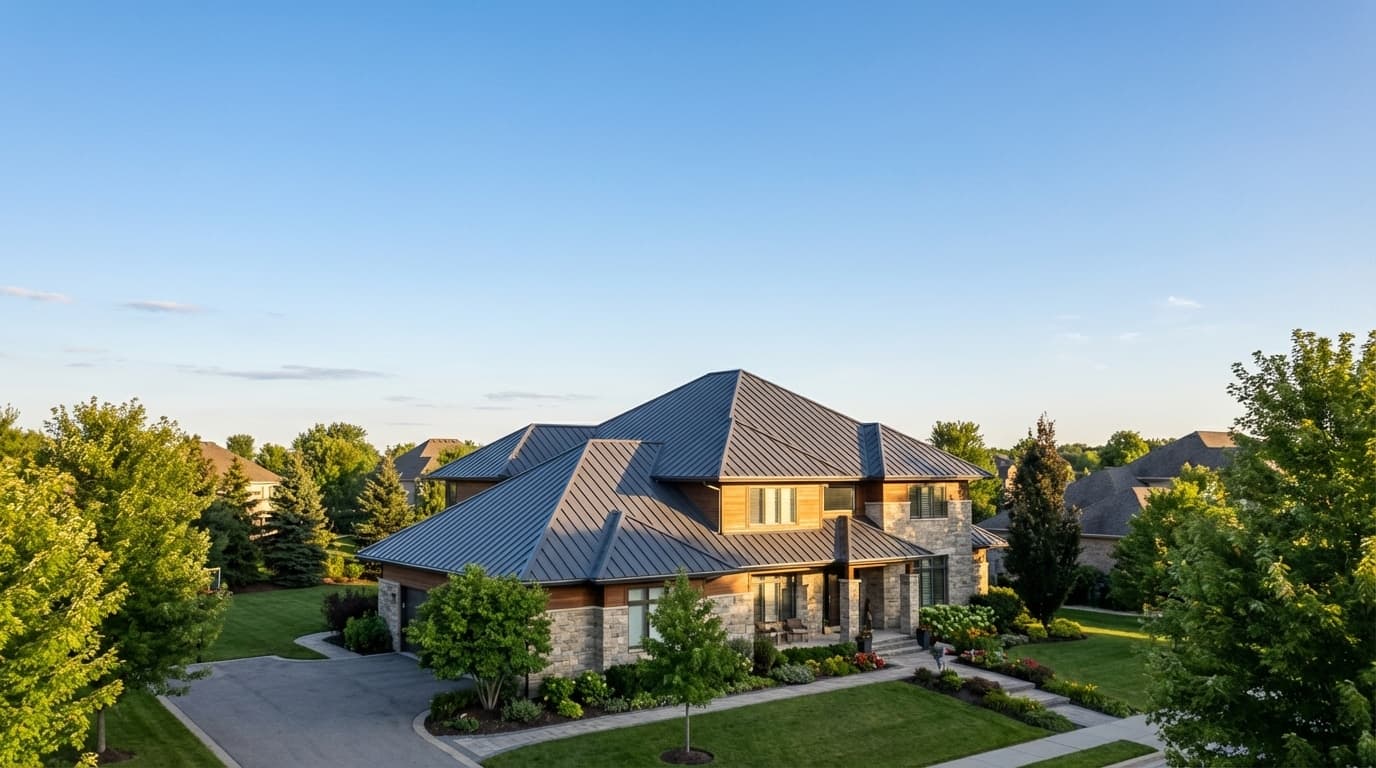

Metal roofing has evolved from an industrial option into a smart, long-term investment for homeowners who want to stop the cycle of re-roofing every 15–20 years: by paying $7–$29 per square foot installed now, you lock in a 40- to 80-year roof that shrinks cooling bills 10–25%, withstands extreme weather, contains up to 60 % recycled content and is 100 % recyclable at end-of-life, all while boosting curb appeal through styles that mimic slate, wood or tile. The article unpacks exactly how material choice, roof size and complexity drive price, revealing that corrugated steel can match premium asphalt upfront yet outlast it three-fold, while standing-seam, stone-coated or copper systems climb toward the high end of the range; for a typical 1,500-sq-ft home, expect $10,500–$43,500, with labor eating 40–60 % of the total. Readers learn quick sizing rules—multiply living area by 1.1–1.5 to account for pitch and overhangs—and see why steep, cut-up roofs add 10–15 % waste and safety surcharges. By comparing lifetime costs, energy savings and landfill diversion against traditional shingles, the guide equips homeowners to request apples-to-apples bids, choose the right metal system for their budget and climate, and turn what used to be a recurring expense into a one-time upgrade that appreciates in value decade after decade.
Introduction
Metal roofing’s 50-year leap from 12% to a projected 19% of the residential market is driven by roofs that last twice as long as asphalt, cut cooling bills up to 25%, divert tons of landfill waste, and now come in styles that look like slate or wood.
Why Metal Roofing is Gaining Popularity in 2025
Metal roofing has captured 18% of the residential market in 2025, up from 12% in 2019, with continued growth projected at 19% through 2028 [3]. This surge stems from homeowners prioritizing long-term value over initial costs. The exceptional lifespan of metal roofs drives adoption—they last 40-80 years compared to just 15-20 years for traditional asphalt shingles [2]. This durability translates to fewer replacements and reduced waste. During their lifetime, these roofs withstand extreme weather conditions including high winds, heavy snow, and hail that would damage conventional materials [1].
Energy efficiency represents another compelling advantage. Metal roofs reflect sunlight rather than absorbing heat, reducing cooling costs by 10-25% [3]. This reflective quality, enhanced by specialized coatings, makes metal roofing particularly valuable in warmer climates where cooling expenses add up [1]. Environmental benefits further explain metal roofing's growing popularity. Most metal roofing contains up to 60% recycled content and remains fully recyclable at the end of its useful life [2].
This contrasts sharply with asphalt shingles, which contribute approximately 11 million tons of waste to landfills annually [3]. Aesthetic versatility has eliminated the industrial appearance that once limited metal roofing adoption. Modern options include standing seam panels, shingles that mimic slate or wood, corrugated styles, and stone-coated finishes in numerous colors—allowing homeowners to achieve desired looks without sacrificing performance [2].
The True Value of Durability in Roofing Investments
Durability fundamentally changes the economics of roofing investments. As steel construction professionals, we've witnessed firsthand how the financial equation shifts dramatically when you choose materials built to last generations rather than decades [4]. The true value of a durable roof extends far beyond its purchase price—it's about eliminating the cycle of repeated replacements, repairs, and disruptions that traditional roofing materials impose on homeowners [5].
When you invest in quality metal roofing, you're not just buying protection from the elements. You're purchasing peace of mind, energy efficiency that compounds year after year, and a home improvement that actually appreciates in value [5][6]. This durability advantage becomes particularly compelling when integrated with other steel building components, creating a cohesive system engineered for longevity.
Rather than viewing your roof as a recurring expense, metal roofing transforms it into a one-time investment that appreciates over decades.
What This Guide Will Cover: Making Informed Decisions on Metal Roofing
This guide provides the essential information needed to determine if metal roofing delivers lasting value for your specific situation.
Drawing from our extensive experience in steel construction, we'll walk you through every aspect of metal roofing investment—from understanding true costs to recognizing long-term benefits that many homeowners overlook [7][8].
2025 Metal Roofing Cost Overview
Budget $10,500–$43,500 for a 1,500-sq-ft metal roof—corrugated steel at the low end, copper at the high—and get multiple quotes because labor alone can eat 60% of the tab.
Current Average Cost Range for Metal Roofing ($7-$29 per sq ft)
Metal roofing costs typically range from $7 to $29 per square foot installed, making it a premium roofing choice compared to traditional materials [10][11]. This wide price spectrum reflects significant variations in material quality, style, and installation complexity. Lower-end options like corrugated steel or aluminum may cost under $7 per square foot, while premium materials like copper can exceed $29 per square foot [11].
For a 1,500-square-foot roof, homeowners should budget between $10,500 and $43,500, with most spending around $19,250 [11]. Style dramatically affects pricing—corrugated panels represent the most affordable option, followed by standing seam systems ($9-$16 per square foot), while metal shingles and stone-coated steel command premium prices [12][11]. Regional labor rates also influence costs, with installation labor comprising 40-60% of total project expenses [12].
When comparing national averages, a 1,700-square-foot metal roof installation costs approximately $14,039 ($10,940 to $16,722 range) for standard materials, while premium options for the same area can reach $46,233 ($23,890 to $68,575 range) [10][12]. These significant price variations underscore the importance of obtaining multiple quotes and clearly specifying materials when budgeting for a metal roof installation.
Cost Breakdown by Home Size and Roof Complexity
Metal roof costs scale directly with home size but are significantly affected by roof complexity. For typical homes, expect to pay $7-$29 per square foot installed, with a 1,500-square-foot roof costing between $10,500-$43,500 [11]. Your roof area is usually 10-50% larger than your home's footprint due to overhangs and pitch—a one-story home's roof typically measures 1. 1-1.
5 times the home's square footage [11]. For multi-story homes, divide the total square footage by the number of stories, then multiply by the same factor. A 2,000-square-foot home typically requires $17,500-$72,500 for metal roofing, while a 3,000-square-foot single-story home costs $25,200-$104,400 [11]. Roof complexity dramatically impacts price—steeply-sloped roofs with pitches greater than 6:12 require additional labor, equipment, and safety measures [13].
Roofs with multiple corners, peaks, valleys, and penetrations demand more materials and installation time, with contractors typically adding 10-15% to material costs to account for waste on complex systems [13]. Labor represents 40-60% of total project expenses ($400-$800 per square), making complexity a major cost factor [13]. Material choices compound these differences—while corrugated panels might cost just $5-$12 per square foot installed on a simple roof, the same materials on a complex design could approach the $9-$16 per square foot range of standing seam systems [13].
Regional Price Variations Across the Country
Metal roofing costs vary significantly by region, with price differentials of 20-30% across the country [14]. Northeast homeowners typically pay premium rates of $14-16 per square foot, while Southern states enjoy more affordable pricing at $11-13 per square foot due to lower labor rates and milder weather conditions [14]. Western states command the highest prices nationwide, with California and Washington homeowners facing costs 25-35% above the national median [14].
In metropolitan areas like Seattle and the Bay Area, expect to pay $14-18 per square foot for standard metal roofing, while Los Angeles and San Diego prices range from $16-20 per square foot [14]. These regional disparities stem from several factors: stricter building codes in Western and Northern states, higher labor costs in areas with elevated living expenses, climate-specific installation requirements, and material availability constraints [14]. The premium extends beyond standard panels to specialty metals, with zinc and copper roofing costing up to 40% more in Western regions than elsewhere in the country [14].
Installation labor, which comprises 60-70% of total project costs, varies dramatically between regions with higher costs in areas like San Francisco and New York where living expenses exceed national averages [15].
Understanding the Price Premium: Initial Investment vs. Lifetime Value
Metal roofing's higher upfront cost represents an investment that pays dividends over decades. While metal roofs typically cost $15,000 to $45,000 for an average home—about twice as much as traditional roofing materials—this price premium reverses dramatically over time [5]. After just 15 years, metal roofing becomes 50% less expensive than traditional options, and over a 30-year span, asphalt shingles cost approximately three times more than a metal roof [5].
This cost inversion occurs because traditional roofs require replacement every 15-20 years, while metal roofs last 40-70 years [16]. The financial equation extends beyond mere longevity—metal roofs deliver ongoing savings through minimal maintenance requirements, reduced energy costs of 10-25% annually, and insurance premium discounts ranging from 10-35% in many regions [5][16]. These roofs also represent a recoverable investment rather than a sunk cost, with homeowners recouping 85-95% of installation costs when selling, compared to the average 48% return on investment for general roof replacements cited in the 2024 Cost vs.
Value Report [5][10]. For homeowners who plan to stay in their homes beyond 15 years, the premium pays for itself through combined benefits, transforming what would be recurring expenses into a single long-term investment [5].
Cost Comparison of Durable Metal Roofing Materials
Corrugated steel at $7–$12 installed gives you a 40- to 60-year, 140-mph wind-rated roof for the same price as premium asphalt shingles, making it the budget metal choice that outlasts traditional materials two to three times over.
Entry-Level Options: Corrugated and Ribbed Steel ($7-$12 per sq ft)
Corrugated and ribbed steel panels represent the most affordable metal roofing options, typically costing $7-$12 per square foot installed [10]. This price makes them comparable to premium asphalt shingles while delivering superior longevity. Material costs for these panels range from $3. 00-$3.
50 per square foot before installation [17]. These entry-level options feature exposed fasteners where screws visibly secure the panels to your roof deck, creating their distinctive wavy or ribbed appearance. While economical, these systems still offer impressive 40-60 year lifespans – two to three times longer than traditional asphalt shingles [17]. Their weather resistance includes 140 mph wind ratings and Class A fire protection, making them suitable for wildfire-prone regions [17].
The affordability stems from simpler manufacturing processes and installation techniques, with labor representing 40-60% of the total cost [10]. These panels provide excellent value despite some limitations – they're not as weathertight as premium systems and require more maintenance over time due to exposed fasteners that may need occasional replacement [17]. For homeowners seeking durability on a budget, corrugated and ribbed steel deliver maximum long-term value at entry-level pricing.
Mid-Range Choices: Stone-Coated Steel and Aluminum ($12-$20 per sq ft)
Stone-coated steel and aluminum roofing occupy the middle tier of metal roofing options, balancing performance and price. Stone-coated steel costs $10-$18 per square foot installed, with materials accounting for $5-$10 and labor adding $3-$8 per square foot [18]. This translates to $20,000-$36,000 for a standard 2,000-square-foot roof [18]. The material consists of a steel core coated with zinc-aluminum alloy and stone granules bonded with acrylic resin [18]. This composition enables the material to mimic premium roofing styles like slate, clay tiles, or wood shakes without their weight or maintenance requirements [18].
The manufacturing process involves layering galvanized steel with protective coatings, then applying colored stone granules embedded in acrylic adhesive [20]. These systems last 40-70 years while maintaining their distinctive textured appearance [18]. Aluminum roofing costs $6-$12 per square foot installed, with standing seam aluminum panels commanding $10-$12 per square foot [19]. This lightweight material weighs just 50 pounds per 100 square feet—half of what steel roofing weighs—reducing structural load on existing buildings [19]. Aluminum excels in coastal environments where salt spray rapidly corrodes other metals, naturally resisting rust without protective coatings [19].
The material reflects up to 95% of solar radiation when unpainted, reducing cooling costs by 20-30% [19]. Painted aluminum still reflects 85-90% of solar heat, maintaining excellent energy efficiency [19]. For homes within 10 miles of saltwater, aluminum's higher initial cost pays off through extended lifespan and minimal maintenance requirements [19]. Its malleability allows fabrication into complex architectural designs that other metals cannot achieve [19].
Premium Selections: Standing Seam, Copper, and Zinc ($20-$29+ per sq ft)
Standing seam metal roofing represents the most popular premium option, costing $9-$16 per square foot installed [12]. These systems feature concealed fasteners that create a clean, streamlined appearance while providing superior weather protection [17]. The hidden fastener design significantly reduces leak potential compared to exposed fastener systems [17]. Copper roofing commands $23-$35 per square foot installed, making it among the most expensive roofing materials available [17]. This investment delivers exceptional longevity—copper roofs regularly last 60-100 years and sometimes extend beyond 150 years with proper installation [21].
The material starts with a distinctive reddish-orange appearance before developing a blue-green or brown patina through natural oxidation [17]. Many homeowners specifically choose copper for this evolving aesthetic that enhances curb appeal over decades [21]. Despite its beauty, copper presents challenges including run-off staining on adjacent materials and incompatibility with most other metals used in roofing [21]. Zinc roofing matches copper's price range at $23-$35 per square foot installed while offering 80-100+ year lifespans [17]. Its self-healing characteristics allow the protective surface layer to repair minor scratches and surface damage over time [21].
Zinc's bluish-white appearance transforms to a distinctive blue-gray patina as it ages, though this process can produce chalky white streaks in water runoff areas [17]. All premium metal options require specialized installation knowledge—zinc specifically demands proper ventilation to prevent underside corrosion and accommodate its significant thermal movement in varying temperatures [21]. These premium selections deliver exceptional value through multi-generational durability despite their substantial upfront cost.
Material Durability Ratings and Their Impact on Long-Term Costs
Durability ratings directly influence the total lifetime cost of metal roofing, with higher-rated materials commanding premium prices but delivering superior value over time. Steel roofing, rated for 40-60 years of service, represents the most economical starting point with expected lifespans at least double that of traditional asphalt shingles [10]. Aluminum offers similar longevity while providing superior corrosion resistance for coastal environments, justifying its 35% price premium over steel [17]. Premium materials demonstrate the most dramatic durability-to-cost relationship—copper roofs routinely last 60-100 years and sometimes extend beyond 150 years, while zinc systems deliver 80-100+ year lifespans despite their $23-$35 per square foot installed cost [17].
These extended lifespans transform the cost equation by eliminating multiple replacement cycles. Weather resistance ratings further enhance this value proposition, with premium metal systems achieving Class A fire ratings and withstanding winds up to 120 mph [22]. Hail impact resistance—particularly important for insurance considerations—varies significantly between materials, with stone-coated metal roofing systems capable of withstanding hailstones up to 2. 5 inches in diameter [22].
These durability advantages translate directly to financial benefits, with many insurance companies offering premium reductions of 10-35% for metal roofing installations [10]. The self-healing properties of materials like zinc, which can repair minor scratches through natural oxidation, further reduce lifetime maintenance costs [17]. When calculating true long-term value, the initial price premium of higher-rated materials often reverses completely—after 30 years, homeowners with traditional roofing pay approximately three times more than those who invested in durable metal systems [10].
Hidden Costs and Budget Considerations
Labor devours up to 60 % of a metal-roof budget—so lock in off-season bids, vet installers for your exact system, and brace for possible $5 k structural reinforcement before the first panel goes on.
Installation Labor Costs (40-60% of Total Project Cost)
When budgeting for your metal roof, it's crucial to understand that labor typically represents the single largest expense—accounting for 40-60% of your total investment [12][23]. For perspective, a 2,500-square-foot roof often requires $11,000 to $18,000 in labor costs alone [11]. This substantial proportion isn't arbitrary—it reflects the specialized expertise, comprehensive training, and professional-grade safety equipment necessary for quality metal roof installation [23]. Labor rates vary regionally, with California contractors charging $60-$80 per hour [12].
Understanding what influences these costs helps you plan more effectively. Steeper roof pitches demand enhanced safety protocols, while complex architectural designs featuring multiple angles and penetrations require additional time and precision [12][23]. Access challenges and unexpected structural discoveries during installation can also impact your budget [12][23]. The roofing system you choose plays a major role too—standing seam installations with concealed fasteners typically cost twice as much in labor as exposed fastener systems, reflecting the meticulous attention to detail these premium systems require [12].
Seasonal timing also affects pricing, with rates typically increasing 10-15% during peak summer and fall months when demand outpaces contractor availability [23]. To manage these costs, obtain multiple quotes during off-peak seasons (winter/early spring), ensure your project scope clearly defines all requirements, and confirm contractors are specifically experienced with your chosen metal roofing system [23].
Structural Reinforcement Requirements for Heavier Materials
Here's an important consideration many homeowners overlook: metal roofing systems often weigh more than traditional asphalt shingles, which means your existing roof structure might need reinforcement. When upgrading from lightweight materials to more substantial metal panels, you may face additional engineering and construction costs ranging from $2,000 to $5,000 [14]. This investment in Before installation, an engineer's evaluation ($300-$600) is essential to determine necessary modifications and prevent structural damage [14].
Let's break down the technical side: most residential roofs can handle live loads of at least 20 pounds per square foot, but material weights vary significantly. Premium metals like copper and zinc require more robust support than lighter options such as aluminum or corrugated steel [25]. The reinforcement process often involves strategically attaching 2x4s to existing trusses, creating a stronger framework that spans your entire home [25].
For more substantial reinforcement, new trusses might be necessary, costing $60 to $500 per truss for wood or $150 to $700 per truss for steel materials alone [24]. The reinforcement method depends on your current roof structure's condition—older homes or those with previous water damage may require more extensive modifications [25]. Failing to properly reinforce your roof can lead to serious structural issues signaled by sagging sections, ceiling cracks, water leaks, or unusual creaking sounds [25].
Removal and Disposal of Existing Roofing
The removal and disposal phase represents another budget consideration that catches many homeowners off guard. This essential step adds $1-$3 per square foot to your project—meaning $1,500-$4,500 for a typical 1,500-square-foot roof [27]. The process involves more than simply tearing off old materials; crews must carefully strip everything down to a clean roof deck, load debris for transport, and pay substantial disposal facility fees [26].
Multiple layers of old roofing dramatically increase both labor requirements and disposal expenses, with contractors typically charging an initial fee for the first layer plus additional costs for each subsequent layer [26]. Roof material type further impacts removal costs—heavy materials like concrete tile or multiple layers of asphalt shingles demand more labor and generate more waste than lighter materials [27]. Condition also matters, with damaged or deteriorated roofs often requiring extra care during removal to prevent structural damage [27].
The tear-off process provides critical opportunity to inspect the underlying deck, potentially revealing hidden issues like water damage or rot that require addressing before installing new roofing [27]. These inspections may identify necessary repairs that add to project costs but prevent future problems [27]. Because removal and disposal represent a substantial portion of your roofing budget, discuss these costs explicitly with contractors during the quoting process to avoid unexpected charges later [27].
Additional Components: Underlayment, Fasteners, Trim, and Flashing
Your metal roofing system requires several essential components beyond the visible panels—and understanding these helps prevent budget surprises. Think of underlayment as your roof's hidden defender, creating a crucial moisture barrier between the deck and metal panels. Modern synthetic underlayments outperform traditional felt, with quality options ranging from $160-$179 per roll for standard 30-year warranty products to $318-$355 for premium self-adhesive versions backed by 50-year warranties [15]. Trim and flashing—essential for waterproofing roof edges and transitions—vary dramatically in price depending on your roofing system. Exposed fastener systems require $2.
50-$4. 00 per linear foot for trim, while standing seam systems demand $5. 50-$8. 00 per linear foot [15]. For budgeting purposes, add approximately 25% to your panel cost for trim with exposed fastener systems and 30-40% for concealed fastener systems [15].
Fasteners themselves represent a smaller but necessary expense that varies based on roof size and panel type. When dealing with architectural features like skylights and chimneys, expect additional flashing expenses that protect these vulnerable areas from water infiltration [28]. Together, these components represent a meaningful portion of your total investment. While they're frequently overlooked in preliminary estimates, each element plays a vital role in ensuring your metal roof delivers the decades of reliable performance you're counting on.
Financial Benefits of Durable Metal Roofing
A one-time $30,000 metal roof can save you $15,000–$30,000 over 50 years by eliminating the “replacement multiplier effect” that forces asphalt owners to pay for 2–3 re-roofs at ever-rising prices.
Longevity Factor: 40-70 Year Lifespan vs. 15-20 Years for Asphalt
As detailed in earlier sections, metal roofing's 40-70 year lifespan fundamentally alters the long-term cost equation compared to traditional materials. This exceptional longevity stems from the structural properties of metal—its resistance to thermal expansion and contraction, immunity to UV degradation, and ability to shed water without absorbing moisture [29][31]. From an engineering perspective, metal roofing systems maintain their structural integrity through decades of freeze-thaw cycles, high winds, and temperature extremes that would progressively deteriorate organic materials like asphalt [30].
The financial implications become clear when examining replacement cycles. While homeowners replace asphalt shingles 2-3 times over 50 years, a properly engineered metal roof requires just one installation [30]. Each future replacement compounds costs through inflation and rising labor expenses—typically 30-50% higher per cycle [30].
This creates what we call the "replacement multiplier effect": a $15,000 asphalt roof today becomes a $45,000-$60,000 expense over five decades, while a $30,000 metal roof remains a one-time investment [31]. Premium standing seam systems, with their concealed fastener design and superior water-shedding capabilities, can achieve even longer lifespans—some reaching 100 years with proper installation and maintenance [31]. The engineering principle is simple yet powerful: eliminate points of failure through superior design, and the entire system performs exponentially better over time.
Insurance Premium Reductions (Up to 35% in Some Regions)
Insurance companies recognize metal roofing's superior performance through substantial premium reductions, reflecting the reduced risk these systems represent. From a structural engineering standpoint, metal roofs earn these discounts through measurable performance advantages: Class A fire ratings, wind uplift resistance exceeding 140 mph, and impact resistance that prevents penetration from hailstones up to 2. 5 inches in diameter [22][35]. The discount structure varies by region and reflects local risk factors.
Coastal areas prone to hurricanes often see the highest reductions—up to 35%—due to metal roofing's exceptional wind resistance achieved through interlocking panel systems and engineered fastening patterns [35]. In wildfire-prone regions, the noncombustible nature of metal provides critical ember protection, earning discounts of 20-30% [35]. Even in moderate climates, standard discounts of 10-15% recognize metal's resistance to common perils like hail damage and ice dams [7]. These premium reductions compound over decades, creating another layer of financial benefit.
A homeowner saving $300 annually on insurance premiums recovers $12,000 over a metal roof's 40-year lifespan—a significant offset to the initial investment. When combined with energy savings and avoided replacement costs discussed throughout this guide, insurance discounts help transform metal roofing from a premium expense into a strategic financial decision.
Home Value Increase (85-95% Cost Recoupment at Resale)
The exceptional 85-95% cost recoupment at resale distinguishes metal roofing as one of the highest-returning home improvements available [5].
This remarkable recovery rate stems from buyers' increasing awareness of long-term value—they understand they're purchasing decades of reliable protection rather than inheriting a future replacement expense.
The mechanics of value creation work through multiple channels.
Maintenance Economics: Long-Term Cost Advantages
Metal roofing’s weatherproof durability—shrinking maintenance to simple debris-clearing while eliminating storm, hail, and fire repairs—cuts lifetime ownership costs through avoided emergencies and insurance discounts up to 35%.
Minimal Maintenance Requirements and Associated Costs
When evaluating total ownership costs, metal roofing's minimal maintenance requirements deliver substantial economic advantages that compound over decades.
Your annual maintenance routine becomes remarkably simple—basic inspections, clearing debris from valleys and gutters, and checking sealants at penetration points [33].
Compare this to traditional shingles that demand frequent attention for wind damage, cracking, and progressive decay [16].
Durability Against Extreme Weather Conditions (Hail, Wind, Fire)
The maintenance economics of metal roofing shine brightest when severe weather strikes—precisely when traditional materials fail and generate unexpected repair costs. Quality metal systems withstand hailstones up to 2. 5 inches in diameter without requiring repairs, while conventional roofs often need extensive restoration or complete replacement after similar impacts [35].
This translates to zero post-storm repair expenses versus thousands in emergency fixes. Hurricane-force winds exceeding 140 mph pose no threat to properly engineered metal roofing systems, thanks to interlocking panel designs and secure fastening methods that eliminate wind uplift damage [35][36]. This means avoiding the repair cycles that follow every major storm in vulnerable regions.
The Class A fire rating inherent to metal's noncombustible composition provides another maintenance advantage—no fire damage repairs and no preventive treatments required in wildfire-prone areas [35]. These weather-resistant characteristics directly impact your maintenance budget through reduced repair frequency and lower insurance premiums, with many carriers offering 10-35% discounts that recognize metal roofing's superior performance [35]. Understanding these durability factors helps homeowners in extreme weather regions recognize that metal roofing's higher initial investment eliminates the unpredictable maintenance expenses that make traditional roofing a costly gamble.
Warranty Considerations (30-50 Year Warranties vs. Standard Options)
Metal roof warranties consist of four distinct types that significantly affect your long-term investment value. Substrate warranties cover the metal itself, with Galvalume steel offering up to 45 years of protection against perforation, while standard galvanized steel or aluminum typically come without substrate warranty coverage [37]. Finish warranties protect against paint degradation (chalking) and color fading, with high-quality metal roofing systems offering 30-50 year finish warranties compared to 10-20 years for traditional materials [7].
However, these warranties often permit specific levels of color change that can result in noticeable appearance differences while technically remaining within warranty parameters [37]. Workmanship warranties from qualified installers typically range from 5-10 years and cover installation-related issues like fastener and trim failures [37]. The rarest type—weathertightness warranties—guarantee against leaks for approximately 20 years but appear primarily in commercial projects rather than residential installations [37].
Maintaining warranty coverage requires following specific maintenance protocols like clearing debris and scheduling regular inspections [37]. Professional installation becomes crucial as improper workmanship can void both material and labor warranties, leaving homeowners unprotected against future problems [7]. When comparing metal roofing warranties to standard roofing options, the 30-50 year coverage represents a significant advantage over the 15-20 year protection typically offered for asphalt shingles, providing substantial long-term value despite the higher initial investment [7].
Repair Costs Comparison: Metal vs. Traditional Roofing Materials
The true maintenance economics between metal and traditional roofing emerge when you examine both repair costs and frequency over your roof's lifetime. Individual repairs tell only part of the story—asphalt shingle fixes run $150-$500 per incident, while metal roof repairs range $400-$1,200 [38]. This higher per-repair cost reflects metal roofing's need for specialized expertise and equipment, as proper repairs require technicians trained in specific panel systems and attachment methods [38]. However, the frequency equation transforms these numbers dramatically.
Traditional shingles begin their decline after just 7-10 years, developing granule loss, curling edges, and wind damage that demand increasingly frequent attention [38]. Metal roofs, by contrast, fail primarily from installation errors or severe impacts rather than gradual deterioration—meaning properly installed systems often require zero repairs over decades [38]. Your 30-40 year ownership calculation reveals the stark difference: asphalt roofs typically need 3-5 repair cycles, while quality metal installations require 0-1 [39]. Post-storm economics further widen this gap.
Where traditional roofs often need extensive restoration or complete replacement after severe weather, properly engineered metal systems emerge unscathed, eliminating both emergency repair expenses and insurance deductibles [38]. This reduced claim frequency helps maintain favorable insurance rates while avoiding the out-of-pocket costs that make storm season a financial concern for traditional roof owners [38]. For homeowners evaluating long-term value, metal roofing's higher individual repair costs become insignificant when multiplied by near-zero frequency—delivering lifetime savings that justify the initial investment [39].
Making the Right Investment Decision
If you're staying in your home past 15 years, combine the metal roof’s break-even math—faster in harsh climates like Wisconsin—with the $1,200 federal Energy Efficient Home Improvement Credit for materials to turn a one-time installation into a lifetime of avoided replacements and lower bills.
Calculating Your Break-Even Point on Metal Roofing Investment
As detailed in our cost comparison sections above, the financial crossover point when metal roofing becomes more economical than traditional materials typically occurs between years 15-20 [40]. This timing aligns with when asphalt shingle owners face their first costly replacement while metal roof owners continue enjoying reliable protection. To calculate your specific break-even point, consider the initial investment difference alongside cumulative savings from reduced energy costs, insurance discounts, and avoided replacements—factors we've explored throughout this guide [31][40].
The calculation becomes particularly compelling when you factor in regional considerations. In areas with extreme weather patterns, such as Wisconsin's freeze-thaw cycles, the break-even point often arrives sooner due to accelerated deterioration of traditional materials [40]. Understanding these regional variations helps homeowners make informed decisions based on their specific location and climate challenges.
For those planning to remain in their homes beyond 15 years, the mathematics strongly favor metal roofing as a one-time investment rather than a recurring expense [31].
Financing Options and Tax Incentives for Metal Roofing
Beyond the long-term savings, metal roof investments qualify for immediate financial relief through the federal Energy Efficient Home Improvement Credit. This program offers 30% of material costs up to $1,200 annually through 2025 for qualifying metal roofs with special pigmented coatings [41][43]. Understanding the credit requirements is crucial—only materials qualify, not installation labor, and the roof must be installed on your primary residence [43]. To maximize your investment value, file Form 5695 with your tax return and maintain proper documentation including itemized receipts that clearly separate material from labor costs, manufacturer certification statements, and Energy Star certification proof [41][43].
Remember that this nonrefundable credit reduces tax liability but won't generate refunds beyond what you owe [41]. Smart homeowners layer these federal benefits with local opportunities. Many utility companies offer additional rebates for energy-efficient roofing, while some municipalities provide property tax reductions or permit fee waivers [43]. The federal program also includes complementary credits for home energy audits (30% up to $150) and insulation improvements (30% up to $1,200) that work synergistically with your metal roof investment [42].
For forward-thinking property owners, metal roofs create an ideal platform for future solar installations, which qualify for the separate Residential Clean Energy credit with no dollar cap [43]. Starting in 2025, ensure your contractor provides products with Manufacturer Identification Numbers for seamless credit qualification [42].
Finding and Vetting Qualified Metal Roofing Contractors
Selecting the right contractor for your metal roofing project demands careful vetting, as proper installation determines whether you'll realize the full benefits outlined throughout this guide.
Begin with a professional roof inspection to establish your current condition before gathering estimates [44].
Key Questions to Ask Before Committing to a Metal Roof Purchase
Protecting your metal roofing investment requires asking the right questions before signing any contract. Drawing from our experience in steel construction, we recommend focusing on these critical areas: Experience and Credentials: Demand proof of at least 3 years of metal roofing experience and request addresses of recent local installations you can inspect personally [46][48]. Verify active licensing and insurance documentation—both general liability and worker's compensation are essential to protect you from potential liabilities [48]. Detailed Project Scope: Insist on comprehensive written estimates that itemize all aspects covered in this guide—from material costs to removal and disposal fees [47][48].
Professional contractors provide transparent pricing that reflects the true project scope, including any structural assessments or reinforcements discussed in earlier sections. Warranty Protection: Clarify both manufacturer warranties (typically 30-50 years as detailed in our warranty section) and workmanship coverage [46][48]. Ensure all warranty terms are documented in writing with clear coverage parameters and maintenance requirements. Installation Specifics: Discuss the exact installation methodology for your chosen system—standing seam installations differ significantly from exposed fastener systems in both technique and timeline [46].
Establish weather contingency plans and understand whether subcontractors will perform any work, as this affects quality control and accountability [48]. Project Management: Define clear completion procedures including final walkthrough protocols and punch list resolution before final payment [48]. Professional contractors welcome these discussions as they demonstrate commitment to customer satisfaction and project success. These conversations reveal whether a contractor possesses the expertise to deliver the long-term value metal roofing promises.
Conclusion
Summarizing the True Cost of Durable Metal Roofing
When evaluating metal roofing as a long-term investment, the true cost extends far beyond initial pricing.
Balancing Budget Constraints with Long-Term Value
Making the right investment decision involves carefully balancing today's budget realities with tomorrow's value. At National Steel Buildings Corp, we understand that the initial investment in quality metal roofing—typically ranging from $15,000 to $45,000—requires thoughtful financial planning [4]. That's why we help our clients explore practical financing solutions that make this investment accessible.
Smart financing transforms a significant one-time expense into manageable monthly payments that often align with the immediate energy savings metal roofing provides. Home improvement loans, equity-based financing, and specialized roofing finance programs each offer unique advantages depending on your situation [4]. The beauty of this approach lies in how quickly the benefits compound—energy savings begin immediately, while the long-term financial advantages we've discussed throughout this guide continue building over decades [50].
As experienced professionals in the steel building industry, we've seen firsthand how the 15-year break-even point transforms metal roofing from an expense into an asset [51]. The quantifiable benefits—from reduced maintenance to insurance savings—create a compelling case for homeowners committed to their property's long-term value. When you're ready to explore how metal roofing fits your specific budget and goals, our team stands ready to provide personalized guidance [4].
Next Steps in Your Metal Roofing Journey: Resources and Recommendations
Your metal roofing journey begins with partnering with experienced professionals who understand both the technical requirements and your unique needs. Start by scheduling a comprehensive evaluation of your current roof structure—this critical first step ensures your investment delivers maximum value. When selecting a contractor, prioritize those with specialized metal roofing expertise and verifiable project history in your area [52].
Understanding warranty distinctions proves equally important: quality systems offer both material warranties (often 30+ years for premium finishes) and workmanship protection that can extend from standard terms to lifetime coverage [53]. The most comprehensive warranties address both manufacturing quality and installation excellence, providing peace of mind that matches your roof's exceptional longevity [52]. As you move forward, gather multiple detailed quotes that clearly separate material and labor costs—this transparency helps with both budgeting and potential tax credit applications [54].
Remember, investing in metal roofing represents more than a home improvement project; it's a decision that enhances your property's durability, efficiency, and value for generations.
- Metal roofing lasts 40-80 years, 2-4× asphalt, cutting replacements and waste
- Expect $7–$29/sq ft installed; 1,500 sq ft roof runs $10.5k–$43.5k
- Labor eats 40-60% of budget; complex or steep roofs add 10-15% material waste
- Region swings 20-30%: Northeast $14-16, South $11-13, West up to 40% premium
- Corrugated steel starts at $7/sq ft—cheapest metal, still 40-60 yr lifespan
- Metal reflects sun, trims cooling bills 10-25%, ideal for hot climates
- Up to 60% recycled content and 100% recyclable vs. 11M tons asphalt waste yearly
- https://www.perfectexteriorsmn.com/blog/roofing/why-metal-roofs-are-gaining-popularity-in-2024/
- https://acculynx.com/metal-roofing-a-trend-thats-here-to-stay/
- https://blog.mcelroymetal.com/metal-roofing-and-siding/metal-roof-shingles-why-more-homeowners-are-making-the-move
- https://www.totalroof.com/metal-roof-budgeting-costs-and-roi
- https://nearmeroofingcompany.com/blog/metal-roofing/metal-roofing-cost-analysis/
- https://modernmetalroofing.com/metal-roofing-pay-for-itself/
- https://www.threetreeroofing.com/metal-roof-replacement-costs-planning/
- https://www.mountaintopmetalroofing.com/blog/metal-roof-cost-what-to-consider/
- https://www.heartlandroofingandconstruction.com/blog/metal-roofing-cost/
- https://www.thisoldhouse.com/roofing/metal-roofing-cost
- https://modernize.com/roof/metal/cost
- https://cobexcg.com/metal-roof-cost/
- https://homeguide.com/costs/metal-roof-cost
- https://eaglernr.com/metal-roofing-cost/
- https://www.westernstatesmetalroofing.com/metal-roof-cost
- https://sunshinemetalsupply.com/2025/01/29/metal-roofing-cost-vs-traditional-roofing/
- https://www.westernstatesmetalroofing.com/blog/metal-roof-types
- https://modernize.com/roof/metal/stone-coated-steel
- https://www.ambientehomes.com/best-type-of-metal-roof-complete-guide
- https://firstamericanroofing.com/blog/stone-coated-steel-roofing-cost/
- https://sheffieldmetals.com/learning-center/zinc-copper-stainless-steel-specialty-metal-roofing/
- https://www.decra.com/blog/is-metal-roofing-a-good-investment
- https://www.roofreplacementcost.ai/blog/roof-labor-cost-breakdown-what-are-you-really-paying-for
- https://homeguide.com/costs/roof-truss-prices
- https://master-roofinginc.com/how-to-determine-roof-load-bearing-capacity/
- https://www.billraganroofing.com/blog/what-average-cost-tear-off-replace-roof
- https://www.reimagineroofing.com/how-much-does-a-metal-roof-replacement-cost-in-arizona-in-2025/
- https://paletzroofing.com/how-much-does-it-cost-for-metal-roofing/
- https://www.thisoldhouse.com/roofing/metal-vs-asphalt-roof
- https://www.mightydogroofing.com/greater-west-chester-pa/resources/blog/categories/roof-lifespan-cost/metal-roofing-vs-asphalt-shingles-50-year-cost-c/
- https://www.drurybros.com/cost-of-metal-roof-vs-asphalt-shingle-longevity/
- https://www.angi.com/articles/metal-roofing-facts-and-myths.htm
- https://fasteelmrs.com/2025/03/09/rolled-metal-roofing-blog/
- https://metalmaniacsfl.com/cost-vs-value-is-metal-roofing-worth-the-investment/
- https://www.statefarm.com/simple-insights/residence/metal-roof-pros-and-cons
- https://www.kellyroofing.com/blog/metal-roof-pros-and-cons
- https://www.buildingenclosureonline.com/articles/93258-what-metal-roofing-warranties-typically-offer-and-cover
- https://www.deschutesroofing.com/metal-roof-vs-asphalt-shingle-repairs-costs-challenges-more/
- https://blog.mcelroymetal.com/metal-roofing-and-siding/how-much-does-a-metal-roof-cost-compared-to-shingles
- https://bestroofhelp.com/blogs/metal-roof-vs-shingle-roof-cost-2025/
- https://www.irs.gov/credits-deductions/energy-efficient-home-improvement-credit
- https://www.energystar.gov/about/federal-tax-credits
- https://dmlusa.com/metal-roof-tax-credit-2025/
- https://www.decra.com/blog/how-do-i-find-a-reliable-metal-roofing-contractor-in-my-area
- https://skylightroofing.com/how-to-check-roofing-contractor-license/
- https://fabral.com/questions-to-ask-your-contractor-before-building-a-metal-roof-2/
- https://www.esrwa.com/4-questions-to-ask-your-metal-roof-contractors
- https://www.westernstatesmetalroofing.com/blog/choosing-metal-roofing-contractor-installer-hiring-questions
- https://getroofsmart.com/blog/lifetime-cost-vs-initial-price-metal-roofs
- https://greenmetal.ca/5-factors-that-affect-the-cost-of-your-metal-roof-replacement/
- https://xteriorproroofsiding.com/blog/why-metal-roofing-is-a-smart-investment/
- https://www.gaf.com/en-ca/blog/your-home/the-homeowners-guide-to-the-gaf-timbersteel-metal-roofing-system-281474980457568
- https://rescue-my-roof.com/blog/metal-roof-warranty-things-to-know/
- https://www.truemetalsupply.com/resources?srsltid=AfmBOop5icCleiyJNoc2o-ZcfZ02Ttt0tA9rumm2bVKXLvUXw3zu1eer