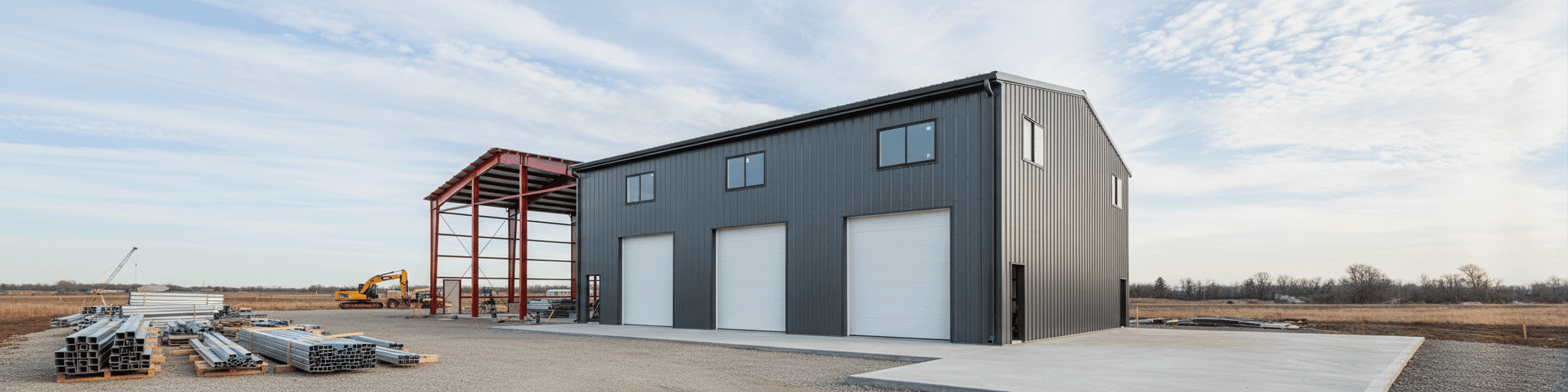

A 40×80 metal building delivers 3,200 sq ft of clear-span, column-free space that farmers, tradespeople, and small-business owners can tailor to virtually any use—equipment storage, workshop, retail bay, or recreation center—while the engineered red-iron frame, customizable roof pitch, and site-specific wind and snow loads ensure decades of low-maintenance service. The guide walks readers through every critical decision: selecting a flat, well-drained site; interpreting soil tests to choose among slab, pier-and-beam, or perimeter-wall foundations; integrating utilities early; and staging construction logistics so delivery trucks and crews move efficiently. Along the way it explains how 12- or 14-gauge steel gauges affect longevity, why a 2:12 roof pitch is standard, and how smart drainage and gravel base layers protect the investment, turning what could be an overwhelming project into a step-by-step, budget-controlled success.
Understanding 40×80 Metal Building Specifications
A 40×80 metal building delivers 3,200 square feet of clear-span, column-free space that farmers and small-business owners can precision-engineer—from roof pitch to steel gauge—to create distinct work, storage, and equipment zones under one durable, code-compliant red-iron shell.
Dimensional Analysis and Space Utilization Potential
A 40×80 metal building provides 3,200 square feet of usable space, striking an optimal balance between size, usability, and investment. The 40-foot width accommodates equipment and vehicles, while the 80-foot length allows for effective separation between work and storage areas.
This dimensional configuration makes it particularly popular among farmers, small businesses, tradespeople, and recreational users seeking versatile space without stepping up to a 100-foot length building [1]. The space utilization potential spans multiple applications – from equipment storage and workshops to commercial operations and recreational facilities.
This building size allows owners to organize different functional areas within a single structure while maintaining efficient workflow. When planning your layout, consider how to maximize this footprint for your specific needs, whether creating dedicated zones for different operations or designing multi-purpose areas that adapt to changing requirements.
Standard Structural Components and Engineering Features
40×80 metal buildings feature bolt-together structures precision-engineered from industrial-grade steel I-beams, often called "red iron" construction [4]. The primary components include main structural framing, secondary framing, arch-style PBR metal roof and wall panels, plus all necessary fasteners and sealants [4]. The key engineering advantage is the clear-span design that eliminates interior columns, maximizing the usable space and allowing flexible interior layouts [4][4].
These buildings come standard with a 2:12 roof pitch but can be engineered with pitches ranging from 1:12 to 4:12, with some suppliers offering custom pitches up to 6:12 [4]. The steel frame gauge significantly impacts structural strength and longevity, with common options including 14-gauge and 12-gauge steel [4]. Each structure is custom-engineered for the specific installation location, ensuring it meets local building codes and weather load requirements [4].
This engineered approach provides a trussless roof design that maintains the full 3,200 square feet of unobstructed interior space [4].
Ideal Applications: From Commercial to Residential Uses
The 3,200 square feet of clear-span interior space in 40×80 metal buildings adapts to diverse applications across multiple sectors. In commercial settings, these structures function effectively as retail spaces, warehouses, and office buildings with ample room for inventory and equipment [5].
For residential purposes, this footprint creates a comfortable four-bedroom family home, with two-story designs doubling the living space to 6,400 square feet [6]. The flexible layout accommodates extended families or separate living areas for rental suites and bed-and-breakfast businesses [6].
Agricultural applications include equipment storage, livestock housing, and processing facilities. Custom options for doors, windows, roof profiles, and structural elements allow owners to tailor the building to specific requirements, whether for business operations or living space [5].
Load-Bearing Capabilities and Durability Factors
40×80 metal buildings feature exceptional load-bearing capabilities designed to withstand multiple environmental forces. The primary structural system must account for dead loads (the building's weight), live loads (temporary weight from maintenance or occupancy), and collateral loads from systems like sprinklers and electrical installations [9]. Engineers typically design these structures with a minimum collateral load of 3 pounds per square foot (PSF), which accommodates standard insulation and lighting [9]. For specialized equipment or suspended elements, additional concentrated load calculations are essential—roof units like HVAC systems, suspended heaters, ductwork, and walkways all require precise structural support [9].
Environmental forces significantly impact metal building durability. Snow load creates vertical pressure that varies by density and accumulation—light, fluffy snow weighs approximately 5 pounds per square foot while packed snow with ice can reach 57 pounds per square foot [7]. Wind generates primarily horizontal pressure against building sides, with additional lift forces if doors or windows fail during storms [8]. Regional variations dramatically affect required load capacities; coastal areas face higher wind speeds while northern regions require greater snow load resistance [9].
Seismic considerations are equally important, with buildings designed to resist horizontal and vertical earthquake forces based on location-specific data rather than general zones [9]. The steel's superior strength-to-weight ratio enables these structures to meet or exceed all local building codes regardless of environmental challenges when properly engineered [8].
Planning Your 40×80 Metal Building Project
Strategic site selection—flat, stable, flood-free ground with utilities nearby—plus professional grading, drainage, and soil testing is the non-negotiable first step that safeguards your 40×80 metal building from water damage, budget overruns, and future settling.
Site Selection and Preparation Requirements
Choosing the perfect location for your 40×80 metal building sets the foundation for project success. We recommend prioritizing flat, stable areas away from flood-prone zones—this strategic choice minimizes excavation costs and protects your investment from water damage [11]. Your site needs to accommodate the building's footprint plus additional space for access roads, parking areas, and potential future expansion [11]. Here's a crucial tip from our experience: verify proximity to essential utilities like water, electricity, and sewer lines early in your planning, as extending these services to remote sites can significantly impact your budget [11]. Once you've selected your site, preparation begins with comprehensive clearing—removing all vegetation, rocks, debris, and existing structures from the building area [11]. Professional grading follows, creating that perfectly level surface essential for your foundation's integrity and your building's long-term stability [10].
Proper drainage planning is non-negotiable for protecting your investment. We recommend implementing strategic sloping (minimum 1% grade) away from the foundation, and depending on your site conditions, installing French drains or culverts for effective water management [11]. A pro tip: adding a compacted layer of crushed gravel not only improves drainage but creates an exceptionally stable base for your foundation [11]. Don't skip soil testing—this crucial assessment reveals your land's load-bearing capacity and drainage characteristics, directly informing your foundation design [11]. If testing reveals poor soil conditions, don't worry; solutions like deeper compaction or soil amendments can prevent future settling issues [10]. Planning for construction logistics now saves headaches later: establish clear pathways for equipment and delivery trucks with adequate turning radius for those large vehicles [11].
We always recommend designating a nearby staging area for materials and equipment—this simple step keeps your worksite organized and installation running smoothly [11]. If your building requires utilities, integrate this planning into your site preparation phase. Early coordination with local providers for electricity, water, or gas installation allows you to complete trenching and conduit work before pouring the foundation [11]. This proactive approach prevents costly retrofitting and frustrating service interruptions down the road. Don't forget erosion control—implementing measures like silt fences or straw bales is particularly crucial for sites near water sources or on sloped terrain [11].
Foundation Options: Slab, Pier, and Perimeter Considerations
Your foundation choice dramatically impacts your 40×80 metal building's performance, longevity, and functionality. Let's explore the three primary foundation systems to help you make an informed decision. Concrete slab foundations remain the most popular choice for enclosed metal buildings, serving double duty as both floor and structural support [12]. This monolithic design delivers exceptional stability for structures housing heavy equipment—standard slabs require a minimum 4-inch thickness, increasing to 5-6 inches when storing heavy machinery [12]. Pier and beam foundations offer a different approach, using concrete piers sunk deep into the ground to support each steel column, with underground ties preventing any shifting [13].
This option excels for buildings needing dirt or gravel floors, partially enclosed structures like equipment pavilions, or challenging sites with unstable soil or high water tables [12]. The elevated design provides valuable benefits—creating space between soil and building that enhances flood resistance while maintaining easy access to utilities for maintenance or upgrades [14]. Perimeter wall foundations (also known as perimeter footings) involve pouring concrete around your structure's exterior to support the frame's outer walls [12]. For projects requiring maximum stability, we often combine perimeter walls with concrete slabs or piers—this hybrid approach delivers exceptional strength [13]. Several key factors guide your foundation selection: soil conditions, local climate patterns, intended building use, equipment weight, and planned utilities like plumbing or electrical systems [12].
Your regional weather plays a crucial role—areas experiencing freeze-thaw cycles, expansive clay soils, or flood risks often require specialized foundation designs for optimal performance [14]. Here's something important to understand: metal buildings exert different forces than conventional structures, especially at those critical anchor bolt connections where steel columns meet concrete [12]. Your foundation must reliably resist all loads from primary frames under various conditions including wind, snow, and seismic activity [12]. We strongly recommend consulting with a licensed structural engineer experienced in metal building requirements—this expertise ensures your foundation properly supports your entire structure [12].
Navigating Permits, Zoning Regulations, and Building Codes
Building permits serve as your legal authorization to construct while ensuring your 40×80 metal building meets all safety standards [15]. The process starts by submitting detailed blueprints and specifications to your local building department, where officials thoroughly review your project for code compliance, structural loading requirements, zoning restrictions, safety measures, and potential conflicts with easements or utilities [15]. Good news: most jurisdictions follow the International Building Code (IBC), which standardizes requirements while allowing for local variations addressing region-specific challenges like hurricane winds or seismic activity [15]. Here's crucial advice: always secure permits before investing in site preparation or materials.
Starting construction without proper permits can lead to severe consequences—daily fines up to $100, potential demolition orders, insurance complications, and future property sale issues [15]. Budget wisely for permits, as costs vary dramatically by location: rural areas may charge as little as $150 while metropolitan regions can reach $7,500, though most 40×80 building permits fall between $550-$2,000 [15][16]. If you're planning a commercial structure, expect more rigorous requirements than residential projects, especially regarding public access and safety features [15]. Start by verifying zoning regulations—these rules determine whether your metal building is permitted at your chosen location and may restrict height, area, style, and intended use [15].
If current zoning doesn't align with your plans, don't give up; you can often pursue a variance by securing neighbor support and presenting your case to planning officials [15]. Properties within HOA jurisdictions require extra diligence—you'll need both municipal permits and HOA approval to avoid conflicts [15]. Remember to include specialized sub-permits in your planning for systems like electrical, plumbing, drainage, fire suppression, and foundation work [15].
Creating a Realistic Budget and Timeline
A 40×80 metal building typically costs between $86,400 and $128,600 fully installed [17][18]. Understanding the cost breakdown helps you budget effectively: the building kit runs $18-$22 per square foot, concrete foundation adds $4-$8 per square foot, and construction labor contributes $5-$10 per square foot [17]. Height significantly impacts pricing—a 12-foot structure starts around $57,600 while a 20-foot building reaches $70,400, with each additional 2-foot increment adding $3,000-$7,000 [18]. Here's an important budgeting tip: standard quotes often exclude critical elements like site preparation, permits, and interior finishing, which can add 20-30% to your total investment [18]. Successful projects require realistic timeline expectations.
Your 40×80 building will progress through these sequential phases: design and engineering (2-4 weeks), permitting (2-6 weeks depending on your jurisdiction), site preparation (1-3 weeks), foundation curing (1-2 weeks), and the exciting steel erection phase (typically just 2-3 days) [18]. Plan for a complete timeline of 4-8 weeks from order to completion, though local permit processing and contractor availability can affect this schedule [18]. Pro tip: weather conditions can extend timelines, especially during foundation work and steel erection, so build in buffer time during your region's challenging seasons. Smart budgeting includes a 5-10% contingency fund for market fluctuations and unexpected challenges [18]. The steel market has experienced considerable volatility—some structural components saw price increases up to 91% between 2020 and 2021 [18].
Our recommendation: obtain multiple detailed quotes that clearly outline included and excluded items, and consider securing materials early when possible to minimize exposure to price fluctuations. Your foundation represents a significant investment at approximately $16,000 ($4-$6 per square foot), so budget accordingly [17]. Labor costs vary dramatically by region, ranging from $16,000 to $32,000 for the complete project, making local contractor quotes essential for accurate budgeting [18].
Design and Customization Options
Strategic insulation—R-8 to R-30 fiberglass, rigid foam, or insulated panels matched to your climate zone—cuts lifetime energy costs while IECC/ASHRAE vapor and air-barrier rules keep your 40×80 metal building condensation-free and code-compliant.
Climate Considerations: Insulation and Energy Efficiency Solutions
Metal buildings conduct heat easily, making proper insulation essential for climate control in your 40×80 structure. Without adequate insulation, your building becomes susceptible to temperature fluctuations, increased energy consumption, and condensation issues [23]. Three primary insulation types serve different climate needs: fiberglass insulation (the most cost-effective option), continuous insulation systems with rigid foam cores, and insulated metal panels that provide superior thermal properties [23]. Fiberglass options range from standard single-layer systems to high-R configurations that meet stringent energy codes in extreme climates [23]. The insulation's R-value—measuring resistance to heat flow—should align with your specific climate zone requirements, with values typically ranging from R-8 to R-30 for metal buildings [23].
For controlling moisture in humid environments, vapor retarders with appropriate perm ratings (0. 02 to 0. 9) prevent condensation that can damage both structural components and insulation performance [23]. Energy codes have transformed metal building insulation practices, with requirements varying by climate zone according to International Energy Conservation Code (IECC) and ASHRAE 90. 1 standards [24].
The IECC recognizes specific metal building roof constructions, including liner systems that require uninterrupted vapor barriers below purlins with unfaced insulation between them [24]. Climate zone dictates minimum insulation values—for example, filled cavity systems range from R-19 to R-30 depending on location [24]. Addressing air infiltration remains essential regardless of climate, with air barriers becoming mandatory in buildings constructed under IECC 2015/ASHRAE 90. 1-2013 code cycles and newer [23]. Strategic insulation placement not only improves comfort but delivers significant energy cost savings throughout the building's lifetime [20].
Using 3D Design Tools for Visualizing Your 40×80 Building
Modern 3D design tools transform how you plan and visualize your 40×80 metal building before breaking ground. These intuitive platforms let you create detailed virtual models that bring your concept to life with precise spatial relationships. Most tools offer both template-based starting points and blank-canvas options, accommodating various experience levels [25]. Begin by selecting from customizable templates for garages, workshops, barndominiums, or commercial spaces, then adjust dimensions to your specific 40×80 requirements [25].
The visualization process goes beyond basic floor plans by allowing interior and exterior customization—position doors, windows, and color schemes while evaluating their aesthetic and functional impact [26]. For interior planning, place scaled objects to optimize workflow and space utilization, preventing expensive post-construction modifications [25]. Many platforms include specialized templates for common applications like workshops with lean-tos, multi-bay garages, or commercial warehouses that can be adapted to your 40×80 specifications [25]. These tools particularly excel at demonstrating how clear-span designs maximize usable space without interior columns [27].
After finalizing your design, most platforms connect you directly with suppliers for competitive quotes, typically from multiple manufacturers [25]. The completed virtual model then becomes a reference point for professional engineers who convert your concept into detailed blueprints and construction documents [25]. Desktop browsers generally provide the optimal experience for these applications, with Chrome, Firefox, Edge and Safari offering the best performance [27].
Construction and Implementation Process
Before a single 40×80 steel beam is set, insist on full concrete cure time—often weeks—to prevent the foundation cracks that can silently doom your entire metal building.
Pre-Construction Preparation and Material Handling
Successful metal building projects begin with thorough site assessment and preparation. The process starts with professional surveying to establish property lines and building placement, followed by soil testing to determine if your land can support the structure and provide proper drainage [28]. These tests reveal critical load-bearing capacity information that directly impacts foundation design choices [28]. After completing assessments, clear the site by removing obstacles, vegetation, and existing structures that might interfere with construction [29]. This clearing establishes a rough grade before moving to precise grading that creates a level surface essential for your 40×80 building's structural integrity [29]. With your foundation type already selected during the planning phase (as discussed in Foundation Options), construction readiness depends on proper curing time. For concrete pad foundations, dimensions must match your 40×80 building specifications exactly to ensure proper anchoring and certification compliance [30].
Here's a critical point many overlook: concrete requires full curing—typically several days to weeks—before construction can begin, even when it appears dry [28]. This waiting period isn't negotiable; premature building disrupts crystal formation, leading to foundation cracking or crumbling that compromises your entire structure [28]. For sites with slopes or uneven terrain, experienced installation teams can adjust column lengths during construction, but we recommend ordering the tallest available leg height to ensure sufficient material for these adaptations [30]. Effective material handling prevents costly delays and damage during the construction phase. Schedule material delivery only after your site is fully prepared and any concrete has completely cured [28]. Coordinate logistics with your supplier to ensure all components arrive in the proper sequence [28]. Create a designated staging area near the construction site that provides sufficient space for equipment maneuvering while protecting materials from contamination and damage [29].
This area should remain organized throughout the construction process to maintain workflow efficiency and prevent loss of critical components [28]. Finalize all pre-construction preparations by running necessary utilities to the site, including power, water, and gas [29]. This often requires obtaining additional permits and working with licensed contractors to ensure proper installation [29]. The complete pre-construction phase typically spans 1-2 months, though permit acquisition in some jurisdictions may extend this timeline considerably [29]. Create a detailed checklist covering site preparation, foundation requirements, material delivery logistics, and permit verification to prevent common mistakes [28]. Thorough planning during this phase directly correlates with smoother construction operations and fewer expensive mid-project adjustments.
Step-by-Step Steel Frame Erection Guide
Steel frame erection creates the critical skeleton for your 40×80 metal building. Begin with thorough pre-erection preparation by inspecting all steel components for damage and verifying quantities match your building plans [31]. Establish a clear sequence of assembly and position materials strategically around the construction site to minimize handling during installation [32]. Before lifting any components, prioritize safety with proper personal protective equipment including hard hats, steel-toed boots, gloves, and fall protection systems [31]. When erecting the initial frame, start by installing the corner columns, ensuring they're perfectly plumb using levels and transit instruments [32]. Secure these columns to your foundation using anchor bolts torqued to manufacturer specifications [31].
Next, connect the main beams to columns using high-strength bolts—typically tightened in a specific sequence from the center of connections outward [32]. After establishing the primary frame, install purlins and braces according to your building design specifications [32]. Position these secondary components using measurement tools to maintain proper spacing and alignment—typically 24 to 36 inches apart depending on local weather conditions and building requirements [32]. The correct installation of these elements is crucial for the structure's ability to withstand wind and snow loads [31]. Frame calibration represents a critical step often overlooked by inexperienced builders. Once the initial frame is erected, conduct thorough measurements to verify all components are properly aligned before proceeding [32].
Check diagonal measurements between opposite corners to confirm the frame remains square, and adjust as needed using come-alongs or turnbuckles [31]. This calibration prevents compounding errors that could compromise structural integrity [32]. With the initial frame properly aligned, proceed to install subsequent frames following the same methodical approach [32]. Each additional frame should connect to the previous one using properly torqued bolts and specified bracing [32]. Maintain constant measurement verification as you progress, as even small alignment errors can accumulate across the 80-foot length [31]. Once all frames are erected, conduct a comprehensive pre-covering inspection to verify every connection is secure and the entire structure maintains proper alignment before proceeding to roofing and siding installation [32].
Roofing, Siding, and Exterior Component Installation
Installing the roofing and siding represents a critical phase that determines both performance and appearance of your 40×80 metal building. Begin by installing purlins (roof support members) and girts (wall support members) according to engineering specifications [35]. These secondary components provide the attachment points for panels and transfer loads to the main structural frame. For the roof installation, start at the eave and work upward toward the ridge, ensuring each panel properly overlaps the previous one [34].
Most metal roofing systems feature factory-applied sealant that creates weather-tight connections between panels when properly compressed [35]. Proper fastener installation is crucial—overtightening creates dimples that collect water while under-tightening leads to leaks and potential panel detachment [34]. When installing siding panels, maintain consistent spacing and alignment to prevent water infiltration and ensure structural integrity. Modern wall systems often utilize tongue-and-groove connections that allow panels to slide into one another for faster installation and better weatherproofing [35].
For buildings requiring superior thermal efficiency, consider Color selection affects both aesthetics and energy efficiency, with lighter colors reflecting heat while darker options absorb it [33]. The standard 26-gauge metal siding can be replaced with alternative materials like Hardie board or faux stone if desired, though this requires additional framing modifications [33]. Window and door openings require specialized framing to maintain structural integrity and prevent water infiltration—these areas demand particular attention to flashing details and sealant application [35]. Throughout the installation process, maintain proper safety protocols including fall protection systems when working at heights [34].
Quality Control Checkpoints and Inspection Guidelines
Quality control throughout construction ensures your 40×80 metal building meets safety standards and performs as engineered. Begin with material verification—inspect all steel components upon delivery for compliance with project specifications and check mill certificates to confirm material grades [36][37]. Look for visible defects such as rust, cracks, or dents before accepting materials, and ensure proper storage to prevent damage before construction [38]. During fabrication, verify that all cutting follows approved shop drawings and inspect welding quality thoroughly [38]. Only certified welders should perform work, with all critical welds receiving visual inspection and ultrasonic testing where specified [38].
The assembly phase requires precise alignment verification—each component must be positioned exactly as designed, with temporary supports used during connection [38]. Measure and document any deviations promptly, addressing them before proceeding [38]. Surface preparation significantly impacts building longevity—all steel should be cleaned of contaminants before applying protective coatings, with thickness measurements taken regularly to ensure consistent application [38]. Before project completion, conduct a comprehensive final inspection to verify structural alignment accuracy, connection security, and coating integrity [38]. This inspection should generate documentation that confirms compliance with design requirements and building codes [36][38].
Implement a formal tracking system for all inspection points, maintaining records of any corrections made during construction [36]. This documentation becomes invaluable for insurance purposes and serves as your reference guide for future maintenance or modifications [36]. Remember, thorough quality control during construction translates directly to reduced maintenance costs and extended building life—key advantages that make steel buildings a smart long-term investment.
Cost Analysis and Long-Term Value
Before you celebrate a $25,000 kit price, brace for the real 40×80 metal-building bill—engineering for coastal winds, seismic bracing, a $16,000 slab, and up to $32,000 in labor can more than double your cost to $60,000-plus.
Current Pricing for 40×80 Metal Building Kits (2023-2024)
The base price for a standard 40×80 metal building kit typically ranges from $20,000 to $25,000, providing 3,200 square feet of clear-span space [39]. This translates to approximately $6. 25-$7.
80 per square foot for basic steel components—representing just the starting point before essential additions. Understanding these baseline costs helps you budget effectively, but the final investment depends on numerous project-specific factors that we'll explore below. When evaluating kit pricing, it's important to recognize what's included in these base figures.
Standard packages typically contain primary and secondary framing, metal panels, and basic fasteners [39]. However, your complete project requires additional components and services. At National Steel Buildings Corp, we help clients understand the full scope of their investment through detailed consultations and transparent pricing for all project elements.
Factors Affecting Total Project Cost
Your 40×80 metal building's total investment extends well beyond the base kit price. Several critical factors shape the final cost: Regional Requirements: Local building codes vary dramatically across the country. High-wind coastal regions, heavy-snow northern areas, and seismic zones each demand specific engineering enhancements that affect pricing [39][41]. These aren't optional upgrades—they're essential for safety and code compliance.
Market Conditions: Steel prices fluctuate with global supply and demand, potentially impacting your project timeline and budget [41]. Working with experienced suppliers helps navigate these market variations effectively. Foundation and Site Work: As detailed in our Planning section, foundation costs typically add $16,000 for a concrete slab ($4-$6 per square foot), though this varies with soil conditions [40][41]. Installation Labor: Professional installation runs $5-$10 per square foot ($16,000-$32,000 total), varying by region and project complexity [40][41].
Customization Elements: Your specific needs drive additional costs—specialized doors, windows, and the insulation systems discussed in our Design section each contribute to the final investment [40][39]. Understanding these factors empowers better decision-making.
Comparing Costs with Traditional Construction Methods
Metal buildings typically cost $15-$20 per square foot for basic kits, with turnkey installation ranging from $24-$43 per square foot [42]. While this represents approximately 15% higher initial investment than traditional pole barn construction, the long-term financial picture tells a different story [43]. The structural differences explain much of this cost variation. Traditional pole barns rely on wood frames connected with screws and nails, while metal buildings feature engineered steel I-beam frames with precision-bolted connections [43].
This fundamental engineering difference creates substantial performance advantages that translate directly to your bottom line. Initial Cost Comparison: – Pole barns: $14-$16 per square foot (kit), $21-$26 (turnkey) – Metal buildings: $16-$19 per square foot (kit), $24-$30 (turnkey) [43] The foundation requirements contribute significantly to this difference. While pole barns can use simpler post-frame designs, metal buildings require engineered concrete foundations—adding $15,000-$25,000 to a 40×80 project but providing unmatched stability and decades of reliable service [43]. What makes metal buildings the smarter investment?
Insurance premiums run approximately 30% lower due to steel's fire-resistant properties [43]. Maintenance costs remain minimal compared to wood structures that require regular treatments, repairs, and eventual replacement. In regions with extreme weather, metal buildings handle environmental challenges more efficiently, often meeting code requirements with less additional engineering [41].
Return on Investment: Maintenance, Longevity, and Resale Value
The true value of steel construction emerges over time. Annual maintenance costs for metal buildings average just 1% of initial investment, compared to 2-4% for wood structures [44]. For your 40×80 building, this difference translates to $5,000-$14,000 in annual savings—money that stays in your business rather than going toward repairs. 30-Year Financial Advantage: – Maintenance savings: $56,000-$120,700 [45] – Insurance savings: $6,000-$15,000 ($200-$500 annually) [45] – Energy savings: $3,000-$9,000 ($100-$300 annually) [45] – Total savings: $65,000-$150,000 [45] These aren't theoretical numbers—they reflect real differences in material performance.
Wood structures require periodic re-roofing, siding replacement, and treatment for pests and moisture damage. Steel buildings resist these issues inherently, maintaining structural integrity for decades with minimal intervention. Perhaps most importantly, metal buildings typically appreciate 20-30% in resale value over 20 years, beyond standard property appreciation [44]. This value retention stems from steel's enduring performance—when wood structures near replacement age at 30 years, metal buildings continue providing reliable service.
For business owners and investors, these long-term economics make the choice clear. The slightly higher initial investment in quality steel construction pays dividends through reduced operating costs, lower risk, and stronger asset value. This financial advantage, combined with the operational benefits of clear-span design and adaptability, positions your 40×80 metal building as a cornerstone investment in your future success.
- A 40×80 metal building delivers 3,200 sq ft of clear-span, column-free space.
- Standard 2:12 roof pitch can be customized up to 6:12 to meet snow/wind loads.
- Site must be flat, flood-free, with 1 % grade away and crushed-gravel base for drainage.
- Choose slab for heavy gear, pier-and-beam for gravel floors or flood zones.
- Always run soil tests and hire an engineer to size anchors for local codes.
- https://www.torosteelbuildings.com/40-x-80-steel-building/
- https://www.buildingsguide.com/standard-sizes/40×80-metal-building/?srsltid=AfmBOooXqBlmzbwsNWucIx9d7hdBl1U7DZA1GgMxaYpPBTSMJPwSAMOU
- https://chinasteelbuildsales.com/40×80-metal-building-cost/
- https://gensteel.com/steel-building-kits/base-building-packages/40×80/
- https://www.buildingsguide.com/standard-sizes/40×80-metal-building/?srsltid=AfmBOorYehI1Icm-a981SAfAMQ-OB3kS-itGbuk83hiGO0UgIZ6j17Fv
- https://www.buildingsguide.com/metal-building-kits/homes/40×80-metal-home/?srsltid=AfmBOooiUkazM2m9dlcUI4G9QX2UUSZeyg3wUmBPGlk3-HWYN7Anc2jV
- https://www.alliedbuildings.com/understanding-snow-load-limits-for-steel-buildings/
- https://www.rhinobldg.com/blog/metal-building-construction-loads-101
- https://norsteelbuildings.com/us/building-codes-permits-us/steel-building-codes-loads/
- https://prebuiltstructures.com/site-preparation-guide/
- https://lionbuildings.com/how-do-i-prepare-my-site-for-a-steel-building-install/5/
- https://champion-buildings.com/blog/what-is-the-best-foundation-for-a-metal-building
- https://www.rhinobldg.com/blog/steel-building-foundations-facts
- https://www.groundworks.com/resources/pier-and-beam-vs-slab-foundation/
- https://www.buildingsguide.com/build/metal-building-codes-permits/?srsltid=AfmBOor6s1jD4Biz7BlQEm_uG2N2vfS03XPcA5lU3YwiKDlKQ6WS5zTE
- https://titansteelstructures.com/metal-structure-tutorials/permits-and-building-codes-what-you-need-to-know-before-installing-your-metal-building/
- https://www.buildingsguide.com/standard-sizes/40×80-metal-building/?srsltid=AfmBOori0iaG8lvWa-VhRMYYdcnu0TzLMpVjmBmfYFcc0zypfXgv3sB1
- https://www.steelcobuildings.com/metal-building-cost-a-comprehensive-guide-to-budgeting-and-planning/
- https://www.metalbuildingoutlet.com/40×80-metal-building-kit/
- https://www.uspatriotsteel.com/sizing/40×80-metal-building/
- https://www.buildingsguide.com/metal-building-kits/homes/40×80-metal-home/?srsltid=AfmBOor9Z1q8Lkf_vyDYRNVsWxWNg1yRvhpvNIn8CRqX5p_deTtAeGno
- https://www.buildingsguide.com/standard-sizes/40×80-metal-building/?srsltid=AfmBOopf4ghSzDEuMTbcnqxQ-Cgea719p-ugdYc5LKxmRlpcyZc_a2w8
- https://therm-all.com/a-guide-to-metal-building-insulation/
- https://www.cecobuildings.com/blog/energy-code-insulation-solutions-metal-buildings/
- https://www.buildingsguide.com/design/3d-metal-building-designer/?srsltid=AfmBOopE-tR27tn2W-LbWnm2DY25JGilyn0mjH3moq1DGlJli5iMbXBR
- https://www.muellerinc.com/3d-tool
- https://mortonbuildings.com/design-your-morton-building
- https://www.worldwidesteelbuildings.com/blog/pre-construction-checklist-for-metal-buildings/
- https://www.buildingsguide.com/build/metal-building-site-prep/?srsltid=AfmBOoqW_OaYNu35DqMTqA9q2m4YN27qtKkjeHGCUu7p0FYUAkZidSnu
- https://www.steelbuildingsandstructures.com/blog/metal-building-installation-checklist/
- https://www.steelcobuildings.com/how-to-build-steel-building/
- https://www.clarisdesignbuild.com/8-essential-steps-in-the-steel-erection-process/
- https://www.buildingsguide.com/build/how-to-build-a-metal-home/?srsltid=AfmBOooLQlsKF7QIpuWxd6QqBX0JBoVEeY5xs1AqryZfuCX7BX51e7Ze
- https://www.westernstatesmetalroofing.com/metal-roofing-siding-installation-guides
- https://blog.mcelroymetal.com/metal-roofing-and-siding/installing-metal-buildings-101
- https://www.calahan.com/a-guide-to-metal-building-quality-control-in-construction/
- https://quollnet.com/chk/construction/steel-materials-fabrication-inspection-checklist
- https://goaudits.com/checklist/structural-steel-quality-control-checklist/903/101/
- https://www.uspatriotsteel.com/blog/how-much-does-a-40-x-80-metal-building-cost/
- https://www.buildingsguide.com/standard-sizes/40×80-metal-building/?srsltid=AfmBOoowyPaN8oUJuXuSUjP_qUpjpV7z7MV8RvXWpKZKBsfCa-OcRH49
- https://americansteelinc.com/blog/steel-building-costs-prices-guide/
- https://www.buildingsguide.com/metal-building-prices/?srsltid=AfmBOopySEEevAg8_gZKfbQSEpSpEoa-i_01Wn9AGfQzkmhvF3P5CwUL
- https://www.buildingsguide.com/build/pole-barn-vs-metal-building/?srsltid=AfmBOor8gZ5mIYp9Vj-tmY7L4SXYSejgflzL5ic1gn-iP5fedEV07Zoo
- https://www.summitsteelbuildings.com/20-year-cost-comparison
- https://www.indacometals.com/resource/metal-building-cost-30-year-comparison