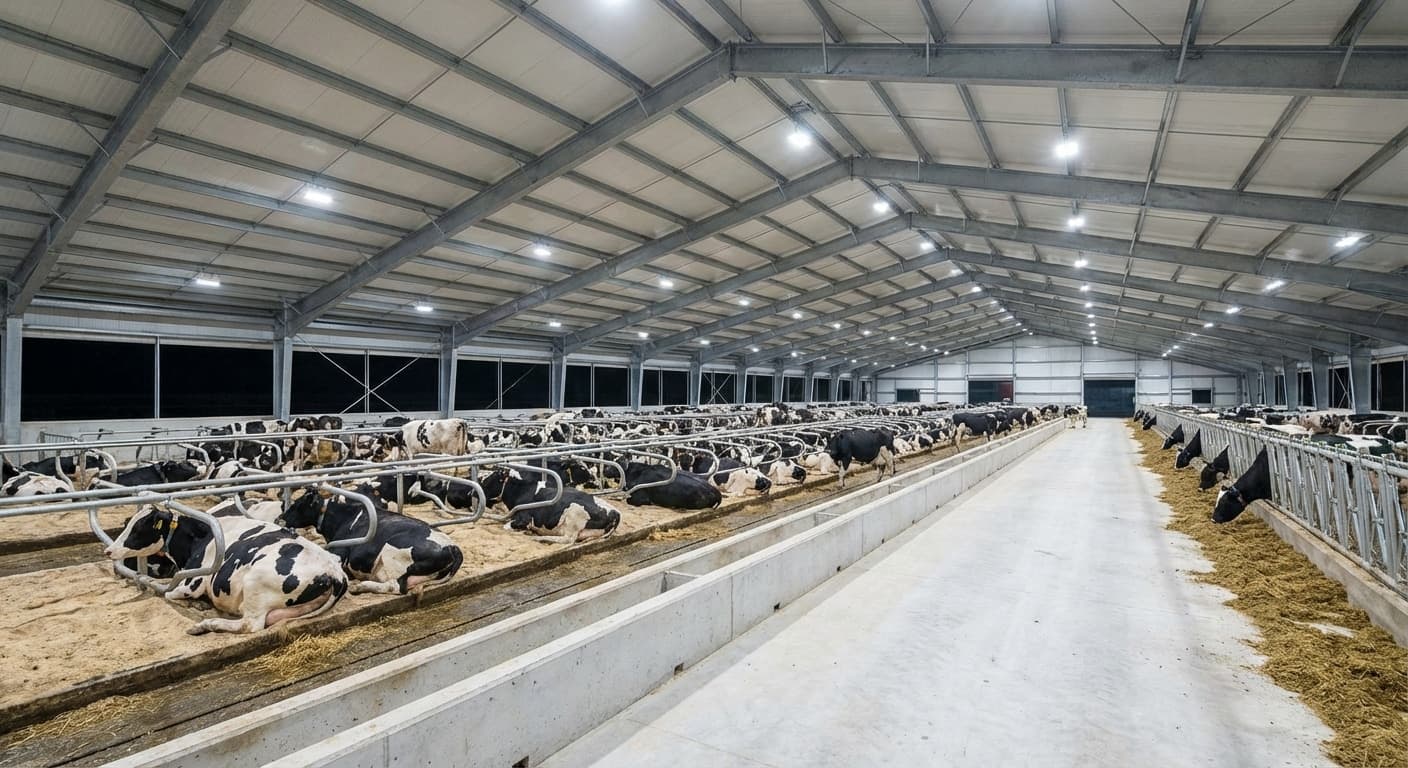

The basic formula is simple: multiply the required square footage per animal by your total head count. What makes it complex is that square footage shifts based on housing type, animal weight, and feeding management. [1] For enclosed, unheated bedded pack barns housing finishing cattle, FASS Guidelines require 35 ft² per head. A 500-head operation needs 17,500 ft² of floor space (35 ft²/head x 500…
Determining Optimal Floor Space per Animal
Calculating square footage using head count and weight
The basic formula is simple: multiply the required square footage per animal by your total head count. What makes it complex is that square footage shifts based on housing type, animal weight, and feeding management. [1] For enclosed, unheated bedded pack barns housing finishing cattle, FASS Guidelines require 35 ft² per head. A 500-head operation needs 17,500 ft² of floor space (35 ft²/head x 500 head).
That's precise–and with Bunk space runs parallel to floor space as a constraint. In older buildings, it's often the first limitation you'll hit. [1] For finishing cattle with free-choice grain access, FASS Guidelines require 6 inches of bunk space per head. That 500-head operation needs 3,000 inches, or 250 linear feet, of bunk.
When feeding from a single side, bunk length sets your minimum building length. Floor area divided by bunk length determines width: 17,500 ft² / 250 ft = 70 ft. Bunk requirements can override floor-space calculations entirely when determining your building's footprint.
Balancing pen area for beef cattle and dairy cows
Beef and dairy cattle have different space needs–not just because of size, but because of management and social structures. Beef cattle operate within strict hierarchies. Animals lower in the pecking order–typically younger heifers–face restricted feed access in overcrowded conditions. A 1,300 lb cow on a bedpack requires 50 ft² per head.
An 800 lb bred heifer needs less–but housing type and feeding frequency shift the requirement. [3] Dairy cows require per-animal resting space allocations. In freestall systems, that means one stall per animal sized to Holstein-specific dimensions. [4] Because dairy management is intensive–with lactation, dry periods, and calving cycles–underspacing creates compounding health risks.
Beef pen design protects feed access for subordinate animals. Dairy pen design must also protect rest cycles and prevent injury during repeated lying and rising movements. Don't apply beef space figures to dairy housing or vice versa. Within each category, size to the heaviest animal in the group, not the average.
Integrating feed bunk dimensions into overall layout
Bunk barrier type determines how much linear space each animal uses–and therefore how long your building needs to be. For dairy operations, 24-inch headlocks are standard. But only 80% fill at peak feeding times because cows can't always find open slots. [5] You need more total headlock count than a simple animal-to-space ratio suggests.
30-inch headlocks–recommended for close-up and post-fresh cows–reduce total lock count but increase required bunk length per animal. [5] Post-and-rail barriers offer more movement freedom but generate aggressive displacement at the bunk. This undercuts space efficiency gains from their simpler design. [5] For beef cattle, feeding alleys require 10 feet of clear width for feeders and 12 feet for mature cows–enough for one animal at the bunk plus two to pass behind.
[6] (Feed delivery alley specifications are covered in Layout Strategies below. ) Total building width equals the sum of resting area, bunk, and compliant delivery alley. You can't back-calculate it from floor space alone.
Designing Stall and Freestall Dimensions for Health
Standard stall width and length guidelines
Your stall dimensions determine whether your cows stay healthy or develop injuries–it's that simple. For freestalls housing 1,300-1,500 lb cows, you need stalls at least 48 inches wide and 9 feet long. That 9-foot length gives your cow 68-70 inches for her body plus 38-40 inches of forward space to thrust her head down when she stands up. [7] Cut that length short and you're forcing an open-front design with a 32-inch opening–workable for retrofits, but you'll build it right the first time with proper dimensions.
[7] Tie-stalls work differently: calculate length by multiplying rump height by 1. 2, and set width at 54 inches minimum for mature Holsteins–the old 52-inch standard didn't account for how cows actually rest. [8] Your dry cows and special-needs animals need 6 extra inches of width. [8] Here's what happens when you get it wrong: Ontario data from 317 tie-stall farms found 90% didn't meet current specs for stall length, width, tie-rail height, or chain length.
Result? Hock lesions in 44% of cows and widespread lameness. [9] Size every stall to your largest animal, not the average–undersized stalls injure the biggest 20% of your herd.
Head‑lunge and bunk space requirements
Your cow needs 10 feet from tail to nose when she lunges forward to stand–block that space and you'll see injuries pile up. In head-to-head configurations, build platforms at least 17 feet long so cows on opposite sides don't interfere with each other. [10] Shorter 14-15 foot platforms force side lunging, which means diagonal lying and manure everywhere it shouldn't be. [10] Keep posts, pipes, and equipment out of that lunge zone–position structural elements between stall dividers, never in front of them.
[11] Bunk space follows the same no-compromise rule. As covered in floor space calculations, subordinate cows get pushed out when space runs short. You need 30 inches of linear bunk space per cow–that's the Ontario standard for all pen types, especially critical in close-up and fresh cow pens. [11] Standard 2-row barns give you only 24 inches per cow; 3-row layouts drop to 18 inches.
Both fall short of preventing displacement. [11] Calculate your bunk length first, then let it drive your building dimensions–not the other way around.
Adjustments for mature vs. growing livestock
Your growing heifers need completely different setups than mature cows–not scaled-down versions of the same stalls. Keep heifers under 400 lbs out of freestalls entirely; bedded packs match their size and movement better. [13] From 400 to 1,200 lbs, freestalls work, but you're designing for safe movement and rest, not udder hygiene like you would for lactating cows.
[13] Heifers tolerate more stall surface options–mattresses, manure solids, organic bedding all work where they'd cause mastitis in lactating pens. [13] Width matters most: research proves cows in 50-inch stalls lie down 42 minutes more per day than those in 42-inch stalls. Narrow stalls force perching–front hooves on, back hooves off–which wrecks legs and hooves.
[12] Size heifer stalls to the biggest animal in each weight group right now, not where she'll be in six months. Your heifer groups change constantly as animals grow, so build in adjustability.
Layout Strategies to Enhance Animal Movement and Welfare
Single‑side versus dual‑side feeding configurations
Your feeding layout choice drives your entire building width. It's simple math you can run right now. Take a 200-head beef operation: at 15 inches of bunk space per animal, you need 250 feet of total bunk length. [5] Single-side feeding?
That 250 feet becomes your building's length. With 10,000 ft² total floor area, you get a 40-foot-wide building. Dual-side feeding? Split that bunk to 125 feet per side.
Same floor area now gives you an 80-foot-wide building. [5] That's a 40-foot width difference from one decision. Here's what each layout delivers: Single-side bunks: – Feed delivery stays outside the pen – Less equipment traffic through animal areas – Simpler manure management [14] Dual-side bunks: – Better feed access for subordinate animals – More entry points reduce competition – Critical for herds with strong pecking orders [5] Remember: as covered in the feed bunk design section, you'll need 18-20 feet of delivery alley width regardless of which configuration you choose. [5] That's non-negotiable space for safe equipment operation.
Optimizing aisle width and clearance for equipment
Aisle width affects two things that matter to your bottom line: equipment access and air quality. Minimum widths that work: – 12 feet: Bare minimum for equipment or two animals passing [16] – 14 feet: Standard for main aisles–allows safe equipment operation and cross-ventilation [15] – 16 feet: Best for high-traffic areas where multiple activities overlap [16] Why these numbers matter: At 12 feet, you're one stepped-out cow away from a stuck loader. At 14 feet, your operator can turn equipment, extend hydraulic arms, and exit the cab without creating hazards.
At 16 feet, feed delivery, bedding removal, and vet access can happen without moving animals. Think beyond the equipment footprint. Your operator needs room to: – Turn the machine – Manage attachments – Exit safely in emergencies – Work without spooking animals Build 14-foot aisles minimum.
Where you expect cross-traffic–feed intersections, main access points–go 16 feet. It's cheaper to build wide now than to move animals every time equipment enters later.
Future‑proofing for herd expansion and add‑ons
Plan for growth before you break ground.
Your best move?
Phase your construction to match cash flow and herd growth.
Implementing Livestock Housing Building Dimensions with Steel Solutions
Leveraging pre‑engineered steel frames for precise dimensions
Pre-engineered steel frames solve a simple problem: what you calculate is what you get. Your stall dimensions stay exact from blueprint to barn floor. No field measurement errors. No compressed alleys. No surprises that force animals into spaces too tight for their welfare. Clear-span framing gives you total flexibility.
Without interior columns, you place stalls exactly where animals need them–not where posts dictate. Your head-lunge zones stay unobstructed. Your feed alleys maintain proper width. For operations needing precise dimensions, size 20-30% wider than minimum calculations. This buffer ensures dominant animals can't block access points and every animal gets consistent feed and water access. Frame selection matters at scale.
For dual-sided feeding layouts and large freestall barns, heavier gauge steel delivers the stability you need. Match your column specifications to local wind and snow loads–not generic minimums. Before any steel gets cut, modern design tools let you place scale models of livestock, equipment, and partitions to verify clearances and movement paths. You'll spot conflicts before fabrication starts, not after installation.
Ensuring code compliance and durability
Building codes change by postal code. What passes inspection in one county fails in the next. That's why certified engineers calculate loads specific to your exact location–not just your state or province. They factor everything: the structure's weight, equipment loads, snow accumulation, wind forces, even seismic requirements where applicable. These loads work together. Snow plus wind creates different stresses than either force alone. Peak occupancy plus equipment weight compounds the load.
Get any calculation wrong and you face structural failure, failed inspections, or costly rebuilds–problems that only surface after construction starts. Agricultural permits demand detailed specifications. Local zoning adds more constraints on setbacks, heights, and permitted uses. [23] But here's what makes steel the right choice for livestock: it resists everything that destroys other materials. Ammonia-rich air that rots wood? Steel shrugs it off. Pests that compromise framing?
Can't penetrate steel. Weather cycling that loosens connections? Steel stays tight. [24] Yes, protective coatings matter. Site orientation affects longevity. Proper ventilation design prevents moisture buildup.
Single‑source project workflow from design to erection
Single-source delivery eliminates the translation errors that plague multi-vendor projects. The team that models your stall rows cuts the steel to match. No interpretation. No field adjustments. No surprises. Components arrive ready to assemble–prefabricated, precut, pre-drilled, pre-welded.
Your crew puts pieces together like a precision kit, not a puzzle. That's how steel buildings go from delivery to completion in two to three weeks, while conventional construction drags on for months. Site preparation determines whether that timeline holds. Grade it right, compact it properly, and assembly stays on schedule. Skip proper prep and delays compound–no amount of prefabrication fixes a bad foundation. Smart builders use 3D visualization before cutting any steel.
You'll see exactly how stalls, equipment clearances, and structural members work together. Conflicts get solved on screen, not on site. Changes after fabrication cost time and money you can't recover. What single-source really delivers is accountability. From your initial animal welfare calculations through final construction, one team owns the entire project. The dimensions you calculate for healthy livestock are the dimensions your animals actually get.
- Size every stall to the largest animal, not the average, to prevent injury.
- Bunk length, not floor area, often sets minimum building length and overrides square-foot rules.
- Beef and dairy space standards differ–never swap one set of numbers for the other.
- Freestalls under 48 in wide and 9 ft long cut daily lying time and raise lameness risk.
- Single-side bunks shrink building width 40 ft versus dual-side for the same head count.
- Pre-engineered steel frames keep calculated stall and alley dimensions exact from plan to barn.
- Build 14-ft aisles minimum; 12 ft risks stuck equipment and 16 ft allows simultaneous tasks.
- https://extension.psu.edu/beef-cattle-spacing-requirements/
- https://www.barnworld.com/uncategorized/what-are-the-ideal-shelter-sizes-and-spaces-for-various-farm-animals/
- https://extension.psu.edu/beef-cow-pen-and-bunk-spacing-requirements/
- https://www.vet.cornell.edu/animal-health-diagnostic-center/programs/nyschap/modules-documents/housing-bedding-and-fly-control
- https://thedairylandinitiative.vetmed.wisc.edu/adult-cow-housing/feed-bunk-design/
- https://u.osu.edu/beef/2026/02/18/how-much-barn-space-is-needed/
- https://extension.psu.edu/designing-and-building-dairy-cattle-freestalls/
- https://afs.mgcafe.uky.edu/articles/tie-stall-facilities-design-dimensions-and-cow-comfort
- https://pmc.ncbi.nlm.nih.gov/articles/PMC1255592/
- https://thedairylandinitiative.vetmed.wisc.edu/adult-cow-housing/freestall-design-and-dimensions/
- http://www.ontario.ca/page/dairy-cow-comfort-free-stall-dimensions
- https://pubmed.ncbi.nlm.nih.gov/15290969/
- https://thedairylandinitiative.vetmed.wisc.edu/youngstock-housing/heifer-freestall-dimensions/
- https://ruralbuildermagazine.com/feeders-and-waterers-in-modern-livestock-facility-design/
- https://builtmorbuildings.com/blog/livestock-barn-design-essential-features-for-animal-health/
- https://www.lighthoof.com/blogs/blog/horse-barn-layout-essentials-12-design-secrets-from-top-equestrian-architects?srsltid=AfmBOopIeVfgY1kd12ORhtt9MAvxxmT60gjlwIzLNC3oJ9z_ble4t7Ba
- https://homesteadingfamily.com/barn-design-must-haves/
- https://www.uspatriotsteel.com/metal-barns/livestock-barns/
- https://www.vikingbarns.com/blog/choose-the-right-dimensions-for-your-custom-steel-barn
- https://titansteelstructures.com/metal-structure-tutorials/how-to-design-a-steel-livestock-shelter-with-our-3d-building-designer/
- https://peb.steelprogroup.com/peb-structure/agricultural/metal-livestock-shelter/
- https://norsteelbuildings.com/us/building-codes-permits-us/steel-building-codes-loads/
- https://www.cfisherconstruction.com/6-things-to-consider-before-constructing-agricultural-steel-buildings/
- https://www.metalcarports.com/blog/pre-engineered-metal-farm-buildings/
- https://steelcommandercorp.com/livestock-steel-buildings/
- https://www.fortifybuildingsolutions.com/products/metal-buildings/agriculture/
- https://imagebuildingsystems.com/pre-engineered-agricultural-buildings/