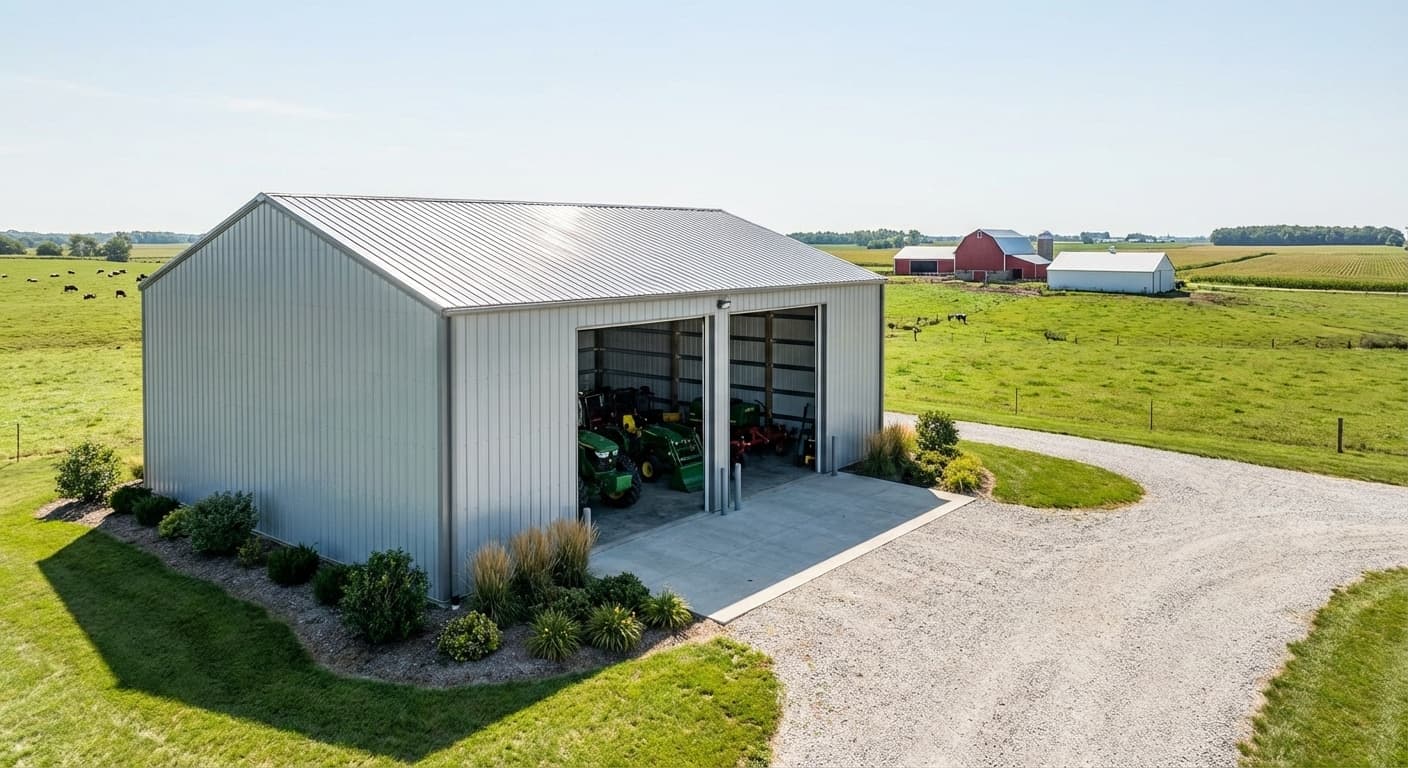

A 30×40 metal agricultural building kit may list for $14-25k, but the article demystifies the true turnkey cost–$24-43 per square foot–by exposing five routinely hidden budget killers: site prep, engineered foundations, freight beyond 50 miles, permits, and professional installation, all of which can inflate the sticker price 30-50%. Readers learn how steel gauge, local codes, soil conditions, door placement, and even regional labor rates swing the final number, and why investing in 12-gauge I-beams, galvanized panels, and stamped engineering pays off in decades of storm-proof, low-maintenance service. It contrasts DIY savings with turnkey speed, details agricultural financing that syncs payments to harvest cycles, and touts single-source providers who quote one transparent, tax-included price and back the structure for 60+ years–eliminating surprise bills, permit delays, and finger-pointing if problems arise. Ultimately, the piece equips farmers to budget accurately, choose upgrades that protect equipment or livestock, and decide whether to wield the hammer themselves or trust a ProTrades crew that can have a building operational in days, not months.
Understanding the Metal Agricultural Building 30×40 Installed Price
A 30×40 metal building kit may start at $14k, but once you add engineered foundation, soil testing, doors, insulation and code-driven extras, your true installed price can easily double–so budget the whole project, not just the steel.
Breaking Down Kit Costs
Your 30×40 metal building kit runs $14,000 to $25,000–that's 1,200 square feet of clear-span space for your equipment [1][2]. This covers your steel skeleton: I-beam frames, purlins, girts, panels, fasteners, and sealants [2][3]. Nothing else. The price swings based on steel gauge (12-gauge beats 14-gauge every time), roof style, and your local codes [2]. Kit pricing excludes foundation, doors, windows, insulation, permits–everything that turns steel into a working building [2].
Figure $18-22 per square foot for the basic kit [2][3]. Your actual cost? Depends on what you need. Big equipment doors for combines? That's extra.
Insulation for livestock? Add it on. Walk doors for daily access? Factor them in. Plan your openings around your biggest equipment–it's cheaper than retrofitting later.
Foundation and Site Preparation Expenses
Your foundation runs 15-25% of total project cost–get it wrong and nothing else matters [5]. Budget $8,000-$12,000 for a standard 30×40 concrete slab, including excavation, gravel, vapor barrier, rebar, and finishing [4]. Site prep adds another $5,000-$6,500 for grading and drainage [4]. Test your soil first. Spend $500-$1,500 now or risk tens of thousands later [5]. One farmer skipped testing–expansive clay cost him $18,000 in emergency foundation modifications [5]. Your soil dictates everything: standard slab, pier foundation (30-50% more expensive), or deep footings for frost protection [5].
Northern builders, take note: you need footings down to 48 inches or more. Southern operations might get away with 12 inches [5]. Know your frost line. Permits and engineering run $500-$2,000 [5]. You need stamped foundation plans and multiple inspections. Anchor bolt placement? Critical.
Even quarter-inch errors mean your steel won't fit. Smart contractors use templates. DIYers eyeballing it? Good luck with that [5]. For complete pricing breakdowns including these foundation costs, see our section on "Transparent Pricing – No Hidden Site-Work Fees.
Professional Installation Fees and What They Cover
Professional installation adds $5-$10 per square foot–that's $6,000-$12,000 for your 30×40 building [8].
Your investment buys speed, expertise, and peace of mind.
Transparent Pricing – No Hidden Site-Work Fees
National Steel Buildings gives you one upfront, all-in quote–site prep, delivery, permits, installation, even sales tax–so the price you see is the price you pay, sparing you the 30-50% sticker shock competitors hide.
Common Hidden Costs to Watch For
You'll find five expenses missing from most advertised metal building prices. First, site preparation ($1. 50-$5 per square foot) covers clearing, grading, and soil work that adds thousands to your project [9][10].
Second, foundations need engineering specific to your soil and building loads–costs detailed in our foundation section above [11]. Third, "free shipping" typically means within 50 miles of the supplier–beyond that, freight charges climb fast [11]. Fourth, your local building department requires permits and stamped engineering drawings, rarely included in base quotes [11].
Fifth, professional installation runs $5-$10 per square foot, as we covered earlier [10][11]. These overlooked items push your real cost 30-50% higher than the advertised kit price. For agricultural operations, you'll also budget for utility runs, drainage, and ventilation based on your specific needs and site layout [10][11].
How National Steel Buildings Guarantees All‑In Pricing
National Steel Buildings takes a different approach–we quote the real price upfront. No surprise delivery charges. No hidden installation fees. We even pay your sales tax, which typically adds 6-10% to your final bill elsewhere [12].
Your quote includes everything: heavy-duty steel framing, weather-resistant panels, secure anchors, delivery to your site, and professional installation by our ProTrades crews [12]. Standard features stay standard–no upselling basic components as premium upgrades [12]. You get one detailed quote covering every project phase from foundation planning through final bolt tightening [12]. This transparency matters for agricultural projects where surprise costs can delay equipment storage or livestock housing.
Our customers tell us they appreciate knowing their exact investment from day one–the quoted price is the final price [13]. It's how building purchases should work.
Comparing Turnkey vs DIY Cost Structures
As outlined in our installation section, turnkey buildings run $24-$43 per square foot while DIY approaches cost $15-$25 per square foot [14]. That 20-30% savings looks attractive until you factor in the real costs of going it alone [4]. DIY means you're the general contractor–coordinating foundation crews, managing deliveries, renting equipment, and learning steel erection on the fly [15]. Professional crews finish in 3-5 days; DIY projects stretch into weeks or months [4]. Consider two real projects: A North Texas rancher paid $80,000 turnkey for a 30×50 shop with spray foam insulation and covered concrete workspace.
A DIY builder in Arkansas spent $35,000 on a similar structure by acting as his own contractor [4]. The difference? The Texas rancher was operational in two weeks. The Arkansas project took four months of weekends, and he admits cutting corners on insulation and drainage that he's now fixing. Your time has value.
Factor in equipment rental, specialized tools, potential rework from mistakes, and warranty concerns–suddenly that DIY discount shrinks [4][15]. For agricultural operations needing quick shelter for equipment or livestock, delays cost more than contractor fees. Choose based on your situation: If you have construction experience, flexible timing, and available labor, DIY makes sense.
Key Factors Influencing the 30×40 Building Cost
The real 30×40 price swing comes from steel gauge, I-beam versus tube framing, corrosion-proof panels and fasteners, plus local codes that can add 60% to your bill for snow, wind or seismic demands.
Steel Gauge and Material Quality
Your steel choice determines your building's lifespan and protection. Lower gauge numbers mean thicker, stronger steel–and yes, you'll pay 15-25% more for 12-gauge versus 14-gauge [16][17]. But when you're protecting $100,000 worth of equipment or livestock, that upgrade pays for itself the first time a storm hits. Here's what separates quality from cheap: commercial-grade I-beam frames versus tubular steel.
You'll see dramatic price differences between seemingly identical 30×40 buildings–now you know why [16]. Those North American-manufactured I-beams we use? They'll outlast tubular frames by decades. Smart buyers look beyond the frame to these often-hidden quality markers: * Panel galvanization that resists agricultural chemicals and fertilizers [17] * Self-drilling screws with neoprene washers versus basic fasteners * Engineered anchor bolt patterns for superior wind resistance [18] * Connection hardware rated for your building's full design life Each upgrade adds modest upfront cost while preventing expensive failures.
Cheap fasteners need replacement within 5-10 years. Substandard panels corrode from fertilizer exposure [17]. Poor anchor systems fail during the storms you built protection against [18].
Regional Labor, Code Requirements, and Permits
Your location drives more cost variation than any other factor–up to 60% difference between regions [8]. Northern installers charge premium rates for their snow-load expertise and compressed building seasons. Southern crews work year-round at lower rates. Simple geography, significant impact. But here's what really affects your budget: local code requirements that determine your building's actual design [19]. Coastal properties need hurricane-rated structures. Mountain locations require serious snow-load capacity.
California demands seismic engineering. These aren't optional upgrades–they're legal requirements that protect your investment. Every jurisdiction enforces specific standards through their adopted building codes [19]. Your permit package needs: * Site-specific engineering calculations (not generic designs) * Stamped drawings from a licensed engineer ($500-$2,000) [8] * Detailed site plans showing setbacks and property lines * Foundation designs matching your actual soil conditions [19] Permit fees run $550-$2,000 depending on your area's review process [8]. Plan on 2-8 weeks for approval, with inspections at key construction milestones [19]. Here's how you avoid costly delays: generic building designs get rejected. Missing setback information stops permits cold.
Foundation plans that don't match engineering loads require expensive redesigns [19]. Smart move? Call your local building department before ordering anything. Five minutes on the phone saves weeks of permit headaches and thousands in modifications. We handle this coordination daily–it's why our buildings sail through permitting while others stall.
Custom Features and Add‑On Impacts
Your customization choices make or break both budget and functionality. Overhead doors pack the biggest price punch–their placement drives engineering changes throughout your entire structure [20]. Put a 14-foot door on the sidewall instead of the end wall? That decision ripples through header sizes, load paths, and material requirements. Smart customization prioritizes function over features. Equipment access doors sized right the first time prevent expensive modifications later [20]. Walk doors and windows add moderate individual costs but improve daily usability [15].
As covered earlier, interior steel liners and foundation work represent major budget items you've already factored. Here's where strategic upgrades pay dividends: * Heavier-gauge roof panels that shrug off hail damage [15] * Premium fasteners with lifetime warranties versus 5-year replacements * Ventilation systems designed for your specific agricultural use * Reinforced mounting points where you'll hang equipment Color choices? Most manufacturers include multiple options at no extra charge–pick what matches your operation [21]. Agricultural-specific features deserve careful consideration. Wash bays with proper drainage. Chemical storage areas with code-required ventilation. Equipment maintenance zones with reinforced floors.
These specialized additions cost more upfront but transform a basic shell into a working asset [21]. Your best investment strategy: spend on structural elements you can't upgrade later. Save on features you can add as cash flow allows. Focus upgrades where they protect expensive equipment or improve daily operations. That 60-year building lifespan makes smart initial choices incredibly cost-effective [21].
Maximizing Value with Single‑Source Solutions
From design-to-erection with one team, lock in a budget that harvest cycles can handle, secure the loan against the building–not your home–and call a single number for decades of zero-fuss, 60-year steel performance.
Design‑to‑Erection Benefits with ProTrades You get your building faster when one team handles everything from design to final bolt.
Financing Options and Price‑Lock Guarantees
Smart financing puts your metal building within reach without draining operating capital. Agricultural lenders understand your business–they'll structure payments around harvest cycles, not arbitrary monthly deadlines [25]. You choose what works: fixed rates for predictable budgeting, adjustable rates for flexibility, or variable options that track with your income patterns [26]. Some lenders even share their profits back with you through cash dividends, effectively lowering your borrowing costs over time [26].
Small operations aren't left out either. With as little as $1,000 in annual agricultural income, you could qualify for leasing programs that preserve capital and may offer tax advantages [27]. Here's what makes agricultural building loans different: you don't need to put your home on the line. The loan secures against the building itself, and funds go directly to you–putting you in control of your project [25].
Lock in your budget before design starts, or work with manufacturers who have pre-established lender relationships to speed up approval [27]. Either way, you're building without betting the farm.
Ongoing Support, Maintenance, and Service Excellence
Your building relationship doesn't end when the last bolt tightens. With single-source providers, you have one number to call whether you need a replacement part in year one or an expansion in year ten [28]. No hunting through old paperwork to figure out which vendor supplied what component. No finger-pointing between contractors when something needs attention. Metal buildings work harder with less fuss.
While your neighbor replaces rotted wood posts and treats for termites every few years, your steel structure stands strong for 60+ years with minimal care [29]. The specialized coatings handle whatever your operation throws at them–fertilizer overspray, livestock waste, chemical exposure–without the constant maintenance wood demands [29]. The best providers keep your building's complete specifications on file, making future modifications straightforward [28]. Need to add a lean-to for equipment storage? Your building consultant already knows your snow loads, foundation details, and structural capacities.
This long-term partnership approach means faster approvals, accurate pricing, and expansions that integrate seamlessly with your original structure. Smart service packages include scheduled inspections that catch small issues before they become expensive problems [30]. You'll know your building stays weathertight, structurally sound, and ready for whatever demands tomorrow brings. For agricultural operations where downtime equals lost revenue, this preventive approach protects your investment and your livelihood [28].
- Kit price $14-25k excludes foundation, doors, insulation, permits, freight.
- Soil test ($500-1,500) prevents $18k+ foundation fixes on expansive clay.
- Turnkey 30×40 runs $24-43/sq ft vs DIY $15-25/sq ft but 3-5 days vs months.
- 12-gauge steel costs 15-25 % more than 14-gauge but resists storm damage.
- Local codes can raise total cost 60 % via snow, wind, seismic engineering rules.
- Overhead door placement drives engineering changes–size and location matter.
- Single-source quote covers all line items; hidden extras add 30-50 % to low ads.
- https://americanmetalgarages.com/30×40-metal-garage-cost-breakdown-what-you-get-and-how-it-works/
- https://www.probuiltsteel.com/blog/30×40-metal-building-cost/?srsltid=AfmBOorPnyPjQ0_g-CL3NVkMIMCeumpVMGdEJnY-16V-vn5qUjrZWT-J
- https://www.buildingsguide.com/standard-sizes/30×40-metal-building/?srsltid=AfmBOorkYexKSRXaAg_nxEBDgc0dWkh2ULPNMRsXTZ8o48bGoS2QmC0k
- https://www.reddit.com/r/metalbuildings/comments/1mer6n7/real_cost_breakdown_of_a_30x40_metal_garage_with/
- https://mbmisteelbuildings.com/blog/steel-building-foundation/
- https://www.probuiltsteel.com/blog/30×40-metal-building-cost/?srsltid=AfmBOooVzv8qb_x0m35Cu8B02e6zp9uofGBhSjKJrqTc6plFafooNLzg
- https://www.buildingsguide.com/metal-building-prices/?srsltid=AfmBOoqK5ZrOLs9sSPAzr_D4ZWBHLIFconn5X7GBuT5N4Ah-kFT1Q8ul
- https://www.cascadingfallsinc.com/what-do-prefab-metal-building-cost-to-construct
- https://ecosteel.com/ecosteelprefab/hidden-costs-in-steel-building-projects-how-to-avoid-them/
- https://swfunk.com/news/metal-buildings-costs/
- https://www.uspatriotsteel.com/blog/hidden-costs-to-watch/
- https://www.buildingsguide.com/metal-building-prices/?srsltid=AfmBOooJh7qzgFqN-zKdbT3y_aSwdd7IpCIQOGMkz11VT0lz8Gl8Lu0R
- https://info.fbibuildings.com/blog/30-x-40-pole-barn-costs-diy-kits-vs.-construction
- https://www.buildingsguide.com/metal-building-prices/?srsltid=AfmBOorSWkNszhlzjk5gZsakCaDqB-kpibZl_T-wgEJxm7jl2_RRkWpJ
- https://www.vikingsteelstructures.com/metal-shop-building-prices?srsltid=AfmBOorfnBEtoOA4xCouOeAoesLoKS90jap2P41gnRptkufvaqi_odDv
- https://www.uspatriotsteel.com/blog/how-much-does-a-30×40-metal-building-cost/
- https://www.engineeredmetalbuildings.com/blog/30×40-metal-building-prices/?srsltid=AfmBOoqwiwk3zIbCrvGAyB_LJA8nlRrU5fPhT9Py-MwdeDbtr3JMfwJ-
- https://www.buildingsguide.com/metal-building-prices/?srsltid=AfmBOopaybpZ2FKgtUCjLr8fo3JPQ5-0qBvwlHtNurDtmxrW7GquyLuy
- https://www.coast-to-coastcarports.com/how-much-does-a-30×40-metal-building-cost?srsltid=AfmBOor7CoRuDTO-WOYEZGWh0wWbE2MYSg4cM_cyz9ScSVbEyIiaW2vX
- https://www.mbci.com/blog/benefits-of-metal-panels-for-agricultural-applications/?srsltid=AfmBOoqXNOaW10YUPpSGxddUxRfgOMlD3SAKH09ikFkEuq7W2eoLOhrR
- https://www.advancedbuildingcorporation.com/blog/pros-cons-pre-engineered-metal-buildings/
- https://www.alliedbuildings.com/pre-engineered-metal-buildings/
- https://www.hfsfinancial.net/home-improvement-loans/metal-buildings-loans/
- https://www.fcsamerica.com/financing/facility-loans
- https://cgb-agfi.com/morton-buildings/
- https://norsteelbuildings.com/advantages-of-steel-series/advantages-single-source-responsibility/
- https://www.mbci.com/blog/benefits-of-metal-panels-for-agricultural-applications/?srsltid=AfmBOooqWhgaih_69YOoCY2H-FPFtr1qy1jyTiA9CJez1rEh4IEsnud0
- https://designandbuildwithmetal.com/featured-content/2025/09/11/steel-agricultural-buildings-exploring-the-many-benefits