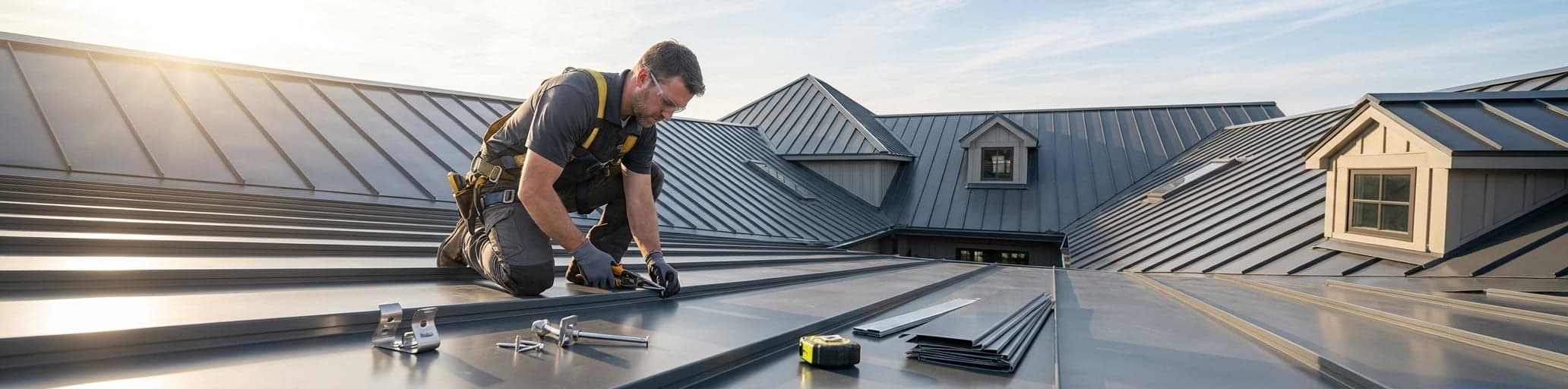

We help you understand why metal roof installation costs significantly more than materials alone, with labor typically accounting for 50 to 70 percent of your total project expense. Understanding these cost drivers upfront lets you budget accurately and avoid invoice surprises on your metal roofing investment.
Why Metal Roof Panel Installation Costs More Than You Expect
Labor costs for metal roofing typically consume 60% of your budget because installers need specialized training in thermal expansion, clip systems, and metal-specific flashing that general roofers don't possess.
The hidden labor factors that inflate installation expenses
Roof pitch and shape do more to your labor bill than most estimates admit.
Steep or complicated roofs can double installation time compared to a simple, low-slope design, and complexity multipliers adjust labor rates based on roof shape and pitch, so a basic metal roof running around $7 per square foot installed can climb to $12 or more once valleys, dormers, and steep angles enter the picture.[1] Tear-off and disposal of the old roofing adds another line item that rarely shows up in a quick verbal quote, since removing and hauling away the existing surface has to happen before any new panels go down.[1] Standing seam systems compound this further: precision panel alignment and specialized tools push labor to 40% to 60% of total project cost, well above what exposed-fastener panels require.[2] Features like skylights, chimneys, and multiple valleys demand extra cutting and custom flashing work, stretching labor hours on jobs that looked straightforward on paper.[2]
How specialized skills and equipment requirements increase per-square-foot pricing
Labor eats the biggest share of a metal roofing budget, running roughly 60% of total project cost, because crews need training that general roofing labor doesn't cover.[3] Installers have to understand thermal expansion behavior, clip-system mechanics, and metal-specific flashing design before they ever set a panel.[3] Panel handling adds another layer of skill: crews have to move and fasten sheets without denting the metal or scratching factory-applied finishes, since a scratched panel means a visible flaw for decades rather than a quick patch.[3] Standing seam work raises the bar further, using concealed clips that hold panels from the sides with no fasteners piercing the panel face, a technique that takes longer to execute correctly than driving exposed screws.[3] That specialized labor pool is smaller than the crew base available for asphalt shingles, which keeps rates elevated regardless of region.[3] Material choice compounds the equation too, since premium coatings and higher-end metals like copper or zinc push per-square-foot pricing well past basic steel or aluminum options.[4]
What separates budget estimates from final invoices on metal roofing projects
A verbal quote and a final invoice rarely match because estimators price what they can see, not what's underneath the old roof.[5] Tear-off often reveals rotted decking, and repairing that damaged plywood or OSB adds cost only after the old surface comes off.[6] Permits and inspections follow a similar pattern: most municipalities require them for a roof replacement, and fees can run from roughly $100 to $1,400 depending on the jurisdiction and project scope, yet they rarely appear in a rough number given over the phone.[6] Delays compound the gap too, since weather, material backorders, or crew scheduling problems can trigger added labor or equipment rental charges that a budget estimate never anticipated.[5] The safest move is asking upfront who covers unexpected findings and building in a contingency, since some contractors offer fixed-cost guarantees for defined timeframes while others pass every surprise straight through to your invoice.[5] A written scope that spells out labor breakdowns, material specs, and responsibility for permits closes most of that gap before work starts.[5]
The Biggest Problems With Metal Roofs: Labor, Installation Complexity, and Long-Term Maintenance
Metal roof labor costs climb because specialized installation skills remain scarce, with 36% of contractors still struggling to find qualified workers in 2025.
Installation complexity as the primary cost driver compared to asphalt shingles
Asphalt shingle crews can nail down a basic roof fast, while metal panel installation demands specialized skills roofers rarely need for shingle work, and that skills gap alone widens the price separating the two materials.[7] Standing seam systems push that gap further because the process simply takes longer than laying shingles, and every added hour lands on the labor line.[7] Roof geometry compounds the difference: more roof penetrations mean more flashing work regardless of material, but metal's tighter tolerances make each penetration slower to finish correctly.[7] Pitch matters too, since steeper slopes require extra safety measures like harnesses and tie-offs that stretch labor time on any roof, metal or shingle.[7] Asphalt stays cheaper and faster precisely because it skips these complexity penalties, which is why the first invoice on a shingle job almost always undercuts a metal one even on an identical footprint.[8] On simpler roof layouts without heavy pitch or multiple facets, that labor gap narrows considerably.[9]
Why finding qualified metal roofing contractors remains a supply-side challenge
That price gap traces back to a shrinking supply of installers willing and able to do the work.
Among top metal builders, 42% named labor their biggest challenge in 2022, up from 23% just a year earlier, and the problem hasn't reversed since.[10] A 2025 industry survey backs that up: 36% of roofing contractors still cite a lack of qualified workers as a top business challenge, with average labor costs up 14% as crews grow scarcer.[11] The construction trades broadly feel this squeeze, too.
Nearly three-fourths of firms surveyed nationally expected to add headcount, yet two-thirds struggled to fill open roles, and roofers specifically skew heavily foreign-born, a labor pool disrupted by tighter immigration enforcement and post-recession attrition that never fully reversed.[12] Fewer available hands with metal-specific training means contractors can charge more and still stay booked, and that scarcity premium lands squarely on your invoice.[10]
Thermal expansion, fastening methods, and why improper installation leads to costly repairs
Metal panels move with temperature swings, and how a crew fastens them determines whether that movement stays harmless or turns into a warranty claim.
Through-fastening systems drive large-head screws with neoprene washers directly through the panel, and repeated thermal cycling can loosen or back out those fasteners over time, leaving the roof with reduced wind resistance and open paths for moisture intrusion.[13] Because through-fasteners pin the metal down, they also restrict natural expansion and contraction, which shows up as oil-canning, especially on larger panel runs.[13] Concealed-clip standing seam systems sidestep that problem by holding panels from the sides without piercing the face, letting the metal slide as it heats and cools rather than fighting against fixed screws.[13] Installers who overdrive or underdrive fasteners compound the risk further: overdriven screws crush washers and underdriven screws leave gaps for water, and backed-out screws frequently trace back to incorrect torque rather than any defect in the panel itself.[14] Getting fastener choice and torque right the first time is what separates a roof that ages quietly from one generating repeat service calls.[14] Metal Roof Panels vs. Shingles: A Realistic Cost and Labor Comparison
Upfront installation labor costs: metal panels demand 30-50% more skilled labor hours
Metal panel installation simply eats more labor hours than shingle work, and the per-square-foot pricing shows it: asphalt shingles run roughly $3 to $7 per square foot installed, while metal roofing lands between $8 and $16, with standing seam systems at the top of that range.[15] That gap traces directly to skill requirements.
Shingle crews finish most jobs in a few days using widely available materials, but metal installation demands precision alignment, specialized tools, and training most general roofing crews never receive, which stretches labor hours even when the job isn't overly complicated.[15] Complexity compounds the difference further.
A steep or multi-faceted roof can push labor costs 25% to 50% higher than a simple layout, and that penalty hits metal harder because tighter tolerances around valleys, dormers, and skylights slow crews down more than they would on asphalt.[16] On a straightforward, low-pitch roof, that labor premium narrows considerably, but it rarely disappears entirely.[9]
Long-term maintenance and labor savings that offset initial installation expenses
That higher installation labor bill starts working in your favor the moment the crew leaves.
A metal roof lasts 40 to 70 years depending on material, while asphalt shingles need replacement every 15 to 30 years, meaning you'd pay for a full shingle tear-off and re-install two or three times before a metal roof needs the same treatment.[7] Shingle roofs also demand ongoing patching, moss removal, and routine inspections, while metal panels stay largely maintenance-free, needing little beyond occasional cleaning and a basic checkup for decades of service.[17] Resistance to mold, rot, and insect damage cuts down on the repair calls that eat into a shingle roof's lifetime labor cost.[7] Reflective panels also lower cooling costs by 10 to 25% in warm climates, trimming a cost that shingle roofs keep adding to your utility bill year after year.[17] Exposed-fastener systems do need occasional fastener replacement, but that upkeep is minor next to what an asphalt roof requires over the same span.[7]
Total cost of ownership: when metal roofing labor investment pays for itself
Run the labor premium out across a full ownership window and the math flips.
A metal roof installed once can outlast two or three shingle roofs, since asphalt needs replacing roughly every 15 to 25 years while metal panels hold up 40 to 70 years, so the extra labor you pay upfront buys out multiple future tear-offs and re-installs.[18] The crossover point where metal's higher labor cost pulls ahead typically lands between year 12 and year 28, depending on local install pricing, roof complexity, and how long your first shingle roof actually lasts before storm damage or granule loss forces a redo.[19] Homeowners staying under 5 to 7 years rarely recover that premium, since resale gains alone won't offset the price gap in a short window.[19] Past that point, every year without a second tear-off, re-deck, and re-install is money the shingle owner is spending that the metal owner isn't.[20]
How National Steel Buildings Reduces Metal Roof Installation Labor and Risk
One team handling design, fabrication, and installation keeps panel lengths, trim colors, and quality consistent from start to finish, eliminating costly remakes and visible mismatches.
Single-source design-build advantages: coordinated panel fabrication and expert installation teams
When fabrication and installation come from separate companies, every handoff is a chance for measurements to get lost in translation, and a panel order that's even a few inches off has to be remade from scratch since metal panels are cut to custom lengths rather than trimmed on site.[21] A single-source design-build model closes that gap.
When the same team specifying your roof also fabricates the panels and puts them up, panel length, trim color, and production run stay locked together instead of getting sourced separately and risking a visible mismatch.[21] That is exactly how our metal roofing systems come together–one team, one batch, one point of accountability from design to delivery.
That coordination matters even more on standing seam systems, where ridge caps, rake trim, and eave trim all have to color-match field panels exactly, a guarantee that only holds when everything comes from one batch instead of a patchwork of suppliers.[21] This is the same accountability question worth asking before you sign with any commercial steel building construction company, since divided responsibility between designer and installer is where schedule slippage and finish-quality disputes usually start.[21]
ProTrades erection division ensures consistent labor quality and faster project timelines
Roughly 40% of today's construction workers are set to retire by 2031, and the labor pool replacing them is thinner than it looks once you filter for anyone with metal-specific training [22]. A crew installing panels every week, rather than switching between shingles, siding, and standing seam on alternating jobs, builds the pattern recognition needed to catch a misaligned clip or a scratched finish before it becomes a callback.
Keeping erection work in-house through our ProTrades erection division, instead of re-bidding it to a new subcontractor on every project, means the same trained hands show up whether your job site is in Ohio or Texas–with little ramp-up time lost to someone learning your specs on the fly. Roofing crews holding to a 'do it right the first time' standard, rather than treating rework as routine, tend to finish jobs faster since punch-list items rarely enter the schedule [23].
This consistency keeps a multi-building rollout moving on one timeline instead of resetting the clock with every new crew.
Pre-engineered panels with precise specifications eliminate field adjustments and rework
Panel tolerances get locked in before a truck ever leaves the plant, and that precision is what keeps a crew from re-cutting trim in the parking lot. Every frame, purlin, and panel comes pre-cut, pre-drilled, and engineered to fit exact site specifications, so field crews bolt together rather than fabricate on the fly.[24] Manufacturing in a controlled facility keeps steel members straight and connections accurate, which means consistent tolerances instead of the misalignments and panel fit issues that eat hours during erection.[25] Roof panels and wall systems arriving pre-engineered also cuts down on-site cutting, welding, and adjustment, which limits errors, material waste, and the rework that follows when a panel doesn't sit right the first time.[26] Fewer field modifications means fewer surprise costs added mid-project, since punch-list items tied to panel fit rarely make it onto the schedule at all.[24] That precision is what helps a 30×30 metal building go up with fewer change orders piling up.
Metal roof labor costs climb because of pitch, complexity, specialized skills, and a shrinking trained workforce. You cut down on those variables when the same team designs, fabricates, and erects your roof–panels arrive pre-engineered to fit, trained crews install them to spec, and fewer surprises end up on your invoice. That approach helps keep a project cost-effective, on schedule, and within budget, whether you are roofing a warehouse, a hangar, a church, or a barn. We're with you every step of the way. Get a Free Quote and let's make it steel.
Frequently Asked Questions
-
Why did my metal roof quote jump so much higher than the final invoice?
Verbal quotes often price only what’s visible, but tear-off can reveal rotted decking that adds repair cost once the old roof is off, and permit fees (roughly $100 to $1,400 depending on jurisdiction) rarely show up in a rough phone estimate. Weather delays, material backorders, or crew scheduling problems can also add labor or equipment charges an initial estimate never anticipated. Ask upfront who covers unexpected findings and get a written scope covering labor, materials, and permit responsibility.
-
How much more does metal roofing cost per square foot than asphalt shingles?
Asphalt shingles run roughly $3 to $7 per square foot installed, while metal roofing lands between $8 and $16 per square foot, with standing seam systems at the top of that range. A basic metal roof around $7 per square foot can climb to $12 or more once valleys, dormers, and steep angles are involved, since complexity multipliers adjust labor rates. Compare an actual written quote against these ranges rather than a rough verbal number.
-
Is standing seam metal roofing worth the extra installation labor cost?
Standing seam systems push labor to 40% to 60% of total project cost because concealed clips hold panels from the sides without piercing the face, which takes longer to execute than driving exposed screws but lets the metal expand and contract without the oil-canning risk that through-fastened panels face. That said, exposed-fastener systems are cheaper to install but need occasional fastener replacement over time. Which option makes sense depends on your roof’s complexity and how long you plan to own the property.
-
Does the higher labor cost of metal roofing ever pay off compared to asphalt shingles?
A metal roof lasts 40 to 70 years versus 15 to 30 years for asphalt shingles, so the upfront labor premium can buy out two or three future shingle tear-offs and re-installs. The article notes the crossover point where metal’s higher labor cost pulls ahead typically lands between year 12 and year 28, depending on local pricing, roof complexity, and how long a first shingle roof lasts. Homeowners staying under 5 to 7 years rarely recover that premium.
-
Why are metal roofing contractors harder to find and more expensive than shingle crews?
Labor makes up roughly 60% of a metal roofing project’s total cost because crews need training in thermal expansion behavior, clip-system mechanics, and metal-specific flashing that general roofing labor doesn’t cover. Industry data cited in the article shows 42% of top metal builders named labor their biggest challenge in 2022 (up from 23% the year before), and a 2025 survey found 36% of roofing contractors still cite a lack of qualified workers, with average labor costs up 14% as crews grow scarcer. That shrinking specialized labor pool keeps rates elevated regardless of region.
- Labor costs account for 50-70% of total metal roof installation expenses, often surprising property owners who budget only for materials.
- Standing seam metal roofs cost $12-16 per square foot installed versus $4-8 for corrugated systems due to higher skill requirements.
- Roof complexity, steep pitches, and multiple valleys can double installation costs from $7 to $12+ per square foot without changing materials.
- Metal roofs reach break-even with asphalt shingles between years 12-18 when accounting for maintenance, replacements, insurance discounts, and energy savings.
- Thermal expansion and contraction cause fastener failure and water intrusion when installers don't account for metal panel movement during installation.
- 85% of roofing contractors struggle to hire skilled labor, with demographic trends and post-pandemic workforce shifts creating a structural shortage.
- Pre-engineered metal buildings with dedicated erection crews reduce installation timelines by 40-50% and lower total labor costs by 25-30%.
- https://sqpanel.com/blog/metal-panel-cost-guide-factors/
- https://rc-roofs.com/standing-seam-metal-roof-price/
- https://goldenhammernjco.com/metal-roof-installation-cost/
- https://modernize.com/roof/metal/cost
- https://asestimation.com/blogs/hidden-costs-in-estimating/
- https://paradigmroofs.com/roof-cost-estimate/
- https://www.theroofcowaco.com/2024-cost-comparison-metal-roofs-vs-asphalt-shingles
- https://metalamerica.com/metal-roof-vs-asphalt-shingles/
- https://rockland-builders.com/blog/lifetime-cost-comparison-metal-versus-shingle-roof/
- https://readmetalroofing.com/finding-workers-during-a-labor-shortage/
- https://www.roofingcontractor.com/articles/101643-2026-state-of-the-roofing-industry-report
- https://www.iko.com/na/blog/overcome-skilled-labor-shortage-in-roofing-industry/
- https://www.nachi.org/metal-roofs-part8-117.htm
- https://www.tristate.pro/metal-roof-installation-9-checkpoints-that-prevent-callbacks
- https://kplamarco.com/insight/metal-roof-vs-asphalt-shingles/
- https://www.gorillaroofing.com/resources/roofing-labor-costs-overview/
- https://hixwood.com/the-advantages-of-metal-roofing-over-asphalt-shingles/
- https://www.interlockroofing.com/blog/metal-roof-vs-asphalt-shingles-cost-30-year/
- https://frontlinegc.com/blog/metal-roof-vs-shingles-cost/
- https://www.legacyexteriorspro.com/post/standing-seam-metal-roof-vs-shingles-cost
- https://metalamerica.com/metal-roofing-for-contractors/
- https://www.pathtopro.com/
- https://roofcoatingsohio.com/
- https://www.tylerbuilding.com/post/speed-to-market-how-pre-engineered-metal-buildings-cut-construction-time-by-30
- https://constructionexec.com/article/how-pre-engineered-metal-buildings-can-help-contractors-shorten-project-timelines/
- https://metalcon.com/blog/beyond-the-roof-how-prefabrication-helps-contractors-cut-build-times-and-protect-profit-margins/