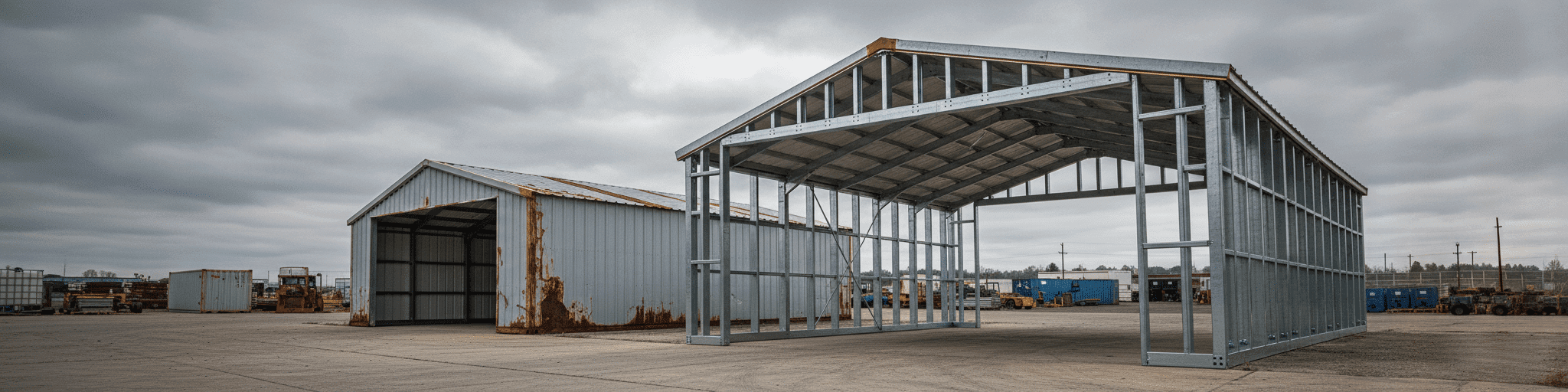

We help you understand why steel garages outperform generic metal alternatives through superior durability, structural integrity, and long-term value. Choosing properly engineered steel with the right coating and gauge for your climate zone means decades of dependable performance with minimal maintenance.
Understanding the Material Distinction: Metal and Steel Defined
Steel's deliberate carbon and alloy composition–not the vague label "metal"–determines whether your garage frame holds its shape for decades or dents and sags.
Why 'Metal' and 'Steel' Are Not Interchangeable Terms in Garage Construction
Ask ten garage shoppers what a "metal garage" is, and you will get ten different answers, aluminum siding, sheet-metal carports, and engineered steel structures all get lumped under the same label. That looseness matters once you start comparing options, because the industry itself treats steel as a distinct material choice within the broader metal category, not a synonym for it.
Steel garages and steel carports, for example, are both accurately described as metal car shelters, yet they differ significantly in structure, security, customization, durability, and long-term value. [1] If two steel structures can vary that much, a generic aluminum or thin-gauge metal building and an engineered steel garage are not remotely comparable. When you are budgeting, comparing climate performance, or weighing usage requirements, the specific alloy and construction method behind the word "metal" determines what you actually get, not the marketing label on the listing. [1]
Steel as a Specific Metal Alloy: Composition and Performance Advantages
Steel is not a generic term, it's iron deliberately alloyed with carbon, typically between 0.05% and 2.1% by weight, and that carbon content is what separates a garage frame that holds its shape for decades from sheet metal that dents and sags. [2] Manufacturers also add manganese, chromium, and nickel in controlled amounts, elements that boost hardness, toughness, and resistance to wear well beyond what plain iron or aluminum sheet can offer. [3] Even small alloying additions matter: chromium and aluminum additions to carbon steel have been shown to stabilize protective surface films and cut pitting corrosion rates in harsh, saline exposure conditions compared to plain carbon steel. [4] That engineered chemistry is why a steel garage frame carries structural loads, resists denting, and holds up to weather in ways a loosely defined 'metal' panel, often thinner gauge aluminum or unalloyed sheet stock, simply cannot match pound for pound. [2] The alloy composition, not the word 'metal,' is what determines whether your garage frame is engineered or improvised.
Common Metal Alternatives Used in Garage Framing and Why They Fall Short
Aluminum shows up most often as the metal alternative in garage construction, and it earns that spot fairly, it resists corrosion naturally and won't rust like an unprotected steel panel [5]. But framing is a structural job, not a cosmetic one, and aluminum's lower yield strength means it dents and deforms under loads that a steel frame shrugs off without issue [5].
Wood carries its own tradeoffs as a framing alternative: it delivers warmth and character, but without regular sanding, sealing, and repainting, it warps, swells, and rots [6]. Neither alternative resists everyday impacts the way properly gauged steel does, and steel remains the standard for households and structures that need dependable rigidity year after year [5].
Cost may tempt buyers toward lighter, softer metals up front, but the tradeoff shows up later in maintenance, structural sag, and repair frequency, exactly where a garage frame can least afford weakness.
Durability, Longevity, and Climate Performance: Steel Garages Win
Galvalume-coated steel frames last 40 to 60 years by combining aluminum's corrosion resistance with zinc's sacrificial protection, outlasting generic metal panels by three to six times.
Corrosion Resistance: How Steel Coatings Outperform Generic Metal Finishes
Generic metal panels often skip any real corrosion barrier, but steel garage frames typically get one of two engineered coatings: galvanized steel, coated in pure zinc through a hot-dip process, or Galvalume, a steel core wrapped in roughly 55% aluminum and 43.5% zinc [7]. Zinc alone protects sacrificially, meaning it corrodes first to shield the steel underneath, but that layer erodes faster under salt spray or acid rain [7].
Galvalume's aluminum content forms a stable oxide layer that resists pitting and uniform corrosion even after scratches, and salt spray testing shows it lasting two to four times longer than standard galvanized steel [7]. Field data from the Metal Construction Association puts Galvalume's service life at 40 to 60 years or more, roughly three to six times better than plain galvanized steel [8].
A bare aluminum panel resists rust on its own, but it can't replicate that zinc-aluminum combination or the underlying steel's structural strength [8]. That's the coating advantage generic 'metal' garages skip entirely.
Load-Bearing Capacity and Structural Integrity Over 20+ Years
Load-bearing capacity is where gauge and coating decisions compound over decades, not just years. Lower-gauge galvanized steel, meaning thicker, denser panels, typically holds structural integrity for 20 to 30-plus years when properly maintained, giving frames enough rigidity to resist sag under snow load and wind pressure long after a generic thin-gauge metal panel would deform [9].
Galvalume-coated steel pushes that structural service window to 30 to 40-plus years, a difference that matters most in a garage frame carrying roof loads and door assemblies for two to three decades [9]. Aluminum, by contrast, isn't typically used for garage framing or panels at all.
It shows up in trim, accents, and roofing because it lacks the rigidity to serve as a structural frame, and its practical lifespan tops out around 10-plus years even with regular care [9]. That gap explains why a garage marketed simply as "metal" without a specified gauge or coating can't guarantee the same 20-year structural performance a properly specified steel frame delivers.
Climate Resilience: Steel Performance in Extreme Weather, Salt Air, and Freeze-Thaw Cycles
Coastal air and winter road salt attack steel garages the same way they attack any structure: through moisture and chloride ions working their way into exposed metal.[10] Salt exposure accelerates corrosion primarily through permeation into a material's surface, which triggers physiochemical breakdown once salts reach vulnerable substrate.[11] Aluminum panels are especially prone to filiform corrosion, a creeping surface failure that starts at scratches or cut edges once humidity climbs between 40 and 90 percent, common conditions along any shoreline.[10] Properly coated steel avoids that vulnerability because its protective layer resists pitting even after scratches occur.
Freeze-thaw cycles bring a separate challenge: repeated expansion and contraction degrades traditional materials quickly, while a well-built metal structure holds its function and appearance through those seasonal swings.[12] Mixing incompatible metals compounds the risk further.
Galvanic corrosion occurs whenever dissimilar metals share an electrically conductive path, letting one metal's ions attack and oxidize the other, so a continuous coating or gasket separating materials is essential.[10] That's why matching gauge and coating to your climate zone matters more than the generic 'metal' label ever will.
Cost Analysis and Long-Term Value: A Transparent Comparison
Steel structures cost 40 to 60 percent less than stick-built construction and require only two hours of annual maintenance versus 15 to 20 for wood.
Initial Purchase Price vs. Total Cost of Ownership (Cost Estimates)A generic metal garage often wins on sticker price, but steel structures typically run $8,000 to $80,000 depending on size, gauge, and features, with the shell price covering only the building itself before delivery, installation, and foundation work [13]. Add $3,000 to $8,000 for delivery and installation, plus $4 to $8 per square foot for a concrete slab foundation, roughly $9,600 to $19,200 on a 2,400 square foot footprint [13]. Compare that against stick-built construction, which runs $150 to $280 per square foot, and steel's 40 to 60 percent savings become obvious even before factoring maintenance [13].
The real gap opens over ownership. Thin-gauge metal panels sag, chip, and corrode faster, driving repaint and repair cycles a properly coated, thicker-gauge steel frame avoids for decades. Calculating total cost of ownership across 20 to 30 years, not just the invoice total, is what separates a bargain from a liability [13].
National Steel Buildings puts national buying power behind every project to help keep that shell price cost-effective from day one, which can help you avoid trading a low sticker price for expensive problems later.
Maintenance and Repair Expenses: Why Steel Garages Cost Less Over Time
Maintenance is where steel earns its keep year after year.
Wood structures need repainting every 3 to 5 years, a cycle that runs $1,000 to $2,500 each time, plus separate budgets for sealing, staining, and pest treatments to stop rot and termite damage.[14] Add it up and wood owners log roughly 15 to 20 hours a year on upkeep, while steel garage owners spend closer to two hours annually, usually just an exterior wash.[14] Factory-applied coatings on steel panels resist fading, chalking, and chipping for decades, so there's no ladder work, no primer, and no repaint schedule to plan around.[15] Because steel doesn't rot, attract termites, or support mold growth, insurers treat it as lower risk, and that can translate into annual insurance savings of 30% or more compared to a comparable wood structure.[15] Those avoided repair cycles and lower premiums are what separate a bargain sticker price from a genuinely cheaper garage over 20 to 30 years of ownership.[14]
Resale Value and Insurance Implications of Material Choice
Material choice follows you past the purchase, showing up again when you sell or file a claim. Insurers classify buildings by combustibility, and steel structures typically land in a lower-risk class than wood framing, which can translate into better rates from day one [16].
Steel also holds an edge on the risk factors carriers weigh most: wind, snow and ice loads, hail impact, water damage, and termites, all areas where a steel frame outperforms wood and reduces the insurer's exposure to claims [16]. On resale, gauge matters as much as material label.
A 14-gauge frame is standard, but stepping up to 12-gauge and confirming galvanized steel with a rust-through warranty gives buyers documented quality that a generic thin-panel structure can't match, which supports property value rather than dragging it down [17]. Poorly braced structures that buckle under snow or storm debris do the opposite, dragging resale value down regardless of what the listing calls them [17].
Choosing the Right Material for Your Garage: Decision Framework and Next Steps
Match your garage material to your climate's dominant weather risk–salt air, snow load, or heat–before finalizing size or gauge.
Assessing Your Climate, Use Case, and Long-Term Ownership Plans
Your climate zone should drive the coating and gauge decisions covered earlier, not just aesthetics. Coastal and humid regions demand corrosion and mold resistance, cold regions need weatherproofing against freeze-thaw damage, and hot, dry climates call for heat-reflective materials that limit thermal absorption. [18] Site conditions matter just as much as regional weather: soil type, drainage, and lot size all influence how large a footprint you can build and how the structure should be laid out. [19] Use case shapes insulation priorities too. Metal conducts heat and cold readily, so a workshop, an agricultural steel building, or a garage running power tools and heaters needs a different insulation and ventilation plan than a space used strictly for vehicle storage. [20] Before finalizing size or gauge, map out:
- Your region's dominant weather risk (salt air, snow load, heat)
- Whether you'll run equipment or climate control inside
- Room for future expansion without a full rebuild
That groundwork prevents costly mismatches between the structure and how you actually plan to use it for decades. [19]
Why National Steel Buildings Specializes in Steel Garages and What That Means for You
Specializing in one material sounds narrow until you see what it buys you. National Steel Buildings works exclusively in steel, so you're never guessing at gauge, coating, or bracing for your climate. Every project runs on the same alloy logic covered earlier: fire resistance, rust resistance, and structural rigidity that generic wood or thin metal typically can't match [21].
That focus also means customization doesn't have to come at the expense of durability. You get a range of colors, layouts, insulation options, and door configurations while the frame's strength stays intact, including cold-formed steel structures and metal roofing systems engineered to one consistent standard [24]. Prefab steel kits built that way assemble faster and hold structural integrity better than mixed-material builds patched together on-site [21].
For anyone comparing metal garage buildings' pros and cons, that specialization is the practical difference between a supplier who sells whatever's in stock and one who engineers specifically for how steel performs over decades.
From Selection to Erection: How the Design-Build Process Protects Your Investment
Choosing steel over generic metal only pays off if the build process itself doesn't introduce new risk, and that's where design-build delivery earns its keep. Studies cited by the Design-Build Institute show cost savings of 10% to 18% and schedule savings of 15% to 60% compared to hiring separate designers and builders under traditional design-bid-build contracts [22]. Fewer contracts also mean fewer places for a garage project to break down: one negotiation, one point of contact, and no finger-pointing between an architect and a builder when something needs adjusting mid-project [22].
Bringing engineering and construction expertise together from day one catches conflicts, like a foundation spec that doesn't match your steel gauge, before they turn into change orders [23]. Single-source accountability means one team owns the outcome, so unforeseen site conditions or last-minute scope changes get solved by people already coordinating daily, not routed through separate firms trading blame [23]. That's exactly how National Steel Buildings works.
You get one team that designs, supplies, and erects your structure in-house, and we're with you every step of the way, from concept to completion. The result is a project built to go up fast, last long, and stay within budget. Tell us your vision, and we'll make it steel. Get a Free Quote.
Frequently Asked Questions
-
What’s the real difference between a “metal garage” and a “steel garage”?
The article notes that shoppers often use “metal garage” loosely to cover aluminum siding, sheet-metal carports, and engineered steel buildings, but the industry treats steel as a specific, distinct material within that broader metal category. Steel is iron alloyed with carbon (roughly 0.05%–2.1%) plus elements like manganese, chromium, and nickel, which is what gives it structural rigidity that generic thin-gauge metal or aluminum panels can’t match pound for pound.
-
How much does a steel garage cost compared to stick-built construction?
Per the article, steel garage shells typically run $8,000 to $80,000 depending on size, gauge, and features, with delivery/installation adding $3,000–$8,000 and a concrete slab foundation adding $4–$8 per square foot (about $9,600–$19,200 on a 2,400 sq ft footprint). Stick-built construction runs $150–$280 per square foot, which the article says makes steel’s savings roughly 40–60% before maintenance is even factored in – check current listings for your exact size and gauge.
-
Is aluminum a good substitute for steel in garage framing?
The article says aluminum resists rust naturally but has lower yield strength, so it dents and deforms under loads a steel frame handles without issue, and it isn’t typically used for structural framing at all – mainly trim, accents, or roofing. It also notes aluminum’s practical lifespan tops out around 10-plus years even with regular care, and it’s prone to filiform corrosion in humid, coastal conditions.
-
How long do steel garage coatings actually last?
According to the article, galvanized (zinc hot-dip) steel typically holds structural integrity for 20 to 30-plus years when maintained, while Galvalume-coated steel (aluminum-zinc) pushes that to 30 to 40-plus years and shows a service life of 40 to 60 years or more in Metal Construction Association field data. The article attributes this gap to Galvalume’s aluminum content forming a stable oxide layer that resists pitting even after scratches, unlike zinc alone.
-
How should my climate affect the gauge or coating I choose for a steel garage?
The article recommends matching material specs to your region’s dominant weather risk: coastal/humid areas need stronger corrosion and mold resistance, cold regions need freeze-thaw-resistant coatings, and hot, dry climates benefit from heat-reflective materials. It also flags that mixing dissimilar metals without a separating coating or gasket can cause galvanic corrosion, so coating choice should be climate-specific rather than based on a generic ‘metal’ label.
- Steel is iron alloyed with carbon (0.05-2.1% by weight) plus manganese, chromium, and nickel, making it structurally superior to generic thin-gauge metal or aluminum for garage framing.
- Galvalume-coated steel lasts 40-60+ years compared to 20-30+ years for galvanized steel and 10+ years for aluminum, performing 2-4 times better in salt spray testing.
- Steel garage frames require only 2 hours of annual maintenance versus 15-20 hours for wood structures, which need repainting every 3-5 years at $1,000-$2,500 per cycle.
- Over 20-30 years of ownership, steel structures deliver 40-60% savings versus stick-built construction and lower insurance premiums up to 30% due to reduced risk classification.
- Coastal and humid regions require corrosion-resistant coatings, cold climates need freeze-thaw protection, and use case determines insulation and ventilation requirements.
- Design-build delivery with a single contractor achieves 10-18% cost savings and 15-60% schedule improvements compared to traditional separate design and construction contracts.
- Gauge thickness and coating type directly impact structural longevity: 14-gauge is standard, but 12-gauge with galvanized steel warranty provides documented quality for resale value.
- https://norsteelbuildings.com/us/steel-building-planning-design/carport-vs-garage/
- https://www.xometry.com/resources/materials/carbon-steel/
- https://niftyalloys.com/blogs/mild-steel-vs-carbon-steel-vs-alloy-steel
- https://www.azom.com/article.aspx?ArticleID=24844
- https://visiondoors.ca/blog/aluminum-garage-door-pros-and-cons-review/
- https://dansgaragedoorservices.com/steel-vs-wood-vs-aluminum-garage-doors/
- https://www.englertinc.com/articles/difference-between-galvalume-and-galvanized-metal-roofing-projects
- https://metal-america.com/steel-vs-aluminum-garage/
- https://www.carportsadvisor.com/blog/how-long-do-metal-garages-really-last
- https://www.constructionspecifier.com/corrosion-resistance-and-environmental-considerations-for-architectural-metal-coatings/
- https://www.sciopen.com/article/10.26599/HTRD.2024.9480008
- https://eastlakemetals.com/category/metal-industry-news/page/4/
- https://metal-america.com/steel-buildings-cost-guide-for-2026/
- https://metal-america.com/metal-garage-benefits-every-homeowner-needs/
- https://iconsteelbuildings.com/metal-building-vs-stick-built/
- https://blog.mcelroymetal.com/metal-roofing-contractors/insurance-and-easyframe-metal-buildings
- https://www.carport.com/blog/will-value-property-rise-fall-purchasing-metal-carport/
- https://cmsmaterialsolutions.com/blogs/news/how-climate-and-location-affect-material-choices-in-construction
- https://kcon.build/2024/12/25/choosing-metal-buildings-layouts/
- https://lionbuildings.com/how-to-maximize-comfort-and-lower-your-utility-bills-in-your-metal-building/2/
- https://www.metalcarports.com/blog/metal-vs-wood-garage/
- https://dbia.org/why-the-manufacturing-sector-loves-design-build/
- https://www.selectlee.com/2025/02/25/the-benefits-of-design-build-vs-design-bid-build-for-large-projects/
- https://www.metalcarports.com/blog/metal-vs_wood_garage/