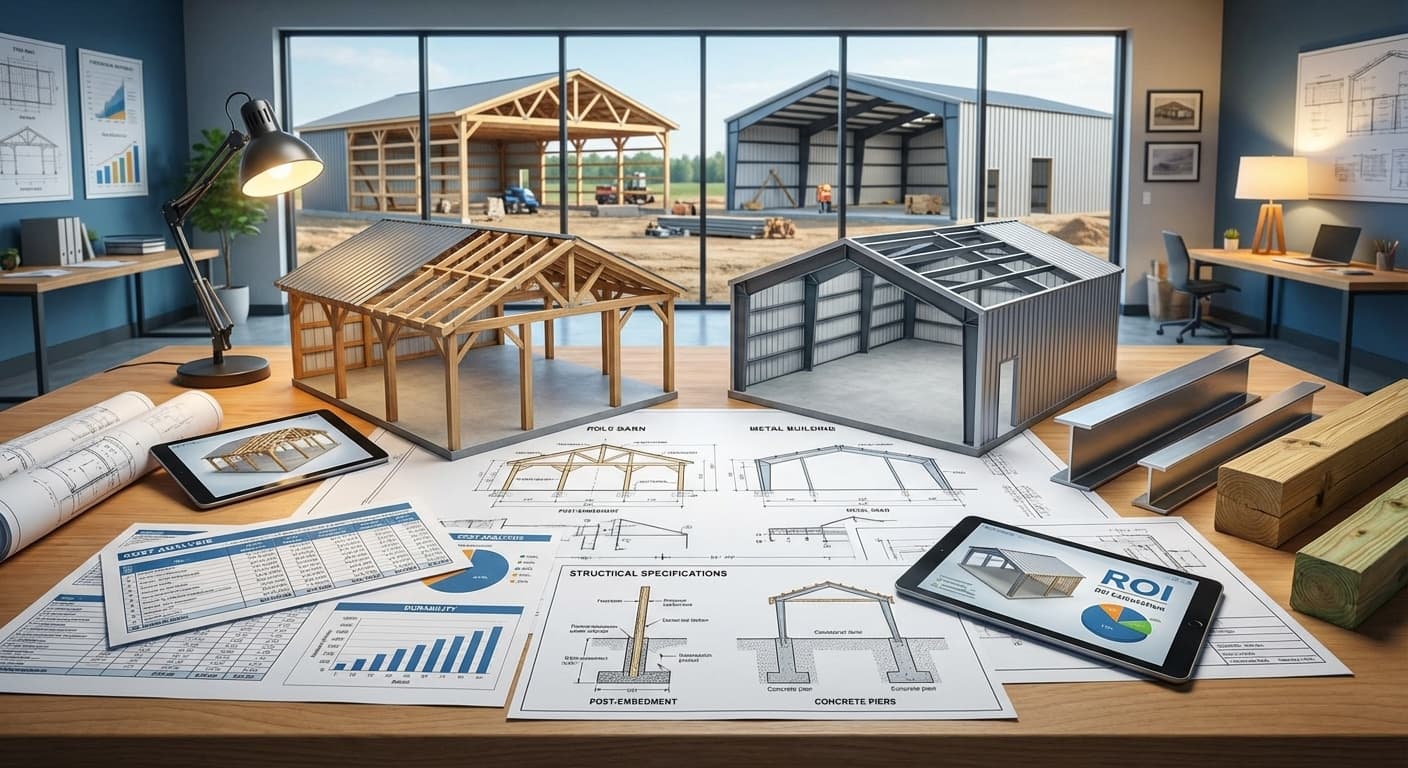

This article delivers a no-nonsense reality check for anyone weighing a 30×40 pole barn against a pre-engineered steel building, revealing that the real decision hinges on decades of ownership costs, not the slim 15% upfront price gap. Readers learn why steel's bolted-to-foundation frame eliminates the seasonal shifting, rot, pest, and fire headaches that plague buried-wood pole barns, while also speeding permits, cutting insurance up to 30%, and carrying a 40-year transferable warranty that props up resale value. Side-by-side cost tables expose the hidden treadmill of pole-barn maintenance, earlier roof replacement, and property-value drag, proving that the steel premium pays for itself year after year. Layout comparisons show how wider column spacing frees owners to place doors, lifts, and workflows exactly where they boost productivity instead of forcing awkward detours around an 8- to 12-foot post grid. The piece ends with a simple litmus test: if you need quick, short-term farm storage on land you'll soon sell, a pole barn suffices; if you're building a workshop, commercial bay, or any long-term asset in wet, windy, or code-strict country, steel is the only path that turns your building into a low-maintenance, appreciating property investment.
Core Differences Between a 30×40 Pole Barn and a Metal Building
Because pole barns sink wood posts directly into shifting soil while steel buildings anchor a rigid frame to concrete, the latter gives you up to 300 ft of column-free space and 50+ years of termite-proof, rot-proof service without the annual re-leveling and loose-nail headaches that plague wood structures.
Structural framing and engineering basics
You'll see the key difference between these two building types the moment you look at the foundation. Pole barns drive wooden posts directly into your soil — those buried poles carry the entire weight of walls and roof. Preengineered steel buildings take a different approach: steel columns bolt to steel rafters to create one rigid frame that sits on top of concrete footings at engineered intervals. [1] That foundation choice affects your building for decades. Soil shifts with the seasons — it expands when wet, contracts when dry.
Your buried wooden posts move right along with it. Within five to seven years, you're looking at re-leveling the entire structure to fix doors that won't close and walls that have shifted out of plumb. [2] Steel frames avoid this headache completely by sitting on the foundation, not in the ground. The connection points tell another story. Wood frames use nails and staples that work loose as lumber swells and shrinks with moisture changes. That movement creates gaps where water gets in and structural integrity gets compromised.
Steel frames use high-strength bolts that maintain their grip no matter what the weather does. [1] You also get consistent dimensions with steel — every member is manufactured to exact specs. Lumber varies from board to board in density, straightness, and strength, making your final structure less predictable. [1] Need wide-open space inside? Steel framing can span up to 300 feet without interior support columns. Wood pole construction maxes out much sooner, limiting your layout options.
Material durability and lifespan expectations
Your building faces three enemies from day one: moisture, pests, and time. Steel wins this battle hands down. It's inorganic — termites can't eat it, water won't rot it, and mold has nothing to grow on. You're looking at 50-plus years of reliable service with minimal maintenance.
[5] Pole barns tell a different story. Even pressure-treated posts eventually surrender to moisture seeping through the wood grain. You might get 20 years in a wet climate or stretch to 60 in perfect conditions with religious maintenance. [4] [5] Most pole barns land somewhere in between — and that unpredictability becomes your problem.
Build in a humid region? Your pole barn could show structural issues before it hits 40 years old. The same steel building in that location just keeps standing, no intervention needed. The insurance implications of this durability gap are covered in detail in our cost comparison section below.
Code compliance, permits, and safety
Here's what catches most buyers by surprise: there's no standard building code for pole barns. Your local permit office has no benchmark to evaluate them against. That means slower approvals, inconsistent requirements, and sometimes flat-out denials. [6] Pre-engineered metal buildings arrive at your permit office with a complete engineering package — wind loads, snow loads, seismic calculations all figured for your exact location. The permit reviewer sees familiar documentation that meets their requirements. You get faster approval.
[7] The foundation gets the same treatment — your concrete slab or pier specs come pre-calculated to local code. Everything works as one engineered system instead of a collection of parts hoping to pass inspection. [6] Safety splits just as clearly. Steel doesn't burn — that's less fire risk for your building and everyone who works in it. [8] Those pressure-treated posts in pole barns? They're soaked in chemical preservatives that can poison livestock.
If you're housing animals, that's a real problem. [6] Wind resistance tells the final story. Pole barns tap out around 90 mph — not enough for hurricane country or high-wind zones. Metal buildings get engineered well past that threshold to meet whatever nature throws at your location.
Total Cost Comparison for a 30×40 Pole Barn vs Metal Building
That modest 15% upfront premium for a steel building vanishes fast when you skip the concrete slab, cut insurance up to 30%, and kiss pole-barn repaints, rot repairs and mid-life roof jobs goodbye.
Up‑front construction costs and pricing factors
The upfront price gap surprises most buyers — metal buildings cost only about 15% more than pole barns, typically just a few thousand dollars difference on your project. [11] Pole barns run $15 to $45 per square foot installed, putting most builds between $25,000 and $50,000. [10] Metal building shells start at $18,000 to $25,000, reaching $30,000 to $40,000 with a concrete slab. [9] That foundation requirement creates the sharpest cost split.
Metal buildings need a concrete slab or pier foundation. Pole barns can start on gravel or buried posts, skipping that expense on basic builds. But you'll pay the same add-ons either way: site grading runs $5,000 to $6,500, electrical costs $1,200 to $5,000, and insulation adds $2,000 to $7,000 whether you pick fiberglass or spray foam. [9] Your biggest cost drivers?
Regional labor rates, soil conditions, and how many upgrades you add before signing. [10] With national buying power and direct manufacturer pricing, you eliminate broker markups — keeping more budget for the features you actually want.
Maintenance, insurance, and operational expenses
The real cost difference shows up after construction — in what you pay year after year to maintain your building. Pole barns demand constant attention: repainting, wood sealing, rot inspections, pest control. Those bills never stop coming. [12] Steel buildings need occasional rust checks and minor touch-ups. That's it.
No rot, no warping, no termites — your maintenance budget stays in your pocket. [13] Insurance companies know the difference. Steel's fire resistance and weather durability earn you premiums up to 30% lower than pole barns. [12] The roof tells the same story: standing seam metal roofs last twice as long as the mechanically fastened roofs on pole barns. You'll replace a pole barn roof mid-lifespan.
Your metal building roof? Still going strong. [13] Add it up — maintenance labor, treatments, insurance, roof replacement — and that small upfront premium for steel pays you back every year. [14] You're not just buying a building. You're buying decades of avoided costs.
Long‑term ROI and resale considerations
Resale value settles the long-term math decisively. Metal buildings boost property value more because buyers pay premium prices for low-maintenance structures. A building that needs nothing beats one that needs constant care. [15] Sure, well-maintained pole barns can appeal to buyers — but maintaining that appeal costs you money every year. Steel buildings hold value without the upkeep expense.
[16] The warranty seals the deal. Pre-engineered metal buildings come with 40-year transferable warranties. Future buyers see documented protection. Wood structures? No manufacturer backs them that long.
[13] Lower maintenance, cheaper insurance, transferable warranty — that 15% upfront premium isn't a cost. It's protection for your investment that pays you back at resale. [15] Smart money thinks long-term.
Design Flexibility and Functional Layout Options
Metal buildings turn your 30×40 footprint into a custom workflow engine by spacing columns 20-30 ft apart so you can place doors, lifts, and production zones exactly where they maximize daily efficiency instead of forcing you to work around an 8-12 ft post grid.
Clear‑span interiors and customizable floor plans
Your 30×40 building should work exactly how you need it to work — not force you to work around it. As covered in the structural basics above, pole barns space posts every 8 to 12 feet, creating a grid that dictates where you can place equipment, vehicles, and walls. [17] [18] Metal buildings deliver genuine flexibility: columns sit 20 to 30 feet apart, opening up your floor plan options dramatically.
[18] This wider spacing translates directly to usable square footage. You can position a vehicle lift exactly where it makes sense. Run a production line without dodging posts.
Create distinct work zones without compromise. [17] In a 30×40 footprint, that difference between working with your layout versus working around it adds up to thousands of dollars in efficiency over the building's life. Metal buildings let you design your workflow first, then fit the structure to it — not the other way around.
Door, window, and loading configurations
You need doors and windows where they make sense for your operation — not where the posts allow them. Pole barns lock you into 8-to-12-foot spacing, forcing every opening to squeeze between posts. Metal buildings put you in control: with columns 20 to 30 feet apart, doors and windows go exactly where you want them. [19] That flexibility pays off immediately. Need a 16-foot overhead door for equipment access?
Done. Want drive-through capability with doors on opposite walls? No problem. Planning multiple personnel entries for workflow efficiency? Place them precisely where they speed up operations.
[20] Yes, metal buildings have column-to-rafter connections that take up some wall space where the roof meets the sidewall. [21] But that minor trade-off beats forcing your entire operation to work around a post grid. When you're moving equipment, materials, or vehicles through a 30×40 space daily, door placement isn't a detail — it's the difference between smooth operations and constant workarounds.
Scalability and future expansion potential
Your business won't stay the same size forever.
When growth happens, your building needs to grow with you — not limit you.
Pole barns can extend lengthwise fairly easily, but width expansion hits a wall: you're stuck with the same 8-to-12-foot post spacing that constrains everything else.
Making the Right Choice for Your 30×40 Project
Choose your 30×40 building like you're picking a spouse, not a first date: decide first if you want a cheap, temporary shed you'll walk away from or a permanent, single-source steel asset you'll profit from later.
Evaluating project needs, timeline, and budget
You've got three questions to answer, and the order matters: what you'll use it for, when you need it done, and what you can spend. Get the order wrong, and that low pole barn price tag locks you into a choice you'll regret in five years. Yes, pole barns go up fast — we covered earlier how basic structures rise in days. [24] And yes, metal buildings need that foundation time. But here's what really decides it: what you're building for.
Need basic storage on rural land you won't own long? That's pole barn territory — built for exactly that job. [25] But if you're putting up a workshop, commercial bay, or anything you'll eventually sell, the math changes fast. You're not just comparing sticker prices anymore. You're weighing a pole barn's maintenance treadmill and higher insurance against steel's set-it-and-forget-it reliability.
[25] [26] For your 30×40 project, forget the kit price comparison. Ask yourself one question: temporary utility shed or permanent property asset? That answer tells you everything.
Benefits of a single‑source solution with National Steel Buildings
Here's what kills most 30×40 projects: three different companies pointing fingers when something goes wrong. Your kit supplier blames the erection crew. The crew blames the foundation contractor. Nobody owns the problem, and you own the delay. [27] Single-source changes everything. One company designs your building, manufactures it, and stays your only contact from first sketch to final bolt. [28] Component damaged?
One call. Question during construction? Same number. No phone tag between vendors who insist it's someone else's problem. [27] That single-source advantage keeps working after you move in. Need to expand in five years? The company that designed your original frame has the specs ready.
Need a replacement part? They know exactly what you ordered. [27] Buy direct from the manufacturer and you cut out another headache — broker markups. Your price reflects actual steel and production, not someone's commission. Plus, you talk directly to engineers about customization, not salespeople reading from scripts.
Decision checklist: pole barn vs metal building
Run through this checklist. Count your answers. The pattern tells you what to build.
Go with a pole barn when: – You need basic agricultural storage, nothing fancy – You're in dry country where wood lasts – You'll own it less than 20 years – You need it up yesterday without concrete work – Your budget's locked and can't stretch [30] Go with a metal building when: – It's a workshop, commercial space, or livestock facility – You're selling this property someday – You're in wet, humid, or high-wind territory (over 90 mph) – You're done with paint, sealant, and pest control bills – Local building codes run strict – You'll expand the footprint later [31] Here's the override: if you're building to hold, improve, and eventually sell, steel wins the math every time. A pole barn for 15-year storage? Maybe.
But anything you're keeping becomes a steel decision once you add up total ownership cost.
- Steel buildings last 50+ years vs 20-60 for pole barns, with zero rot or termite risk.
- Metal buildings cost only 15% more upfront but save 30% on insurance and near-zero maintenance.
- Pole barns max out at 90 mph wind; steel frames are engineered to local wind/snow/seismic codes.
- Pole spacing every 8-12 ft dictates layout; steel columns at 20-30 ft give true open floor plan freedom.
- Pre-engineered steel arrives with full engineering docs, speeding permits vs pole barns' inconsistent approvals.
- Steel's 40-year transferable warranty and higher resale value beat pole barns' ongoing upkeep costs.
- Choose pole barns for short-term, dry-climate storage; choose steel for permanent, code-compliant, expandable assets.
- https://www.omni-builders.com/home-tips/pole-barn-vs-metal-building-cost-maintenance-longevity-compared
- https://www.buildingsguide.com/build/pole-barn-vs-metal-building/?srsltid=AfmBOory8S7YSHc-KNh3ZUFRA0jF69dkNF9xY3xHwhCcJl2oFxT1y-Pp
- https://steelbuildingsguide.org/pole-barn-vs-metal-building/
- https://www.reddit.com/r/metalbuildings/comments/1mer6n7/real_cost_breakdown_of_a_30x40_metal_garage_with/
- https://summertownmetals.com/pole-barn/pole-barn-cost-guide/
- https://www.buildingsguide.com/build/pole-barn-vs-metal-building/?srsltid=AfmBOortzmrPRJXtse7YybkVUZm30NBjx3Khl8ZPoG9uI7F62WGc9_K5
- https://www.buildingsguide.com/build/pole-barn-vs-metal-building/?srsltid=AfmBOorGKFdm__LgP-kuO72I1hLnIjoIPa_WlYNlvtmNh5YoCR5fOv3h
- https://bargainmetalbuildings.com/pole-barn-vs-metal-building/
- https://alansfactoryoutlet.com/blog/metal-building-vs-pole-barn/?srsltid=AfmBOoqnV3QcdS69SkcGpD4lXyBC6KpAZeZZUM6E751XGrT78yNuqNwO
- https://www.buildingsguide.com/build/pole-barn-vs-metal-building/?srsltid=AfmBOoqQ-leUe-HDKGr0mbkbkzsfB7AJEWym_aaaS5YhGx7JnSjHKo3F
- https://www.buildingsguide.com/build/pole-barn-vs-metal-building/?srsltid=AfmBOopq2AJHi1qAaFuyVilwK-65xbr3BTR_hwkzjFzOu80dSu0gB9BD
- https://www.buildingsguide.com/build/pole-barn-vs-metal-building/?srsltid=AfmBOoru2xrXlp2fF_ZM1Vu89-3EE2ZRJrCb9n-BjPM_0bifY4qji9SU
- https://www.buildingsguide.com/build/pole-barn-vs-metal-building/?srsltid=AfmBOopbRbHs8lrhf0uo1Y8jFdZrSIKIOU9hR0tm7i1HJ2LopjDZC8SV
- https://www.buildingsguide.com/build/pole-barn-vs-metal-building/?srsltid=AfmBOoqGbr3rhC_1kfXSnTrZCVCRTVNlZn3jXJT6ff-Bw6vfYSlFVWz_