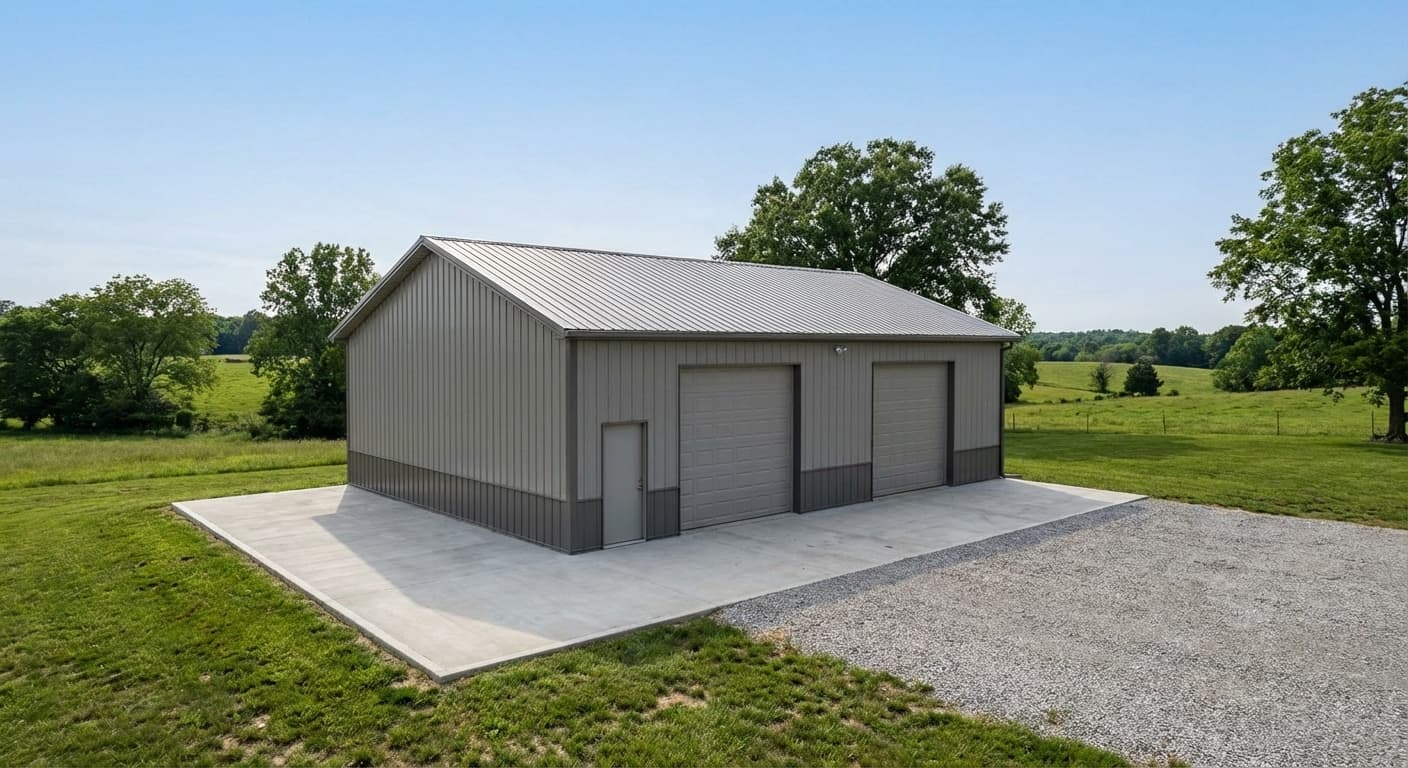

Comparing 30×40-foot pole-barn costs across Illinois, Indiana and Iowa, this guide shows why the lowest kit price–$12,000 to $36,000–rarely equals the best deal once you add concrete, labor, permits and site work that can push installed totals anywhere from $33,000 in rural Indiana to $50,000+ for finished Midwest garages. Readers learn how state-specific variables like Indiana's cheaper slabs and streamlined permits, Illinois' higher concrete rates and code-driven engineering fees, or Iowa's county-by-county agricultural exemptions swing bottom-line costs by thousands, while timing orders before steel tariffs and choosing laminated posts, 29-gauge coated steel and certified trusses lock in long-term value. The article stresses demanding itemized, fixed-price quotes that bundle engineering, doors, insulation and warranty; vetting single-source NFBA builders for licensing, bonds and references; and phasing gravel floors or cosmetic trim to keep initial spend low yet ROI high through eliminated storage fees, faster property sales and tax or insurance breaks that typically repay the investment within five to seven years.
30×40 Pole Barn Price Comparison: Understanding the Cost Landscape
Base Kit Costs Across Key States
You're looking at $12,000 to $36,000 for a 30×40 pole barn kit–that's $10-$30 per square foot before anyone picks up a hammer. [1] Wood-frame kits start low, steel post-frame kits run higher, and what's actually in the box makes all the difference. [1] Most kits ship with framing, roofing, siding, and fasteners. What they don't include: labor, doors, windows, and the dirt work to get started. [2] Factor in professional installation and you're at $15-$40 per square foot.
[1] Your zip code changes everything. Shipping distance, local labor rates, and building codes all move your final number up or down. [3] That $18,000 Midwest kit? It could cost thousands more delivered to a rural site with rough access roads. An urban lot near major highways keeps delivery costs in check.
[2] Steel prices swing with the market too–order timing matters as much as location. [3] Bottom line: get your delivered price with installation included. That's the only number worth comparing when you look at costs across state lines.
Hidden Expenses That Impact the Bottom Line
Here's where budgets blow up: the stuff between bare kit and finished building. Site prep hits first–$1,200 to $8,000 to level ground, clear obstacles, maybe demolish what's already there. [4] Rocky slopes? Add thousands more.
Your concrete slab runs another $4-$8 per square foot. Planning to park heavy equipment inside? You need thicker, reinforced concrete–no shortcuts there. [5] Permits pile on: $500 to $2,500 for the building permit alone, with electrical and plumbing tagged separately.
[4] Rural sites face another hit–running power, water, or gas lines from distant connection points. [2] Then come the pieces your kit didn't include: insulation at $1-$3 per square foot, electrical work at $50-$120 per hour, and those overhead doors you'll source separately. [4] Every single project needs these additions. That's why smart buyers focus on total project cost, not kit price.
How Local Labor and Permits Influence Prices
Labor costs swing harder than any other line item based on where you build. Shell construction runs $5-$10 per square foot, but that's just the starting range. [6] Urban markets push higher. Rural areas look cheaper until you factor in material delivery to remote sites. General contractors take 10-20% of total project cost or charge $50-$150 hourly–and yes, hot markets command premium rates regardless of project complexity. [4] Need an electrician? Same story: $50-$120 per hour, with metro areas hitting the high end while rural counties offer relief if you can find available trades. [6] Permits make labor look predictable.
Rural residential? Often under $400. Inside city limits or commercial zoning? Now you need engineer-stamped drawings at $3,000-$10,000 before touching a permit application. [7] Most jurisdictions charge $500-$2,500 for building permits, with separate fees for electrical and plumbing. [4] Your climate matters too. Heavy snow country? High-wind zones?
You'll need beefier structural specs, more engineering review, longer permit timelines, and higher costs all around. [4] Here's the pattern: Midwest and Southern states see better pricing because contractors there know pole barns inside out. Post-frame construction is their bread and butter. Coastal markets? Expect the opposite–fewer experienced crews mean higher prices and longer waits. [4] The state-by-state breakdown ahead shows exactly how these factors play out in Illinois, Indiana, and Iowa markets.
State‑by‑State Price Comparison for a 30×40 Pole Barn
Illinois: Mid‑Range Costs and What Drives Them
Illinois lands in the middle of the national cost range for a 30×40 build, and concrete drives much of that position. Standard 4-inch concrete in Illinois runs $9-$12 per square foot installed–higher than the baseline estimates covered earlier–which means your floor decision alone adds $10,800-$14,400 to the project. [8] You can phase your concrete decision–start with compacted gravel if your immediate use allows it.
[8] Illinois permits split predictably: rural counties keep it simple at under $400 for residential outbuildings, while city limits and commercial projects trigger engineer-stamped drawing requirements that push costs to $3,000-$10,000. [8] The difference between those scenarios is why working with a builder who knows Illinois code variations saves you from permit surprises. Site prep is the other unpredictable line item: Illinois terrain varies enough that placing a building on the most level, accessible part of your property can eliminate thousands in grading and fill costs that otherwise compound quietly before construction even starts.
[8] Illinois benefits from the Midwest's deep post-frame experience pool, keeping labor competitive–though rural sites can offset those savings through delivery charges. [9] That's where national buying power matters: suppliers with established logistics networks absorb those distance costs better than regional players ordering project by project.
Indiana: Budget‑Friendly Options and Trade‑offs
Indiana is the most cost-accessible of the three states for a 30×40 build. A basic equipment shelter with no interior finish comes in at $33,000-$40,000 fully installed, while a residential garage configuration with two overhead doors and a walk-in entry runs $38,000-$50,000 depending on options. [10] That lower floor exists because Indiana combines dense contractor experience with established supply chains built specifically for post-frame construction. The concrete slab, however, is where Indiana's range widens: a 30×40 pour in Northern Indiana runs $8,000-$15,000 depending on thickness and site conditions–a wider spread than Illinois, but with a lower entry point.
[10] Permit costs stay lean for straightforward rural builds, typically $200-$1,500 by county, and most residential outbuildings don't require engineer-stamped drawings unless you're building commercially or in a jurisdiction with stricter rules. [10]Indiana's savings opportunities hide in smart specification choices. Overhead door prices have spiked–skip the wood grain and multi-window options for simple panels you can paint to match. [11] Sidewall height barely moves your total; it's the footprint and concrete that drive real cost.
[11] Your highest-leverage moves: phase the concrete, handle site prep yourself if equipped, and save the cosmetic upgrades–cupolas, steep pitches, custom trim–for after the shell is up and working. [11] Insulation, if needed for year-round use, adds $3,000-$8,000+ to the project, so it's worth deciding upfront whether the building needs to be climate-controlled or whether that cost can follow later.
Iowa: Premium Pricing Factors and Savings Strategies
Iowa's 99 counties each run their own permit playbook–some waive agricultural building permits entirely while others charge $200-$600 for standard residential projects. [12] Commercial builds trigger additional reviews for drainage, fire safety, and water retention that push costs higher. [12] Call your county office first, not last–permit costs in Iowa can't be estimated from a kit price alone. Site prep in Iowa shifts based on soil conditions, slope, drainage requirements, and whether you're building a gravel pad or a concrete-ready base.
[12] Owners with access to excavation equipment can handle that work themselves–one of the few line items on an Iowa build where self-performing genuinely eliminates rather than defers cost. [12] When concrete is part of the plan, laying compacted stone first isn't optional; it prevents settling and drainage failures that are far more expensive to correct once the structure is up. [12]Iowa rewards strategic timing and phasing. Like the other Midwest states, starting with gravel instead of concrete keeps your initial investment lean.
[12] Strip the first phase down to essentials–save the cupolas and custom trim for later–and you'll see the real shell price. [6] Time your order for late fall or winter when Iowa contractors have schedule gaps, and you'll lock better pricing plus a firm spring start date.
Choosing the Right Value Package for Your 30×40 Build
Invest once in fully-treated laminated columns, 29-gauge coated steel, certified trusses and a single-source build team–or pay far more later to retrofit a cheap kit that can't handle your 30×40 workshop's real demands.
Standard vs. Upgraded Kits: Feature Trade‑offs
You get what you pay for with pole barn kits–and the differences run deeper than paint color. Standard kits deliver the basics: framing, roofing, siding, and fasteners. But look closer. Those solid 6×6 posts? They're only partially treated, leaving the core vulnerable to rot. [13] Upgraded kits use laminated columns–multiple layers of fully treated lumber that won't twist, bend, or decay from the inside out. [13] Steel quality tells the same story.
Budget kits save money with thinner panels. Premium options spec 29-gauge steel with advanced coatings that last 2-4 times longer than basic galvanized. [13] Your trusses matter too. Uncertified trusses leave you guessing on load capacity. Engineered, third-party certified trusses? They come with documentation that satisfies permit offices and stands behind the warranty. [13] Doors and windows separate basic from professional builds.
Standard kits skip them entirely or include versions without thermal breaks–turning your heated workspace into an energy drain. [13] Match the kit to your purpose: storing lawn equipment needs less than housing your business. A gravel-floor storage shell works fine with standard specs. But if you're building a workshop, office, or commercial space, invest in quality columns, thicker steel, and proper openings now. Retrofitting costs more than doing it right the first time.
Single‑Source Turnkey Solutions from National Steel Buildings
Multiple contractors mean multiple headaches. The excavator blames the concrete crew. The framer points to the electrician. Meanwhile, your schedule slips and costs climb. A single-source provider ends that chaos.
One contract. One point of contact. One warranty covering everything from site prep to final inspection. [14] The real value shows up in how components work together. Your engineered trusses need columns, fasteners, and panels that meet the same specs–otherwise, that certified truss rating means nothing.
[14] When one team handles design, supply, and construction, every piece fits. No surprises when the inspector arrives. No scrambling for engineer stamps because someone ordered the wrong components.
Financing and ROI Considerations
Don't judge your pole barn investment by appraisal value alone. Yes, appraisers typically credit 50-70% of construction cost–your $30,000 build might add $15,000-$21,000 to assessed value. [15] But that's just the opening number. Storage fees tell the real story. At $100-$200 monthly, you're looking at $12,000-$24,000 over ten years. Your barn eliminates that drain.
[15] When selling time comes, properties with quality outbuildings move 20-40% faster. That speed has dollar value when you're coordinating your next purchase. [15] Location drives returns. Rural and semi-rural markets value a 30×40 barn with power and concrete at $25,000-$35,000. Agricultural properties see 10-15% total value increases with proper storage buildings–buyers expect them. [15] Add tax benefits–agricultural exemptions, business deductions, reduced insurance premiums for sheltered equipment–and the math improves further.
[15] Most owners break even within 5-7 years through these combined benefits, before counting appreciation. [15] The smart play: build what you can afford to do right. A smaller barn with concrete and electrical returns more value percentage-wise than a larger shell that screams "unfinished" to appraisers and buyers. Quality beats size when ROI matters.
Actionable Steps to Secure the Best 30×40 Pole Barn Deal
Itemize every 30×40 pole-barn quote–permits to vapor barrier–then verify the builder's license, bond, and insurance with state records before you sign, or you'll swallow hidden five-figure costs and liability.
Requesting a Clear, Itemized Quote
The lowest quote rarely stays the cheapest build. You need itemized pricing that shows exactly what you're buying–and what you're not. Start with these five must-have line items: permits and engineer-stamped drawings, concrete slab and footings, overhead and walk doors, site prep and cleanup, and warranty coverage. [17] A quote without concrete for your 30×40 barn hides $10,000-$20,000 in foundation costs you'll pay someone else to handle.
[17] Push deeper on the details. Does the quote include vapor barrier under the roof? Are trusses rated for your local snow load? Will the design pass your building department's review on the first submission?
[18] Smart buyers insist on site visits before signing–your property's grade, drainage, and access affect both cost and timeline in ways remote quotes miss. [18] Once you collect itemized quotes, line them up side by side. Compare apples to apples on every component, then ask builders to explain any gaps.
Evaluating Contractor Credentials and Communication
Evaluating contractor credentials and communicationThree documents separate legitimate contractors from risk: current state licensing, a valid surety bond, and active insurance coverage–both general liability and workers' comp. Skip any one and you own the liability personally. [19] Pull the license number from your state's contractor board website, not the contractor's business card. Bonds and insurance do different jobs: bonds protect you when contractors bail or break licensing rules, while insurance covers damage and injuries on your property. [19] Get insurance certificates straight from the carrier–contractor-provided copies prove nothing about current coverage. [19] Look for certifications like National Frame Building Association (NFBA) membership, which signals specialized post-frame training beyond basic construction knowledge. [20]### Checking track record and referencesReferences tell you what photos can't. Get three to five contacts from similar projects–same use, not just same size–and call every one. [19] Ask the money questions: Did they hit the timeline?
Stay on budget? Handle surprises professionally? Would you hire them again? [21] Recent projects matter more than old ones since crews and processes change. [21] Better yet, visit a completed building. Photos hide structural details and finish quality that your eyes won't miss. [19] Online reviews below 4. 5 stars are a red flag, but actual client conversations trump aggregate ratings when they conflict. [19] ### Using responsiveness as a pre-contract signalBad communication causes 48% of construction rework and drives 70% of all project complaints.
[19] [20] Watch how contractors handle your first questions–slow or vague responses now mean the same problems later, only costlier. [19] Before signing anything, nail down the communication plan: How often will they update you? Through what channel? Who's your single point of contact for decisions? [19] Contractors who answer these specifics clearly–and explain technical issues without hiding behind jargon–are showing you the transparency that prevents disputes. [20] Get every promise in writing. A quick email summary after each call creates the paper trail that protects both sides when memories differ.
Leveraging Market Monitoring for Ongoing Savings
Leveraging market monitoring for ongoing savingsMaterial prices for pole barn construction don't move on a predictable schedule–they move with tariffs, supply chain shifts, and seasonal demand, which means the timing of your purchase decision carries real financial weight. Tariffs on imported steel and lumber are a live variable: roughly 70% of U. S. lumber comes from Canada, and those imports already carry tariffs that recent policy changes could push significantly higher, with industry leaders estimating price inflation of around 10% as a result.
[22] Steel panel costs follow similar pressure. The practical response isn't to wait for prices to stabilize–it's to lock in pricing before increases take effect. Most builders issue quotes valid for only 30 days, and that window may shorten as material costs become harder to predict. [22] Asking your builder directly whether they offer fixed pricing–meaning your contract price won't adjust if materials rise between signing and build–is one of the highest-leverage questions you can ask before committing.
[22] Some builders get ahead of supply chain volatility by purchasing lumber inventory in advance and manufacturing components like trusses in-house, which insulates their pricing from spot market swings that hit builders who source materials project by project. [22] Factoring in lead time matters too: smaller crews may book a year out, while larger builders with dedicated crews can offer earlier start dates–which matters if you're trying to build before the next price increase hits.
- 30×40 kit costs $12k-$36k before labor; installed total hits $15-$40/sq ft.
- Concrete alone adds $10k-$20k; gravel start defers this big-ticket item.
- Indiana is cheapest of IL/IN/IA; basic 30×40 installed runs $33k-$40k.
- Permits vary $200-$10k; rural ag often waived, cities demand stamped plans.
- Single-source builder cuts risk; one contract covers design, supply, build, warranty.
- Material quotes lock 30 days; ask for fixed-price contracts to beat tariff spikes.
- Quality 29-gauge steel & laminated posts double lifespan vs. thin, untreated kits.
- https://homeguide.com/costs/pole-barn-kit-prices
- https://info.fbibuildings.com/blog/30-x-40-pole-barn-costs-diy-kits-vs.-construction
- https://themetalshopllc.com/how-much-is-a-30×40-pole-barn-kit/
- https://www.angi.com/articles/how-much-does-it-cost-build-pole-barn.htm
- https://www.probuiltsteel.com/blog/30×40-metal-building-cost/?srsltid=AfmBOoo_-k7lky1CPfnDcne1DdSz1sdF_CKtbK7lkSOvNVK3B_N3EU0J
- https://homeguide.com/costs/pole-barn-prices
- https://milmarbuildings.com/how-much-does-a-pole-barn-cost
- https://milmarbuildings.com/learning-hub/cost-to-build-a-pole-barn-in-illinois
- https://themetalshopllc.com/how-much-does-it-cost-to-build-a-30×40-pole-barn/
- https://sunrisestructures.net/blog/pole-barn-prices-in-indiana/
- https://milmarbuildings.com/learning-hub/cost-to-build-a-pole-barn-in-indiana
- https://info.fbibuildings.com/blog/iowacost
- https://info.bgsupplyco.com/blog/30-x-40-x-10-pole-barn-kit-cost
- https://www.buildingsguide.com/build/pole-barn-vs-metal-building/?srsltid=AfmBOopFsa6Qzt8FVRjTTazMgJAl-_eZNATP-cCtqyeNbVHLMS-hgX6v
- https://matadorstructures.com/blog/pole-barns-increase-property-value/
- https://www.diypolebarns.com/learn/does-a-pole-barn-add-value-to-a-home/
- https://www.tallpinesbuilding.com/information/what-s-really-included-in-your-pole-barn-price-5-scope-items-homeowners-often-overlook
- https://polebarnsdirect.com/6-questions-you-must-ask-when-considering-a-pole-building-quote/
- https://barngeek.com/checklist-for-hiring-a-barn-contractor.html/
- https://www.dutchbuilders.com/blog/how-to-choose-the-right-local-pole-barn-builder
- https://barnpros.com/resource-center/how-to-find-choose-a-barn-builder/
- https://info.fbibuildings.com/blog/2026-tariffs