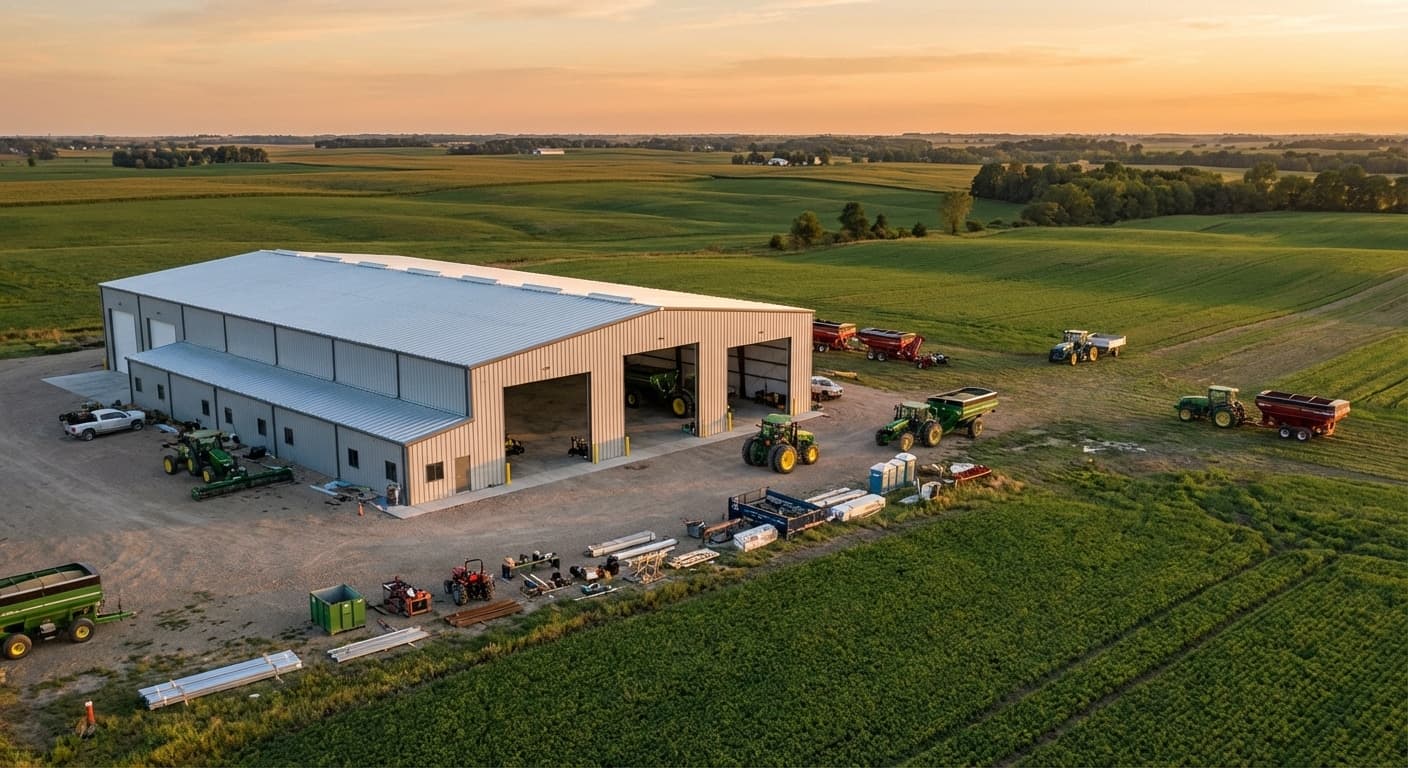

Pre-engineered steel agricultural buildings slash construction time to 6-12 weeks through factory-made, pre-cut components that bolt together on site, letting farmers generate revenue faster while cutting interest and avoiding seasonal delays. Beyond speed, these structures deliver 50-year durability with 30-year panel warranties, fire and pest resistance, and minimal upkeep–saving 60% on maintenance and 10-25% on insurance while supporting clear-span, column-free interiors that adapt from 30×40 barns to 100,000-sq-ft mega-dairies and expand simply by removing an end wall. Modern versions integrate solar arrays, IoT climate and feeding systems, rainwater harvesting, and up to 80% recycled content, qualifying for LEED and USDA loans up to $600k and positioning farms for 80% energy independence and environmental incentives. Single-source suppliers provide transparent $15-$43/sq-ft pricing, AISC-certified engineering that meets local snow, wind, and seismic codes, and lifetime service with 50-year structural guarantees, so farmers manage crops and livestock instead of chasing contractors. Readers will learn how to accelerate expansion, lock in lower lifetime costs, access financing, and future-proof their operations with smart, sustainable steel buildings that pay for themselves decade after decade.
Why Pre-Engineered Steel Agricultural Buildings Are Transforming Modern Farming
Pre-engineered steel buildings slash construction time to weeks, not months, so your harvest-ready barn or dairy expansion starts earning faster while outlasting weather, pests, and fire with one-call accountability.
Speed of construction and time-to-operation
You need your new barn up before harvest. Your dairy expansion can't wait for next season. Pre-engineered steel gets you operational in weeks, not months [2]. Here's what that looks like: Your building design takes 1-3 weeks. While you're preparing the site, factory fabrication runs 3-6 weeks. Delivery takes about a week, then 1-3 weeks for assembly [2]. A 3,000 square foot equipment shed?
You're looking at 6-8 weeks total. Even a 10,000+ square foot facility wraps up in 8-12 weeks [2]. Why so fast? Your building components arrive pre-cut, pre-drilled, and ready to bolt together [1]. No measuring and cutting on-site. No weather delays during fabrication. No scrambling for materials.
Your foundation work happens while steel fabrication runs at the factory–parallel processes that save you weeks [2]. This speed matters to your bottom line. You start generating revenue sooner. You pay less interest during construction. You hit your seasonal targets without compromise [2]. For operations that can't afford delays, pre-engineered steel delivers the timeline advantage you need.
Quality and durability standards
Your farm building faces harsh realities–blizzards, summer heat, equipment wear, and constant use. Steel handles it all without breaking a sweat [5]. Quality starts at the source. Reputable manufacturers follow I.
A. S. certification standards, ensuring every steel component meets strict specifications [4]. You get warranties that matter–up to 30 years on steel panels from premium suppliers [5].
That's confidence you can bank on. Steel brings practical advantages wood can't match: – Fire resistance that protects your hay storage and equipment [5] – Zero appeal to termites and pests–no rot, no warping [5] – Engineer-certified designs that exceed local building codes [5] – Decades of service with minimal upkeep beyond occasional cleaning [5] The bottom line?
Single-source solutions simplify project management
One supplier. One phone number. One accountability chain. That's the power of single-source steel building solutions [7]. You get everything in one complete package–steel frame, panels, trim, fasteners, even the detailed assembly instructions. Every component arrives labeled and organized, with a master packing list that matches what you ordered [7].
No chasing down multiple vendors. No finger-pointing when something's missing. This simplicity saves you more than time. When you have questions during assembly, you call one number [6]. Need a replacement part? Same contact handles it.
Planning an expansion next year? Your original supplier already knows your building inside and out [7]. For busy farm operations, this matters. You're managing crops, livestock, equipment, and employees–not construction headaches. Single-source responsibility means fewer phone calls, clearer accountability, and components designed to work together from day one [6]. It's project management simplified for people who have better things to do than coordinate contractors.
Design Flexibility: From 30×40 Barns to Mega Dairies
From a 30×40 equipment shed to a 100,000-plus-sq-ft mega-dairy, clear-span steel buildings let farmers start small, reconfigure interiors on demand, and expand simply by removing an end wall–all while integrating ventilation, temperature control, and equipment layouts tailored to any agricultural operation.
Scalable layouts for diverse farm operations
Pre-engineered steel buildings accommodate virtually any agricultural need through adaptable designs that scale from small operations to industrial-sized facilities. These structures support at least 15 different farm applications including livestock shelters, equipment storage, processing plants, and hybrid spaces that combine multiple functions [8]. The clear-span design eliminates interior columns, creating unobstructed spaces that farmers can configure for everything from dairy operations to grain storage without structural limitations [10].
This flexibility extends to building dimensions–the same engineering principles apply whether constructing a modest 30×40 equipment shed or expansive 100,000+ square foot livestock facility [9]. When operations grow, these buildings can be readily expanded by removing end walls and extending the frame, avoiding the costly demolition and rebuilding traditional construction requires [9]. For specialized needs, farmers can integrate features like controlled environments for livestock, temperature regulation for produce storage, or retail spaces for direct farm sales–all within a unified structural system [10].
This adaptability proves particularly valuable for diversified operations that manage multiple agricultural activities simultaneously, allowing internal spaces to be reconfigured as seasonal needs or business models evolve [8].
Customizable interior configurations
Pre-engineered steel buildings feature clear-span framing that creates column-free interiors, allowing farmers to configure spaces for specific operational needs without structural limitations [11]. This design flexibility accommodates everything from strategic equipment placement to optimized livestock flow. For dairy operations, interior layouts can be customized to position milking equipment for maximum efficiency, with manufacturers working directly with equipment suppliers to ensure proper integration [12].
Ventilation systems can be tailored to specific livestock requirements, with options including natural sidewall curtains or powered systems that maintain ideal barn conditions throughout seasonal changes [12]. Sound management features like Hi-Rib Acoustical Steel reduce machinery noise, creating less stressful environments for both workers and animals [12]. The precise placement of doors, windows, and stalls can be strategically determined to create the most efficient and safe working environment while supporting animal health [12].
Clear height specifications can be designed to accommodate large equipment access, with customizable door sizes that enable machinery movement without constraints [11]. For specialized operations like beef cattle facilities, monoslope designs feature higher roofs that overhang to the south, blocking direct sunlight while maximizing air circulation–a configuration specifically engineered for animal comfort and productivity [13]. These customization options allow agricultural buildings to serve multiple functions simultaneously or be reconfigured as farming operations evolve.
Integrating technology and sustainability
Pre-engineered steel buildings have evolved into technology-enabled structures that support sustainable farming operations. Modern designs now integrate photovoltaic panels directly into building components, with roof slopes and orientations optimized for maximum solar capture, enabling some facilities to achieve up to 80% energy self-sufficiency [16]. IoT systems transform static structures into smart environments through automated feeders, remote climate control, and real-time monitoring of structural stress points that automatically adjust ventilation systems [15].
These buildings accommodate advanced surveillance systems with motion sensors to protect livestock and equipment while providing data for operational decision-making [15]. The sustainability advantages are substantial–steel components contain up to 80% recycled content and remain 100% recyclable at end-of-life, reducing lifecycle carbon emissions by 30-40% compared to concrete alternatives [16][14]. Water management features like integrated rainwater harvesting systems further reduce environmental impact and operating costs [16].
For farms pursuing certification, these structures easily meet LEED, Green Globes, and Living Building Challenge standards, potentially qualifying for environmental incentives [15]. The modular nature of these buildings supports future technology integration as agricultural systems evolve, providing long-term adaptability for emerging precision farming techniques [16].
Cost Efficiency and ROI of Pre-Engineered Steel Structures
Pre-engineered steel buildings give farmers transparent, $15-$43 per-square-foot pricing today and pay them back with 60% lower maintenance costs, 40% energy savings, and 50+ years of virtually upkeep-free service.
Accurate sizing, pricing, and budgeting
You know your farm's expansion budget down to the last penny. Pre-engineered steel buildings respect that precision with transparent, predictable pricing that eliminates guesswork. Your 30×40 equipment shed starts around $24,000, while a 50×100 facility runs approximately $75,000 for materials–that's $15-$20 per square foot you can count on [17]. Want everything handled?
Turnkey installations including foundation, delivery, and construction typically cost $24-$43 per square foot [17][19]. Your specific costs depend on several straightforward factors: local building codes for snow and wind loads, building dimensions, design complexity, and accessories like insulation or ventilation systems [19]. A 40×60 structure runs $43,200-$60,000, while larger 60×80 buildings reach $86,400-$120,000 for materials [18]. Factor in site preparation, foundation work, and any exterior finishes to complete your budget picture [19].
This pricing transparency means no surprises that derail your expansion timeline. You'll know exactly what you're investing before breaking ground–keeping your project on schedule and your operation running smoothly.
Lifecycle cost savings and maintenance
Your steel building pays you back year after year. While traditional structures drain budgets with constant repairs, pre-engineered steel requires virtually no maintenance–less than $0. 15 per square foot annually, saving you 60% compared to wood-framed buildings [21]. That's money staying in your operation instead of disappearing into upkeep.
These buildings deliver 50+ years of reliable service while conventional structures need major renovations after just 20-30 years [21]. Your initial investment keeps working for you decade after decade. Add energy-efficient insulation and ventilation that cut heating and cooling costs by up to 40%, and you're looking at serious operational savings [21]. Insurance companies recognize steel's superiority too.
Your premiums drop 10-25% compared to traditional construction thanks to fire resistance and weather resilience–benefits we covered earlier regarding durability standards [21]. When you calculate total ownership costs, traditional buildings run 20-30% more expensive to maintain than steel structures [20]. In agricultural environments where livestock, chemicals, and equipment create harsh conditions, this maintenance advantage becomes even more valuable [22]. You focus on farming while your building takes care of itself.
Financing options and government incentives
Farmers can access multiple USDA financing pathways to fund steel building construction projects. Farm Service Agency (FSA) Farm Ownership Loans provide up to $600,000 for constructing or improving farm buildings, paying closing costs, and implementing soil and water conservation measures [23][24]. For smaller projects, FSA Microloans offer streamlined application processes with reduced paperwork, designed specifically for small and beginning farmers [24].
Farmers recovering from natural disasters can utilize Emergency Loans to rebuild damaged structures or replace lost equipment [24][25]. The USDA also offers two distinct loan structures: Direct Loans made directly from FSA to farmers, and Guaranteed Loans provided by USDA-approved commercial lenders with federal backing [24]. Beginning farmers receive special consideration with targeted loan funding set-asides, making building expansion more accessible for new agricultural operations [24][25].
For farmers considering climate-smart building features, USDA loans can finance specialized equipment and practices that improve environmental performance [25].
Choosing a Trusted Partner: Service Excellence with National Steel Buildings
From a single point of contact who coordinates every truck and bolt to 50-year structural guarantees and AISC-certified steel, National Steel Buildings delivers a worry-free, transparent process that keeps your farm project on schedule and protected for decades.
Clear communication throughout the build
Your steel building project runs smoothest when you have one person coordinating everything–from the first truck arrival to the last bolt. That single point of contact manages driver entry, unloading schedules, and site traffic to keep your project safe and on schedule [26]. You'll know exactly what's happening through regular progress meetings where your team addresses concerns before they become problems [27].
You get both a hard copy and digital version of your bill of materials for easy tracking [26]. This documentation prevents the usual headaches: late design changes, unprepared sites, and delivery confusion [26]. Your project timeline spells out every phase with clear start and end dates, so you always know what's coming next and when you need to make decisions [28].
No surprises, no guesswork–just transparent communication from day one [28].
Problem-solving support and after-care
Your building partner should stick around long after the last beam goes up. Look for providers offering 50-year structural guarantees and 25-year coating warranties–real protection for your investment [29]. When you need help, you want one phone call to solve the problem, not a runaround between contractors [29].
Regular maintenance checks catch small issues before they turn expensive. Your partner's specialists inspect structural integrity and coating conditions to keep your building performing like new [29]. As your farm grows, you need a partner who can expand, renovate, or upgrade your existing structure without starting from scratch [29].
This lets you focus on farming while your building partner handles the infrastructure.
Ensuring quality through certified engineering
Your steel building needs rock-solid engineering from start to finish. AISC-certified fabrication means every component meets strict quality standards–no missing parts, no structural surprises [30][31]. Annual audits keep these facilities honest, catching problems before they reach your job site [31].
For farm buildings facing weather extremes, you need steel that meets ASTM A36 or A992 standards. This guarantees consistent strength and proper weldability in every beam and panel [32]. Your building design accounts for local snow loads, wind requirements, and seismic codes right from the start [30].
Quality control follows your building through every phase: – Design standards specific to your agricultural needs [30] – AWS D1. 1 welding standards for structural integrity – ISO 1461:2022 galvanizing (≥85μm thickness) for corrosion resistance in livestock environments [30] – Field verification of bolt torque and weld quality–especially critical for clear-span barns [30] This attention to detail pays off: buildings that last 50 years, minimal maintenance costs, and the structural safety your operation depends on [30]. When you're investing in farm infrastructure, certified engineering protects that investment for decades.
- Pre-engineered steel buildings cut construction time to 6-12 weeks with factory-made components.
- Steel buildings last 50+ years, cost 60% less to maintain, and reduce insurance by 10-25%.
- Clear-span interiors adapt to any farm use and can be expanded without demolition.
- USDA loans up to $600,000 and energy savings up to 40% improve ROI.
- Single-source supply means one contact for design, delivery, and future support.
- Steel is fire-resistant, pest-proof, and meets strict I.A.S. and AISC quality standards.
- Integrated solar and IoT systems can reach 80% energy self-sufficiency.
- https://www.tylerbuilding.com/post/pre-engineered-metal-buildings-vs-traditional-builds-a-comprehensive-comparison
- https://metalprobuildings.com/pre-engineered-steel-building-timeline/
- https://www.universalsteel.com/why-agricultural-steel-frame-buildings-are-the-best-choice-for-modern-farms/
- https://premierbuildings.com/agricultural-farm-steel-metal-buildings/
- https://www.rhinobldg.com/blog/13-reasons-farmers-and-ranchers-choose-steel-systems
- https://www.buildingsguide.com/build/advantages-of-pre-engineered-steel-buildings/?srsltid=AfmBOooPaoSyg2D8NnHZkLbH0Kw1498UZi-MzhLWhZ8PBpmD02Km2sBd
- https://norsteelbuildings.com/advantages-of-steel-series/advantages-single-source-responsibility/
- https://peb.steelprogroup.com/steel-structure/agricultural/type-of-farm-buildings/
- https://pebsteel.com/en/pre-engineered-steel-building-applications-in-agricultural-construction/
- https://classicbuildings.com/agricultural-buildings/hybrid-farm-buildings/
- https://mavericksteelbuildings.com/steel-buildings/agricultural/
- https://mortonbuildings.com/projects/dairy
- https://www.agristeelusa.com/building-design
- https://farmonaut.com/infrastructure/flat-pack-agricultural-buildings-steel-framed-ag-storage
- https://www.vikingbarns.com/blog/how-innovative-uses-of-metal-farm-buildings-shaping-modern-farming
- https://www.clsteelstructure.com/how-can-modular-and-prefab-steel-structures-assist-agricultural-building.html
- https://www.buildingsguide.com/metal-building-prices/?srsltid=AfmBOoqBd392HJy6z6ynWEZ9QZkODAGZclEl7tFpdzdQMJqDU7hh4tJR
- https://www.metalbuildingoutlet.com/metal-building-cost/
- https://www.rhinobldg.com/blog/how-much-does-a-pre-engineered-metal-building-cost
- https://ecopeb.com/2025/02/19/pre-engineered-buildings-vs-traditional-structures/
- https://www.summitsteelbuildings.com/steel-systems-are-the-cost-effective-solution-throughout-a-lifecycle
- https://marbuildingsolutions.com/understanding-cost-savings-of-pre-engineered-metal-buildings/
- https://www.usda.gov/farming-and-ranching/financial-resources-farmers-and-ranchers/grants-and-loans
- https://www.fsa.usda.gov/resources/farm-loan-programs
- https://www.farmers.gov/loans
- https://www.metalconstructionnews.com/articles/delivering-metal-buildings-on-time/
- https://bullbuildings.com/4-essential-steps-in-building-a-metal-building-project-with-precision/
- https://mqsbarn.com/2025/05/05/the-importance-of-establishing-a-timeline-during-steel-building-construction-in-dillon/
- https://peb.steelprogroup.com/peb-structure/agricultural/farm-buildings/
- https://qsbsteel.com/en/pre-engineered-steel-building-standards-a-complete-guide-from-a-to-z/
- https://www.rhinobldg.com/blog/quality-control-in-steel-building-fabrication
- https://www.alliedbuildings.com/grades-and-standards-of-steel-for-pembs/