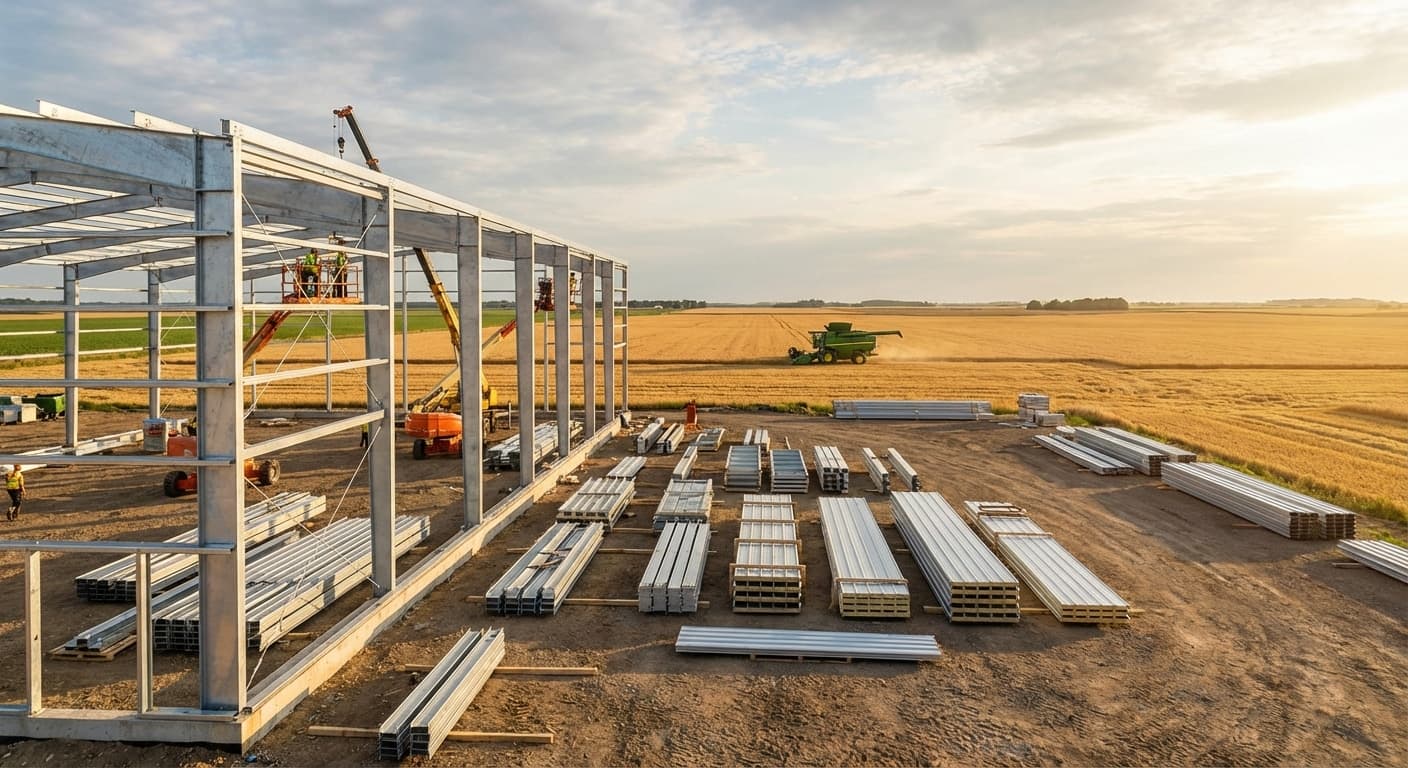

Steel-building contractors who specialize in agriculture know that harvest windows are non-negotiable, so they engineer, schedule, and erect prefabricated steel systems that go up 30-60 % faster than conventional construction while you're still in the field. By moving fabrication indoors, they slash weather delays, deliver laser-cut components that bolt together in days, and let you expand bays later without disrupting the original structure–so grain, equipment, or livestock shelter is ready before the first truck rolls in. They size door heights, turning radii, and cubic meters around your combines, handlers, and projected yields, then bundle kit ($15-$25/ft²) or turnkey pricing ($24-$43/ft²) into one contract that coordinates foundations, permits, and erection crews, tying payments to milestones on your farming calendar, not arbitrary dates. Continuous, harvest-friendly communication–text, radio, or site walks–keeps you informed, while factory testing, code-compliant engineering, and protective coatings cut lifetime maintenance up to 5 % versus wood. Readers learn how to lock in summer construction slots, phase work around soil conditions and frost heave, and use real-time weather and crop-maturity data to hit the perfect build window, ensuring new storage or housing is weather-tight and cash-flow aligned when harvest urgency peaks.
Harvest Timing and Its Influence on Steel Agricultural Building Projects
Schedule your steel building project around harvest downtime–starting design in early spring and timing major construction for the dormant season–so contractors can finish foundations and framing without blocking combines, disrupting 12-hour harvest days, or letting weather delays jack up costs.
Seasonal cycles dictate design and material choices for steel agricultural building contractors
Your steel building project works best when scheduled around your farming calendar. Summer months (June-August) give you optimal conditions with fewer weather delays that jack up costs [1]. Start planning in early spring–you'll need about 3 weeks for design and 2-3 months from design to completed building [1].
Your material choices matter: heavy-gauge metal sheeting protects against rain, snow, and temperature swings that destroy traditional structures [2]. Your soil type drives foundation decisions: clay expands and contracts with moisture, while sandy soil drains well but needs extra support [3]. Smart contractors design foundations that handle your specific challenges–frost heave in cold regions, soil shrinkage in hot climates [3].
This planning keeps your project on track without interfering with harvest.
Key responsibilities of contractors during peak harvest windows
During harvest, you're working 12+ hour days with no time for construction headaches [5]. Your contractor's job is setting realistic milestones that work around your schedule [4]. The right approach keeps construction moving without disrupting your operations.
Good contractors stay in constant contact about progress–they never say "we're not in a hurry" because that pushes your project to the back burner [4]. They coordinate deliveries and crews to avoid blocking your equipment routes. Your contract should tie payments to completed milestones, not calendar dates [4].
Weather affects both harvest and construction, so your contractor needs backup plans while still hitting deadlines [6]. This coordination protects your access to fields, equipment movement, and processing operations when you need them most.
Aligning construction milestones with farm operations to protect yields
Your harvest determines your profit–smart contractors schedule around it. Major work like foundations and steel frames happens during your dormant season when equipment sits idle [9].
Today's contractors use weather data and crop maturity forecasts to find perfect construction windows. You won't find crews blocking field access when combines need to roll [9].
The prefabricated components covered in the next section allow rapid assembly between your busy seasons [7]. Your contractor builds flexibility into schedules for surprise weather that speeds up harvest [9].
Accelerated Engineering with Prefabricated Steel Systems
Prefabricated steel buildings slash your construction time by half–turning a 3-4-month project into a 4-7-week harvest-ready reality with pre-cut, pre-tested components that bolt together like a kit.
Modular designs that enable rapid on‑site assembly without compromising strength
You need your agricultural building up fast–before harvest hits. That's where prefabricated steel systems deliver. These buildings go up 50% faster than stick-built structures because the components arrive pre-cut, pre-drilled, and ready to bolt together [10]. No waiting for custom cuts. No measuring twice. Just rapid assembly that gets you operational when you need it.
The secret? Moving 60-80% of construction into controlled factory environments where weather can't slow things down [11]. Your building's frame bolts together like a well-designed kit–no specialized equipment needed, minimal crew required. The modular design maintains full structural integrity while cutting on-site labor by 70% [11]. Here's what matters for your timeline: A 1,000-square-meter storage facility goes from foundation to finished in 4-7 weeks. Traditional construction?
You're looking at 3-4 months minimum [12]. That's the difference between having shelter for your harvest or watching equipment sit in the weather. Need to expand next season? The modular system lets you add bays and sections as your operation grows [10]. No structural compromises, no starting over. Just smart growth that matches your production.
Advanced prefabrication technologies that reduce errors and shorten build time
Today's steel prefabrication cuts your project timeline by 30-50%. How? Computer-controlled manufacturing that gets it right the first time [13]. Laser cutting and CNC bending hit tolerances within millimeters–which means no field fixes, no delays, no surprises when you're racing harvest deadlines [15].
Every component gets tested before it ships. Result: Parts that fit together perfectly when they reach your site [13]. The pieces arrive clearly labeled and pre-drilled. Your crew can erect the entire frame in days, not weeks [14].
This precision pays off in three ways: – Less waste from exact cutting (your budget stays intact) – Minimal assembly errors (your timeline stays on track) – Weather-protected manufacturing (your project keeps moving) [13][15] Bottom line: You get into your new facility 20-40% faster than with traditional construction [14]. That's the difference between being ready for harvest or scrambling for alternatives.
Integrated weather‑proofing and site‑ready features for uninterrupted progress
Rain can't stop factory production. That's the advantage of moving 60-80% of your building's construction indoors [16]. While traditional builders wait for clear skies, your steel components are being cut, welded, and tested–on schedule, every time. When materials reach your site, they're ready to go up fast. Standard structures install in just 1-2 days once your foundation's set [17].
Even if weather threatens, the engineered connections let crews pause and resume without losing progress or compromising strength [17]. Smart contractors coordinate just-in-time delivery. Your components arrive when you're ready to build–not sitting in the mud for weeks [18]. This tight scheduling cuts total construction time by 40-60% compared to stick-built structures [18]. What does this mean for your operation?
You get functional buildings weeks or months sooner [16]. Storage ready before grain comes in. Equipment shelters up before winter hits. Processing facilities operational when you need them. Every day counts when harvest waits for no one.
Smart Sizing, Transparent Pricing, and Single‑Source Procurement
Size your ag building right–from 5 m doors for combines to 0.8 m³ per grain tonne–then lock in real costs: DIY steel kits at $15-$25/ft² or turnkey at $24-$43/ft², and watch the price drop 20-40 % as the barn grows.
Choosing the optimal building size–from 30×40 barns to mega dairies–based on production goals
You need a building that works today and grows with you tomorrow. Start with your equipment–modern combines need doorways at least 5 meters high. Telescopic handlers require room to turn around [19]. Your livestock dictates space too: dairy cows need 1. 25 square meters each just for feeding, beef cattle need 2. 5-3 square meters per animal [19]. For grain storage, take your biggest yield estimate and add 20%. Each tonne needs about 0.
8 cubic meters of space [19]. Height matters for both capacity and airflow–plan ridge height at 1. 5 times your building width to keep air moving and structure sound [19]. Your operation type drives the design. Loafing sheds–those three-sided, open-front structures–work great when animals need free access to weather protection [20]. Full enclosures suit harsh climates better [20]. Dairy operations need specialized layouts with dedicated milking parlors and processing areas [20]. Don't forget access.
Loading bays need 4. 5 meters width and 4. 8 meters height minimum. Your biggest equipment needs room to maneuver–plan turning radius accordingly [19]. Steel gives you options. As covered in our prefabricated systems section, expansion happens without disrupting your original structure [21]. Just check local building codes first. Height restrictions and lot coverage limits can surprise you if you don't verify early [19].
Clear cost structures, budgeting tools, and ROI calculators for farmers
You need real numbers, not estimates that blow up at harvest time. Steel building kits run $15-$25 per square foot. Want us to handle everything? Turnkey installations cost $24-$43 per square foot–a difference that matters when cash flow gets tight [22]. Take a 30×40 equipment shed (1,200 square feet).
The kit alone: $21,600-$30,000. Full turnkey with site prep, concrete, delivery, and construction: $28,800-$51,600 [22]. Bigger buildings save you money per square foot–warehouses and livestock facilities cost 20-40% less per square foot than smaller structures [22]. Don't forget the extras: – Site preparation: 10-20% of total project cost – Concrete foundations: $4-$8 per square foot – These add up fast if you're not planning for them [22] Smart farmers use tools like the Agricultural Budget Calculator (ABC) to see the full picture. It shows how equipment age affects your bottom line–newer tractors cost $43.
99 per acre to run versus $26. 94 for older models [23]. Use that data to time your building investment against equipment replacement. Good calculators let you adjust everything–building size, metal gauge, doors, insulation. You get exact costs that fit your harvest schedule and available capital [22].
One‑stop sourcing of steel, components, and services to simplify project management
One call. One contract. One company handling everything from steel to services. That's how you beat harvest deadlines without losing sleep over coordination nightmares. Single-source procurement means you get a complete, weather-tight building through one coordinated effort [24].
No juggling architects, subcontractors, or material suppliers. You turn the key and start using your facility–that's it [26]. Your project coordinator manages every detail across departments. You get clear schedules for: – Anchor bolt drawings – Permit sets – Erection plans – Every critical deliverable [24] Three delivery options fit your needs: – Sole-source: Everything from one factory – Buy-out items: Specific components sourced separately when needed – Phased delivery: Perfect for sites with limited laydown space [24] This streamlined approach cuts project delivery time by up to 25% [25]. Less paperwork.
Less coordination headaches. Less time waiting. For harvest-critical projects, every day counts. When your grain storage or equipment shelter must be ready before combines roll, single-source procurement delivers the speed you need without the typical construction chaos [24]. As discussed in our prefabricated systems section, this efficiency combines with rapid assembly to get you operational weeks ahead of traditional methods.
Service Excellence Through Clear Communication and Ongoing Support
From the first clear conversation to post-build inspections, we tailor every update, schedule tweak, and engineering check to your harvest calendar so your farm stays productive and your steel building stays code-solid for decades.
Proactive communication plans that keep growers informed at every stage
You'll know exactly where your project stands–from day one through final inspection. We start with a clear conversation about your tasks, timeline, and farm-specific requirements, making sure everyone understands the plan before work begins [28]. During harvest, when every hour counts, we schedule pre-planned meetings that align our construction activities with your operational calendar [27]. You explain what you need for harvest; we show you how we'll work around it.
Your preferred communication method becomes ours–whether that's group texts, emails, or radio updates. You get real-time progress reports and immediate notification of any schedule adjustments [27]. When weather threatens both your harvest and our construction timeline, you'll hear from us first with a solution. We adapt our communication to how you work best.
Visual learners get detailed site plans and timelines. Those who prefer verbal updates get regular calls. Hands-on operators see demonstrations of what we're doing and why [28]. Regular progress reviews catch potential issues before they impact your harvest, keeping your farm productive while we keep building on schedule [28].
Rigorous quality‑assurance protocols ensuring structural integrity and compliance
Your building starts strong and stays that way. Every steel component undergoes rigorous engineering assessments to handle your specific snow, wind, and equipment loads [29]. Factory testing catches problems before materials reach your site, delivering dimensional accuracy that eliminates costly field corrections [30]. We follow the National Farm Building Code and all provincial regulations–no shortcuts, no surprises.
Heavily loaded structures or unusual soil conditions? We bring in additional engineering expertise [29]. Your building gets designed right the first time. After construction, you need semi-annual inspections–spring after the final freeze and fall before winter sets in.
Check roof trusses, truss plates, and bracing for damage or rust [31]. In extreme weather zones, inspect more frequently [31]. Our quality protocols protect your investment: * Protective coatings that resist moisture, fertilizers, and chemicals [31] * Expansion joints that handle temperature swings without damage [31] * Food-safe, non-toxic surfaces for storage and processing areas [31] * Value-engineered solutions that meet every code without excess weight [29] You get a building that performs exactly as promised, year after year.
Post‑construction maintenance, rapid‑response repairs, and long‑term partnership
Your steel building saves you up to 5% annually compared to wood structures that need constant repairs [32].
- Prefabricated steel buildings go up 50% faster than stick-built, cutting downtime during harvest.
- Plan construction around harvest: summer builds avoid weather delays and equipment conflicts.
- Single-source procurement slashes project delivery time by 25% and coordination headaches.
- Steel kits cost $15-$25/sq ft; turnkey runs $24-$43/sq ft–budget 10-20% extra for site prep.
- Design doorways ≥5 m high and turning radius for combines; add 20% to peak yield for grain storage.
- Factory-built components arrive pre-cut, pre-drilled, and tested, trimming on-site labor by 70%.
- Tie payments to completed milestones, not calendar dates, to keep projects on harvest schedule.
- https://www.steelsmithinc.com/2017/03/time-to-start-planning/
- https://www.simpsonsteel.com/2025/08/12/why-farmers-are-switching-to-steel-agricultural-buildings/
- https://armstrongsteel.com/blog/how-weather-and-soil-conditions-affect-the-installation-of-metal-buildings
- https://smallfarms.cornell.edu/2020/04/what-you-dont-say-when-working-with-contractors/
- https://www.ziprecruiter.com/e/What-is-a-typical-work-schedule-like-for-a-Custom-Harvesting-position-during-harvest-season
- https://learn.aiacontracts.com/articles/seasonal-construction-work-how-weather-shapes-the-industry/
- https://www.ibeehivesteelstructures.com/blog/why-steel-is-the-future-of-agricultural-construction/
- https://farmonaut.com/blogs/horticultural-agricultural-buildings-2026-trends
- https://www.agritecint.com/harvest-efficiency-hacks-in-farming-techniques-and-technologies-to-maximize-yield/
- https://farmonaut.com/infrastructure/flat-pack-agricultural-buildings-steel-framed-ag-storage
- https://www.clsteelstructure.com/how-can-modular-and-prefab-steel-structures-assist-agricultural-building.html
- https://peb.steelprogroup.com/peb-structure/modular-construction/modular-build-time/
- https://www.vmsconsultants.com/how-advanced-prefabrication-techniques-are-revolutionizing-time-and-cost-in-industrial-construction/
- https://ecosteel.com/ecosteelprefab/learn-how-steel-prefab-buildings-increase-speed-of-construction/
- https://www.technology.org/2026/02/10/the-technology-driving-the-evolution-of-prefabricated-steel-buildings/
- https://metalprobuildings.com/pre-engineered-steel-building-timeline/
- https://www.eaglecarports.com/blog/how-long-does-metal-building-installation-take
- https://peb.steelprogroup.com/steel-structure/building/metal-building-construction-time/
- https://www.robinsons-group.com/finding-the-perfect-size-for-your-agricultural-steel-building/?srsltid=AfmBOor7GEoUG9nL2ftqS4z6RdUgBR3WjkhiLNz5z_dnFrdFszHzP4DU
- https://peakpolebarns.com/articles/steel-agricultural-buildings-guide/
- https://www.hswilliams.com/blog/selecting-the-ideal-metal-building-for-your-agricultural-requirements
- https://vandykeoutdoors.com/metal-building-cost-calculator/
- https://cap.unl.edu/abc/machinery/
- https://www.metalconstructionnews.com/articles/delivering-metal-buildings-on-time/
- https://www.gordian.com/resources/construction-procurement/
- https://jgmusa.com/a-guide-to-turnkey-industrial-construction/
- https://www.farmprogress.com/commentary/communicate-harvest-time-expectations-clearly
- https://frscoop.ie/communicating-effective-and-easily-with-farm-staff-and-contractors/
- https://www.summitsteelbuildings.com/things-to-consider-when-adding-a-new-agribusiness-structure
- https://upkeep.com/learning/agricultural-maintenance/
- https://mirinbuildingsystems.com/importance-of-steel-building-durability-in-agriculture/
- https://www.summitsteelbuildings.com/free-up-time-steel-farming-buildings-require-less-maintenance
- https://premierbuildings.com/seasonal-maintenance-guide-for-metal-buildings/
- https://www.metal-services.com/industries/agricultural/