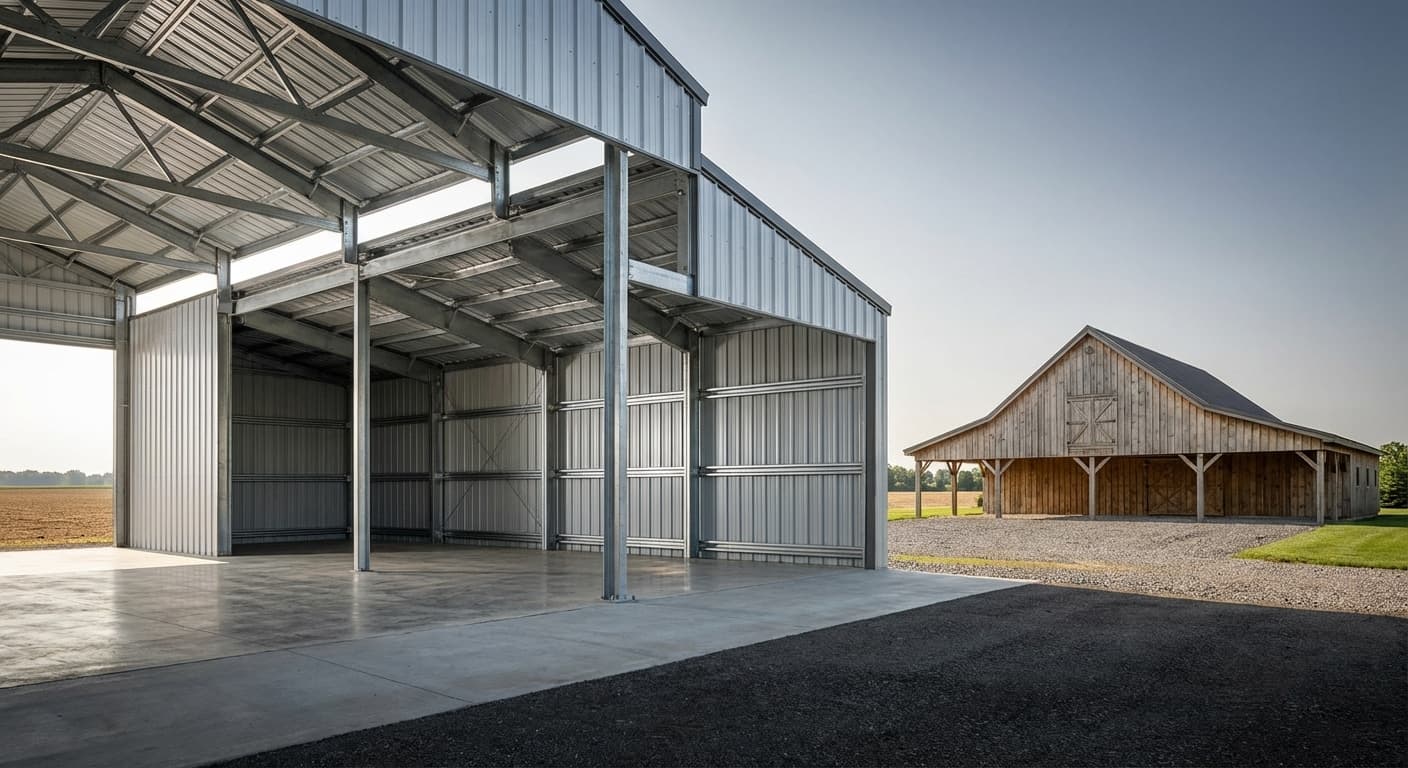

Choosing a barn material is a 20-year financial decision, not a one-time purchase: steel kits run $15-35 per square foot installed versus $30-45 for wood, but the real story unfolds in lifetime costs–steel needs only 1% of its build price in annual upkeep while wood demands 2-4%, saving owners $5,000-17,500 every year on a typical barn. Readers will learn how factory-built steel slashes labor hours and weather delays, shrugs off 140 mph winds, termites, rot and fire, cuts energy bills 10-20% via tight insulated panels, and commands 20-30% higher resale value, while wood faces volatile lumber prices, constant repainting, treatments and surprise repairs that can top $30,000. The article unpacks hidden expenses–foundations, permits, insurance discounts, financing terms, tax depreciation and cash-flow impacts–showing that predictable steel pricing, faster erection, minimal maintenance and insurance savings outweigh its slightly higher slab cost, delivering superior ROI and freeing capital for growth instead of repairs. Ultimately, it matters because selecting steel turns the barn from a money-draining asset into a low-risk, appreciating investment that performs for 30-50+ years, and companies like National Steel Buildings Corp. provide single-source expertise to translate these advantages into a custom, code-compliant structure on time and on budget.
True Cost Comparison: Up‑Front Prices and Hidden Expenses in the steel barn cost vs wood barn debate
Steel barns cost half as much up-front, go up twice as fast, and protect you from wild lumber-price swings–only requiring a concrete slab that eliminates rotting-post headaches for decades.
Purchase price breakdown for steel barns vs wood barns
You'll pay $15-35 per square foot for steel barn kits versus $30-45 for wood [1]. That's real money saved on day one. Why the difference? Steel components arrive from the factory ready to bolt together. Wood needs skilled carpenters cutting and fitting pieces on-site–and lumber prices keep climbing [1]. Your steel barn goes up faster with fewer labor hours [3].
Kit-only pricing tells a different story: $10-20 per square foot for steel, $8-15 for wood [2]. But here's what that comparison misses–foundation costs. Your steel building needs a proper concrete slab or pier foundation. Wood pole barns can get by with posts in the ground [2]. The bigger you build, the more wood costs spiral. Large wooden barns demand extra bracing, heavier foundations, and more skilled labor [1].
Plus, lumber prices swing wildly with market conditions. You can't budget accurately when material costs change monthly [3]. Steel pricing stays predictable. Standardized manufacturing keeps your costs stable, so you know what you're spending from start to finish.
Installation labor, site preparation, and permitting costs
Cut your labor costs in half. That's what happens when you choose steel over wood–pre-engineered components arrive ready to assemble, no measuring or cutting required [6]. Yes, you'll spend 5-10% more on foundations. Steel needs reinforced concrete slabs or piers, while wood pole barns sink posts straight into the ground [5]. But that solid foundation pays you back through decades of stability [4]. Your site prep looks different too.
Wood barns? Dig holes, drop in posts. Steel? Pour a complete concrete platform that anchors your building and protects against moisture [4]. It's worth it–just ask anyone who's dealt with rotting posts. Permits cost about the same for both materials.
In high-wind or earthquake zones, you might need extra engineering stamps for steel [5]. Good news: those certifications often qualify you for insurance discounts when your building handles 140 MPH winds without breaking a sweat [5]. Here's the bottom line on time: steel buildings go up 30% faster than wood. Fewer weather delays, less labor, faster completion. You're using your barn while your neighbor's still framing [5].
Long‑term hidden expenses: maintenance, repairs, and upgrades
After the barn's built, the real costs begin. And this is where steel shines. Your annual maintenance budget tells the story. Steel needs just 1% of construction cost yearly–maybe $1,500-$2,500 for a decent-sized barn. Wood? Budget 2-4%, or $7,000-$20,000 annually [7].
That's before surprises. Wood fights a losing battle against nature. You'll repaint every few years. Seal against moisture constantly. Spray for termites religiously [1]. Miss one treatment?
A termite colony can cost you $30,000 in repairs–and most barn owners never see it coming [7]. Then there's weather damage. Wood warps, cracks, and weakens over time. Steel?
Durability and Performance Over Two Decades
Your steel barn outlasts wood by decades, shrugging off rot, termites, fire, 140 mph winds and 35 PSF snow while cutting energy costs up to $5,000 a year.
Weather resistance, pest protection, and fire safety
Your steel barn keeps working while wood fails. In humid climates, wood rots within 1-2 years when moisture exceeds 20% [9]. Your steel building? It shrugs off 140 mph winds and 25-35 PSF snow loads without breaking a sweat [9]. Termites cost wood barn owners billions yearly.
These pests eat silently for years before you spot swarmers–and by then, major damage is done [9]. Steel remains immune. No cellulose means no food for termites. You save $500-$1,500 annually on treatments alone [9]. Fire protection matters most when seconds count.
Wood-framed buildings can collapse within minutes–the structure itself feeds the flames [9]. Steel doesn't burn. It buys you critical evacuation time and often earns insurance discounts for its non-combustible properties [9] [8]. Twenty years of weather, pests, and potential disasters. Your steel barn handles them all while maintaining the structural integrity wood simply can't match.
Structural lifespan, load capacity, and warranty assurances
Your steel barn delivers 30-50+ years of service. Wood structures? They start deteriorating from day one [4].
This lifespan gap transforms your investment calculations completely. Steel maintains its strength decade after decade. Wood weakens as moisture warps boards and loosens joints [8].
You need clear interior space? Steel spans wide areas without support columns–something wood can't match without costly reinforcement [8]. Standard steel handles 25-35 PSF snow loads and 140 mph winds without compromise [4].
Energy efficiency, insulation options, and operating cost trends
Steel barns cut energy costs by 10-20% compared to wood structures through superior insulation systems. Insulated metal panels seal your steel barn tight. No gaps, no joints, no energy leaks like wood construction suffers [7]. Your annual savings? $2,000-$5,000 for commercial-sized barns.
Wood structures save half that–$1,000-$2,500–even with upgrades [7]. Precision-engineered panels fit together perfectly. They create continuous insulation that keeps temperatures steady with less energy input. Steel's reflective surface cuts summer cooling costs. Its tight construction stops the air leaks that plague aging wood buildings.
These efficiency gains compound over twenty years. Combined with the durability advantages above, they help explain why total ownership costs differ so dramatically–as detailed in our cost comparison section [7]. Energy efficiency isn't just about monthly bills. It's about maximizing your barn investment for decades to come.
Financial Outcomes: ROI, Financing Options, and Tax Advantages
Steel barns pay for themselves through 20-30% higher resale values, lower insurance premiums, and minimal maintenance costs while banks offer 5-10 year longer loan terms than wood structures.
20‑year ROI calculations for steel vs wood
Your steel barn investment pays for itself through superior returns that compound over 20 years. As covered in our maintenance analysis, the lifetime cost advantage is dramatic–but let's focus on what that means for your ROI calculations. Steel delivers three distinct financial wins that directly impact your returns. First, you're looking at predictable costs that make financial planning straightforward. No surprise termite bills.
No emergency rot repairs. Just steady, minimal maintenance that lets you forecast accurately [7]. Second, your property value grows stronger with steel. Buildings that maintain structural integrity command 20-30% higher resale values after two decades–that's real equity you can leverage [7]. Third, you gain expansion flexibility without structural compromises.
Need more space in five years? Steel modifications cost less and disrupt operations minimally compared to wood renovations [12]. Insurance companies recognize steel's advantages too. Your premiums reflect the reduced risk profile–fire resistance, storm durability, and pest immunity translate to real savings every month [12]. Smart investors see past the familiar comfort of wood construction to the financial reality: steel protects your capital while delivering returns that traditional barn construction simply can't match.
Financing structures, interest impact, and cash‑flow planning
Financing your steel barn opens doors that wood construction keeps closed. Banks understand steel's longevity–that's why they'll often extend loan terms 5-10 years longer than for wood structures [1]. You're not just getting better terms; you're getting a partner who sees the same value proposition you do. Your cash flow tells the real story. While you might finance slightly more upfront, your monthly picture improves immediately.
Lower insurance premiums start saving you money from day one–insurers reward steel's fire resistance and storm durability with real discounts [3]. But here's where steel really shines: predictable maintenance reserves. Wood demands you set aside 2-4% annually for repairs–that's serious capital tied up in "what-ifs. " Steel? Just 1% keeps you covered [1].
For a commercial operation, that difference frees thousands monthly for growth instead of repairs. Your banker will also appreciate steel's collateral strength. Buildings that hold value support better loan-to-value ratios. When expansion time comes, you're negotiating from strength, not explaining why your wooden structure needs expensive repairs before qualifying for additional financing [3]. That's the financing efficiency that makes steel the smart money choice–better terms, improved cash flow, and stronger long-term financial positioning.
Tax credits, depreciation schedules, and incentive programs
Tax season becomes profit season when you understand barn depreciation strategies. Bonus depreciation still offers significant write-offs–60% in 2024, though down from previous years [14]. Smart timing on your steel barn project can maximize these benefits before they decrease further. Your steel structure's permanent foundation and engineered design often qualify for better depreciation treatment than traditional construction [15]. Standard MACRS depreciation spreads costs over 20 years, but agricultural operations might qualify for accelerated 10-year schedules [16].
Even better? Qualified Production Property rules can enable 100% immediate write-offs for barns used in manufacturing, production, or storage [15]. Documentation drives these benefits home. Keep everything–material receipts, labor invoices, engineering specs. Your [agricultural steel building](https://nationalsteelbuildingscorp.
com/service/agricultural-buildings/) investment generates substantial tax advantages, but only with proper records [16]. Here's what many miss: steel's lower maintenance costs mean fewer annual deductions, but your overall tax position improves through larger upfront depreciation and a structure that maintains value. You're trading small yearly write-offs for significant initial benefits and long-term appreciation [16]. Work with your tax professional to structure your barn investment for maximum advantage–the right approach can offset a substantial portion of your initial investment through strategic tax planning.
Choosing the Right Solution: Project Fit and Single‑Source Support
National Steel Buildings Corp. eliminates costly project gaps by delivering single-source, steel-only expertise that turns your barn's size, usage and location choices into a permit-ready, weather-tough reality with transparent, locked-in pricing.
Assessing size, usage, and regulatory requirements
Your barn project starts with three critical decisions: size, usage, and location. Each choice shapes your regulatory path and budget.
Size drives permit requirements. Most structures over 200 square feet need permits, regardless of material [18].
Aligning with quality, service excellence, and problem‑solving values
Why National Steel Buildings Corp. offers a confident, solution‑focused partnership National Steel Buildings Corp. turns your vision into steel reality through 20+ years of focused expertise [23]. We specialize exclusively in metal structures–no dabbling, no learning on your dime. Just precision in engineering, procurement, fabrication, and installation [24].
Our single-source approach eliminates the gaps that kill projects. We bridge what engineers design with what your business actually needs, ensuring your building supports operations, not just equipment [24]. From residential garages to industrial warehouses, agricultural barns to aviation hangars–we customize every project while maintaining the structural integrity to handle extreme weather [23]. You get transparent budgets that show exactly where your money goes–materials, labor, contingencies, everything [24]. No hidden costs.
No lowball quotes that explode later. Just honest numbers you can trust. Our value shows up in: – Materials arriving when promised – Project managers who answer on the first ring – Clear updates throughout construction – Schedules that become competitive advantages, not excuses This combination–specialized knowledge plus relentless communication–explains why our buildings perform as reliably as they're built.
- Steel barns cost $15-35/sq ft vs wood's $30-45, cutting day-one spend in half.
- Steel needs only 1% of build cost per year for upkeep; wood demands 2-4%, saving thousands.
- Termite treatments alone cost wood owners $500-$1,500 yearly; steel is immune.
- Steel structures go up 30% faster, slashing labor hours and weather delays.
- Insulated metal panels cut energy bills $2k-$5k yearly, double the savings of wood.
- Steel barns hold 20-30% higher resale value after 20 years, boosting equity.
- Steel qualifies for longer loan terms and lower insurance premiums, improving cash flow.
- https://www.vikingbarns.com/blog/a-cost-comparison-between-metal-barn-buildings-and-wood-barns
- https://www.buildingsguide.com/build/pole-barn-vs-metal-building/?srsltid=AfmBOoq5qSxGkC5IUHHHL-BZSzz5ZNB0wc9FHBLFf6tNxVQi3__hneLs
- https://idadevelops.com/are-metal-barns-cheaper-to-build-than-wood-barns/
- https://www.alliedbuildings.com/steel-barn-or-wooden-barn-how-do-they-compare/
- https://metalcontractors.com/comparing-metal-vs-wood-buildings-a-cost-perspective/
- https://bulldogsteelstructures.com/blog/wood-vs-steel-buildings/
- https://www.summitsteelbuildings.com/20-year-cost-comparison
- https://usnationalsteel.com/steel-buildings-vs-wooden-barns/
- https://metalbuildingsnorthamerica.com/comparing-wood-vs-metal-and-steel-buildings/
- https://www.eaglecarports.com/blog/how-long-do-metal-garages-last
- https://www.americanmetalbuildings.com/blog/steel-barn-buildings-vs-wood-barns-a-cost-comparison/?srsltid=AfmBOorlcJq8K6EJmnd_l0pTIoPRAvzVBwcoDpsXBAHj6uKQfBZ6DM1G
- https://waldropmetalbuildings.com/metal-buildings-vs-wood-structures-the-roi-advantage/
- https://www.americanmetalbuildings.com/blog/steel-barn-buildings-vs-wood-barns-a-cost-comparison/?srsltid=AfmBOopV_5RXJFILXOqenBQo83m_42-TEhpKg4UOawgjmxtRtHydJ5gP
- https://www.pkfod.com/insights/farmers-bonus-depreciation-rules-for-tax-years-2023-2026/
- https://greinerbuildings.com/blog/irs-tax-deduction-for-pole-barns-save-thousands-with-100-depreciation
- https://roimetalbuildings.com/how-to-write-off-a-barn-on-taxes/
- https://barnpros.com/resource-center/agricultural-vs-residential-barns-what-makes-them-different/
- https://themetalshopllc.com/do-you-need-a-permit-for-a-pole-barn/
- https://harrisconstructorsinc.com/what-are-common-steel-building-sizes/
- https://westfieldsteel.com/2024/06/steel-supplier-qualities/
- https://foundationsteel.com/quality-and-safety/
- https://westernsteel.com/services/
- https://www.zoominfo.com/c/national-steel-buildings-corp/1324501321
- https://westernsteel.com/how-to-choose-steel-building-contractors-in-your-area/