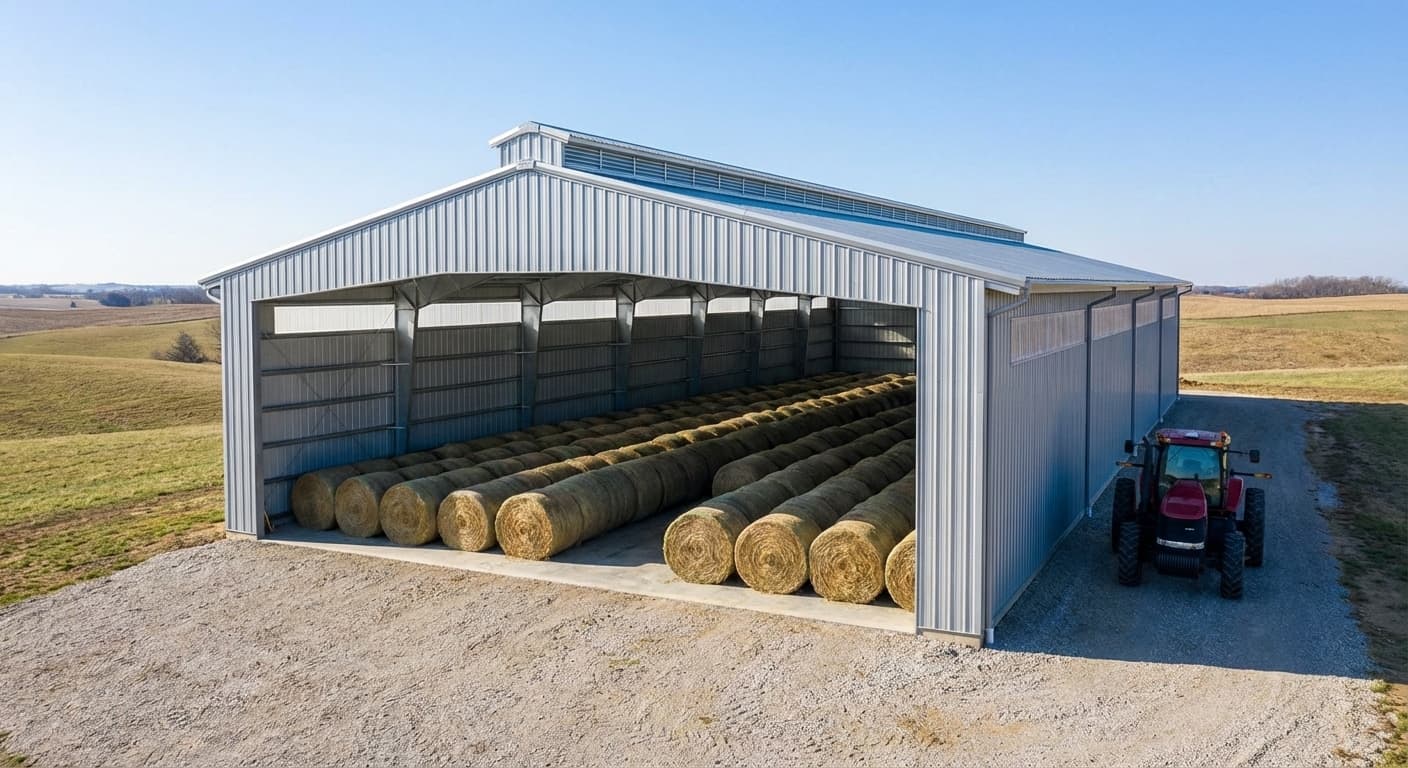

Your barn's dimensions are the difference between dry hay and expensive compost. Research shows outdoor storage without cover destroys up to 60% of your hay — but here's what catches farmers off guard: even a covered barn fails if you get the dimensions wrong. [2] The fix starts at ground level. Elevate your floor 6-8 inches and slope the surrounding soil away from the walls at 2% grade minimum -…
Why Precise Steel Hay Barn Sizes Matter for Dry, Efficient Storage
Impact of barn dimensions on bale ventilation and moisture control
Your barn's dimensions are the difference between dry hay and expensive compost. Research shows outdoor storage without cover destroys up to 60% of your hay — but here's what catches farmers off guard: even a covered barn fails if you get the dimensions wrong. [2] The fix starts at ground level. Elevate your floor 6-8 inches and slope the surrounding soil away from the walls at 2% grade minimum — that stops ground moisture before it starts.
[2] Up top, you need 18-24 inches between your highest bales and the roof. Less than that, and trapped heat creates condensation that drips right back onto your investment. [1] Your barn's orientation matters as much as its footprint. Position the long wall perpendicular to prevailing winds for maximum cross-ventilation.
For open-sided barns, run them east-to-west to cut direct sun exposure on your bales. [1] [2] The payoff is real: just a 4-inch weathering layer on a 6-foot round bale means you've lost 21% of that bale. [3] Get the airflow right, and you protect your hay from both surface weathering and internal heat damage.
How steel hay barn sizes align with load‑bearing standards and climate considerations
Your zip code determines your barn's structural needs more than any catalog spec. Standard steel buildings come engineered for about 20 PSF snow load — but if you're in Minnesota (50+ PSF), coastal Maine (60+ PSF), or mountain Colorado (40+ PSF), that standard frame won't cut it. [4] Skip the local load check, and you're looking at frame failure or expensive retrofits down the road.
Here's where it gets practical: your roof pitch and local snow load work together. A steeper pitch sheds snow faster — moving from 1:12 to 3:12 pitch uses gravity to clear accumulation before it becomes structural risk. [4] But steeper means taller sidewalls for the same interior clearance, which changes your entire cost equation.
Wind adds a different challenge entirely. While snow pushes down, wind pushes sideways and pulls up — that's why a hay barn in Kansas needs completely different engineering than the same footprint in Vermont. [5] Engineers combine both forces using ASCE 7 standards, because real storms don't pick just one.
Balancing capacity, footprint, and cost for optimal performance
Getting your barn size right means understanding the real numbers — not the theoretical ones. As detailed in the next section, your bale type drives your space requirements, and that 60% difference in footprint between round and square bales translates directly to your materials cost. [7] What catches most farmers: your usable space is less than your building footprint.
You need clearance buffers around the walls and overhead space above your stacks — suddenly that 40×60 barn stores less than you budgeted for. [7] Yes, steel costs less per square foot than wood, but the expensive mistake is building too small and needing a second barn later. [8] Even if expansion seems years away, planning 75 feet between potential barn sites costs nothing on paper today but saves major headaches if you grow.
[7] That's the kind of forward thinking that separates successful storage from scrambling for space every harvest.
Assessing Your Farm's Needs to Choose the Ideal Steel Hay Barn Size
Evaluating herd size, feed turnover, and seasonal storage demands
Start with your herd count, not your building size. Your cattle eat 2. 25-2. 5% of their body weight daily in dry matter. [10] Here's what that means for real operations: – 100 mature cows (1,400 lbs each) – 20 first-calf heifers (1,000 lbs each) – 6 bulls (2,000 lbs each) That herd needs about 4,300 lbs of dry matter daily. Over a 150-day winter, you're looking at 320+ tons — before waste.
Add 10-15% for feeding losses, and you need 370 tons stored. [10] Your bale type drives your footprint: – Round bales: 1-2. 5 per ton = 370-925 bales – Large squares: 1. 5-2. 5 per ton = 555-925 bales – Small squares: 25-50 per ton = 9,250-18,500 bales [11] Same tonnage. Completely different space needs.
Feed timing matters too. First-cutting hay makes up half your crop but feeds midgestation cows early in the season. Second and third cuttings — your premium feed — go to late-gestation and calving animals later. [10] Smart barn layouts put lower-quality hay up front for easy access. Premium cuttings stay protected deeper inside. This staging strategy determines your actual peak storage needs, not just total tonnage.
Standard steel hay barn sizes from 30×40 to 60×120 and their typical applications
Standard steel barn sizes match operation scales predictably: 30×40: Your entry point. Perfect for moderate storage with tight site space. 30×60: Steps up capacity. Handles hundreds of bales while keeping equipment access clear. [13] 40×60 and 40×75: Mid-size sweet spot.
More floor space without overbuilding. Single-span frames stay practical. 60×100: Large-scale solution. One roof beats managing multiple buildings. [14] What makes these sizes work?
Clear-span construction. No interior columns means every square foot stays usable — for stacking and equipment movement. [12] Vertical roof panels shed water and debris efficiently across any footprint, cutting maintenance for the barn's lifetime. [13] (See pricing details for these standard sizes in our cost breakdown section below.
Custom sizing options for specialty operations and future expansion
Standard sizes don't fit every farm. Multi-species operations, combined storage needs, or phased growth plans need custom solutions. Pre-engineered steel barns expand modularly. Add bays, lean-tos, or entire sections without shutting down operations.
[17] Lean-to attachments: Your most practical first expansion. Extend floor area along one sidewall. Park tractors, trailers, or equipment right alongside hay storage. [15] Vertical options: Land tight?
Go up instead of out. – Gambrel-style barns add lofts or second floors – Double your capacity on the same footprint [16] – Monitor-style frames create elevated center sections – Better airflow and natural light across large floor plans [16] Here's the critical step: Tell your supplier expansion is coming.
Design Features for Steel Hay Barn Sizes That Keep Bales Dry
Structural design elements that keep hay dry: roof pitch, sidewall sealing, and ventilation
Roof pitch drives your barn's moisture defense from day one. As covered in our climate considerations section, steeper pitches shed water and snow faster — but you pay for that protection in material costs and building height. Here's the practical balance: 4:12 to 5:12 pitches handle most climates efficiently, while 6:12 to 8:12 makes sense only where heavy snow loads demand it. [19] Vertical roof panels beat horizontal styles every time for hay storage — water runs straight off instead of pooling, which means fewer leak points and less maintenance over your barn's lifetime.
[19] Add 2 to 4-foot eave extensions to block wind-driven rain from reaching your bales and protect door hardware from weather beating — a small upfront investment that cuts maintenance calls and extends equipment life. [19]Your barn needs to breathe — period. As discussed in our moisture control section, that 15-20% moisture in "dry" hay becomes condensation without proper airflow, rotting bales from the inside. [19] The fix costs almost nothing when built in: continuous ridge vents paired with high sidewall openings create a natural chimney effect.
Hot, moist air rises out the ridge while fresh air pulls in below — no electric bills, no moving parts to maintain. [19] Step-down roof designs take this further by turning the height change into a built-in exhaust system — air naturally flows up and out through the elevation change. [18] For fully enclosed barns, add gable vents at both ends to eliminate dead air pockets where moisture hides. [19] Hit that 1:100 ventilation ratio minimum (one square foot of vent per 100 floor square feet), or bump it to 1:75 in humid regions — it's the difference between hay that lasts and hay that composts itself.
Selecting high‑quality steel and protective coatings for longevity
Your coating choice determines whether you're replacing panels in 20 years or still admiring them at 50. For hay-only storage, Galvalume wins hands down — the aluminum-zinc alloy lasts 2-4 times longer than straight galvanized coating, according to Metal Construction Association field data. [20] Here's why that matters to your budget: Galvalume self-heals at cut edges where regular galvanized lets rust spread, meaning fewer maintenance headaches and longer panel life even after installation damage.
[21] One critical exception: planning to house animals in that barn? Go galvanized. Ammonia from animal waste attacks Galvalume's coating, while galvanized steel handles that environment without premature breakdown.
[22] For dedicated hay storage, specify AZ55-grade Galvalume (thicker coating than standard AZ50) and add a PVDF paint system — you'll unlock warranty protection that galvanized panels can't match. [21] It's a small upfront decision that saves replacement costs for decades.
Single‑source solutions: integrated planning, engineering, and construction for seamless builds
Managing separate contractors for design, engineering, and construction multiplies your headaches at every handoff. A dimension gets lost between planning and engineering. A load rating never makes it to the foundation crew.
You pay for the miscommunication in delays and rework. Single-source providers eliminate those gaps by controlling the entire workflow — from initial sketches to final bolt tightening. Here's what that means for your project: pre-engineered materials matched to your site, local codes handled without you chasing paperwork, and stamped engineering plans formatted exactly how your permit office wants them.
[23] That stamped plan detail alone can shave weeks off permit approval — the typical bottleneck in barn projects. When the same team handles design through installation, your 50×80 hay barn on paper becomes exactly that in steel — not a compromise cobbled together when planning and construction don't talk.
Pricing and Support for Steel Hay Barn Sizes
Transparent pricing breakdown by size, accessories, and optional features
Steel hay barn pricing follows a predictable size-to-cost curve, but the variables underneath that curve are what catch most buyers off guard. Entry-level enclosed barns start around $12,000-$17,000 for a 42×20 footprint, step up to $17,000-$20,000 for a 36×25 vertical roof configuration, and reach $19,000-$24,000 for a 48×31 fully enclosed structure — all before accessories or site-specific load upgrades. [25] Larger footprints like the 80×100 cost more in absolute terms but less per square foot, which is why consolidating into one larger barn almost always beats building two smaller ones if your tonnage justifies the footprint.
[26] Beyond base size, four variables move the final number: geographic location (which drives engineering load requirements covered in detail earlier), roof style, add-on features, and steel market conditions — which have fluctuated enough that quotes from even six months ago may not reflect current material costs. [25][26] National buying power helps stabilize these fluctuations, letting you lock in competitive pricing even when steel markets spike. On the accessories side, the functional additions that affect hay storage directly include roll-up doors sized for tractor access, ridge and eave ventilation packages (designed to meet the 1:100 ratio discussed in the design section), and extended eave overhangs; aesthetic options like exterior color schemes and panel finishes add cost but also affect long-term maintenance frequency.
[26] Because all four pricing variables interact — a steeper snow load requirement changes column spacing, which changes the base frame cost before a single accessory is added — the most reliable approach is getting a quoted price built around your specific county load requirements and intended bale type, rather than working backward from a catalog footprint.
Efficient installation timeline and best‑practice site preparation
Steel hay barn installation moves through five sequential phases, and permits are almost always the longest wait — typically 1 to 4+ weeks depending on jurisdiction — while on-site assembly for a standard
Service excellence: warranty, maintenance plans, and post‑build support
Steel hay barn warranties split into four distinct layers, and knowing which layer covers which failure keeps you from being surprised when a claim is denied. Rust-through warranties cover perforation-level corrosion — not surface oxidation from a scratch or poor upkeep — while paint and coating warranties address fading and peeling from UV degradation separately. [29] Panel warranties cover structural integrity of roof and wall panels under normal use, and workmanship warranties (typically the shortest, at one year) apply only when the manufacturer's own crew installs the building — third-party installation voids that layer entirely. [29] When you work with a provider that includes their own erection team, you maintain full warranty coverage across all layers.
Coverage lengths differ meaningfully across layers: paint and panel warranties now commonly run 30-40 years as coating technology has improved, while structural warranties typically sit around 20 years. [29] Three additional boundaries apply regardless of provider: warranties are non-transferable to subsequent owners, geographic restrictions may limit coverage based on installation location, and natural disaster damage falls entirely to your farm insurance policy rather than the manufacturer. [29] What voids coverage faster than any of those limits is skipping documented maintenance — most warranties require proof of regular upkeep, and a denied claim from missing records costs far more than the inspection would have. [30] Every dollar spent on preventive care returns $5-10 in avoided repairs and extended building life, which makes the annual inspection the highest-ROI task on a farm calendar.
[30] For steel hay barns specifically, the four tasks that carry the most preventive weight are fastener checks (which head off roughly 90% of water infiltration issues), sealant reapplication around doors and seams where UV cycling degrades barriers over time, drainage system clearing to prevent rust at panel bases, and coating inspection to catch surface damage before it reaches bare steel. [30] Two inspections per year — spring and fall — are the practical minimum; keep dated photos and receipts for each one, because that documentation is what warranty reviewers actually evaluate when a claim is submitted.
- https://americansteelinc.com/blog/hay-storage-metal-barn-solutions/
- https://site.extension.uga.edu/forageteam/2020/03/a-barn-for-your-bale/
- https://extension.sdstate.edu/best-management-practices-reducing-dry-hay-storage-loss
- https://mbmisteelbuildings.com/blog/cold-weather-steel-building-design/
- https://www.uspatriotsteel.com/blog/wind-load-vs-snow-load/
- https://www.alliedbuildings.com/understanding-snow-load-limits-for-steel-buildings/
- https://hayandforage.com/article-4315-Plan-ahead-before-building-a-hay-barn.html
- https://www.vikingbarns.com/blog/frequently-asked-questions-about-metal-hay-barn
- https://www.steelcobuildings.com/breaking-down-the-costs-of-a-metal-barn/
- https://www.beefmagazine.com/feed/how-much-hay-do-you-need-this-winter-
- https://www.farmbrite.com/post/how-many-bales-of-hay-make-a-ton
- https://agribilt.com/metal-hay-barns/
- https://www.uspatriotsteel.com/product/30×60-large-capacity-steel-hay-barn/
- https://gensteel.com/recommended-use/barn/
- https://mavericksteelbuildings.com/steel-buildings/steel-buildings-hay-barn-kits/
- https://sunwardsteel.com/building-type/hay-storage-barn/
- https://www.steelcobuildings.com/steel-buildings/agricultural-buildings/
- https://www.nationwidesteelstructures.com/post/step-down-roof-metal-barn-design-benefits
- https://www.uspatriotsteel.com/metal-barns/metal-hay-barns/
- https://www.millsteel.com/news/galvalume-vs-galvanized-which-coating-is-best-for-your-building
- https://sheffieldmetals.com/learning-center/galvalume-vs-galvanized-metal/
- https://www.westernstatesmetalroofing.com/blog/galvanized-vs-galvalume-metal-roofing
- https://www.steelcobuildings.com/hay-storage-building/
- https://garagebuildings.com/why-clear-span-buildings-are-a-great-choice-for-hay-storage
- https://www.americanmetalbuildings.com/metal-barn-prices/?srsltid=AfmBOoopscneapF-vc98LjpTq-vxdPd775jQHKkzDDxdMn8h47ZFKrR7
- https://gensteel.com/steel-building-kits/hay-storage/80×100-hay-storage/
- https://www.eaglecarports.com/blog/how-long-does-metal-building-installation-take
- https://www.absoluterv.com/metal-building-kits/concrete-foundation/
- https://garagebuildings.com/steel-building-warranties-explained-whats-really-covered-in-2025-2026
- https://steelcommandercorp.com/warranty-maintenance-upkeep-how-ongoing-care-impacts-lifetime-cost/