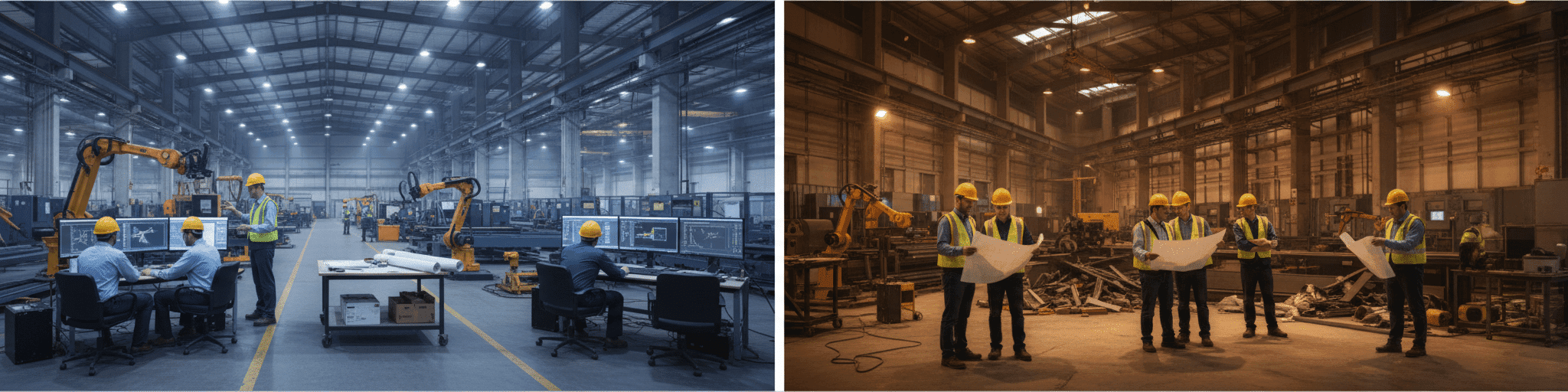

We help you understand why turnkey design-build gives you better control than fragmented general contractor models. One team managing design, fabrication, and erection keeps you on schedule and budget with clear accountability from start to finish.
Who Owns What in a Turnkey Design-Build Steel Building Project
Single-source responsibility for both fabrication and erection eliminates handoff delays and keeps one party accountable for quality through completion.
Design, Engineering, and Code Compliance: One Team From Day One
Fabrication and Quality Control: In-House Oversight vs. Subcontractor Coordination Fabrication quality hinges on who controls the handoff between shop and site. A steel supplier's obligations typically end once fabricated components are delivered and accepted, leaving installation to a separate erection team the owner or GC contracts independently [14].
A steel contractor, by contrast, owns both fabrication and installation under one scope, which cuts handover risk and keeps one party accountable for alignment, tolerances, and safety compliance through erection [14]. That distinction mirrors what separates a strong general contractor on complex builds: firms with in-house craft capabilities in steel fabrication and structural erection hold a coordination and quality-control advantage over GCs who lean entirely on outside subs, since they aren't waiting on subcontractor availability in a tight labor market [15].
When fabrication and erection sit inside one team's schedule instead of two separate contracts, inspection findings get resolved on the same call instead of routed through a chain of purchase orders and change requests.
The Hidden Costs of General Contractor Fragmentation
A single change order can cascade through multiple subcontracts, adding 10 percent or more to project costs when routing approvals through separate chains of command.
Change Order Cascades: Why GC Models Spiral Over Budget
In a GC model, one change order rarely stays isolated — it ripples through every subcontract it touches. Design errors and omissions are the leading cause of change orders, driving 56.5 percent of cost overruns and 40 percent of project delays [16], and each fix has to be re-priced and re-approved separately by every affected trade.
Industry research shows change orders alone can add 10 percent or more to total project cost [17], and unmanaged ones are a major driver of the 10-30 percent cost overruns typical on construction projects [18]. Scope creep without documentation compounds the problem: small field adjustments that nobody writes down can add up to 15 percent more work than the original contract covered, all absorbed as unbilled cost or disputed later [18].
When a GC has to route that single change through an architect, an engineer, and three subcontractors for pricing and sign-off, the delay itself becomes a cost — crews sit idle while approvals crawl through separate chains of command [17].
Communication Delays Between Design, Fabrication, and Erection Teams
Comparison Table: Project Management Overhead in Design-Build vs. GC Delivery Line up the two models side by side and the overhead gap stops being abstract. Design-build runs on one contract covering design and construction, while design-bid-build splits those into two contracts negotiated, tracked, and invoiced separately.[21] That structural difference shows up directly in administration hours: agencies running design-build reported an average 3 percent decrease in contract administration time compared to design-bid-build counterparts.[1]
| Overhead factor | Design-build | GC (design-bid-build) |
|---|---|---|
| Contracts to manage | One, covering design and construction [21] | Separate design and construction contracts [21] |
| Contract administration time | Averaged 3% less than design-bid-build [1] | Baseline against which design-build was measured [1] |
| Schedule control | Design and field crew coordinate from day one [21] | Sequential phases, less field input on drawings [21] |
| Change order routing | Single team approves and executes | Routed through architect, engineer, subcontractors |
Fewer contracts mean fewer people to loop in before a decision moves forward, which is exactly where GC overhead accumulates.
How National Steel Buildings Delivers True Turnkey Control
One turnkey partner manages design, permitting, manufacturing, and erection under a single contract, eliminating miscommunication and keeping your project on schedule and within budget.
From Concept Through Erection: National Steel Buildings's Single-Source Advantage
A turnkey partner means one company manages design, permitting, manufacturing, and erection under a single contract, so you never juggle separate architects, engineers, and contractors [22]. That structure reduces the friction and miscommunication that surface when responsibility splits across multiple firms, since one point of accountability tracks the project from initial drawings through final inspection [22].
Prefabrication reinforces that advantage: because structural components are manufactured to spec while site work and foundation prep happen in parallel, you avoid the sequential delays that stack up when trades wait on each other [22]. A single turnkey source can support more consistent build quality than a patchwork of subcontracted vendors, because one team stays answerable for the work across bolts, connections, and metal roofing panels from start to finish [23].
For you, that means fewer contracts to track, fewer vendors to vet, and one team carrying the project from concept sketch to a fully erected structure ready for occupancy — aimed at staying on schedule and within budget, with National Steel Buildings' national buying power helping keep costs down along the way.
ProTrades LLC: In-House Erection Division Eliminates Subcontractor Risk
Self-performing your own erection crew instead of subcontracting removes the guesswork that comes with vetting a stranger's team, judgment, and equipment. [24] Keeping erection in-house gives you a single point of responsibility and real accountability: the same team that priced the job answers for it when something goes sideways, with no finger-pointing between separate firms. [24] Known supervisors, known crews, and consistent communication and safety protocols hold quality to one standard instead of whatever a rotating cast of subs brings to site. [24] That's the same logic behind self-perform steel erection teams built specifically to improve coordination, safety planning, sequencing, and schedule reliability by keeping a critical-path trade under one accountable roof rather than passing it to an outside crew. [25] National Steel Buildings' in-house erection division, ProTrades LLC, operates on that same principle — one crew, one schedule, one team that knows exactly who's completing each task and can price and predict your project's cost with far less uncertainty than a subcontracted lineup. [24]
Real-World Example: How Turnkey Delivery Saved a Commercial Client 6 Weeks and $47K
Picture a commercial build where foundation crews break ground while fabrication runs in parallel back at the shop — steel components manufactured to spec while site work happens simultaneously, instead of one phase waiting on the other [22]. That overlap is exactly where a turnkey schedule pulls weeks out of a project a fragmented GC model would run sequentially. Layer in the hidden costs a standardized kit or split-contract job tends to surface later — unplanned foundation upgrades, envelope changes, or fit-out scope nobody priced upfront — and the dollar savings compound alongside the schedule gains [27].
A single quote covering materials, engineering, and construction services, broken down by total cost and per square foot, gives an owner one number to hold a builder to instead of chasing change orders across separate contracts [26]. That's the mechanism behind a result like six weeks shaved and tens of thousands avoided: fewer handoffs, fewer surprises, one team accountable for both the calendar and the budget from groundbreaking to grand opening. That's the approach National Steel Buildings brings to its projects — nationwide reach, hometown reliability, and a focus on getting the build right the first time.
Ready to put a single-source team on your timeline and budget? Get a Free Quote.
- Design errors and omissions cause 56.5% of cost overruns and 40% of project delays, with each fix requiring separate re-pricing through affected trades.
- Change orders can add 10% or more to total project costs, and undocumented scope creep can represent 15% additional unbilled work.
- Turnkey design-build requires one contract covering design and construction, reducing contract administration time by an average of 3% versus traditional GC models.
- In-house fabrication and erection under one team eliminates handover risk and keeps accountability unified for alignment, tolerances, and safety compliance.
- Parallel prefabrication while site work occurs simultaneously eliminates sequential delays typical in fragmented GC models where trades wait on each other.
- Single-source turnkey delivery reduces miscommunication and finger-pointing by establishing one point of accountability from initial drawings through final inspection.
- https://www.fhwa.dot.gov/reports/designbuild/designbuild4.htm
- https://www.trccompanies.com/insights/construction-delivery-method-comparison-design-build-vs-design-bid-build/
- https://dbia.org/what-is-design-build/
- https://cicconstruction.com/blog/single-point-of-accountability-how-design-build-delivery-eliminates-project-risk-across-multiple-markets/
- https://finfrock.com/how-design-build-construction-reduces-risk/
- https://theaecassociates.com/blog/design-build-and-design-bid-build/
- https://cmicglobal.com/resources/article/General-Contractor-Project-Management-Software
- https://smartpm.com/blog/construction-company-risks
- https://www.constructconnect.com/blog/4-common-risk-factors-on-construction-projects
- https://www.meltplan.com/blogs/what-is-building-code-compliance-a-complete-guide-for-owners-contractors-and-designers
- https://www.asce.org/publications-and-news/civil-engineering-source/article/2025/09/12/engineering-issues-associated-with-delegated-design
- https://www.procore.com/library/construction-procurement
- https://cmicglobal.com/resources/article/Global-Supply-Chain-Management-in-Construction-Challenges-and-Solutions
- https://xtdsteel.com/steel-structure-company/steel-contractor-vs-supplier/
- https://credencegroup.ca/general-contractor-vs-a-subcontractor-industrial-projects/
- https://www.rhumbix.com/blog/change-orders-construction-definitive-guide
- https://superconstruct.io/blog/change-order-challenges/
- https://projul.com/blog/construction-cost-overruns-prevention-guide/
- https://www.enginero.com/blogs/what-is-construction-rfi-best-practices/
- https://www.procore.com/library/rfi-construction
- https://www.miter.com/resources/design-build-vs-design-bid-build/
- https://americanwesternsteel.com/turnkey-steel-buildings-transform-san-antonio-businesses/
- https://www.doubleblackconstruction.com/best-to-use-one-turnkey-provider
- https://www.cfbsi.com/post/choosing-a-self-performing-general-contractor-for-your-metal-building-erection-benefits-risks-and
- https://veneklasenconstruction.com/services/steel-buildings/
- https://www.summitsteelbuildings.com/turnkey-construction-eliminates-hassles-of-building-kits
- https://xtdsteel.com/steel-structure-building/how-much-does-a-steel-structure-building-cost-in-2025/