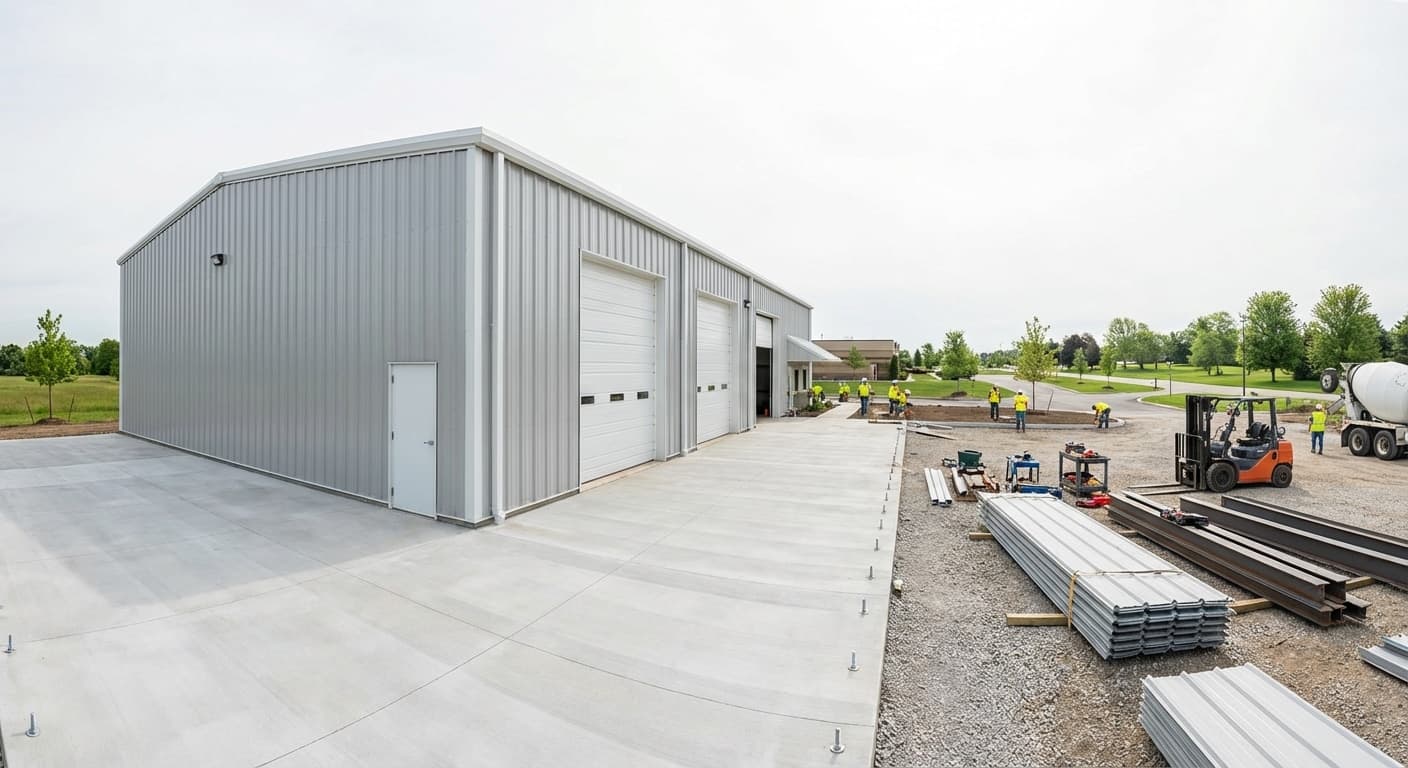

A single turnkey contract for a 30×40 steel building hands every headache–from soil test to final key–over to one accountable builder, sparing owners the cascading delays, finger-pointing, and surprise change orders that plague multi-vendor projects while locking in a fixed price that already exploits the builder's bulk-buy discounts on materials and labor. Readers will learn how this model compresses the typical 10- to 20-week timeline by overlapping permitting, fabrication, and site prep; how to control the $28k-$62k cost band by choosing clear- vs multi-span framing, insulation type, and door upgrades before concrete is poured; and why financing fails when lenders misunderstand steel kits, so pre-qualifying through builder-vetted lenders and adding 20% contingency is critical. The article walks through site-prep pitfalls (drainage, access, setbacks), layout tricks that save thousands by adding length instead of width, and warranty fine print that separates 40-year panel coverage from shorter workmanship terms–knowledge that prevents expensive voids. Ultimately, it equips buyers to vet contractors on metal-building experience, bid detail, and claims history so they can convert an empty lot into a turnkey, ready-to-use shop or storage facility without ever managing a subcontractor or absorbing a cost overrun themselves.
Understanding the Turnkey Promise for a 30×40 Metal Building
A turnkey 30×40 metal-building contract puts one team on the hook for design, permits, steel, slab, and utilities–eliminating finger-pointing delays, locking in bulk-material savings, and handing you a finished, ready-to-use shop the day the keys drop into your palm.
What 'Turnkey' Means for Your 30×40 Project
Turnkey construction means one contractor takes responsibility for everything — design, permits, materials, labor, site prep, and final handover. You sign one contract and receive a finished building.
For a 30×40 steel structure, this matters because metal building projects involve more moving parts than most owners anticipate: soil assessment, engineered drawings, prefabricated component delivery, foundation work, and utility connections all have to sync up correctly. [1] Rather than coordinating architects, engineers, suppliers, and subcontractors separately, a turnkey arrangement folds all of it under a single point of contact.
[2] When applied to a prefabricated metal building, this model works especially well — components are manufactured off-site to exact specifications, then assembled on your lot, which means the contractor controls quality at every stage rather than reacting to on-site surprises. [3] The end result is what the name implies: a building that's ready to use the moment you get the keys.
Key Benefits of a Single-Contract Solution
The most immediate payoff of a single contract is what disappears from your plate. Instead of managing separate agreements with architects, engineers, material suppliers, and subcontractors, you have one point of contact accountable for the entire build. This removes the coordination gaps where delays and miscommunications typically breed — when one party blames another for a scheduling conflict, there's no ambiguity about who's responsible. [4]Beyond logistics, the financial case is concrete.
Turnkey contractors leverage existing supplier relationships and bulk purchasing power to negotiate material pricing that individual owners rarely access independently. They also have a direct financial incentive to avoid costly change orders and schedule overruns, since delays raise their own operating costs. [2] That incentive alignment changes the dynamic — the contractor's interest in finishing on time matches yours. Quality control works differently under a single-contract model too.
Because the turnkey provider owns every phase — from soil prep through final inspection — there's no handoff moment where accountability gets diluted. Skilled subcontractors get vetted by one firm, work gets checked against one set of standards, and problems surface internally before they become your problem. [2] For a prefabricated 30×40, where components arrive pre-engineered to specific tolerances, having one contractor manage both the off-site fabrication coordination and the on-site assembly means fit and finish issues get caught before concrete is poured.
How the Turnkey Model Ensures Clear Communication and Quality
How the turnkey model ensures clear communication and qualityWhen a project involves multiple vendors, information gets filtered, delayed, or distorted between parties. A turnkey structure eliminates that by routing all communication through a single project lead who simultaneously tracks design decisions, site progress, and issue resolution. [5] Clients aren't required to relay messages between disconnected trades or chase down answers from separate contacts — updates are consolidated, and questions reach the person with actual authority to act on them.
[5] This matters most during critical junctures: when a design spec changes late in the process, or when a component delivery shifts the schedule, a unified team can adapt internally without stalling while separate vendors renegotiate their own timelines. Quality on a multi-vendor project depends on handoffs going right every time — which is an unreliable bet. Because the turnkey contractor owns both design intent and physical execution, the standards established during engineering carry directly into construction without translation errors.
[6] There's no moment where an architect's drawing gets interpreted differently by a builder who wasn't in the original design conversation. For a 30×40 pre-engineered steel building specifically, this continuity is structural: anchor bolt placement, wall panel tolerances, and roof system alignment all have to match the fabrication specs exactly. [7] One contractor who coordinated both the off-site engineering and the on-site assembly catches those discrepancies before erection begins — not after concrete is already poured.
Planning and Designing Your 30×40 Steel Structure
Before a single 30×40 steel panel goes up, test the ground like your schedule depends on it–because catching clay soil, hidden water traps, or a 12-inch power-line clearance shortfall now keeps your slab, delivery trucks, and permit from stalling the build later.
Site Assessment and Soil Preparation
Site assessment and soil preparationMost 30×40 build delays don't come from the building — they come from the ground underneath it. A proper site assessment catches the problems that stop installs cold: slabs poured 6 inches short of spec, sites that look level until rain turns them into standing water, or driveways too narrow for delivery trucks to reach the pad. Before any foundation work begins, you need to confirm water movement across the site, not just surface flatness.
A slope is workable; water pooling along a slab edge is not, and fixing it after the fact means pausing installation to cut drainage swales or install French drains. [8] Clay-heavy soil holds moisture and causes long-term shifting, so soil type directly determines your foundation choice — concrete slabs handle heavy use and enclosed builds best, gravel pads work for storage with proper compaction, and direct ground anchoring only holds up when the soil is inherently stable. [9] Beyond drainage, give yourself 2-3 feet of clearance beyond the 30×40 footprint for crew access during erection, and confirm truck access routes have at least 12-14 feet of clearance width — power lines and tree limbs stop deliveries before a single panel goes up.
[8] If utilities are planned for the building, conduit needs to go in before concrete is poured; retrofitting electrical through a finished slab costs far more than routing it during prep. [8] A thorough site assessment also needs to account for local setback requirements — measured from property lines, not fences — and any permit conditions that affect where on the lot the structure can legally sit. [10] When you work with a turnkey provider who manages both design and erection, these site factors get spotted during initial planning rather than becoming surprises mid-build.
Optimizing Layouts for Functionality and Cost
Optimizing layouts for functionality and costThe biggest cost variable in a 30×40 layout isn't the footprint — it's how you configure width, structural type, and openings within it. Width is more expensive to scale than length: adding length only requires inserting a frame line at the end of the building, while every additional foot of width forces longer rafters across the entire frame. [11] Within the 1,200 square feet, you choose between two structural approaches. Clear-span eliminates interior columns entirely, giving you an unobstructed floor — best for vehicles, large equipment, or any workflow where columns interrupt movement.
Multi-span places a center column at the 20-foot midpoint, splitting the floor into two 20-foot bays at lower material cost. [12] That structural decision shapes every downstream layout choice, so make it before finalizing door locations or partition walls. Framed openings — every door and window — require additional steel at each location, which means their number and placement directly affect cost; an overhead door sized two feet wider than your actual clearance need adds steel without adding function. [12] For buildings that need office space, a bathroom, or a mezzanine level, concentrate those partitions at one end of the structure rather than scattering them throughout — this limits interior framing to a single zone and preserves the remainder as one open bay.
[12] Before committing to any configuration, plot your equipment and inventory on graph paper at one square per foot and arrange scaled cutouts to test clearances around columns, door swings, and vehicle turning radii. [12] Conflicts caught at this stage cost nothing to resolve — and a design-build provider can run these scenarios digitally during the planning phase, saving you the graph paper exercise while ensuring every inch works for your operation.
Choosing Materials and Finishes that Meet Service Excellence Standards
Choosing materials and finishes that meet service excellence standardsMaterial selection on a 30×40 determines long-term maintenance costs as much as upfront price. Standard kit packages ship with pre-painted 26-gauge PBR metal roofing and siding panels — this gauge handles most residential, agricultural, and light commercial loads, and the factory finish eliminates field painting. [13] If the exterior finish matters for curb appeal or code compliance, siding alternatives include vinyl, Hardie board, stucco, or faux brick panels, each of which can be applied over the steel frame without changing the structural system.
[13] For color, most suppliers offer 20 or more options across roof, siding, and wainscot independently, so the exterior palette doesn't have to be monolithic — contrasting wainscot at the base cuts the visual weight of the wall and protects the lower panels where moisture contact is highest. [13] Insulation is the interior finish decision with the biggest functional payoff: fiberglass blanket installs between the purlins during erection and costs less upfront, while spray foam seals the envelope more completely and prevents the condensation that degrades uninsulated metal buildings from the inside out. [13] Door material and mechanism type feeds into both finish quality and daily function — sectional, roll-up, sliding, and bi-fold overhead options each carry different clearance requirements, maintenance profiles, and price points, so the right choice depends on traffic frequency and vehicle type, not just opening size.
[13] Slab thickness is technically a foundation decision but functions as a finish specification: a 4-inch pour works for most uses, but storing or operating heavy machinery requires upgrading to 6 inches before concrete is poured — retrofitting a thicker slab after the fact isn't feasible. [13] With national buying power and established supplier relationships, the right turnkey partner can often secure premium materials at standard pricing — getting you better finishes without breaking your budget.
Cost Management and Financing the 30×40 Turnkey Build
A 30×40 turnkey build can cost anywhere from $28K to $62K–what you pick for the slab, insulation, electrical, doors, and financing route decides whether you land near the Tennessee owner's $27.5K or the North Texas owner's $80K.
Transparent Pricing Breakdown for a 30×40 Metal Building Turnkey
You're looking at $28,000 to $62,000 for a complete turnkey 30×40 — a wide range that makes perfect sense once you see what drives each price point. [14] The building kit itself — the steel frame, panels, and basic hardware — accounts for $14,000 to $25,000 of the total. [15] From there, a reinforced 4-inch concrete slab adds $7,500 to $12,000, with soil conditions and local concrete pricing as the main variables; frost footings in cold climates can push that number to $27,000 for the slab alone. [16] Insulation runs $2,000 to $4,000 for basic fiberglass or $4,000 to $7,000 for closed-cell spray foam, which matters significantly for year-round use.
[16] Electrical ranges from $2,000 for basic lighting and outlets to $5,000 or more for a full shop setup with a 200-amp panel, and permits typically add $550 to $2,000 depending on jurisdiction. [14] Labor for erection adds another $5 to $10 per square foot. [14] Framed opening upgrades — better roll-up doors, custom walk-in doors, additional windows — add $3,000 to $8,000 depending on count and mechanism type. [16] A practical baseline: a 30×40 with a standard slab, basic insulation, and minimal electrical comes in around $30,000 to $40,000; add spray foam, a 200-amp service, and upgraded doors and the number climbs to $45,000 to $55,000.
[16] Real builds tell the story: one Tennessee owner landed at $27,500 for kit, slab, and insulation. Another in North Texas hit $80,000 with spray foam, 200-amp service, and a 1,600-square-foot driveway. [15] Same quality steel, different scope — that's what moves the needle.
Financing Options and Budgeting Tips
Most owners finance their 30×40 build, and you've got three main paths that actually work. Home improvement loans work best for smaller builds: they're unsecured (no collateral required), range from $1,000 to $50,000, and carry terms of 2-12 years with APRs between 4% and 20%, though they require a minimum credit score of 660-850. [17] Construction loans operate differently — funds release in stages tied to completed milestones rather than arriving as a lump sum, which reduces lender risk and keeps you from paying interest on money you haven't used yet. [18] Once construction is complete, that loan can convert to a standard mortgage through a construction-to-permanent loan (sometimes called a single-close or OTC loan), which folds land purchase, building costs, and the long-term mortgage into one instrument rather than requiring separate financing at each stage. [17] For rural properties over five acres, agricultural financing through programs like the USDA Farm Service Agency often offers better terms than conventional lenders, partly because agricultural lenders deal with metal structures regularly and don't treat them as unfamiliar risk.
[17]Here's what catches owners off guard: most lenders don't understand metal buildings. The FHA explicitly excludes kit homes and barndominiums from its programs, and most conventional banks have limited experience with pre-engineered steel construction — which translates into slower approvals and stricter requirements for the same project that an informed lender would move through quickly. [17] Work with a lender who knows steel buildings — or better yet, a builder with established lender relationships. These specialized lenders already understand pre-engineered buildings, draw schedules, and the documentation that keeps your project moving. [19] At National Steel Buildings, we've built those relationships over 1,480+ projects, which means your financing moves as fast as your steel.
Lock your building price before applying for financing — steel prices shift weekly, and you don't want your loan falling short when you're ready to build. [17] Add 20% to your estimate for the unknowns: permit surprises, soil conditions, material price swings. That's not pessimism — that's how you stay on budget when reality hits.
Avoiding Hidden Costs through Single-Source Solutions
The real budget killers aren't on any quote — they're the hours you spend coordinating trades, fixing scheduling conflicts, and chasing warranty claims when nobody wants to own the problem. [20] When a leak appears where roofing meets an HVAC penetration, a self-coordinating owner has to prove whose detail failed — which means emails, site visits, and an unresolved problem while two separate contractors point at each other. [20] A lump-sum turnkey contract closes that gap structurally: one fixed price, one contractor accountable for the outcome, and cost overrun risk that sits with the contractor rather than the owner. [21] That risk transfer is the financial core of the turnkey model — the contractor has a direct incentive to catch problems before they escalate, because the overrun comes out of their margin, not yours.
[21] As covered in our turnkey promise section, single-source accountability prevents the budget surprises that kill projects. Your turnkey contractor catches foundation issues during assessment, not mid-pour. Design changes that would trigger re-engineering fees get handled internally before drawings are final — because the same team owns every phase. [22] Steel prices move like any commodity — up with tariffs, down with oversupply.
Your turnkey provider's supplier relationships often include price holds you can't get on your own. Lock that price before starting your loan application, and you've eliminated one more variable from your budget.
Selecting the Right Contractor and Ensuring a Smooth Build
Scrutinize every bid like a crystal ball: a contractor's sloppy proposal, vague pricing, or rock-bottom quote today foreshadows blown budgets, blame-shifting, and calendar chaos once steel starts rising.
Evaluating Contractors for Competence and Calm Service
A contractor's behavior during the bidding process is a direct preview of how they'll behave once work begins. If responses are slow, vague, or dodge direct questions about scope — that pattern won't improve once you've signed a contract. [23] The bid document itself signals competence before a single conversation happens: a proposal that breaks out materials, labor, timeline, and contingencies separately shows a contractor who understands the project; one that offers a round number without explanation suggests they haven't thought through the details, or that line items will surface as change orders later.
[24] Bids that land significantly below competing quotes deserve the same skepticism as bids that come in high — both indicate a misread of scope, and an underpriced bid almost always corrects itself mid-build at your expense. [25]For a metal building specifically, general construction experience isn't enough. Pre-engineered steel systems require familiarity with anchor bolt placement tolerances, purlin spacing, and how fabrication specs interact with on-site erection — knowledge that only comes from doing this type of work repeatedly.
[24] Verify this directly: ask for references from completed metal building projects, not just general construction work, and follow up with those clients about whether the contractor stayed on schedule and handled problems without blaming suppliers or subcontractors. [25] While you're verifying experience, confirm licenses, insurance certificates, and any professional association memberships that indicate the contractor holds themselves to an external standard — operating without valid coverage shifts liability onto you if something goes wrong on site.
Project Timeline: From Dirt to Door
A 30×40 turnkey build runs 10 to 20 weeks from contract signing to occupancy — but that range is deceptive unless you know which phases eat the most time. [26] Design and planning take 2 to 4 weeks depending on how quickly you finalize decisions; every revision cycle adds days, so owners who arrive with use cases, door locations, and layout preferences already mapped out compress this phase significantly. [26] Permitting is the phase that surprises most owners — rural and agricultural zones can clear in 2 to 3 weeks, while commercial or urban jurisdictions regularly run 4 to 6 weeks or longer, and some counties hold permit reviews for months. [26] The move that recovers the most schedule time is submitting permit paperwork while engineering drawings are still being finalized — running those two tracks in parallel rather than sequentially can eliminate weeks of idle time before fabrication even begins.
[27] Fabrication runs 4 to 8 weeks after drawings are approved, with manufacturer backlog and seasonal demand as the primary variables; standard kits ship faster than customized configurations, and lead times lengthen predictably during peak construction seasons. [26] Site prep and foundation work — clearing, grading, anchor bolt placement, concrete pour, and cure — can overlap with fabrication. This is where a turnkey contractor with an Once the kit lands on site, erection moves fast — a straightforward 30×40 shell goes up in days, with insulation, doors, trim, and final inspections adding another week or two depending on finish scope. [26] The total from dirt to door for a standard 30×40 with basic finishes sits closer to 10 to 14 weeks when permitting moves normally and decisions don't stall in the design phase; adding spray foam, electrical, and interior partitions pushes toward 16 to 20 weeks.
[27] Real-world example: inspection sequences alone — open foundation, steel frame, and final building inspections — create mandatory holds that run 1 to 5 days each depending on your municipality's backlog. Schedule inspections the moment each phase completes, not after the next task starts. That's how you keep the critical path moving.
Post-Construction Support and Warranty Guarantees
A turnkey contract doesn't end at occupancy — what it includes afterward is where the real risk transfer happens. Steel building warranties aren't a single document; they're a stack of distinct instruments covering different failure modes on different timelines, and understanding which layer applies to which problem determines whether a repair bill lands on you or the contractor. The structural warranty covers the primary frame — beams, columns, purlins — against defects and load failures, with most providers offering 20 to 50 years of coverage on this layer. [31] Panel warranties operate separately: 26-gauge steel paneling typically carries a 40-year warranty against chipping or cracking, while 29-gauge panels generally get 10 years — and neither covers color fading, which is addressed under a paint or coating warranty that now commonly stretches 30 to 40 years as UV-resistant coatings improve.
[30] Rust coverage requires specific attention: most warranties only cover perforation — where corrosion eats a hole completely through the metal — not surface rust from scratches or poor upkeep, which you handle through maintenance. [29] Workmanship warranties cover assembly errors rather than material defects and run 1 to 5 years — shorter because most installation problems show up within the first rain season or winter cycle. [31] Three actions void coverage across virtually every provider: skipping required annual wash-downs that remove corrosive salt and debris buildup, making structural modifications without engineering approval, and using uncertified installers. [31] That last point matters most — when a single contractor coordinates both materials and installation, you avoid the scenario where a manufacturer's warranty gets voided by a third-party crew's assembly errors.
[29] When comparing providers, look past the headline warranty years. Check whether structural and cosmetic coverage are separate, review the company's claims history to see how often they honor warranties versus dispute them, and verify the company's financial stability — they need to exist when you need them.
- One turnkey contract covers design, permits, materials, labor, site prep and handover for a 30×40 steel building.
- Single-source accountability eliminates coordination gaps and places cost-overrun risk on the contractor, not the owner.
- Real turnkey costs range $28k-$62k; baseline 30×40 with slab and basic insulation lands near $30k-$40k.
- Soil issues, drainage, setbacks and utility stub-outs must be resolved before concrete is poured to avoid delays.
- Clear-span framing maximizes usable space but costs more; multi-span with center column cuts material expense.
- Lock steel pricing before loan approval and add 20% contingency to buffer permit surprises and material swings.
- Verify metal-building-specific experience, warranties and claims history; uncertified installers can void coverage.
- https://www.mastt.com/blogs/turnkey-project
- https://allensconstructllc.com/everything-you-need-to-know-about-turnkey-construction-benefits-costs/
- https://silverspurcontractors.com/turnkey-metal-buildings/
- https://texasmetalbuilders.com/the-benefits-of-turnkey-deals-for-your-metal-building/
- https://wbprimeconstruction.com/residential-construction/discover-the-power-of-turnkey-construction/
- https://kalyaniinfrastructure.com/the-importance-or-single-point-responsibility-in-turnkey-projects/
- https://alltracon.com/what-are-industrial-turnkey-projects-a-complete-guide/
- https://www.americanmetalbuildings.com/blog/how-to-prepare-your-site-for-a-30×40-metal-garage-avoid-costly-install-delays/?srsltid=AfmBOorPQMxVar7CRZ2sFDAdLwSypVwma31aM-yMT6oif8lf8dUfGiOA
- https://americansteelinc.com/blog/30×40-metal-building/
- https://www.worldwidesteelbuildings.com/blog/guide-foundations-for-metal-buildings/
- https://bulldogsteelstructures.com/blog/the-ultimate-guide-to-building-a-30×40-metal-structure-costs-design-and-more/
- https://www.buildingsguide.com/build/30×40-building-construction/?srsltid=AfmBOoqBXMom87sK6gMFmcmjpVs_aIwDCZeVTSjS2Edo-vTmn6W7RtkP
- https://www.buildingsguide.com/build/30×40-building-construction/?srsltid=AfmBOoreEhx65ockJWTwIA40ttJdnZezxfsXodsw92mxWIA4yul0x_dC
- https://www.cascadingfallsinc.com/what-do-prefab-metal-building-cost-to-construct
- https://americanmetalgarages.com/30×40-metal-garage-cost-breakdown-what-you-get-and-how-it-works/
- https://www.reddit.com/r/metalbuildings/comments/1mer6n7/real_cost_breakdown_of_a_30x40_metal_garage_with/
- https://www.buildingsguide.com/build/metal-building-financing/?srsltid=AfmBOoooYDQ29VeuC9jXmEC26xatj2QgN19uxYKqNBP-GX4EvClpE5-5
- https://idadevelops.com/can-you-finance-metal-building-construction/
- https://metalbuildingsnorthamerica.com/metal-building-financing-guide/
- https://www.bbrmnp.com/articles/general-contractor-or-multiple-subs-the-hidden-costs-of-coordination
- https://www.jdsupra.com/legalnews/cost-reimbursable-vs-lump-sum-turnkey-5031498/
- https://ecosteel.com/ecosteelprefab/hidden-costs-in-steel-building-projects-how-to-avoid-them/
- https://learn.aiacontracts.com/articles/selecting-the-right-contractor-red-flags-and-best-practices/
- https://apbuildersusa.com/top-qualities-to-look-for-in-a-reliable-metal-building-contractor/
- https://wcpbuildingrenewal.com/2024/04/look-out-red-flags-avoiding-contractor-disasters/
- https://www.builtbyad.com/learning/how-long-does-it-take-to-build-a-metal-building
- https://metalprobuildings.com/pre-engineered-steel-building-timeline/
- https://incosteelbuildings.com/timeline-metal-building-construction/
- https://garagebuildings.com/steel-building-warranties-explained-whats-really-covered-in-2025-2026
- https://metalgaragecentral.com/what-included-in-metal-building-warranty
- https://metalprobuildings.com/steel-building-warranties-whats-typically-covered/