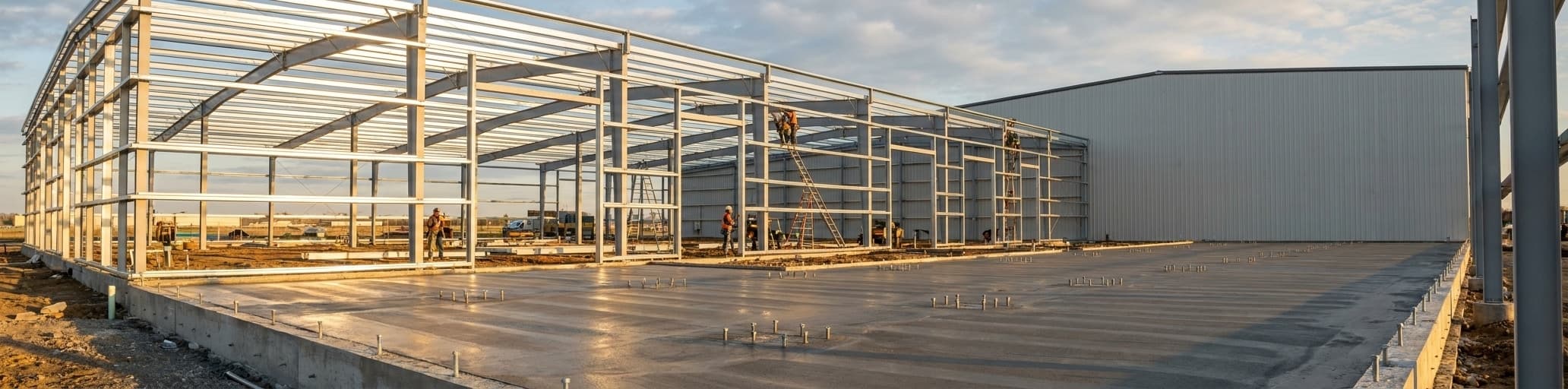

A 40×100 metal building typically costs $80,000 to $160,000 installed, with labor, engineering complexity, and regional factors driving the wide range. We help you navigate foundation, customization, and coordination decisions that prevent budget overruns and ensure your building meets actual operational needs.
What Does a 40×100 Metal Building Cost in 2026?
A 40×100 metal building costs $80,000 to $160,000 in 2026, with labor accounting for 40 to 60 percent of the total project expense.
Base price range: $80,000 to $160,000 for a standard enclosed structure
A 40×100 metal building covers 4,000 square feet of clear-span enclosed space and typically runs $80,000 to $160,000 for a standard enclosed structure in 2026. That range isn't imprecision — it reflects the real distance between a basic shell package and a fully outfitted building with insulation, multiple access doors, engineered erection, and interior finishes. For scale, comparable pole barn structures at similar widths run $15 to $45 per square foot installed,[1] which illustrates how dramatically finish-out choices, materials quality, and labor market conditions move a final number.
Breaking the 40×100 metal building cost per square foot down, an installed enclosed shell lands at roughly $20 to $40 per square foot. Labor drives the widest swings — it typically accounts for 40 to 60 percent of total project cost,[1] which is why two buildings with identical steel packages can differ by tens of thousands of dollars depending on who erects them and where. Regional labor rates, site complexity, and local code requirements each add to or trim that figure before you consider a single customization. A building in coastal California carries seismic and wind engineering requirements that a rural Midwest build does not, and those engineering differences appear directly in the quote.
National buying power changes the starting point of that range. When a single source controls steel procurement, engineering, fabrication, and erection, volume pricing on raw materials offsets costs that fragmented projects absorb individually across multiple vendors. You don't pay a general contractor's margin on top of a fabricator's margin on top of a separate engineer's fee — the structure of the deal itself keeps the project within budget before any negotiation starts.
Cost per square foot breakdown and what drives variation
The variables that push a 40×100 metal building cost per square foot toward the high or low end of the range have less to do with size and more to do with engineering complexity hidden inside the design.
Clear-span framing — the kind that eliminates interior columns across the full 40-foot width — demands deeper rafters, larger haunches, and stiffer columns than a modular layout with intermediate supports.[2] Add roof geometry choices like steeper pitches, canopies, or stepped rooflines and the structural problem compounds: those shapes alter wind pressure zones and load paths, which cascade into heavier secondary members and tighter attachment requirements at corners and edges.[2] Updated ASCE 7-22 standards sharpen this effect by specifying load requirements at the component level rather than across the building as a whole, meaning localized zones can drive material additions that don't appear anywhere on a simple sketch but show up directly in fabricated steel weight and erection time.[2] Geographic location layers another set of cost adjustments on top: a coastal California site carries seismic provisions and hurricane-zone wind speeds that a rural Midwest project does not, while a northern climate with a 50 psf ground snow load versus a 20 psf zone can change purlin gauge, bridging requirements, and frame deflection controls enough to materially shift per-square-foot cost.[2] Steel itself behaves as a globally traded commodity, meaning mill utilization rates, freight costs, and trade policy all influence the material portion of a quote — and a deposit that locks scope after engineering approval is the most direct way to remove that exposure from a budget.[2] Two value engineering levers consistently offset complexity costs: tapered (built-up) members place steel only where structural stress demands it rather than carrying excess weight through uniform straight sections, and optimized bay spacing reduces primary frame count while keeping secondary steel efficient.[2] Pre-engineered metal buildings already use roughly 30% less steel than conventional construction and complete 30-50% faster, so the per-square-foot math starts from a structurally efficient baseline before any project-specific optimization begins.[2]
How National Steel Buildings' national buying power reduces your final quote
Volume purchasing restructures where margin gets added — and how much of it stacks before a quote reaches you. Wholesale-scale steel manufacturers operate factory-direct procurement pipelines with proprietary fabrication equipment designed specifically to deliver quality on schedule,[3] which means material costs enter the project at contracted volume rates rather than at spot-market retail.
When a national supplier is already a contract source for major institutional buyers like the US federal government,[3] the mill relationships and fabrication throughput that support those contracts also benefit standard commercial projects — your 40×100 building draws from the same purchasing infrastructure without requiring the negotiating leverage of a government contract on your own. The practical result is that you avoid the layered markups common in fragmented delivery models: a general contractor's margin applied on top of a separate fabricator's margin on top of an independent engineer's fee can quietly add 15 to 25 percent to a project before a single column is set.
Consolidating procurement, engineering, fabrication, and erection under one source collapses those layers into a single efficient cost structure — and that structural difference shows up in the initial quote, not as a negotiation concession at the end.
Key Factors That Impact Your 40×100 Metal Building Cost
Your foundation choice alone can swing costs from $20,000 to $60,000, so budget it as a full line item matching your steel kit price.
Location, local labor rates, and permit requirements by region
Roof pitch, wall height, and foundation type (slab vs. footings) Roof pitch is the spec that quietly reshapes your 40×100 metal building cost without changing the footprint. The industry standard minimum is a 3:12 pitch — three inches of rise per foot of run — which provides adequate drainage while keeping material costs at the lower end of the range.[6] Steeper pitches like 4:12 or 5:12 improve snow and water shedding but increase fabricated steel weight and shift wind pressure zones across the frame.[6] Choosing a steep 6:12 pitch for a more residential appearance introduces enough engineering complexity to raise the kit price before a single panel ships.[7] Wall height compounds the effect: standard commercial leg heights for a 40-wide clear-span structure run 12 to 14 feet and cover most warehouse or agricultural applications, but stepping up to 16 or 18 feet to clear forklifts or tall equipment means heavier columns, greater wind moment on the frame, and a lift requirement during erection that adds crew time and equipment rental to your budget.[6]
Foundation type is the variable most buyers underestimate when building out a 40×100 budget. A monolithic slab — the most common and cost-effective solution — combines the floor and perimeter footers in a single concrete pour, with edges thickened to 12 inches deep and a center section typically 4 inches thick, with a minimum concrete strength of 3,000 PSI.[6] Foundation costs run $5 to $15 per square foot depending on soil conditions, frost depth, and site drainage requirements.[7] Cold climates often require a slab-on-grade approach instead: footers are poured first, allowed to cure, and then a floor slab is poured on top — a method that adds forming labor, cure time, and concrete volume to the schedule.[6] On a 4,000-square-foot footprint, those variables mean foundation work alone can range from $20,000 to $60,000, a cost category that can match the steel kit itself and must be budgeted as a full line item, not an afterthought.
Customizations: doors, windows, insulation, and interior finishes
Customizations are consistently underestimated as a budget line because buyers treat them as optional upgrades rather than functional requirements — but on a 4,000-square-foot structure, each choice compounds quickly.
Overhead doors, walk doors, windows, skylights, and insulation packages are all priced separately from the base steel kit, meaning the gap between a quoted shell price and a finished, usable building can run $20,000 to $40,000 or more depending on how the building will actually be used.[1] Insulation alone is rarely skippable for any occupied or climate-sensitive application: a warehouse storing temperature-sensitive inventory, a workshop with workers inside, or an agricultural building protecting livestock all require different thermal assemblies, and each one adds labor and material cost to the erection phase.[8] Door count and size drive a parallel cost curve — a single overhead door opening in an agricultural building is a different engineering and material problem than four 14-foot commercial overhead doors for a distribution center, because every opening interrupts the structural diaphragm and requires a header, jambs, and wind-rated framing to compensate.[1] Interior finishes — liner panels, insulated metal panels, office partitions, restroom rough-ins, or mezzanine framing — represent the widest variable in the entire budget because they scale directly with use case and comfort level, and the smart move is specifying them before engineering begins rather than retrofitting them after the frame is erected.[8] Architectural options like board-and-batten siding, brick or stone veneer, cupolas, overhangs, or two-tone wainscot are equally available on a steel-framed 40×100 and deliver curb appeal comparable to conventional construction without sacrificing the low-maintenance advantage of the steel core, though each adds to both the material and engineering scope.[9]
Concrete Slab Requirements and Budgeting for a 40×100 Foundation
A properly engineered concrete slab for your 40×100 building must simultaneously handle vertical loads, wind uplift, and drainage–three non-negotiable functions that standard residential design cannot address.
Why a proper slab matters: load distribution, drainage, and code compliance
A steel building's slab isn't just a floor — it's a structural system that performs three distinct engineering functions simultaneously. Every steel building foundation must distribute the building's weight to prevent settling, resist uplift forces from wind and seismic activity, and maintain level support to preserve the building's structural integrity.[10] These aren't interchangeable priorities: a slab that handles vertical dead load well but fails to resist wind uplift can allow a column base to lift off its anchor bolts during a storm, which compromises the entire primary frame.
On a 40×100 footprint, the concentrated load points where columns meet the concrete create point-load conditions that standard residential slab engineering doesn't account for — the thickened perimeter footer, typically 12 to 18 inches deep, exists specifically to transfer those column reactions into the soil without punching or cracking.[10] Drainage is the second failure mode that an undersized or improperly graded slab introduces. Water accumulation against the foundation perimeter reduces soil bearing capacity and can migrate beneath the slab through capillary action; the corrective measure is both straightforward and non-negotiable — the site must slope away from the building in all directions, and gutters must direct roof drainage well away from the foundation perimeter.[10] Skipping a 6-mil vapor barrier beneath the pour is similarly costly: ground moisture that migrates up through the slab damages stored inventory, corrodes anchor hardware, and creates interior condensation that accelerates any finishes or equipment on the floor.[10] Code compliance is the third constraint, and it operates independently of the structural design.
Local building departments require engineered foundation plans for commercial structures, with building permits typically running 1 to 3 percent of construction value.[10] On top of that baseline, seismic zones mandate special anchoring provisions, hurricane regions require foundations engineered for substantial uplift resistance, and cold climates enforce minimum frost-depth requirements that extend footings well below grade — all governed at the local jurisdiction level, not by the steel manufacturer alone.[10] Foundation drawings must satisfy both the manufacturer's engineering specifications and local code requirements before a single inspection is scheduled.[10]
Estimating slab costs separately from the steel structure (4,000 sq ft calculation)
Separating the slab from the steel quote is the fastest way to catch a budget shortfall before it becomes a problem mid-project. For a 40×100 footprint, the math starts with per-square-foot benchmarks and scales directly: a standard installed concrete slab runs $6 to $12 per square foot, and a reinforced slab with wire mesh, rebar, and a vapor barrier runs $9.29 to $10.04 per square foot.[11] Labor accounts for 40 to 50 percent of the total slab cost, with materials making up the remaining 50 to 60 percent — meaning the crew and site conditions are roughly as expensive as the concrete itself.[11] Thickness also moves the number: a 4-inch slab averages $5.35 per square foot, while a 6-inch slab averages $6.19 per square foot nationally.[12] Applied to 4,000 square feet, those benchmarks produce a concrete-only cost range that buyers should treat as a firm line item in their project budget, not an estimate to revisit later.
| Slab type | Cost per sq ft | 4,000 sq ft total |
|---|---|---|
| Basic 4" slab | $5.35 | $21,400 |
| Standard 6" slab | $6.19 | $24,760 |
| Installed (full range) | $6-$12 | $24,000-$48,000 |
| Reinforced (mesh, rebar, vapor barrier) | $9.29-$10.04 | $37,160-$40,160 |
| Monolithic foundation | $4.50-$14 | $18,000-$56,000 |
A few site-specific factors can push the final number toward the high end of each range before a shovel breaks ground. Gravel base material — required when soil conditions risk shifting or cracking — adds $1 to $3 per square foot, or up to $12,000 on a 4,000-square-foot pour.[11] Grading and leveling, if the site isn't flat, adds another $0.40 to $2.00 per square foot.[11] The practical takeaway: a 40×100 commercial slab budgeted at the national average installed rate of $6.60 per square foot runs approximately $26,400 — but a reinforced pour on a site requiring grading and a gravel base can reach $50,000 or more on the same footprint.[11][12] Treating the slab as a standalone cost category — parallel to the steel kit, not subordinate to it — is what keeps the total project within budget when all line items are finally on the same page.
Integrated design: how National Steel Buildings coordinates slab specs with your building frame
The most expensive foundation mistake on a 40×100 project isn't a bad pour — it's a coordination gap between the frame engineer and the concrete contractor. Bay spacing decisions determine where each primary frame column sits, and each column location translates directly into an anchor bolt pattern that must be cast into the concrete before the steel ships.[13] When those two scopes belong to separate parties working from different documents, even a minor discrepancy in column reaction loads or base plate geometry means epoxy-anchored corrections, core-drilled retrofits, or partial slab replacement after the frame arrives on site.
A single-source approach eliminates that gap at the origin: frame loads feed directly into foundation drawings, anchor bolt templates are produced from the same engineering package that generated the primary frame, and soil-condition variables — which can push foundation type from a monolithic slab to a deeper footing solution depending on bearing capacity — are accounted for in the same design phase rather than discovered during site prep.[13] Understanding how structural steel components transfer load from roof to column to base plate to anchor bolt clarifies why the concrete and the frame can't be engineered in isolation: each decision in the steel cascades into a requirement in the concrete, and vice versa. Phased expansion planning sharpens the value of coordination further.
Engineering the foundation today to accept future bays, lean-tos, or mezzanines means the concrete poured now doesn't become an obstacle to an addition planned three years out — endwall columns, footing geometry, and anchor patterns are sized for the eventual footprint, not just the immediate one.[13] A forward-engineered foundation costs little more to pour; retrofitting one that wasn't planned correctly costs significantly more to fix.
40×100 Metal Building Specifications and Customization Options
Specify your building's intended use before engineering begins to align bay spacing, column placement, and eave height with actual operational needs rather than default assumptions.
Standard specs: bay spacing, column locations, and clearance for your intended use
Bay spacing on a 40×100 clear-span steel building typically runs in 20- to 25-foot increments along the 100-foot length — a standard layout lands at either four 25-foot bays or five 20-foot bays before any optimization for use case.[14] Each bay spacing decision determines where primary frame columns sit along the sidewalls, and on a clear-span 40-foot width, no interior columns interrupt the floor plan, so every square foot between sidewalls is usable without obstruction.[14] Secondary framing — purlins and girts — typically runs at 4 feet on center, spanning between primary frames to carry roof and wall panels.[14] Clearance requirements diverge sharply by application: aviation storage demands wide door openings and tall eave heights to clear aircraft tail heights, while a distribution warehouse prioritizes unobstructed forklift movement and racking height over door width.[14] A vehicle maintenance facility needs overhead clearance for lifts and hoists, which drives eave height decisions independently of door configuration.[14] A manufacturing or fabrication operation may require crane-rail provisions, which alter column sizing and moment connections throughout the primary frame.[14] Specifying intended use before engineering begins — not after the frame is designed — is what keeps bay spacing, column placement, and eave height aligned with how the building will actually operate rather than what a default package assumes.
Comparing 40×100 to nearby sizes (40×80, 40×120, 60×100) and cost differences
The most direct alternative below the 40×100 is the 40×80 — 3,200 square feet versus 4,000, with one fewer primary frame bay along the 100-foot run reduced to 80 feet. For context, a 40x80x14 pole barn kit starts at $28,800 in materials alone,[15] illustrating how even the kit-only baseline shifts meaningfully when 800 square feet leave the scope. In a clear-span steel structure, removing that bay eliminates one full primary frame, reduces roof and wall panel footage proportionally, and shortens erection time — but the per-square-foot cost doesn't drop at the same rate as the square footage removed, because fixed engineering costs (stamped drawings, anchor bolt templates, freight mobilization) are spread across fewer square feet. The 40×120, moving the other direction, adds one bay and 800 square feet over the 40×100 baseline; because the engineering variables — column sizing, haunch depth, wind load provisions — stay nearly identical to the 40×100 frame, the marginal cost per added square foot on the 40×120 is lower than it was stepping from 40×80 to 40×100, making the larger footprint incrementally more cost-efficient to build.
The 60×100 comparison is a different calculation entirely. Width drives structural complexity in a clear-span building far more aggressively than length does, and pole barn suppliers explicitly note that kits exceeding a 60-foot width typically increase in price per square foot compared to narrower structures.[15] Agricultural and commercial pole barn kits in the larger size categories — which include widths approaching or exceeding 60 feet — span from roughly $40,678 to over $121,995 for materials alone,[16] a range that reflects how steeply wider clear spans compound material requirements. In an engineered steel clear-span system, that cost curve is even more pronounced: spanning 60 feet without interior columns demands substantially heavier primary frames, deeper rafters, and larger moment connections than a 40-foot clear span, and the sidewall height typically required to maintain useful clearance under a wider roof adds wind moment to every column. The 60×100 delivers 6,000 square feet versus the 40×100's 4,000, but its per-square-foot cost runs higher — so the choice between the two isn't a size question so much as a use-case question about whether 60-foot clear width is operationally necessary for your application.
| Size | Square footage | Primary cost driver vs. 40×100 |
|---|---|---|
| 40×80 | 3,200 | One fewer bay; lower total cost, higher cost per sq ft |
| 40×100 | 4,000 | Baseline |
| 40×120 | 4,800 | One additional bay; marginal cost per sq ft decreases |
| 60×100 | 6,000 | Wider clear-span frame; higher cost per sq ft than 40×100 |
Single-source advantage: getting frame, erection, and engineering from one team
The accountability structure of a 40×100 project is just as important as the steel itself.
When fabrication, erection, and engineering belong to separate parties, disputes over fit and responsibility are built into the delivery model before a single anchor bolt is set — if components don't align, insufficient material arrives, or parts fail to perform, each party points to the others.[17] A single-source delivery model eliminates that gap by design: every component is specified and engineered to act as a coordinated system rather than a collection of independently sourced parts.[17] The practical result is predictability.
Construction time, labor costs, and material costs are more controllable under a unified delivery structure than when multiple vendors each hold a separate slice of scope — because the variables that cause budget drift (miscommunication between engineer and erector, incompatible tolerances between fabricator and foundation contractor) are removed at the organizational level, not managed reactively after they surface.[17] There's also a long-term dimension to single-source accountability that rarely appears in initial quotes: when a repair or replacement is eventually needed, parts come from the original manufacturer who designed the system, eliminating the compatibility guesswork that plagues buildings assembled from multiple suppliers' components.[17] If you're weighing how coordination failures inflate total project cost across delivery models, the barndominium contractors turnkey vs. shell pricing breakdown maps the same dynamic across a different building type — the cost of fragmented accountability looks the same regardless of what's being built.
- A 40×100 metal building costs $80,000 to $160,000 installed, with labor accounting for 40-60% of total project cost and varying significantly by region.
- Foundation costs range from $20,000 to $60,000 and must be budgeted as a separate line item, with slab type and site conditions dramatically affecting the final price.
- Clear-span framing eliminates interior columns but increases structural complexity; steeper roof pitches, taller walls, and complex geometries significantly raise material and engineering costs.
- Consolidating procurement, engineering, fabrication, and erection under one source eliminates layered markups of 15-25% compared to fragmented delivery models.
- Coordination gaps between frame engineers and concrete contractors cause expensive retrofits; single-source delivery prevents misalignments in column locations and anchor bolt patterns.
- Secondary customizations like insulation, doors, windows, and interior finishes add $20,000 to $40,000 beyond the base steel kit and should be specified before engineering begins.
- Wider clear-span structures like 60×100 have higher per-square-foot costs than 40×100 due to heavier frames and greater wind loads, making width a more expensive variable than length.
- https://summertownmetals.com/pole-barn/pole-barn-cost-guide/
- https://www.tylerbuilding.com/post/2026-metal-building-cost-variables
- https://www.absoluterv.com/metal-building-kits/wholesale-steel-buildings/
- https://ameribuilds.com/steel-building-costs-what-to-expect-2026/
- https://cbcny.org/advocacy/why-it-costs-so-much-build-new-york-city-0
- https://metal-america.com/complete-guide-to-metal-buildings/
- https://iconsteelbuildings.com/how-much-are-metal-buildings/
- https://www.buyabp.com/metal-building-kit-prices-in-florida-what-to-expect
- https://trusteelbuildings.com/steel-buildings/workshops/40×100/
- https://mbmisteelbuildings.com/blog/steel-building-foundation/
- https://homeguide.com/costs/concrete-slab-cost
- https://www.lawnstarter.com/blog/cost/concrete-slab-price/
- https://buildmax.com/how-much-should-a-40×60-slab-foundation-cost/?srsltid=AfmBOopU2qfeRgg_N7Dqd78QT4Tuowz117xQktL-kI_z54P1kGlMlaWN
- https://webuildyourshop.ca/steel-frame/
- https://www.hansenpolebuildings.com/pole-barn-prices/?srsltid=AfmBOornnnU1px9oGO2yBI_55QpaR1GTjvV7muE8BR4zyv7gKT83RV_s
- https://www.diypolebarns.com/prices.php
- https://forgebuildings.com/pre-engineered-metal-buildings-an-investment-alternative/